
Key Takeaways
- At today’s prices, $1,000 a month in dividends takes 834 shares of Lockheed Martin, about $505,300, or 1,887 shares of General Dynamics, about $685,700.
- Lockheed Martin’s 2.4% yield saves about $180,400 against General Dynamics’ 1.8%, and its dividend took 38% of free cash flow over the last twelve months.
- General Dynamics has the better-covered dividend, at 29% of free cash flow, and less debt.
- Lockheed Martin’s check looks like the better deal for a retiree, and its unsettled F-35 Lot 20 contract is the risk to watch.
Lockheed Martin (LMT) and General Dynamics (GD) both raised their 2026 outlooks in October, and both are sitting on backlogs above $200 billion. That’s a good start for anyone who wants a dividend check they can count on.
So let’s take a hypothetical retiree who wants $1,000 a month, or $12,000 a year, from just one of them.
At today’s prices, Lockheed Martin’s 2.4% yield gets there with 834 shares, about $505,300 worth. General Dynamics yields 1.8%, so it takes 1,887 shares, about $685,700. That’s a gap of about $180,400 for the same income, so the question is whether Lockheed’s cheaper check is just as safe.
| Metric | Lockheed Martin (LMT) | General Dynamics (GD) |
|---|---|---|
| Dividend a share, a year | $14.40 | $6.36 |
| Yield | 2.4% | 1.8% |
| Shares for $1,000 a month | 834 | 1,887 |
| Cost | $505,304 | $685,660 |
| Income a month | $1,001 | $1,000 |
| Cash dividend payout ratio, TTM / forward | 38% / 43% | 29% / 33% |
| Net debt / EBITDA | 1.4x | 0.6x |
Source: TIKR and StockAnalysis, at today’s prices. Forward is fiscal 2026 consensus.
6 safe dividend stocks paying retirees 6%+ yields
There are over 100 stocks paying 6%+ annual dividends today.
But after an extensive investment review leveraging TIKR’s proprietary data, we now believe only six of them are truly safe for retirees.
They’re all yours as part of our new investment report. Learn more about how to get access right here.
Lockheed’s record backlog keeps growing
Lockheed Martin’s third quarter gave a retiree plenty to like. Sales rose 11% to $20.7 billion from $18.6 billion a year earlier, and the backlog hit a record $292.0 billion as of Sept. 27, up 27% since the second quarter. On Oct. 15, Lockheed also reached a 10-year framework agreement with the Pentagon covering F-35 production and sustainment. Morgan Stanley called that deal “a significant derisking event for the stock” when it upgraded Lockheed to Overweight from Equal Weight on Oct. 26 and raised its target to $835 from $690.
On Oct. 9, Lockheed raised its quarterly dividend by $0.15 to $3.60 a share, its 24th straight year of increases. It took a comfortable 38% of free cash flow over the twelve months to Sept. 27, and consensus puts it at 43% for fiscal 2026, on free cash flow just under Lockheed’s own guide of $7.8-$8.0 billion for the year.
Free cash flow has covered the dividend in nine of the last 10 fiscal years:
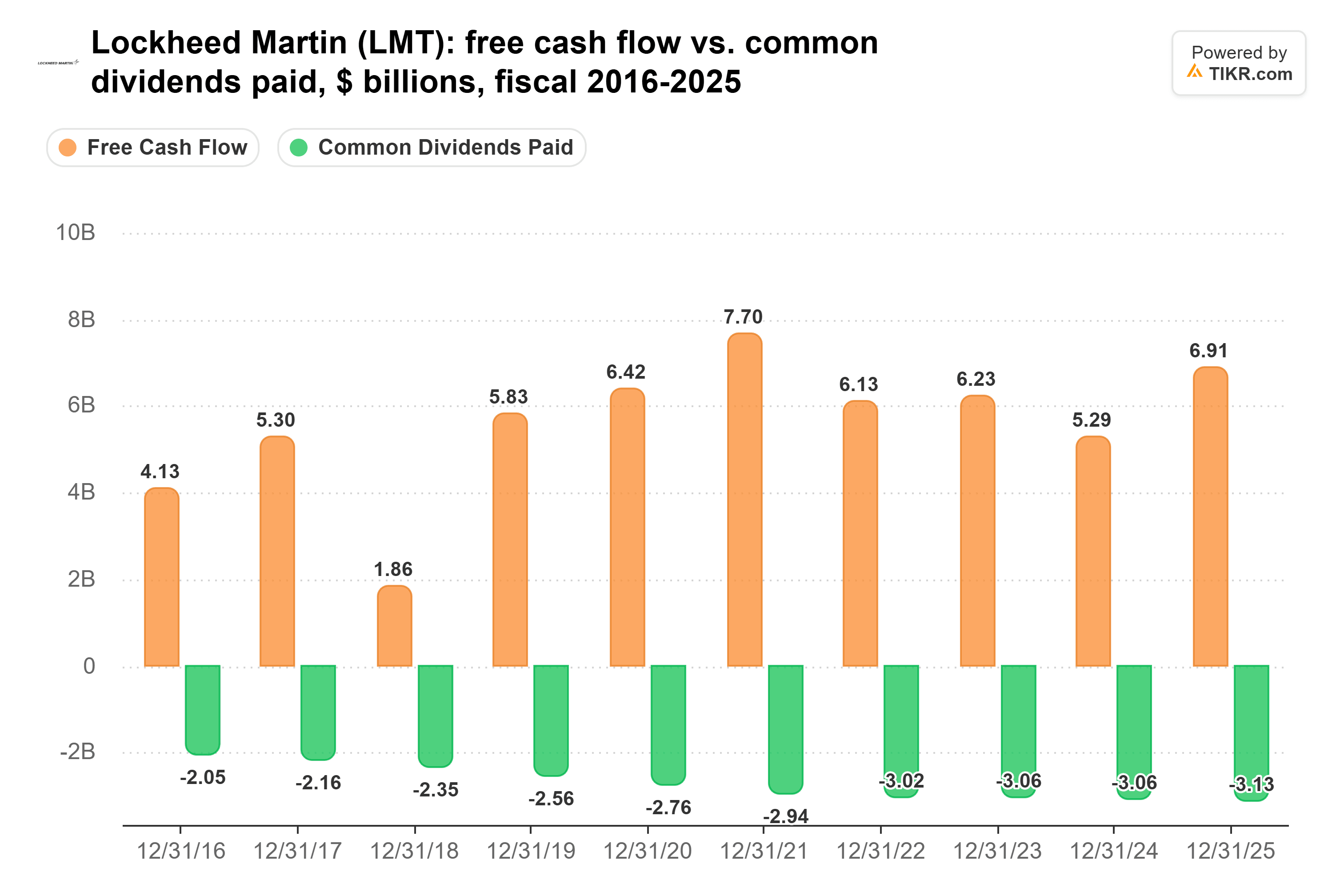
The miss came in fiscal 2018, with $1.86 billion of free cash flow against $2.35 billion of dividends, and Lockheed kept its streak going anyway.
General Dynamics has more room to spare
General Dynamics grew a touch faster in the third quarter. Revenue rose 12.9% to $14.6 billion, Marine Systems revenue jumped 21.1% on Columbia- and Virginia-class submarine work, and a 6.8-to-1 book-to-bill left the backlog at $220 billion.
General Dynamics’ dividend is the better covered of the two, taking just 29% of free cash flow over the twelve months to Oct. 4 and 33% on fiscal 2026 consensus. That consensus is 28% above fiscal 2025’s free cash flow, but the last twelve months’ $5.77 billion is already higher, and management expects free cash flow of around 105% of net earnings this year. CFO Kimberly Kuryea said on the third-quarter call that “we continue to support the dividend as it relates to share repurchase, and we are repurchasing shares enough to cover dilution at this point in time.” Net debt is 0.6x EBITDA, well under Lockheed’s 1.4x.
Free cash flow has topped the dividend every year since fiscal 2016:

So which $1,000 check would I want?
Lockheed Martin is the less covered of the two, so it’s the one to test. Its dividend took between 38.2% and 57.9% of free cash flow in each of fiscal 2021-2025, against 37.6% to 47.9% at General Dynamics. The risk it names that bears most on the cash is the F-35’s Lot 20: the contract still isn’t settled, and Lockheed has spent more on it than the current contract authorizes and funds. Fiscal 2027 also opened under a continuing resolution, though CEO Jim Taiclet said on the call that demand “is driven by the threat. It has bipartisan support and is not tied to any one bill or election.” Less covered isn’t the same as risky, either: even in its tightest recent year, Lockheed’s dividend used well under two-thirds of its free cash flow.
I’d take Lockheed’s check. Both dividends grew 6.4% a year from fiscal 2020 to fiscal 2025, Lockheed’s from $9.80 to $13.35 a share and General Dynamics’ from $4.40 to $6.00, and at that pace either position would pay about $21,000 a year in year 10. So Lockheed gets a retiree the same income and the same growth for about $180,400 less.
General Dynamics’ check is still the safer one. It’s better covered, it carries less debt, and its revenue grew faster last quarter. I’d just rather keep the $180,400 than spend it on a wider margin for a dividend that already looks safe at Lockheed.
Of course, Lot 20 is the thing to watch. A signed contract, plus full-year free cash flow within that $7.8-$8.0 billion guide when Lockheed reports early next year, would back the pick up.
Forget Lockheed Martin: 6 safe 6%+ dividend yields you can buy right now
Dividends can hold the key to enormous wealth. But only if you buy the right ones.
Picking the right high-yield dividend stock can be the difference between a dream retirement…and scraping by every month, waiting for the next Social Security check to clear.
We’ve identified six stocks yielding 6%+ that we believe every retiree should know about right now. (And Lockheed Martin isn’t one of them.)
Disclaimer:
Please note that the articles on TIKR are not intended to serve as investment or financial advice from TIKR or our content team, nor are they recommendations to buy or sell any stocks. We create our content based on TIKR Terminal’s investment data and analysts’ estimates. Our analysis might not include recent company news or important updates. TIKR has no position in any of the stocks mentioned. Thank you for reading, and happy investing!