Key Takeaways
- ONEOK and BP both held their dividends steady in October, with ONEOK yielding 5.3% and BP 4.9%.
- ONEOK’s distributable cash flow covered its dividend 2.25x in fiscal 2025, and BP’s dividends took 31% of its free cash flow over the twelve months to June 30.
- Over 10 years, ONEOK’s dividend per share grew from $2.43 to $4.12, while BP’s fell from $0.40 to $0.33.
- BP carries far less debt, and if its dividend keeps growing at its fiscal 2025 pace, its income would pass ONEOK’s around 2030.
ONEOK (OKE) and BP (BP) both held their dividends steady in October, and both are using a strong year to pay down debt.
ONEOK kept its quarterly payout at $1.07 a share on Oct. 14, weeks after it paid off nearly $5.5 billion of debt principal in September. On Oct. 30, BP held its interim dividend at $0.0866 a share ($0.5196 per ADS), alongside $8.5 billion of underlying replacement cost profit for the third quarter.
So which is the better dividend stock?
| Metric | ONEOK (OKE) | BP (BP) |
|---|---|---|
| Forward dividend yield | 5.3% | 4.9% |
| Dividend growth, fiscal 2020-2025 | 2.0% a year | 0.6% a year |
| Dividend growth, fiscal 2015-2025 | 5.4% a year | -1.9% a year |
| Coverage, on its own measure | 2.25x distributable cash flow (fiscal 2025) | 31% cash dividend payout ratio (TTM to June 30, 2026) |
| Net debt / EBITDA (LTM) | 3.68x | 0.53x |
| Interest coverage (LTM) | 3.53x | 5.98x |
Source: TIKR, at today’s prices.
6 safe dividend stocks paying retirees 6%+ yields
There are over 100 stocks paying 6%+ annual dividends today.
But after an extensive investment review leveraging TIKR’s proprietary data, we now believe only six of them are truly safe for retirees.
They’re all yours as part of our new investment report. Learn more about how to get access right here.
ONEOK’s cash flow has raced ahead of its dividend
Permian volumes are carrying ONEOK. Adjusted EBITDA was $2.24 billion in the third quarter of 2026, up 6% from the same quarter of 2025. NGL raw feed throughput rose 6%, including 16% growth in Gulf Coast/Permian. On Oct. 27, ONEOK raised its 2026 adjusted EBITDA guidance to $8.5 billion to $8.6 billion, its third raise of the year.
That growth leaves the dividend with a lot of room. Distributable cash flow per share went from $3.20 in fiscal 2016 to $9.25 in fiscal 2025, while the dividend went from $2.46 to $4.12:
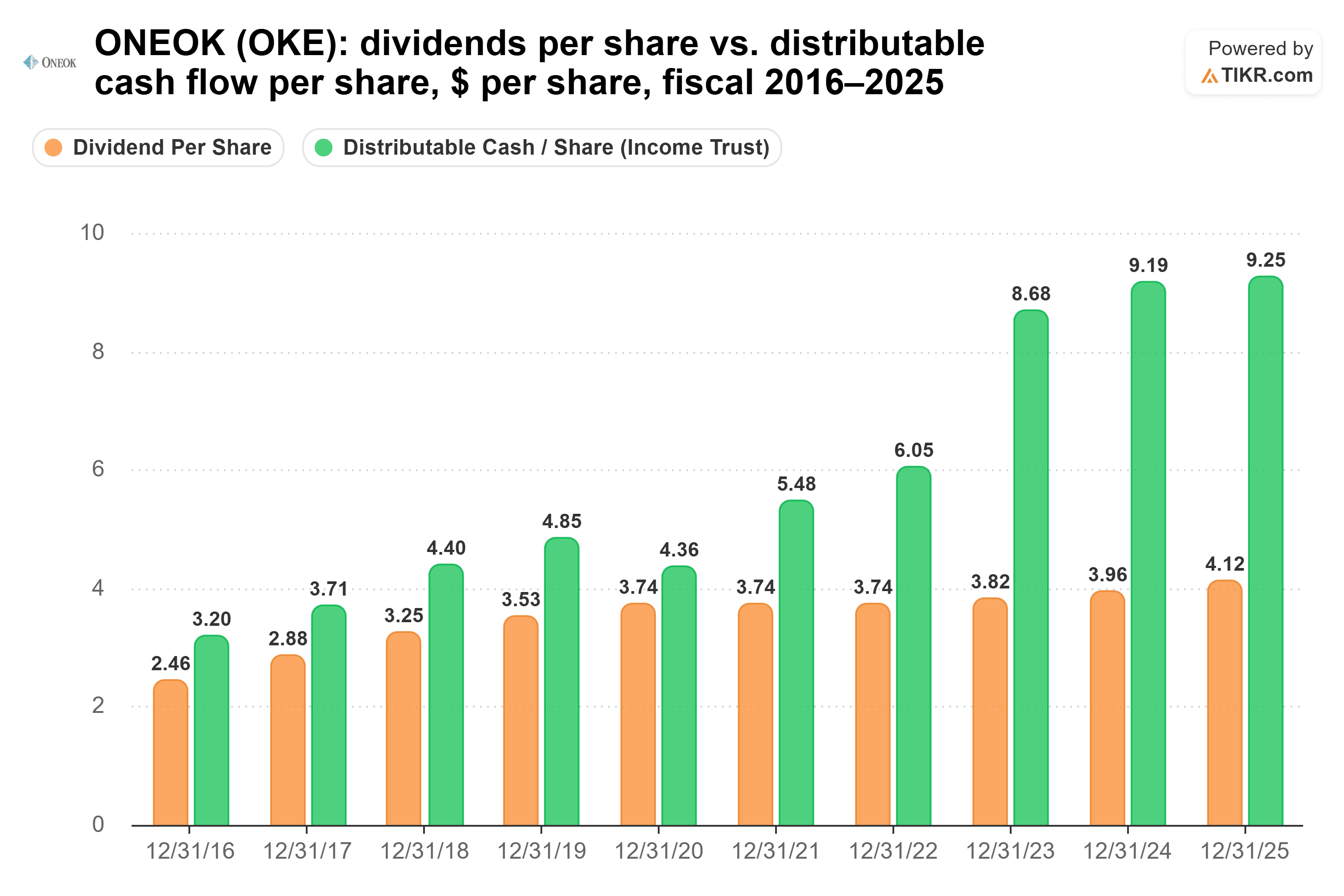
Coverage widened from 1.17x in fiscal 2020 to a comfortable 2.25x in fiscal 2025. When it announced the Brazos Midland acquisition on Aug. 31, ONEOK said the deal gives it more flexibility to return cash to shareholders, including through potential dividend increases.
Debt is the catch. Net debt is 3.68x EBITDA over the last twelve months. CFO Walter Hulse puts the ceiling lower: “We now view 3.5x as the upper end of our targeted leverage range.”
BP’s balance sheet is in better shape, and getting better
BP is cutting debt too, and from a stronger starting point. Net debt is just 0.53x EBITDA, and BP said it brought net debt down to $13.9 billion in the third quarter, $8.4 billion less than in the second. Refining and trading are carrying the business.
Its cash dividend payout ratio was a comfortable 31% over the twelve months to June 30, 2026, down from 44.9% in fiscal 2025. The catch is that BP’s free cash flow swings widely. It fell from $28.9 billion in fiscal 2022 to $11.3 billion in fiscal 2025, while dividends paid rose from $4.36 billion to $5.06 billion.

The dividend hasn’t kept up with that cash over the long run. It went from $0.40 a share in fiscal 2015 to $0.33 in fiscal 2025. Management calls the dividend “the first call on capital.” But Chief Executive Marguerite O’Neill said on the third-quarter call that BP intends “to prioritize the use of excess cash flow to address our remaining Deepwater Horizon liabilities in full.”
So which dividend wins?
ONEOK is the better dividend stock. It pays the bigger check today, and its dividend has grown over the past decade on distributable cash flow that covered it 2.25x last year. The business behind that check is growing too, with three guidance raises in 2026 alone.
At each stock’s 5-year growth rate, $10,000 in ONEOK pays $530 a year now and about $631 in year 10. The same $10,000 in BP pays $490 now and about $518 in year 10. BP’s best argument is its current pace. If BP keeps raising at fiscal 2025’s 6.5% and ONEOK at its 4.0%, BP’s income would pass ONEOK’s in about 3.4 years.
BP’s dividend isn’t in trouble, either. It has by far the lighter debt load, its dividends take less than a third of its free cash flow, and O’Neill wants “more of the value proposition to move back to equity holders through growth, distributions or both.” But BP’s faster pace comes from a single year, and its spare cash is going to Deepwater Horizon first. I’d rather own the dividend with a decade of growth behind it.
Of course, BP plans to explain in December how it will share upside with shareholders, buybacks included. A bigger role for the dividend in that plan would make its case a lot stronger.
Forget ONEOK: 6 safe 6%+ dividend yields you can buy right now
Dividends can hold the key to enormous wealth. But only if you buy the right ones.
Picking the right high-yield dividend stock can be the difference between a dream retirement…and scraping by every month, waiting for the next Social Security check to clear.
We’ve identified six stocks yielding 6%+ that we believe every retiree should know about right now. (And ONEOK isn’t one of them.)
Disclaimer:
Please note that the articles on TIKR are not intended to serve as investment or financial advice from TIKR or our content team, nor are they recommendations to buy or sell any stocks. We create our content based on TIKR Terminal’s investment data and analysts’ estimates. Our analysis might not include recent company news or important updates. TIKR has no position in any of the stocks mentioned. Thank you for reading, and happy investing!