Key Takeaways
- AMD stock is down 24% in the month through Nov. 27 as an AI chip selloff hit Nvidia, Intel and Dell even harder, weeks after AMD’s record third quarter.
- AMD expects about 66% revenue growth this quarter, and Dell reported a record $132.3 billion AI backlog in the same selloff.
- A short-seller-linked report on China and a filing that registers about 337 million shares for resale added pressure of AMD’s own.
- Analysts raised their 2027 earnings estimates through the selloff, which makes the drop look like a chance to load up, and fourth-quarter results in early February are the next test.
Advanced Micro Devices (AMD) stock is down 24% in the month through Nov. 27, even though AMD expects revenue to grow about 66% this quarter.
The selloff hit the whole AI chip trade, and AMD got off lighter than most. Nvidia (NVDA) fell 31%, Intel (INTC) dropped 39% after warning of a PC slowdown, and Dell Technologies (DELL) lost 37% even as it reported a record $132.3 billion AI backlog.
A record quarter, then a chip rout
AMD reported a record third quarter on Nov. 3:
- Revenue rose 45% to $13.4 billion.
- Data center revenue rose 97% to $8.5 billion.
- Management guided fourth-quarter revenue to about $17 billion, with a non-GAAP gross margin of about 55%, as it scales its Helios racks.
The stock barely reacted. Two days later, chip stocks sold off on weak reports from Qualcomm and Arm and on worries that Democrats’ midterm wins would slow the data-center buildout.
Nvidia shows the selloff had little to do with the businesses. Its revenue rose 103% to $115.8 billion in the quarter it reported Nov. 17, and its stock ended the month lower amid CEO Jensen Huang’s exit and return.
Intel’s report cuts both ways. A PC slowdown through at least the first half of 2027 hurts AMD’s client chips. But Intel can’t make enough Xeon server chips, and AMD’s server sales more than doubled last quarter.
TIKR tracks 54 analysts on AMD. How many say “Buy”?
See the full breakdown of Buy, Hold, and Sell ratings on AMD, along with Wall Street’s revenue and earnings estimates, all in one place. More than 500,000 investors use TIKR to research stocks like this one. See AMD’s Analyst Ratings
Two problems of AMD’s own
On Nov. 19, Hunterbrook Media, whose affiliate Hunterbrook Capital is short AMD, alleged that IEIT Systems, a Chinese server maker the US blacklisted in March 2025, kept releasing BIOS updates with newer AMD firmware. AMD fell 7.7% that day and said it complies with US export control laws.
On Nov. 23, AMD filed to register about 337 million shares, roughly 20.5% of the company, for resale. About 320 million are the shares behind its OpenAI and Meta warrants, which vest only as those customers buy AMD’s GPUs and the stock clears set prices.
The final tranches are tied to a $600 share price, more than 40% above where AMD trades now. So the drop pushes that last slice of dilution further off.
Demand still runs ahead of supply
“It is true that demand is higher than supply,” Lisa Su, AMD’s chair and CEO, told analysts on the Nov. 3 call.
Dell, which builds servers on both AMD and Nvidia chips, booked $60.2 billion of AI orders last quarter.
The worry is further out. “I am comfortable in 2027,” Mizuho’s Jordan Klein said on CNBC’s Power Lunch on Nov. 25. “Problem is 2028. It’s a black box.”
At 24x 2027 earnings, the math favors loading up
Analysts expect AMD’s normalized EPS to more than double in 2027:

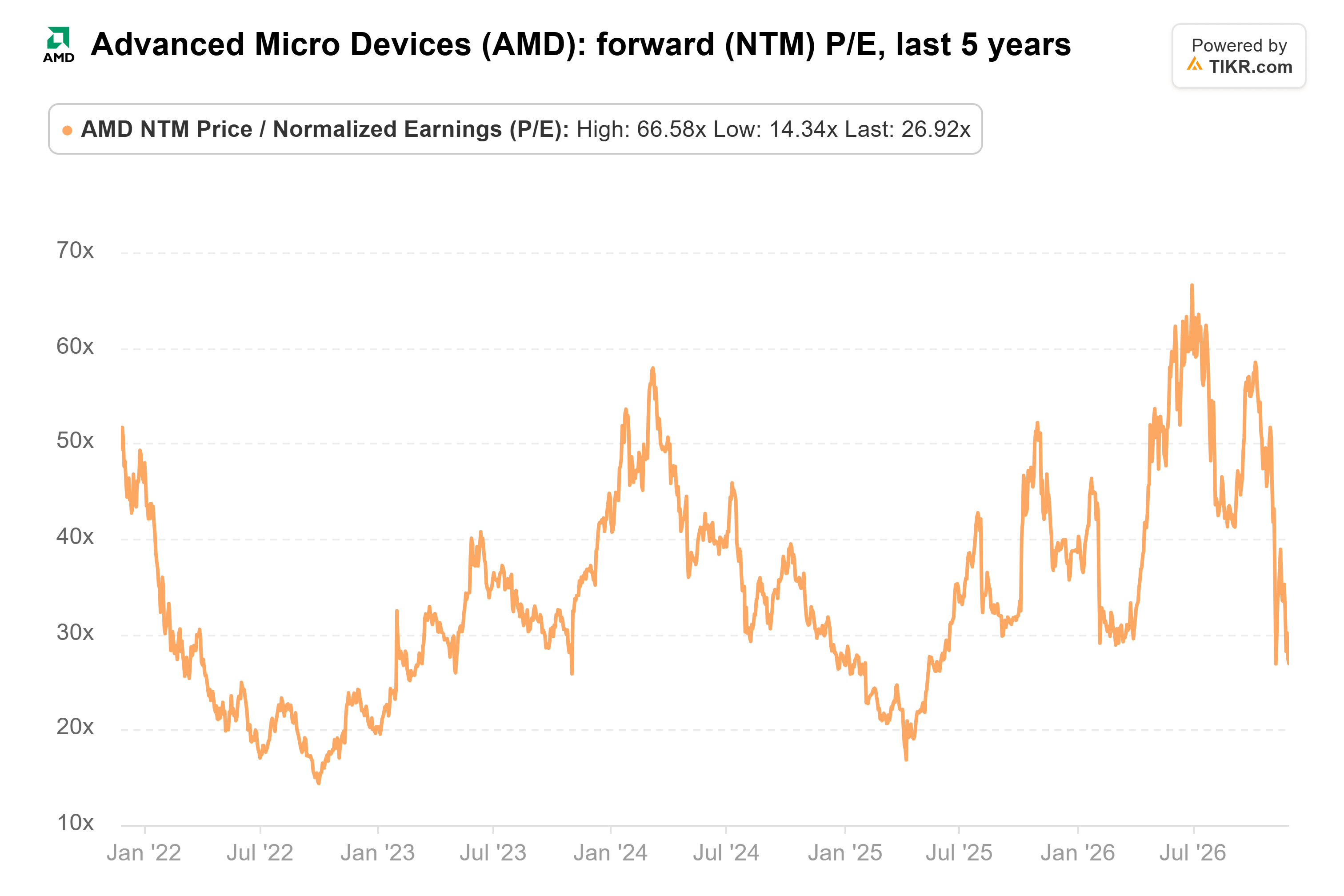
That 2027 estimate was $15.76 on Oct. 23, so it rose through the selloff, and the stock now trades at about 24x it. AMD’s forward P/E has fallen well under its 5-year average of 34x, far from the 67x it hit on June 30:
Analysts’ average price target has held near $650 through the drop:

That’s about 53% above the Nov. 27 close. On 2028’s $25.40 EPS estimate, $650 is about 26x, below today’s forward multiple, so getting there needs no rerating, only for the estimates to hold. Not everyone agrees: Erste Group downgraded AMD to Hold on Nov. 27 on valuation, and UBS cut its target to $625 from $700 on Nov. 25.
Customers are still ordering, estimates are still climbing, and the stock trades below its usual multiple, so the numbers favor loading up. If 2028 AI budgets get cut, those estimates fall too. AMD’s fourth-quarter report, expected in early February, is the next test: revenue at or above the $17 billion midpoint with a non-GAAP gross margin near 55% would show Helios ramping on schedule.
So what is AMD stock actually worth?
TIKR lets you forecast the future price of any stock in less than a minute. Just enter a few assumptions into TIKR’s valuation model and see what AMD could be worth. Start from Wall Street consensus estimates, or adjust the inputs to reflect your own view of the business. It’s free to use.
Disclaimer:
Please note that the articles on TIKR are not intended to serve as investment or financial advice from TIKR or our content team, nor are they recommendations to buy or sell any stocks. We create our content based on TIKR Terminal’s investment data and analysts’ estimates. Our analysis might not include recent company news or important updates. TIKR has no position in any of the stocks mentioned. Thank you for reading, and happy investing!