Key Takeaways
- At today’s prices, a hypothetical retiree needs 2,400 Clorox shares (about $262,700), 2,344 Kimberly-Clark shares (about $256,500) or 2,759 Procter & Gamble shares (about $468,500) to collect $1,000 a month in dividends.
- Procter & Gamble’s check costs the most by far, but its dividend took just 67% of free cash flow over the 12 months to Sept. 30, 2026, the best coverage of the three.
- Clorox’s dividend took 133% of free cash flow over the same 12 months, though management calls the elevated payout transitory.
- Kimberly-Clark closed its roughly $48.7 billion Kenvue deal on Nov. 2, adding debt and about 281.1 million new shares behind its dividend.
If you want $1,000 a month in dividend checks from a single household-products stock, the price runs from about $262,700 to about $468,500.
Take a hypothetical retiree who wants that $12,000 a year from just one of Kimberly-Clark (KMB), Clorox (CLX) or Procter & Gamble (PG). The cheapest check also has the thinnest coverage, so the real question is which one you can count on. Here’s what each takes:
| Stock | Shares for $1,000 a month | Cost | Yield | Dividend a share, a year | Cash dividend payout ratio (TTM) |
|---|---|---|---|---|---|
| Kimberly-Clark | 2,344 | $256,504 | 4.6% | $5.12 | 87% |
| Clorox | 2,400 | $262,704 | 4.6% | $5.00 | 133% |
| Procter & Gamble | 2,759 | $468,478 | 2.6% | $4.35 | 67% |
Source: TIKR, at today’s prices. Payout ratios over the 12 months to Sept. 30, 2026.
6 safe dividend stocks paying retirees 6%+ yields
There are over 100 stocks paying 6%+ annual dividends today.
But after an extensive investment review leveraging TIKR’s proprietary data, we now believe only six of them are truly safe for retirees.
They’re all yours for free as part of our new investment report, which you can access right here.
Kimberly-Clark just got a lot bigger
Kimberly-Clark closed its roughly $48.7 billion purchase of Kenvue on Nov. 2. To pay for it, it issued about 281.1 million new shares, each owed the same $1.28 a quarter, and took on debt.
The old business is soft. Organic sales fell 1.3% in the third quarter of 2026, with the disruption to its China diaper business costing about 270 basis points.
Its coverage has swung around, and its free cash flow fell just short of its dividends in fiscal 2025 after covering them easily in fiscal 2023:
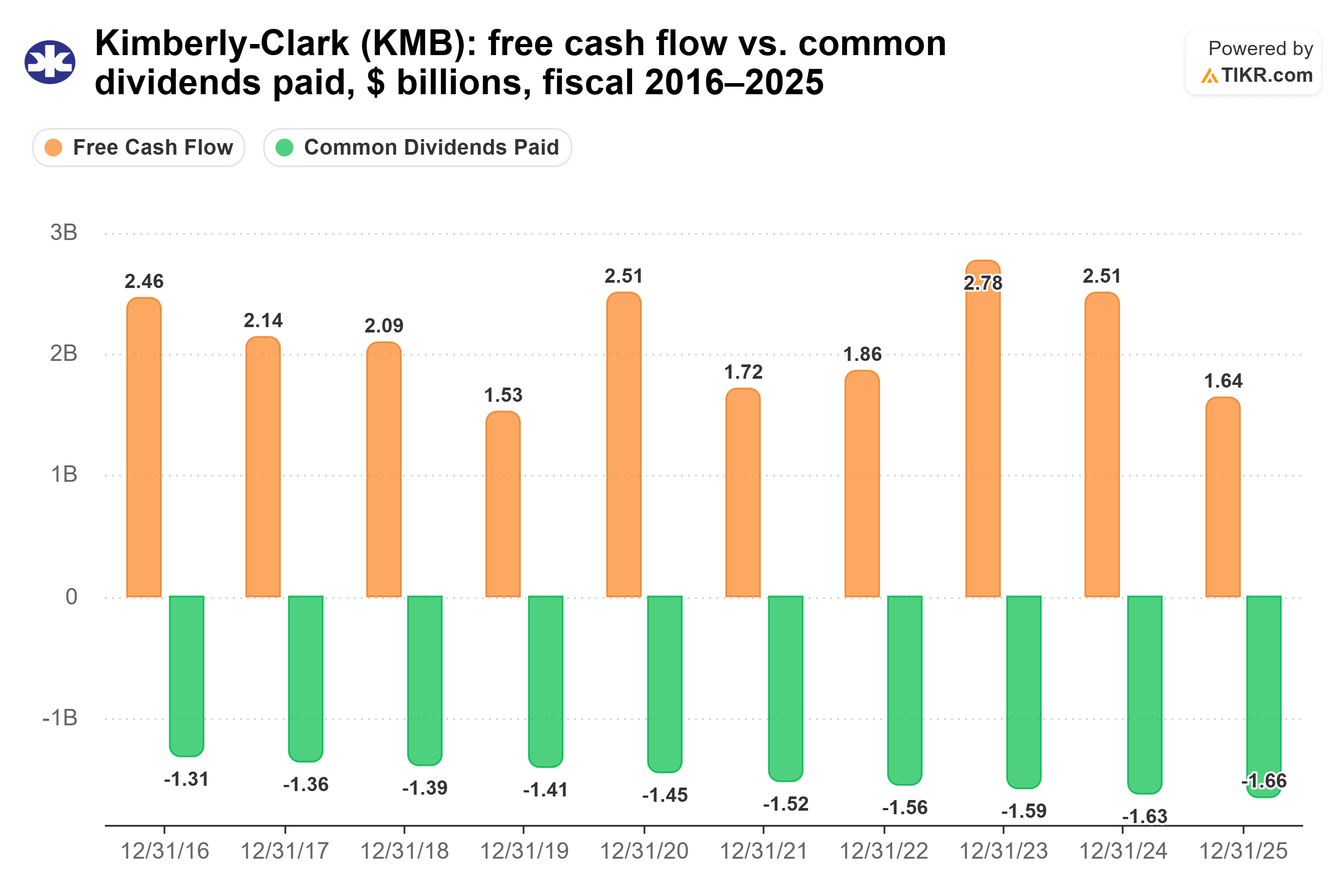
Its cash flow has picked up since. Cash from operations was $2.4 billion in the first nine months of 2026, against $1.8 billion a year before, and the dividend took a tight but covered 87% of free cash flow over the 12 months to Sept. 30. None of that includes Kenvue’s cash flow yet, or its new shares. The company says it has raised its dividend for 54 consecutive years.
Clorox is paying out more than it brings in
Clorox costs about the same as Kimberly-Clark for the same $1,000 a month, with far thinner coverage. Its dividend took a risky 133% of free cash flow over the 12 months to Sept. 30, 2026, and dividends paid topped free cash flow in three of its last five fiscal years:
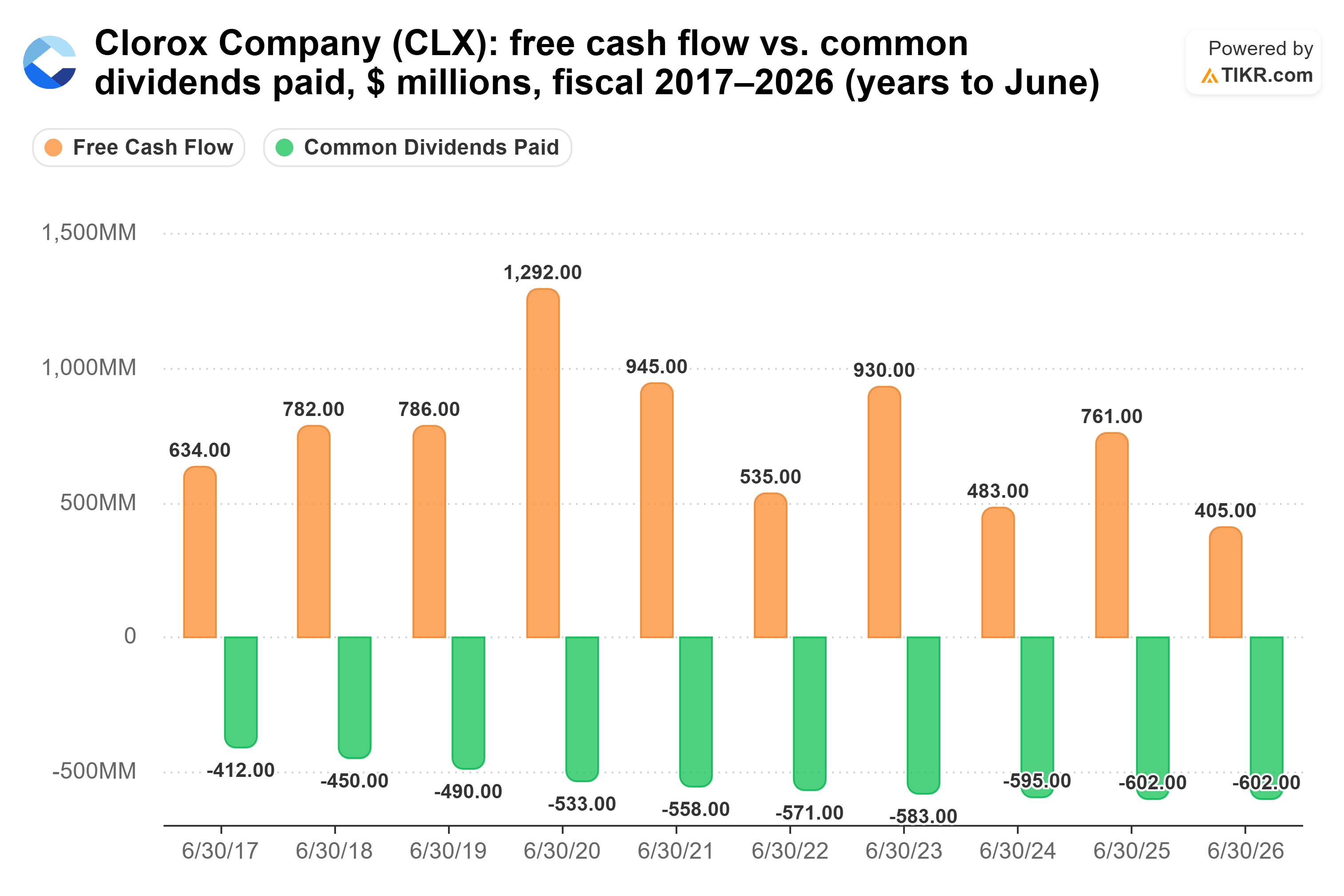
Costs are the problem. The GOJO acquisition lifted sales 33% to $1.91 billion in the quarter ended Sept. 30, 2026, but gross margin fell 130 basis points to 40.4% on higher commodity, manufacturing and logistics costs. On Nov. 2, Clorox raised its input-cost inflation estimate to about $240 million and said adjusted EPS should land near the low end of its $5.70-$6.00 range for fiscal 2027.
Management said on its August call that “the current payout is a bit elevated, but we see this as something more transitory as we rebuild our gross margin and not something structural,” and that on raises, “for now, you should expect this to continue.” Five analysts put free cash flow at $828 million in fiscal 2027, about double fiscal 2026’s $405 million, which would bring the payout ratio down to 74%. Clorox also carries the most debt of the three, at 3.8x net debt to EBITDA.
You pay up for P&G’s coverage
P&G’s 2.6% yield makes its $1,000 a month the most expensive of the three. What you get is the best-covered dividend: it took a comfortable 67% of free cash flow over the 12 months to Sept. 30, 2026, and consensus has 69% for fiscal 2027. Free cash flow has stayed above dividends paid every year since fiscal 2017:
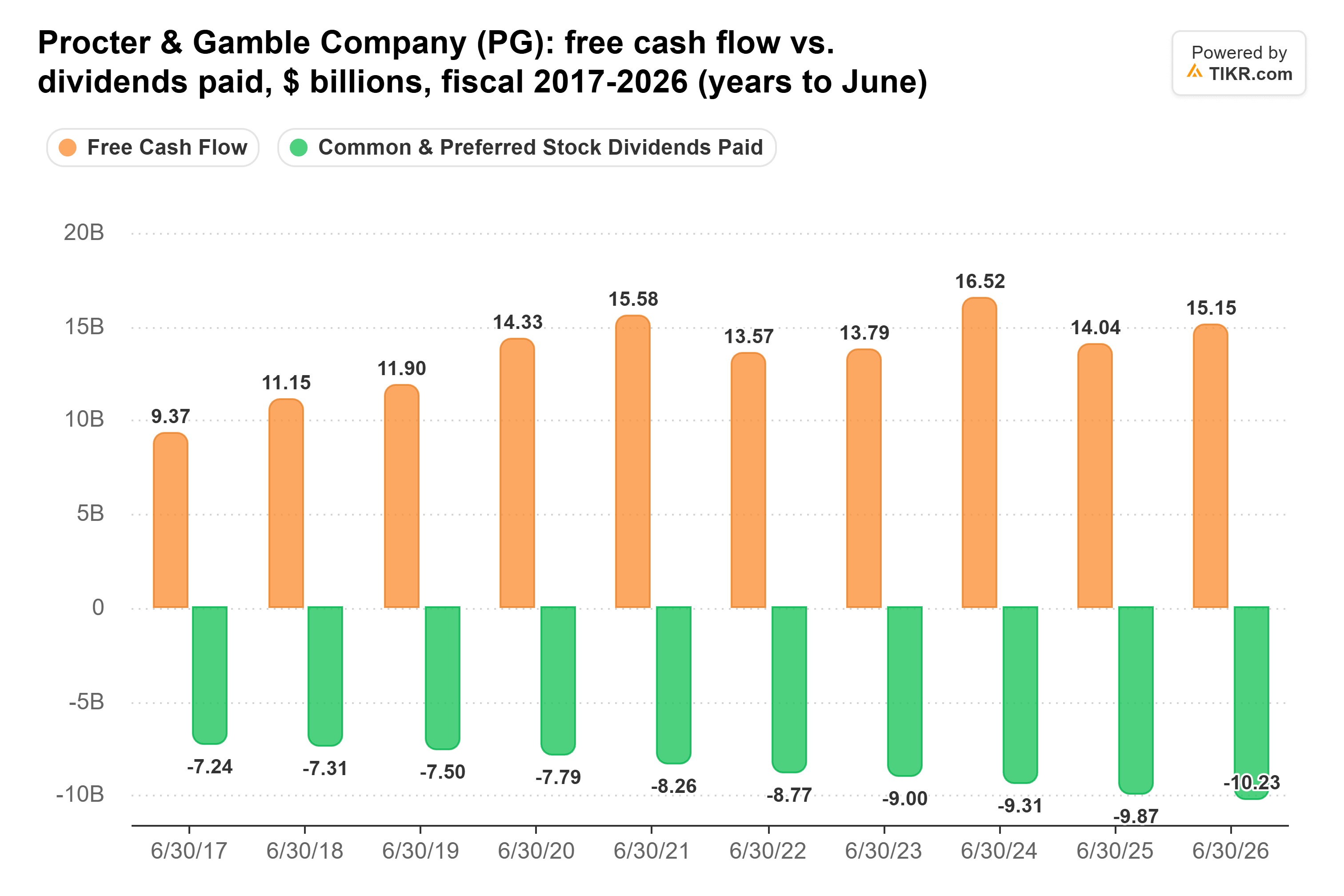
Organic sales rose 4.0% in the quarter ended Sept. 30, 2026. The pressure is costs: P&G now expects a commodity headwind of about $1.4 billion after tax in fiscal 2027, an 11% drag on core EPS growth, and guides for core EPS growth of flat to 3%. Net debt is just 0.9x EBITDA, and P&G has raised its dividend for 70 consecutive years.
I’d pay up for P&G
Clorox is the one to test for a cut, since its dividend has taken more than its free cash flow. I don’t think one is likely soon if the margin rebuild works. But with costs still rising and the most debt of the three, it has the least room for error. And it saves only a few thousand dollars over Kimberly-Clark, which doesn’t buy much for that risk.
For a retiree who wants a check to count on, P&G is the one I’d want. It costs about $212,000 more than Clorox, but it has the best coverage, the least debt and the longest record. It’s also raised its dividend fastest, 5.6% a year from fiscal 2021 to fiscal 2026, against 3.3% a year for Kimberly-Clark (fiscal 2020 to fiscal 2025) and 2.0% for Clorox (fiscal 2021 to fiscal 2026).
If that money isn’t there, Kimberly-Clark is the better of the two cheaper checks: nearly Clorox’s price with better coverage. Of course, its first quarter with Kenvue in the numbers will show whether the bigger company can cover a much bigger dividend bill.
Forget Procter & Gamble: 6 safe 6%+ dividend yields you can buy right now
Dividends can hold the key to enormous wealth. But only if you buy the right ones.
Picking the right high-yield dividend stock can be the difference between a dream retirement…and scraping by every month, waiting for the next Social Security check to clear.
We’ve identified six stocks yielding 6%+ that we believe every retiree should know about right now. (And Procter & Gamble isn’t one of them.)
Disclaimer:
Please note that the articles on TIKR are not intended to serve as investment or financial advice from TIKR or our content team, nor are they recommendations to buy or sell any stocks. We create our content based on TIKR Terminal’s investment data and analysts’ estimates. Our analysis might not include recent company news or important updates. TIKR has no position in any of the stocks mentioned. Thank you for reading, and happy investing!