Key Takeaways
- A hypothetical retiree would need about $364,600 of Duke Energy, $374,800 of Southern Company or $374,900 of WEC Energy Group to collect $1,000 a month in dividends at today’s prices.
- All three cover their dividends comfortably, paying out 67% to 68% of normalized earnings in fiscal 2025, with Southern Company the least covered.
- WEC Energy Group costs the most up front, but its dividend grew 7.1% a year from fiscal 2020 to fiscal 2025, and it plans raises of 6.5% to 7% from here.
- WEC’s faster-growing check looks worth the about $10,300 extra it costs over Duke Energy.
Any retiree hunting for a dividend check they can count on is going to look at utilities like Duke Energy (DUK), Southern Company (SO) and WEC Energy Group (WEC). And all three just reported third quarters lifted by data center demand.
Let’s take a hypothetical retiree who wants $1,000 a month, or $12,000 a year, from just one of them.
At today’s prices, Duke takes 2,765 shares, or about $364,600. Southern takes 3,948 shares, about $374,800, and WEC takes 3,150 shares, about $374,900. That’s about $10,300 between the cheapest check and the priciest, so it’s worth knowing what the extra money gets you.
| Stock | Shares | Cost | Yield | Income a month | Payout ratio of normalized EPS (fiscal 2025 / fiscal 2026 est.) |
|---|---|---|---|---|---|
| Duke Energy | 2,765 | $364,621 | 3.2% | $1,000 | 67% / 65% |
| Southern Company | 3,948 | $374,823 | 3.2% | $1,000 | 68% / 65% |
| WEC Energy Group | 3,150 | $374,944 | 3.2% | $1,000 | 68% / 68% |
Source: TIKR and StockAnalysis, at today’s prices and each company’s current annual dividend, in whole shares.
6 safe dividend stocks paying retirees 6%+ yields
There are over 100 stocks paying 6%+ annual dividends today.
But after an extensive investment review leveraging TIKR’s proprietary data, we now believe only six of them are truly safe for retirees.
They’re all yours as part of our new investment report. Learn more about how to get access right here.
Duke’s check costs the least and grows the slowest
Duke’s dividend rose 2.0% a year from fiscal 2020 to fiscal 2025, from $3.82 to $4.22 a share. Its normalized EPS rose from $4.69 in fiscal 2016 to $6.31 in fiscal 2025, while the dividend went from $3.36 to $4.22:
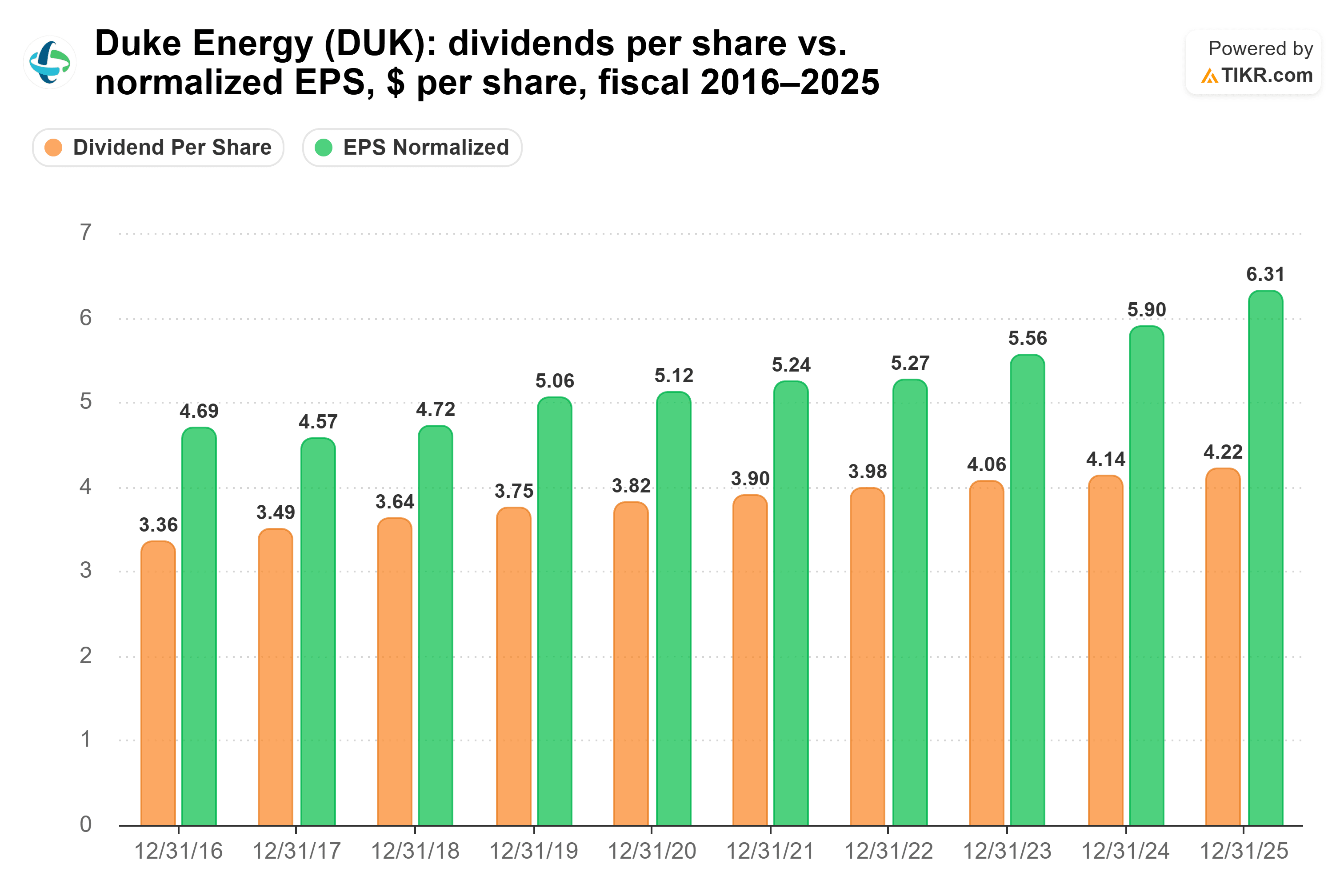
That took the payout ratio of normalized EPS from 76.9% in fiscal 2018 down to a well-covered 66.9% in fiscal 2025. Consensus has it at 65% for fiscal 2026, on EPS of $6.75, right in the middle of Duke’s narrowed $6.70-$6.80 guidance.
That leaves more of its earnings for a record build of 16 gigawatts of new generation by 2031, paid for partly with debt that’s getting pricier. On Nov. 19, Duke sold $875 million of 6.05% notes, partly to repay $600 million of 4.85% notes due in January.
Duke says it has raised its dividend every year for over 20 years. At 2.0% a year, those 2,765 shares would pay about $14,400 in year 10.
Southern’s coverage is the thinnest, by a hair
Southern pays out 68.4% of normalized EPS, the most of the three. But that ratio has come down a long way. Southern’s normalized EPS climbed from $2.89 in fiscal 2016 to $4.30 in fiscal 2025, while its dividend went from $2.22 to $2.94:
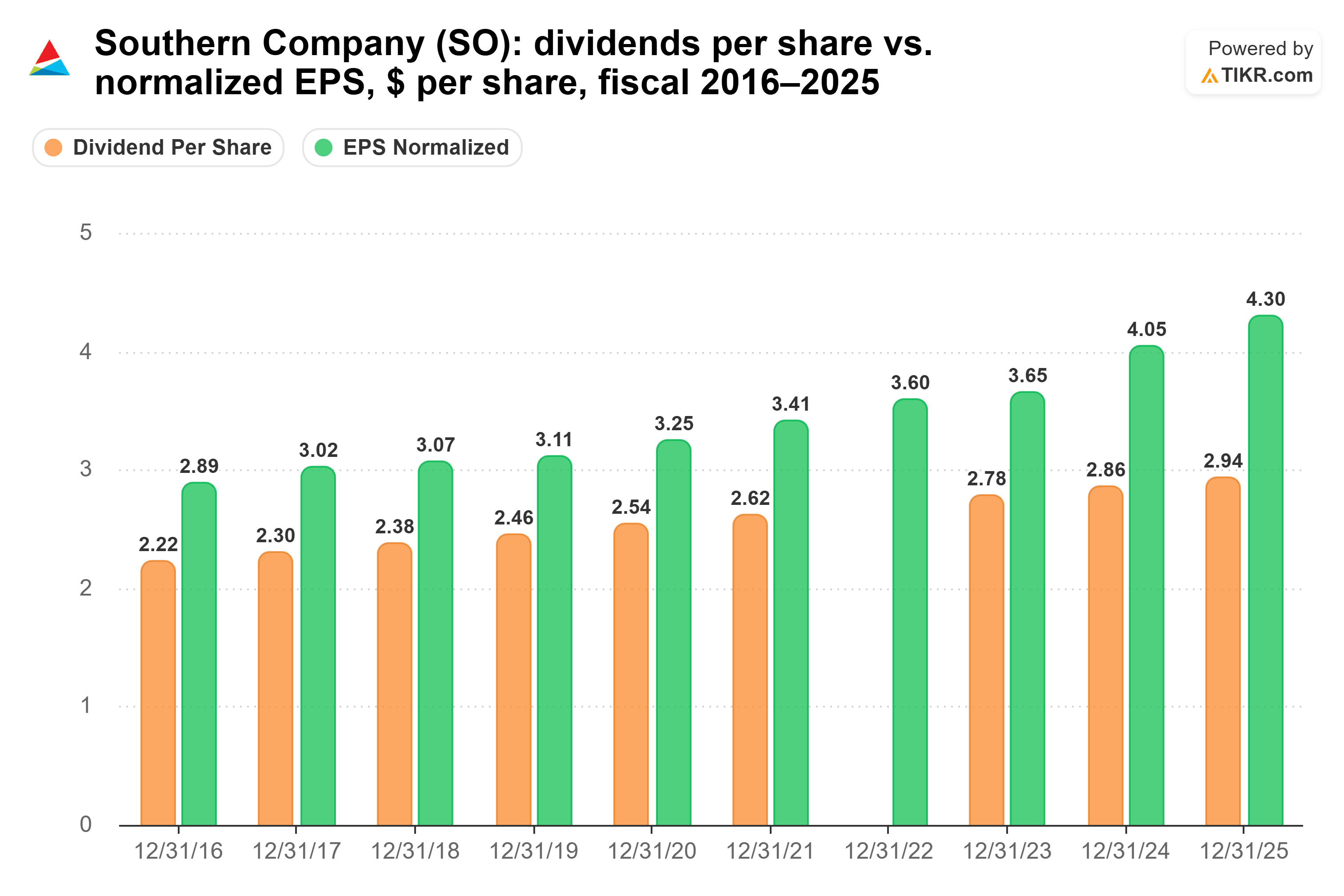
The payout was 79.1% in fiscal 2019. Consensus has it falling to 65% in fiscal 2026, on EPS of $4.65. Southern itself now expects adjusted EPS of $4.70. Data center usage on its system was 59% higher in the third quarter than a year earlier, and it has signed 21 gigawatts of large-load contracts.
Southern’s dividend grew 3.0% a year from fiscal 2020 to fiscal 2025, from $2.54 to $2.94 a share. At that rate, 3,948 shares would pay about $15,600 in year 10.
WEC’s raises track its earnings
WEC’s extra cost gets you the fastest-growing dividend of the three: 7.1% a year from fiscal 2020 to fiscal 2025, plus a 6.7% raise in January to $3.81 a share. WEC expects to keep raising it 6.5% to 7% a year, with a payout ratio of 65% to 70%. It has held that ratio in a tight band for a decade, between 65.4% and 68.4% in every year from fiscal 2016 to fiscal 2025:
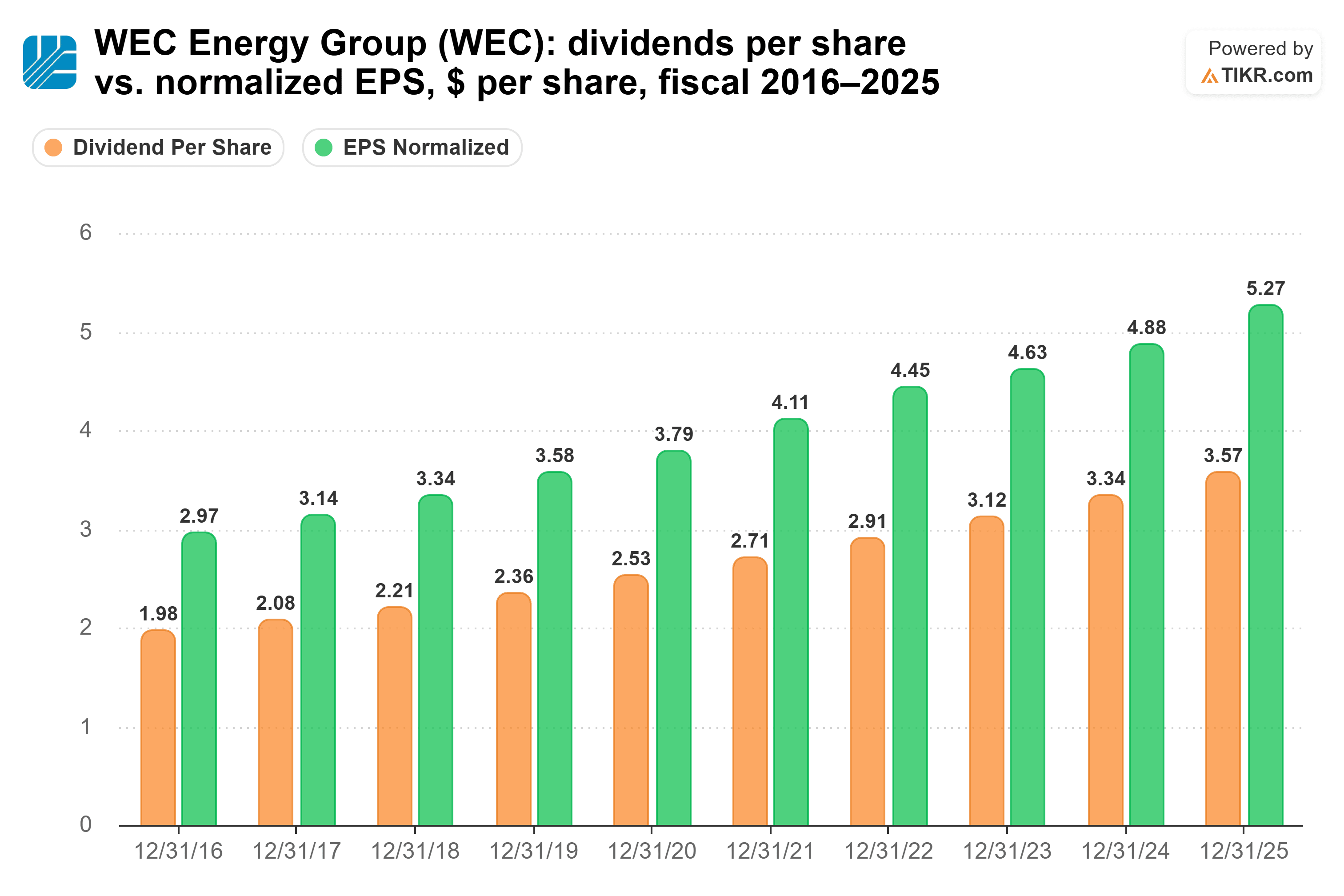
So WEC’s raises are only as good as its earnings growth. Those earnings look solid. It raised its 2026 guidance to $5.60-$5.64 a share from $5.51-$5.61, and it expects EPS to grow 7% to 9-plus percent a year from 2027 to 2031. Behind that is a $47.5 billion capital plan, much of it for Microsoft’s and Vantage Data Centers’ sites. WEC says it has met or beaten the top of its earnings guidance for 22 years straight, and it counts 23 consecutive years of higher dividends.
At 7.1% a year, a touch above the pace it now guides, 3,150 shares would pay about $22,300 in year 10.
I’d pay up for WEC
I’d pay the extra money for WEC. Its check grows the fastest, and it has a long record of delivering the earnings those raises depend on. Its risk is the build itself: it plans to sell $5 billion to $5.5 billion of new stock over five years to help pay for it.
Duke is the cheapest check and has the most room in its payout, which makes it the pick for anyone who wants the most income per dollar today. It just raises at less than a third of WEC’s pace.
Southern, at 68.4%, is the least covered, and so the most at risk of a cut. That doesn’t make it risky. Its payout ratio is falling, its guidance just went up, and it says it hasn’t cut its dividend in more than three-quarters of a century. But Southern expects to need about $2 billion of new equity through 2030, so I’d expect its raises to stay modest.
What’s next: Wisconsin regulators are due to rule on WEC’s rate case by year-end, with new rates in January 2027. An order that keeps WEC’s earnings growing 7% or more a year keeps its raises on track.
Forget WEC Energy Group: 6 safe 6%+ dividend yields you can buy right now
Dividends can hold the key to enormous wealth. But only if you buy the right ones.
Picking the right high-yield dividend stock can be the difference between a dream retirement…and scraping by every month, waiting for the next Social Security check to clear.
We’ve identified six stocks yielding 6%+ that we believe every retiree should know about right now. (And WEC Energy Group isn’t one of them.)
Disclaimer:
Please note that the articles on TIKR are not intended to serve as investment or financial advice from TIKR or our content team, nor are they recommendations to buy or sell any stocks. We create our content based on TIKR Terminal’s investment data and analysts’ estimates. Our analysis might not include recent company news or important updates. TIKR has no position in any of the stocks mentioned. Thank you for reading, and happy investing!