Key Takeaways
- At today’s prices, $1,000 a month in dividends takes 1,686 Chevron shares, about $358,200, or 2,804 ExxonMobil shares, about $449,100.
- Chevron’s 3.4% yield saves about $91,000 up front, and its dividend grew 5.8% a year from fiscal 2020 to fiscal 2025, against 2.8% for ExxonMobil.
- Both dividends are well-covered, at 41% and 40% of free cash flow over the twelve months to Sept. 30. Management expects the refining boom behind much of Chevron’s recent cash to fade.
- I’d take Chevron’s check. ExxonMobil’s stronger balance sheet and 44-year record are the case for paying more.
Any retiree hunting for a dividend check that can ride out oil’s swings is going to look at Chevron (CVX) and ExxonMobil (XOM). Both reported big third quarters on Oct. 30.
So let’s take a hypothetical retiree who wants $1,000 a month from one of them alone. At today’s prices, Chevron’s 3.4% yield gets there with 1,686 shares, for about $358,200. ExxonMobil’s 2.7% yield takes 2,804 shares, or about $449,100.
That’s about $91,000 more for the same dividend check. Here’s how the two stack up:
| Metric | Chevron (CVX) | ExxonMobil (XOM) |
|---|---|---|
| Yield at the current rate | 3.4% | 2.7% |
| Shares for $1,000 a month | 1,686 | 2,804 |
| Cost | $358,191 | $449,145 |
| Dividend income a month | $1,000 | $1,000 |
| Cash dividend payout ratio, TTM to Sept. 30, 2026 | 41% | 40% |
| Dividend growth, fiscal 2020-2025 | 5.8% a year | 2.8% a year |
Source: TIKR and StockAnalysis, at today’s prices and each company’s current dividend rate.
6 safe dividend stocks paying retirees 6%+ yields
There are over 100 stocks paying 6%+ annual dividends today.
But after an extensive investment review leveraging TIKR’s proprietary data, we now believe only six of them are truly safe for retirees.
They’re all yours as part of our new investment report. Learn more about how to get access right here.
Chevron is cashing in on a refining squeeze
Chevron’s check comes from a business that’s throwing off cash right now. Free cash flow hit $12.0 billion in the third quarter of 2026, up from $4.9 billion a year earlier. Its U.S. refineries ran at 98% crude utilization and set a throughput record of 1.09 million barrels a day, and downstream earnings jumped to $4.9 billion from $1.1 billion.
Management was upfront that the windfall won’t last. On its third-quarter call, it said it expects refining margins to stay high only in the short term, with about 10% of the world’s refining capacity knocked offline by conflict. The longer runway is upstream: Chevron plans to roughly double its Venezuela joint ventures’ output to about 600,000 barrels a day by 2031. CEO Mike Wirth said on the call, “With new fiscal terms, Venezuela is now more competitive within our portfolio and immediately accretive and free cash flow positive.”
Over the twelve months to Sept. 30, dividends took a well-covered 41% of free cash flow. The longer record is bumpier. Free cash flow fell well short of the dividend in fiscal 2016 and fiscal 2020, and Chevron kept raising anyway:
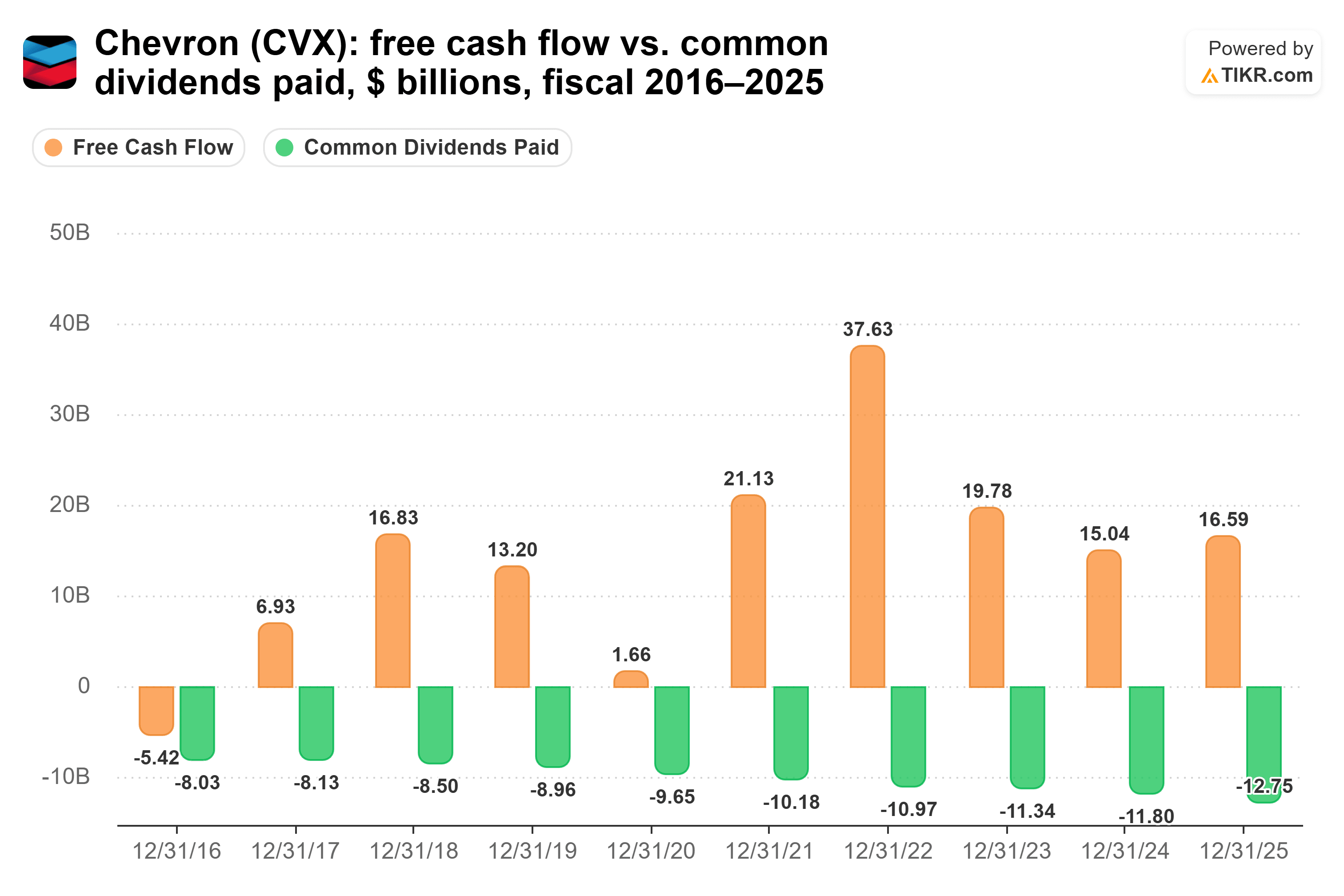
Over fiscal 2024 and fiscal 2025, though, the payout ran a much tighter 78% and 77%. CFO Eimear Bonner was clear on the call about what comes first: “the first priority within that is to grow the dividend consistently.” Chevron says it has raised its dividend for 39 consecutive years.
ExxonMobil’s check comes with a promise
ExxonMobil asks more of your money, and it’s built for steadiness. On Oct. 30, it raised its quarterly dividend to $1.07 a share from $1.03, for what it counts as 44 consecutive years of higher annual dividends per share. CEO Darren Woods didn’t mince words on the call: “we’re not going to ever cut our dividend. So any increases we add becomes an obligation that we’ve got to commit to the future.”
That explains the slow raises. The dividend grew 2.8% a year from fiscal 2020 to fiscal 2025, from $3.48 to $4.00 a share. Buybacks do the rest: “Share buybacks help us maintain that,” Woods said, and ExxonMobil has announced $20 billion of them for 2027. The chart shows that steadiness. Its dividend bill held at $14.9 billion from fiscal 2020 to fiscal 2023, including fiscal 2020, when free cash flow went negative:
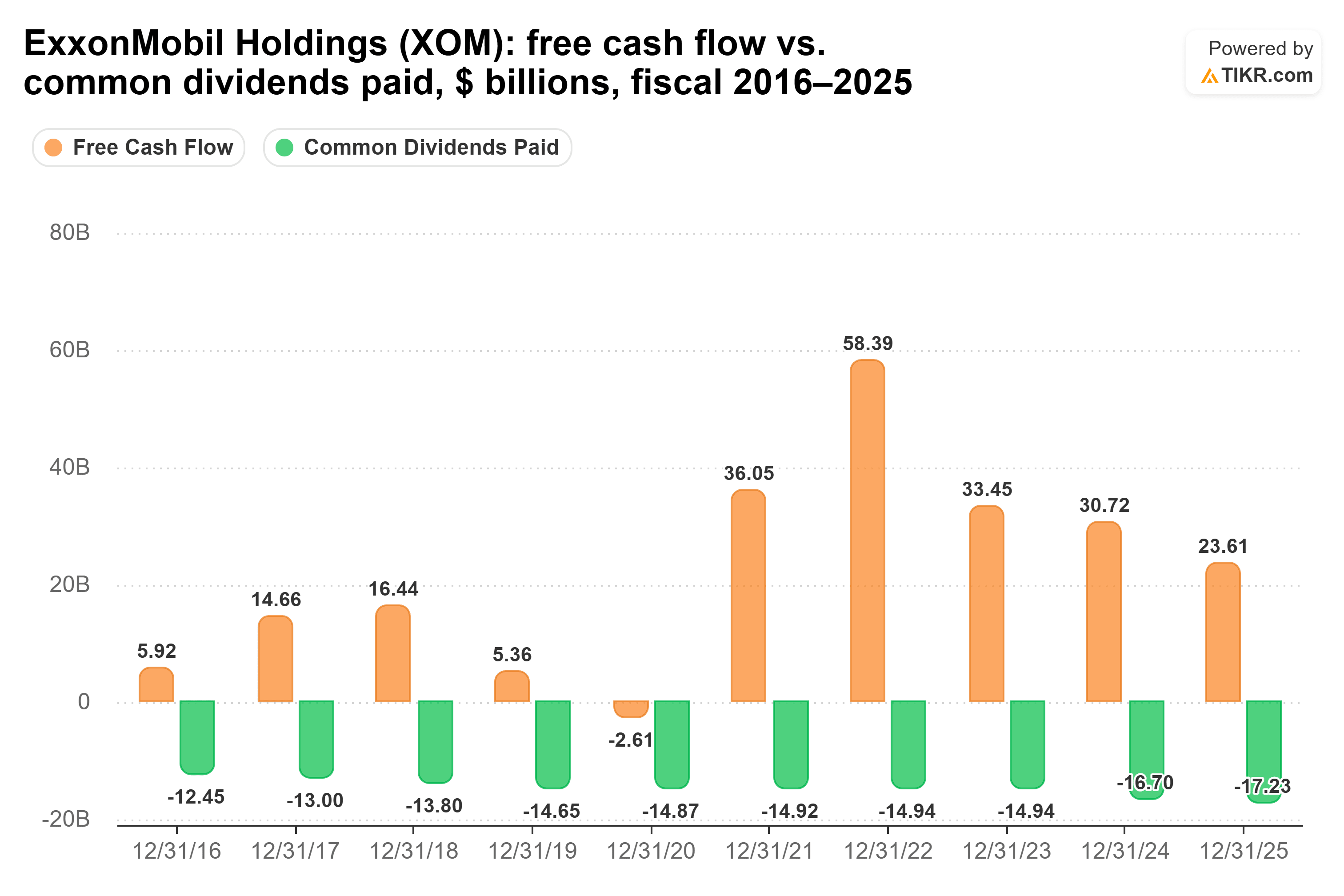
The payout climbed to 73% in fiscal 2025 from 54% in fiscal 2024. But third-quarter free cash flow of $19.1 billion paid $4.3 billion of dividends and $5.1 billion of buybacks, and the past twelve months’ 40% gives plenty of room. Woods called the gains “lasting improvements,” pointing to $16.9 billion of structural cost savings since 2019, with Guyana, the Permian and Golden Pass LNG adding volume.
Oil is the swing factor for both companies. ExxonMobil shares fell 5% on Nov. 4 as Brent crude dropped more than 8% to about $95, and DZ Bank cut the stock to Sell. Middle East damage to Qatar’s LNG trains is also still weighing on its upstream volumes.
So which check should a retiree want?
Chevron is technically the least covered, at 41% of free cash flow to ExxonMobil’s 40%. That’s a coin flip, and even the least covered here isn’t risky. Its net debt is just 0.36x EBITDA, and it cut net debt by $7.8 billion in the third quarter alone. A roughly $5 billion deal for Beacon Offshore, which the Financial Times reported on Nov. 15 that Chevron is nearing, would be a small bite of the $34.07 billion of free cash flow it generated over the past twelve months.
I’d take Chevron’s check. It saves about $91,000 up front, and its dividend has grown about twice as fast. At each company’s 5-year rate, the Chevron shares would pay about $19,900 a year in year 10, against about $15,400 from ExxonMobil’s.
ExxonMobil is still a fine place for income. Its balance sheet is even stronger, at 0.27x net debt to EBITDA, and its record is longer. Plus, it has a CEO on record saying he’ll never cut. I just don’t think that peace of mind is worth an extra $91,000 when Chevron’s dividend is this well-covered.
Of course, Chevron’s 2027 plan is the next test. Management will lay it out in December after meeting with its board, with exploration spending set to rise 50% from last year’s baseline just as refining margins ease.
Forget Chevron: 6 safe 6%+ dividend yields you can buy right now
Dividends can hold the key to enormous wealth. But only if you buy the right ones.
Picking the right high-yield dividend stock can be the difference between a dream retirement…and scraping by every month, waiting for the next Social Security check to clear.
We’ve identified six stocks yielding 6%+ that we believe every retiree should know about right now. (And Chevron isn’t one of them.)
Disclaimer:
Please note that the articles on TIKR are not intended to serve as investment or financial advice from TIKR or our content team, nor are they recommendations to buy or sell any stocks. We create our content based on TIKR Terminal’s investment data and analysts’ estimates. Our analysis might not include recent company news or important updates. TIKR has no position in any of the stocks mentioned. Thank you for reading, and happy investing!