Key Takeaways
- Hershey yields 3.4% and Procter & Gamble yields 2.6%. Hershey grew its dividend 11.7% a year from fiscal 2020 to fiscal 2025, against 5.6% a year for P&G from fiscal 2021 to fiscal 2026.
- Over the last 12 months, Hershey’s dividend took 53% of its free cash flow and P&G’s took 67%.
- P&G has raised its dividend for 70 consecutive years, while Hershey’s didn’t rise in fiscal 2025, a year its gross margin fell as low as 30.5%.
- Hershey’s gross margin has recovered to 46.1%, while P&G expects commodity costs to drag its core EPS growth down 11% in fiscal 2027.
A 20-year dividend stock needs a check that keeps growing through every cost spike, and two of the best-known payers are in one right now.
Hershey (HSY) is climbing out of a cocoa squeeze. On Oct. 29, it raised its 2026 adjusted EPS growth outlook to 36% to 38.5%, from 32.5% to 35%. Procter & Gamble (PG) is heading into a squeeze of its own, and expects commodities to take about $1.4 billion after tax out of fiscal 2027’s earnings.
So if I can only own one for the next 20 years, which is it?
| Metric | Hershey (HSY) | Procter & Gamble (PG) |
|---|---|---|
| Dividend yield | 3.4% | 2.6% |
| Annual dividend, current rate | $5.81 | $4.35 |
| Dividend growth, 5 years | 11.7% a year (fiscal 2020-2025) | 5.6% a year (fiscal 2021-2026) |
| Dividend growth, 10 years | 9.4% a year (fiscal 2015-2025) | 4.8% a year (fiscal 2016-2026) |
| Cash dividend payout ratio (TTM) | 53% | 67% |
| Net debt/EBITDA | 1.5x | 0.9x |
| Interest coverage | 11.7x | 24.2x |
Source: TIKR and StockAnalysis, at today’s prices. Payout ratios are for the 12 months to September 2026. P&G’s fiscal years end in June.
6 safe dividend stocks paying retirees 6%+ yields
There are over 100 stocks paying 6%+ annual dividends today.
But after an extensive investment review leveraging TIKR’s proprietary data, we now believe only six of them are truly safe for retirees.
They’re all yours as part of our new investment report. Learn more about how to get access right here.
Hershey leans on Salty Snacks
Hershey’s third quarter, to Sept. 27, 2026, was strong on profit and slow on sales: adjusted EPS of $2.64 was up 103.1% on the same quarter of 2025, but organic, constant-currency sales grew just 0.8%. North America Salty Snacks carried the growth, with sales up 22.3%, 20 points of it from the LesserEvil acquisition.
Free cash flow pays the dividend, and it has covered it every year since fiscal 2016:
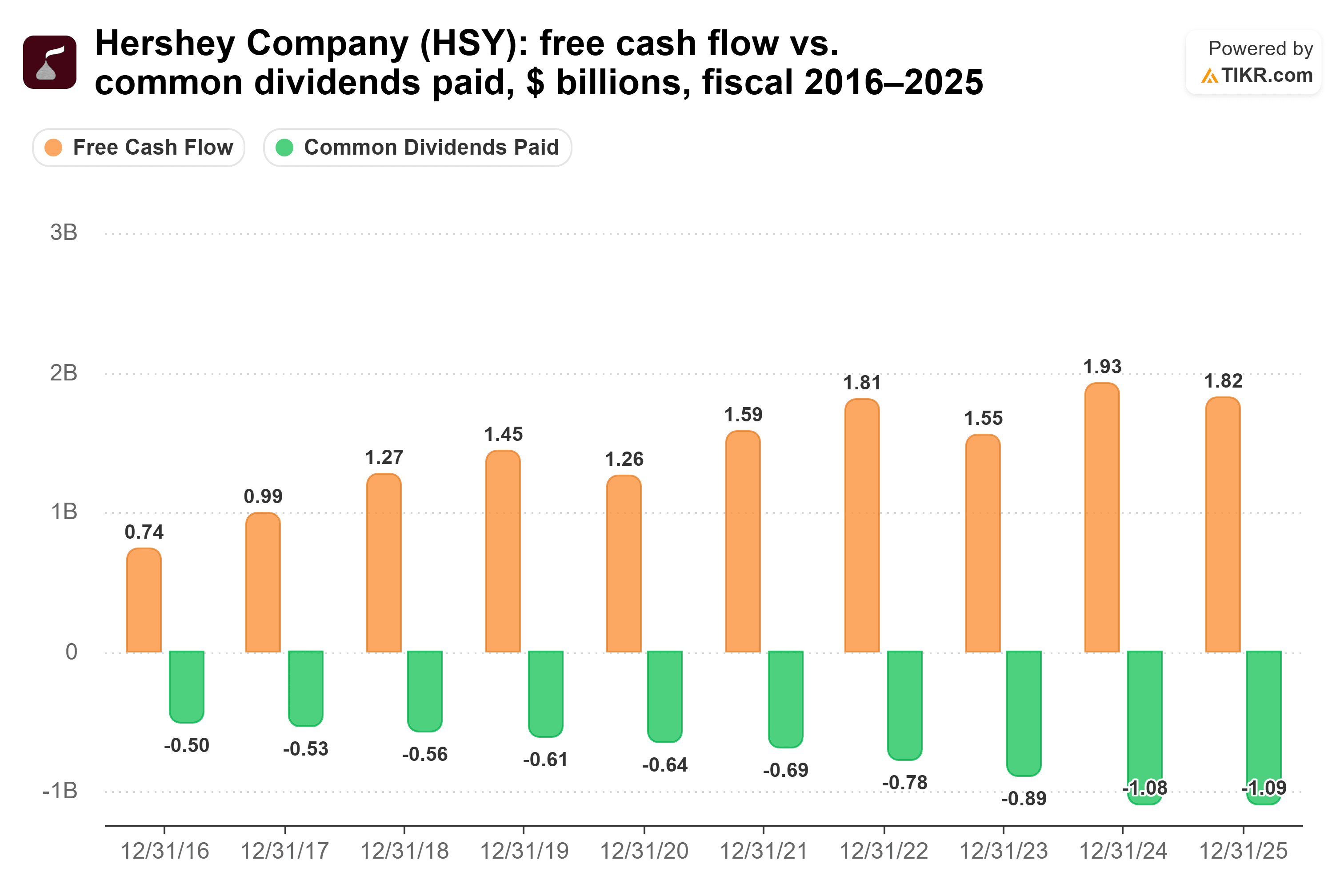
The dividend did grow faster than the cash, from 43% of free cash flow in fiscal 2021 to 60% in fiscal 2025. Then free cash flow hit $2.12 billion over the 12 months to Sept. 27, 2026, so the $1.13 billion dividend took a well-covered 53%. The dividend itself didn’t rise in fiscal 2025, at $5.48 a share.
P&G is growing everywhere, and paying more to do it
Hershey’s growth leans on one segment, while P&G’s comes from almost everywhere. In the quarter to Sept. 30, 2026, its organic sales rose 4.0%, with growth in all 10 product categories and all six regions. Commodity costs are an 11% drag on its core EPS growth this fiscal year, though.
At its Nov. 19 Investor Day, P&G targeted up to $10 billion in productivity savings from fiscal 2027 through fiscal 2030. CFO Andre Schulten said those savings are meant chiefly to fund reinvestment, so I wouldn’t count on them to speed up the dividend.
P&G has raised its dividend for 70 consecutive years, and free cash flow covers it, with less to spare than at Hershey:
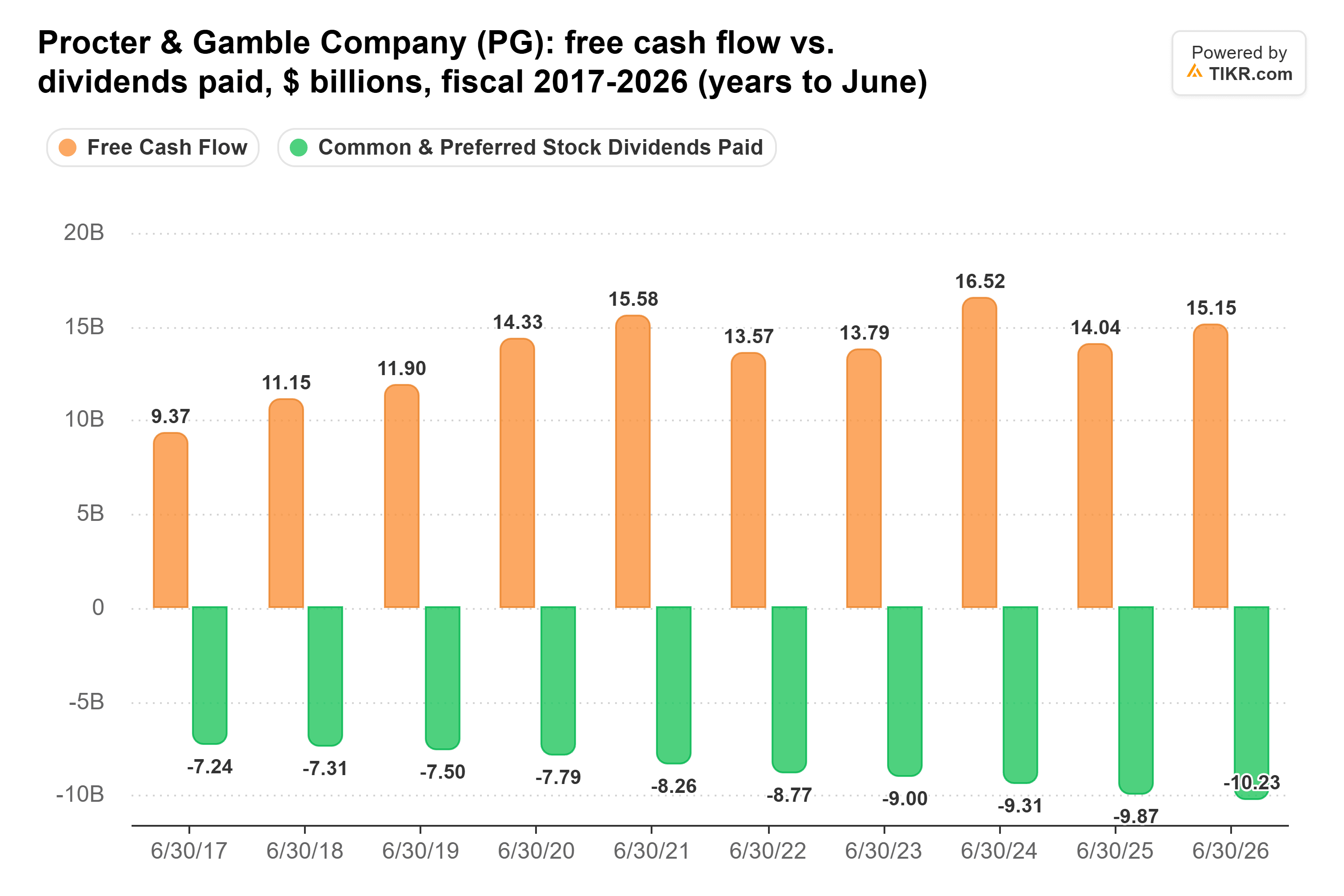
Dividends took 53% of free cash flow in fiscal 2021 and 68% in fiscal 2026. Over the 12 months to Sept. 30, 2026, they took 67%.
So which dividend wins?
If I can only hold one dividend stock for the next 20 years, it’s Hershey.
At each dividend’s 5-year growth rate, $10,000 in Hershey pays $340 this year and about $23,691 over the 20 years. The same $10,000 in P&G pays $260 now and about $9,189 in all.
Hershey won’t raise its dividend 11.7% a year forever, and it doesn’t have to. Hershey starts from the bigger check, so it pays more every year as long as it raises at least as fast as P&G. Suppose Hershey never raised again and P&G kept its fiscal 2026 pace of 4.4%. P&G’s check would pass Hershey’s around 2033, and P&G would pay about $8,082 over the 20 years to Hershey’s $6,800. But Hershey’s current rate is already above fiscal 2025’s, and its gross margin has climbed every quarter since it hit 30.5% in the quarter to June 29, 2025:
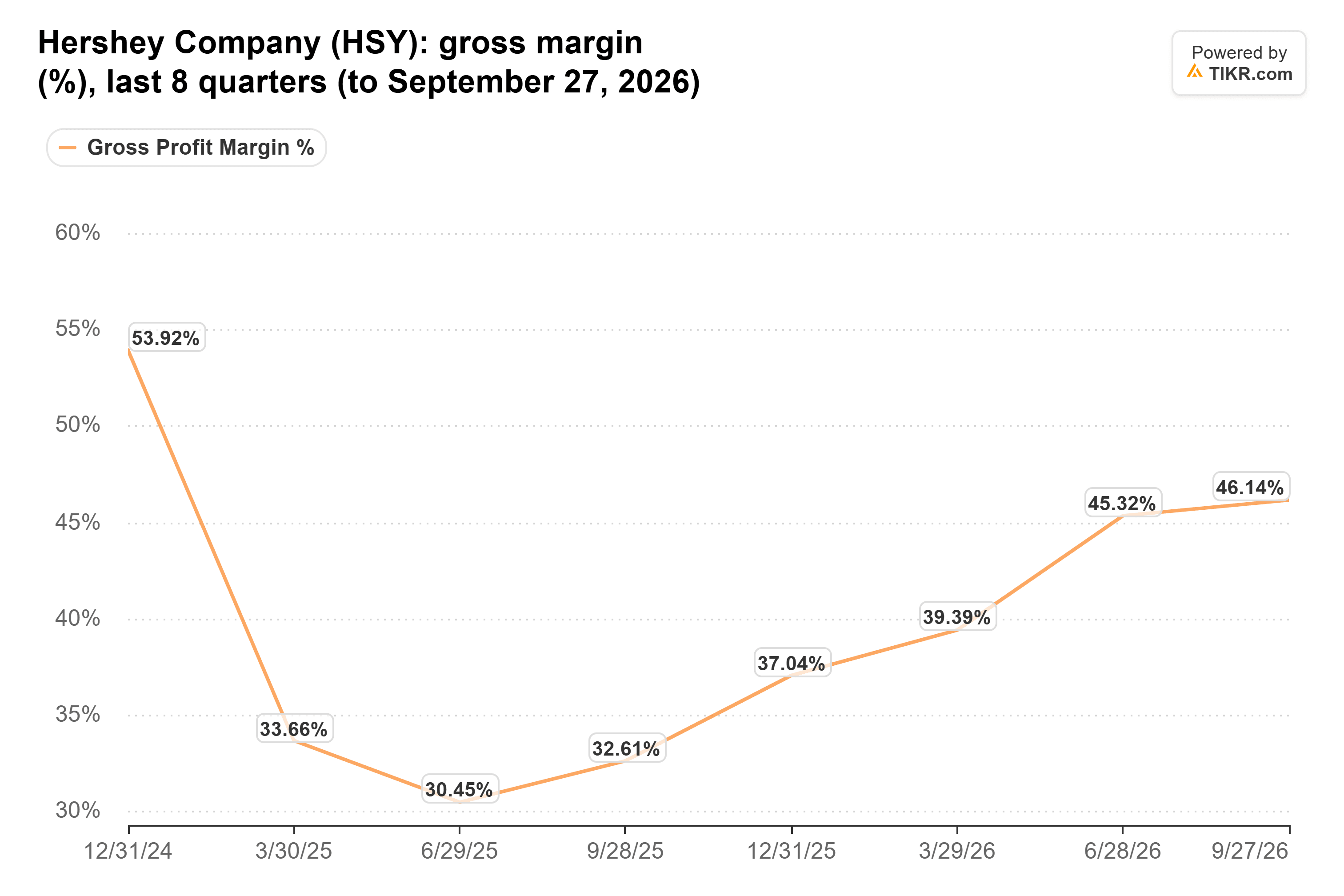
Some of the third quarter’s help won’t repeat: cocoa-hedge gains Hershey expected in the fourth quarter came early, and tariff refunds added 22 cents a share to earnings. Still, CFO Dave Hulays said Hershey continues “to stay focused on achieving mid-40% margin recovery over the long term.” With 53% of free cash flow going to the dividend, Hershey has plenty of room to keep raising it.
This isn’t to say P&G’s dividend is in any danger. Seventy straight years of raises, less debt and growth in every category it sells are a lot to like. It’s just that over 20 years, I’d rather own the bigger check with more free cash flow left over after it’s paid.
Of course, cocoa has squeezed Hershey once already. If its gross margin slips well below the mid-40s next year, once this year’s early hedge gains are behind it, I’d expect slower raises, and I’d take a hard look at P&G instead.
Forget Hershey: 6 safe 6%+ dividend yields you can buy right now
Dividends can hold the key to enormous wealth. But only if you buy the right ones.
Picking the right high-yield dividend stock can be the difference between a dream retirement…and scraping by every month, waiting for the next Social Security check to clear.
We’ve identified six stocks yielding 6%+ that we believe every retiree should know about right now. (And Hershey isn’t one of them.)
Disclaimer:
Please note that the articles on TIKR are not intended to serve as investment or financial advice from TIKR or our content team, nor are they recommendations to buy or sell any stocks. We create our content based on TIKR Terminal’s investment data and analysts’ estimates. Our analysis might not include recent company news or important updates. TIKR has no position in any of the stocks mentioned. Thank you for reading, and happy investing!