Key Takeaways
- Hormel Foods and Albertsons Companies both yield 5.4%, and both picked up a big bill this fall: about $1.06 billion for Hormel’s Brakebush deal, and a $900 million court judgment for Albertsons.
- Over a 20-year hold, the balance sheet and the record behind a dividend matter more than how fast it has grown lately.
- Albertsons’ dividend took 63% of its free cash flow over the last twelve months, against 82% at Hormel, but Albertsons carries 3.4x net debt to EBITDA, against Hormel’s 1.2x.
- Hormel’s Brakebush deal is expected to close in its fiscal first quarter of 2027, and Albertsons plans to give a new financial framework by its fourth-quarter call.
Any retiree hunting for dividend income is going to look at Hormel Foods (HRL) and Albertsons Companies (ACI). Both yield 5.4%.
And both picked up a big bill this fall. On Sept. 30, Hormel agreed to buy chicken maker Brakebush Brothers for about $1.06 billion. On Nov. 5, a Washington state judge ordered Albertsons to pay $900 million over its pharmacies’ role in the opioid crisis.
So if I could hold just one for the next 20 years, which would it be?
| Metric | Hormel Foods (HRL) | Albertsons Companies (ACI) |
|---|---|---|
| Dividend yield | 5.4% | 5.4% |
| Annual dividend | $1.17 | $0.68 |
| Dividend growth, 5 years | 4.5% a year (fiscal 2020-2025) | 24.6% a year (years ended Feb. 2021-Feb. 2026) |
| Cash dividend payout ratio (TTM) | 82% | 63% |
| Net debt/EBITDA (LTM) | 1.2x | 3.4x |
| Interest coverage (LTM) | 12.6x | 2.9x |
Source: TIKR. TTM payout ratios run to July 26, 2026 (Hormel) and Sept. 12, 2026 (Albertsons).
6 safe dividend stocks paying retirees 6%+ yields
There are over 100 stocks paying 6%+ annual dividends today.
But after an extensive investment review leveraging TIKR’s proprietary data, we now believe only six of them are truly safe for retirees.
They’re all yours for free as part of our new investment report, which you can access right here.
Hormel’s cash came up short in fiscal 2025
In the third quarter of fiscal 2026, which ended July 26, Hormel’s net sales slipped to $2.96 billion from $3.03 billion a year earlier as it exited whole-bird turkey and private-label snack nuts. But foodservice grew organically for a 12th straight quarter, and management raised its fiscal 2026 adjusted EPS guidance to $1.45-$1.51, growth of 6% to 10%.
The cash had a rougher run. Free cash flow covered the dividend every year from fiscal 2016 to fiscal 2024, then fell to $534 million in fiscal 2025, against $633 million paid out:
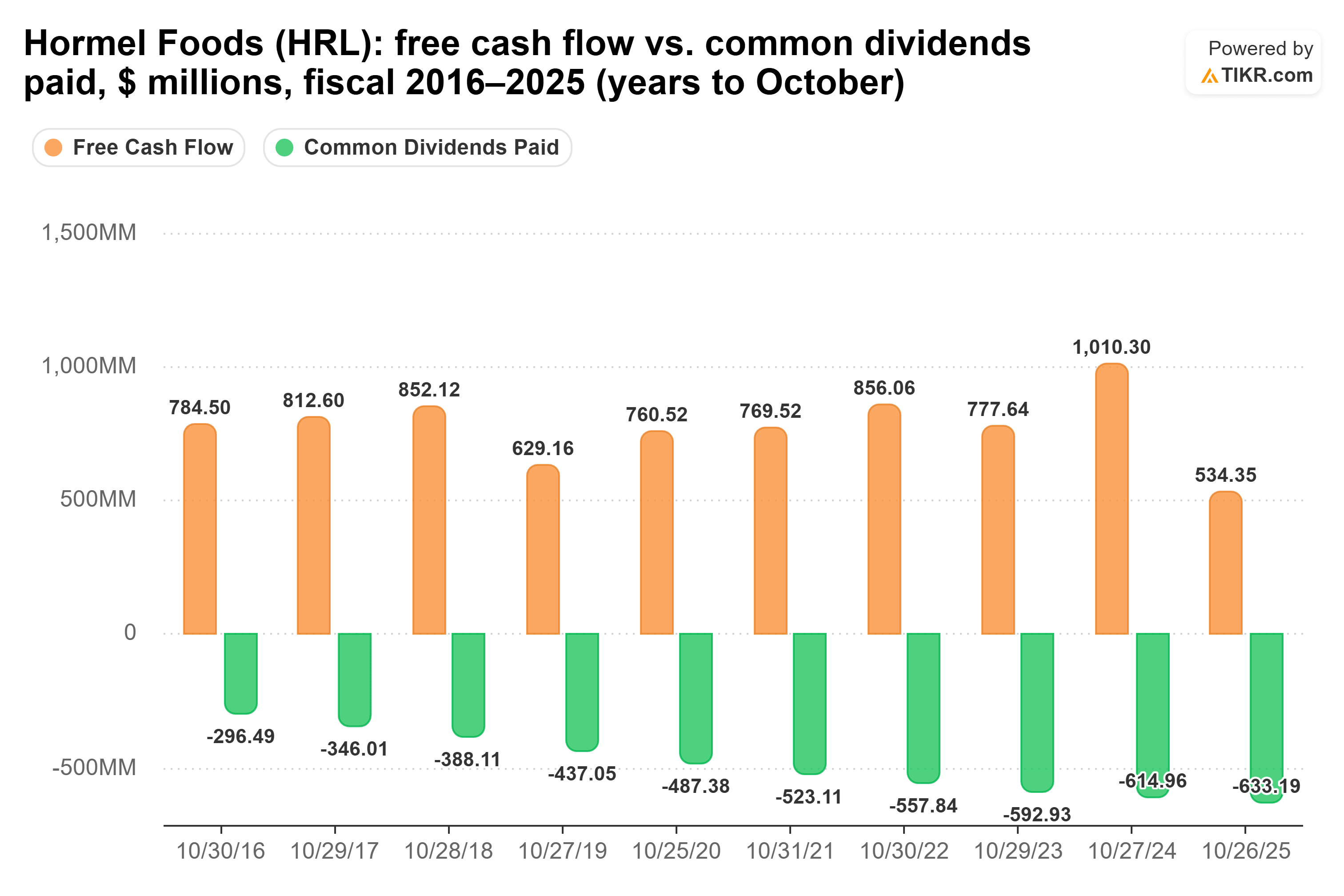
Over the twelve months to July 26, the dividend took 82% of free cash flow. That’s back under 100%, but well above fiscal 2024’s 60.9%.
John Ghingo, Hormel’s president and CEO-elect, said on the third-quarter call that “the dividend continues to be very important to us,” and Hormel has now made 392 consecutive quarterly payouts. The main risk is Brakebush: it adds debt while free cash flow has little to spare, and Hormel doesn’t expect it to add to adjusted EPS until fiscal 2028.
Albertsons is paying more out of less cash
Albertsons’ business, meanwhile, is in a turnaround. In the second quarter of fiscal 2026, the 12 weeks to Sept. 12, identical sales slipped 0.8%, and adjusted EBITDA fell to $784 million from $848.4 million a year earlier, even as digital sales grew 11%. Albertsons pulled its outlook to review the business, and CEO Susan Morris said the review would “tackle even harder a cost structure we can no longer afford.” A new framework is due by its fourth-quarter call.
The dividend has grown faster than the cash behind it. Free cash flow fell from $2.27 billion in the year ended February 2021 to $527 million in the year ended February 2026, while dividends paid rose from $93.7 million to $323 million:
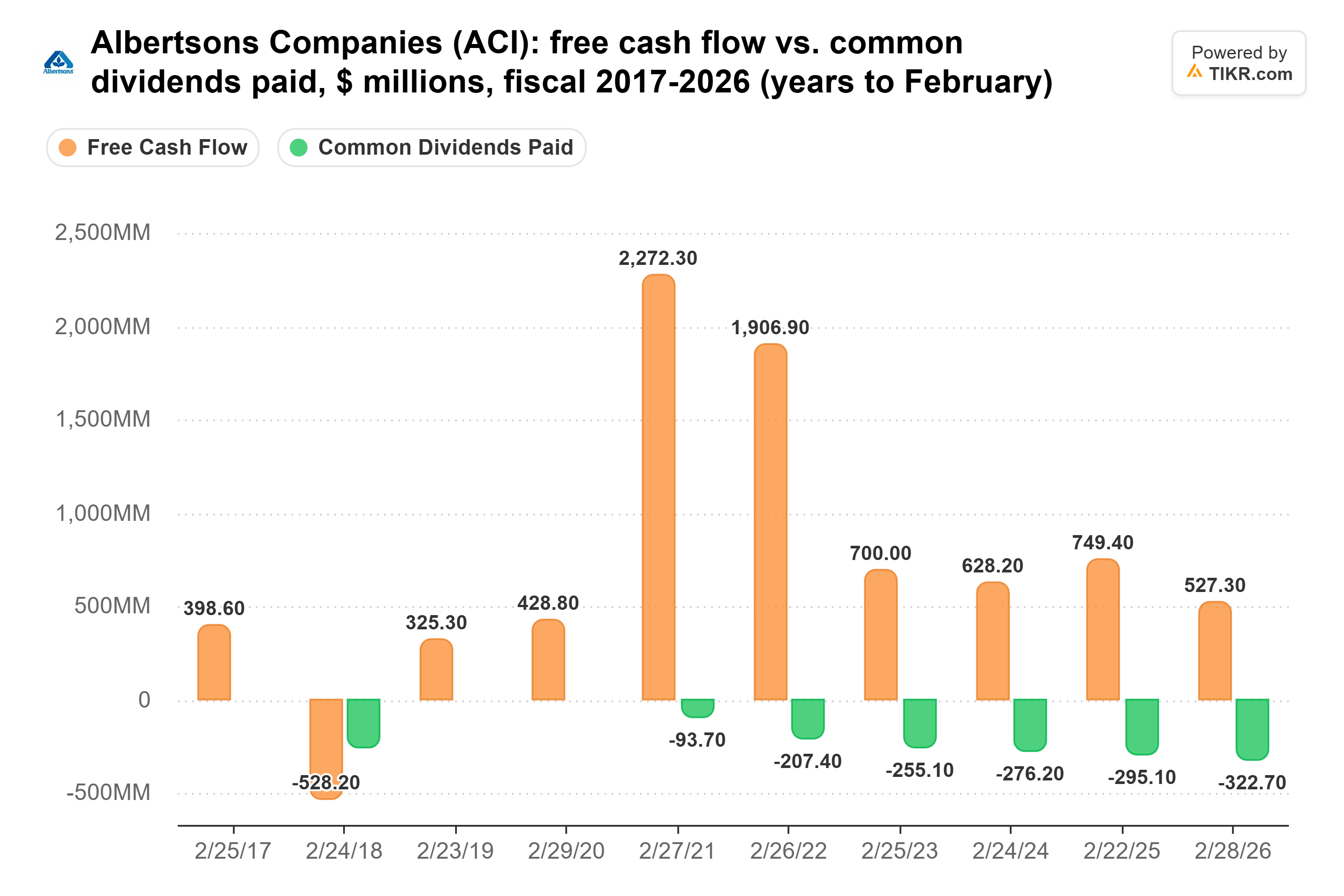
The payout climbed from 36.4% of free cash flow in the year ended February 2023 to 61.2% in the year ended February 2026, and 63% over the twelve months to Sept. 12. Then came the opioid ruling: $900 million is more than the $506 million of free cash flow Albertsons made over those twelve months, though the company said it “will evaluate all available options, including appeal.”
So which dividend wins?
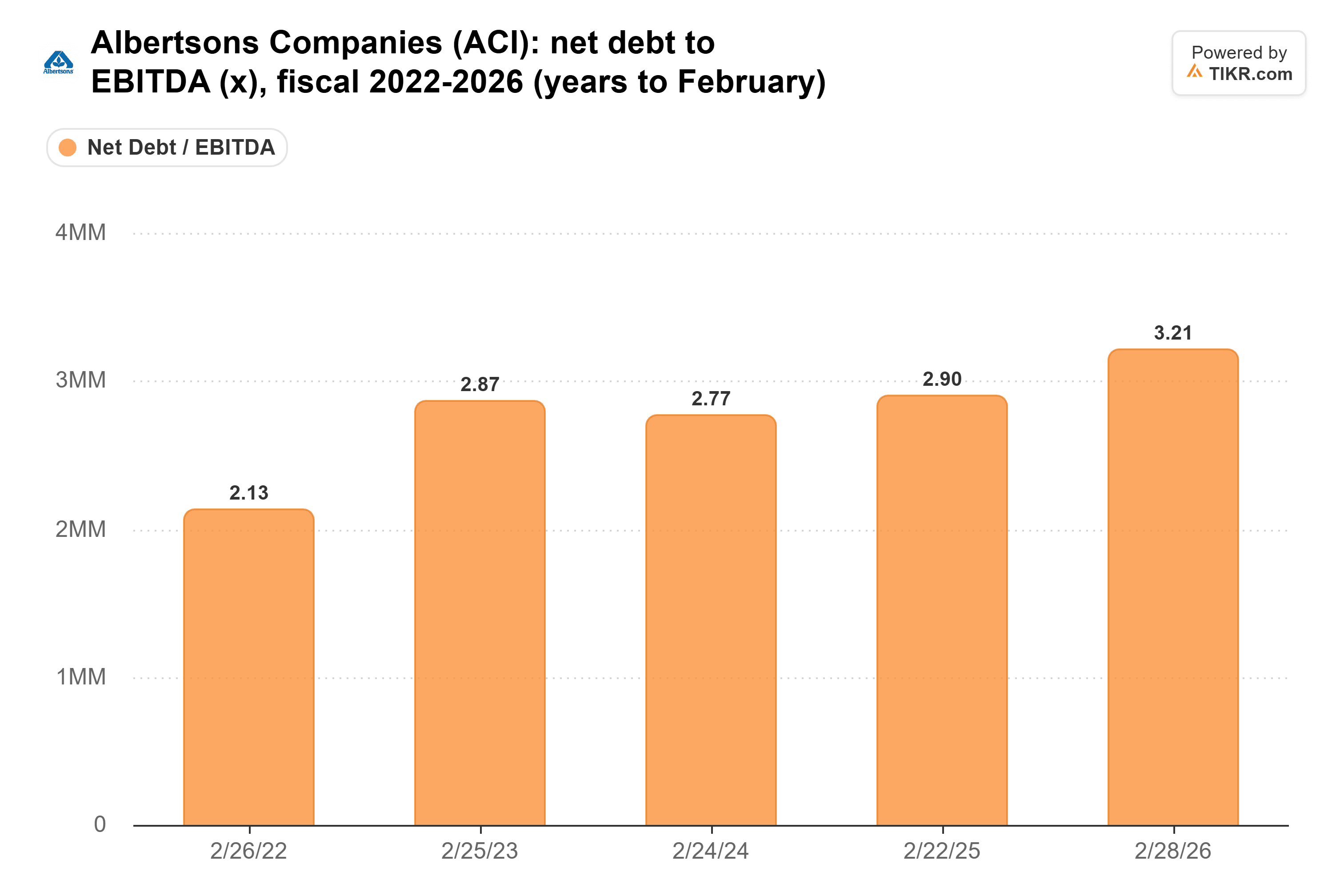
I’d hold Hormel for the next 20 years. It has the balance sheet a 20-year dividend needs: 1.2x net debt to EBITDA, with operating earnings covering its interest 12.6x. Albertsons covers its interest just 2.9x, and its debt was climbing well before the judgment, from 2.1x EBITDA in the year ended February 2022 to 3.2x in the year ended February 2026:
At each dividend’s pace now, $10,000 in Albertsons would pay about $76,000 over 20 years, against about $14,000 for Hormel. But that means repeating its 17.6% raise of the year ended February 2026 every year for two decades, with free cash flow shrinking and debt rising.
This isn’t to say Albertsons’ dividend is unsafe. It’s better covered today, and if Morris finds the cuts she’s after, its dividend could keep outgrowing Hormel’s for years. It’s just that, for a check I want to collect for 20 years, I trust Hormel’s balance sheet and long record more.
Of course, Hormel still has to get its free cash flow comfortably above the dividend while it pays for Brakebush, and its fiscal 2026 results will show how much room it has left.
Forget Hormel Foods: 6 safe 6%+ dividend yields you can buy right now
Dividends can hold the key to enormous wealth. But only if you buy the right ones.
Picking the right high-yield dividend stock can be the difference between a dream retirement…and scraping by every month, waiting for the next Social Security check to clear.
We’ve identified six stocks yielding 6%+ that we believe every retiree should know about right now. (And Hormel Foods isn’t one of them.)
Disclaimer:
Please note that the articles on TIKR are not intended to serve as investment or financial advice from TIKR or our content team, nor are they recommendations to buy or sell any stocks. We create our content based on TIKR Terminal’s investment data and analysts’ estimates. Our analysis might not include recent company news or important updates. TIKR has no position in any of the stocks mentioned. Thank you for reading, and happy investing!