Key Takeaways
- Goldman Sachs kept its Buy rating and $177 target on Alibaba into the Nov. 19 report, 112% above a stock 53% below its January high.
- Cloud revenue grew 53% in the September quarter, but adjusted earnings missed and free cash flow was an outflow of RMB 34.47 billion (about $5.14 billion).
- Alibaba now says a new U.S. chip rule could slow cloud growth to 30% to 45% next fiscal year.
- $177 is 16x the earnings expected a year out, above the 13x five-year average, and rests on the business the chip rule hits.
Alibaba Group (BABA) stock has lost 53% since its January high, and Goldman Sachs thinks the market overshot. Analyst Ronald Keung kept his Buy rating and $177 target going into the Nov. 19 report. That target sits 112% above the stock’s $83.31 close that day.
The same morning, PDD Holdings (PDD) lifted operating profit to RMB 31.2 billion (about $4.65 billion) on flat revenue, and its stock rallied. Three days earlier, Baidu (BIDU) said its AI Cloud Infra revenue grew 94% to RMB 8.2 billion (about $1.22 billion).
Alibaba’s Cloud Is Working. The Cash Isn’t Yet
Cloud revenue rose 53% to RMB 60.97 billion (about $9.09 billion) in the September quarter, and the segment’s adjusted EBITA more than doubled to RMB 8.84 billion (about $1.32 billion). But the AI Labs unit behind the Qwen app lost RMB 10.5 billion (about $1.57 billion), more than the cloud earned.
Adjusted earnings of RMB 8.10 per ADS (about $1.21) missed estimates. Free cash flow was an outflow of RMB 34.47 billion (about $5.14 billion), against RMB 21.84 billion (about $3.26 billion) a year earlier.
The Chip Rule Is Already in the Guidance
On Nov. 16, the Commerce Department announced a license requirement for advanced chips going to data centers that sell large amounts of computing to Chinese companies. It took effect Nov. 19, and existing operators have 90 days to obtain a license. It targets the rented offshore Nvidia capacity Alibaba’s cloud reportedly uses.
On the call, CEO Eddie Wu said Alibaba was still assessing the rule and that cloud growth could slow to 30% to 45% next fiscal year, before returning to 50% or more in calendar 2028 as its chips ramp. That’s a step down from 53%, in the one segment the Buy case runs through.
TIKR Tracks 41 Analysts on Alibaba. How Many Say “Buy”?
See the full breakdown of Buy, Hold, and Sell ratings on Alibaba, along with Wall Street’s revenue and earnings estimates, all in one place. More than 500,000 investors use TIKR to research stocks like this one. See Alibaba’s Analyst Ratings
Does $177 Add Up?
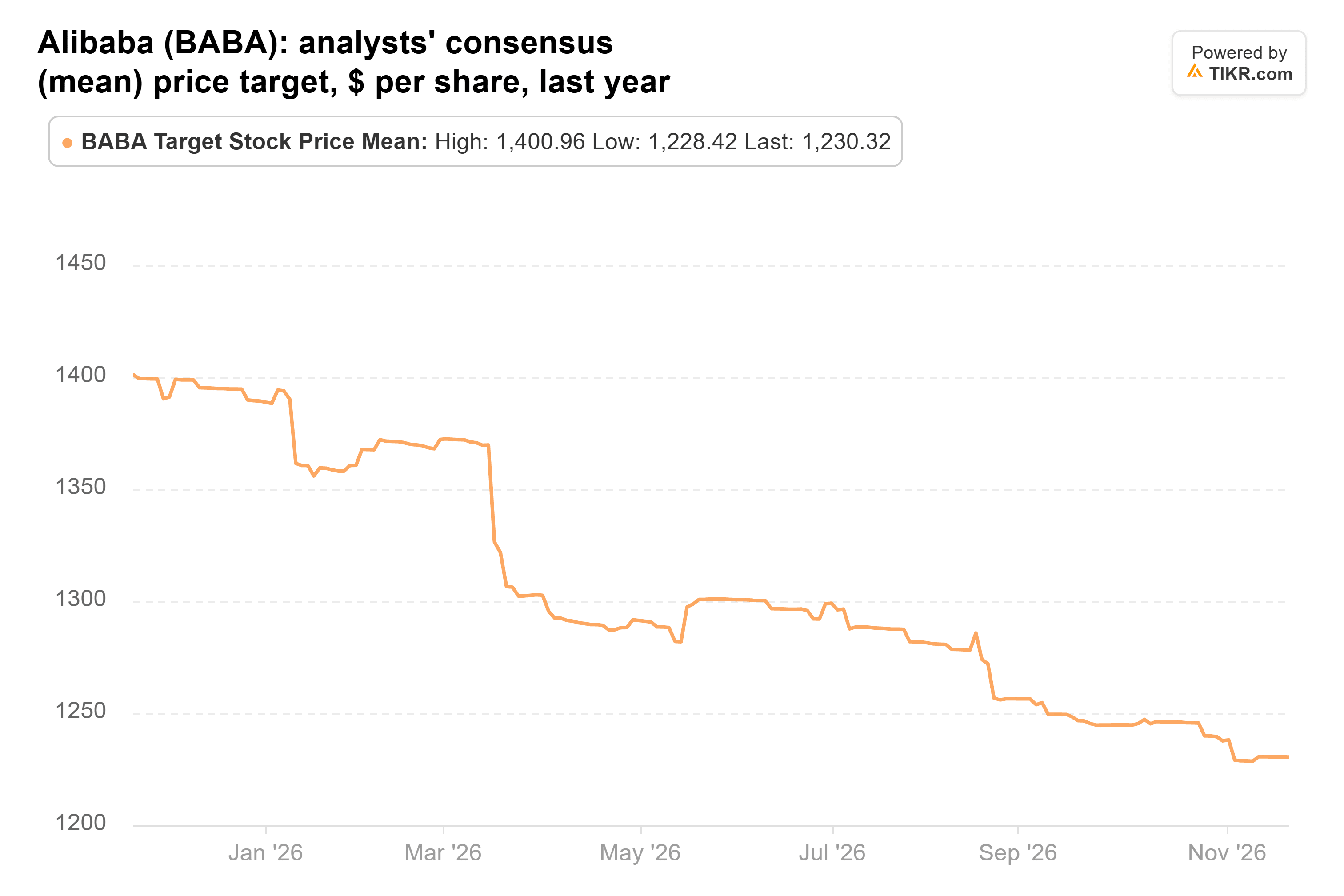
Goldman’s target has been $177 since September. Going into the print, it expected EPS to grow 59% in fiscal 2027 and another 28% in fiscal 2028, according to TipRanks. The consensus target barely moved: it slipped to $185 on Nov. 18 from $198 at the end of 2025, while the stock fell to $83.31 from $146.58.
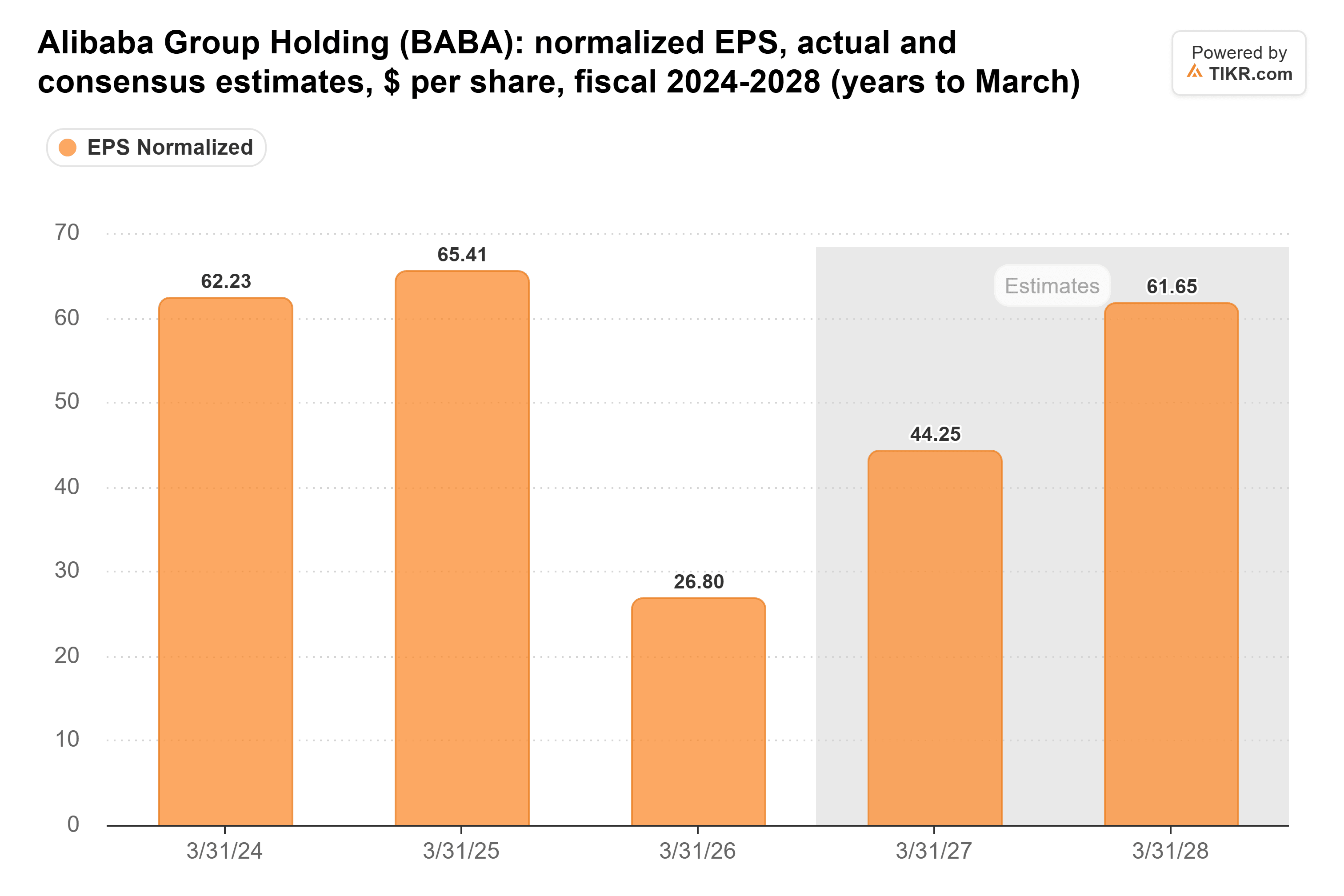
Normalized EPS fell 59% in fiscal 2026 (the year to March). Before the report, consensus had fiscal 2028 back near fiscal 2024’s level.
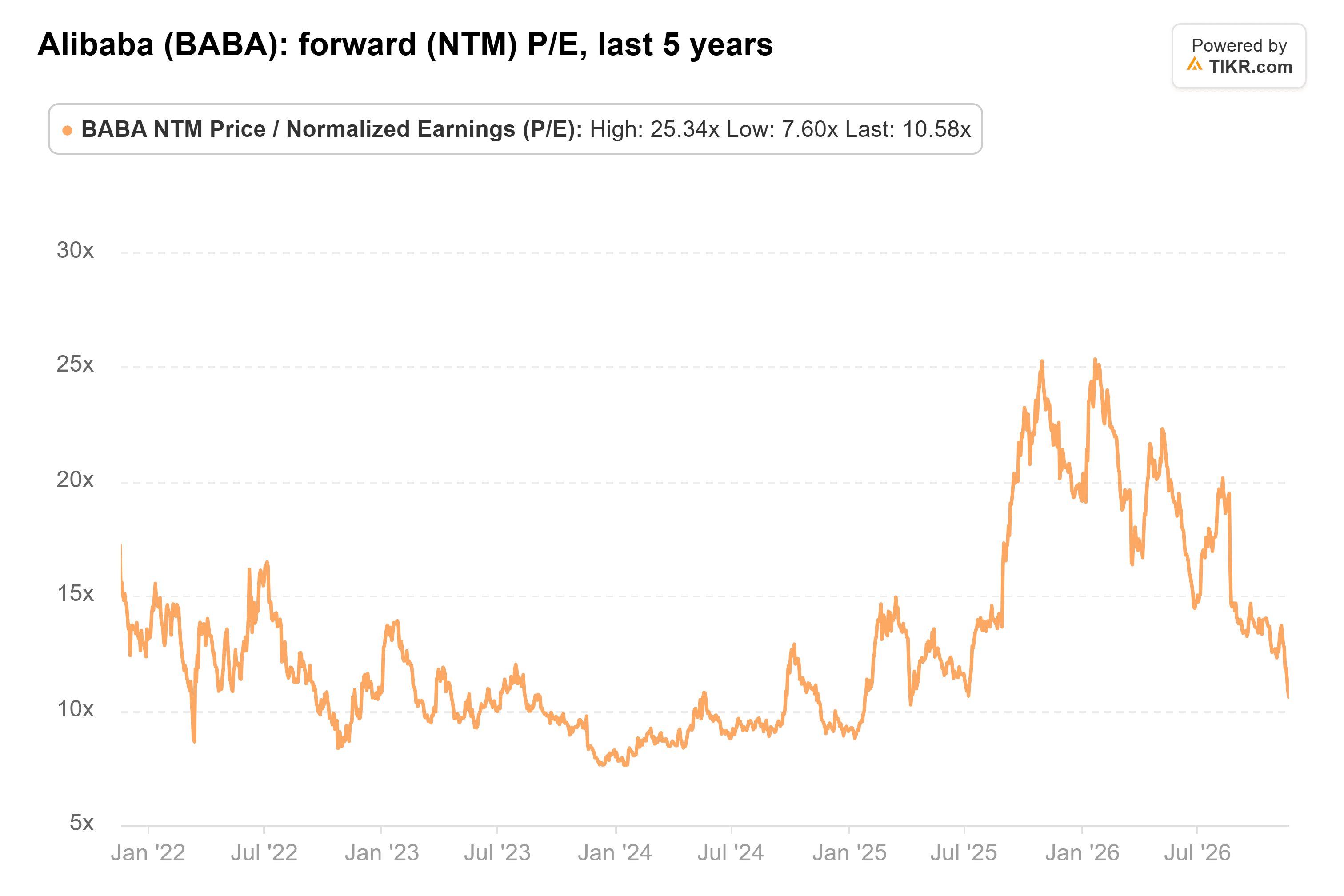
The stock traded at 11x forward earnings on Nov. 18, below its five-year average of 13x.
On pre-report estimates for the 12 months after the target date, analysts expected $11.09 a share, so $177 is 16x.
The Bottom Line on Alibaba Stock
Goldman is right that the selloff overshot: 11x is cheap for a company whose cloud grew 53%. But $177 implies 16x pre-report estimates just as Alibaba says it may target cloud growth of 30% to 45%. Goldman sees group free cash flow turning positive only in fiscal 2029 (the year to March 2029). Until Alibaba’s cloud growth holds near the top of that range, $177 is a target for 2028, not for the next 12 months.
So What Is Alibaba Stock Actually Worth?
TIKR lets you forecast the future price of any stock in less than a minute. Just enter a few assumptions into TIKR’s valuation model and see what Alibaba could be worth. Start from Wall Street consensus estimates, or adjust the inputs to reflect your own view of the business. It’s free to use.
Disclaimer:
Please note that the articles on TIKR are not intended to serve as investment or financial advice from TIKR or our content team, nor are they recommendations to buy or sell any stocks. We create our content based on TIKR Terminal’s investment data and analysts’ estimates. Our analysis might not include recent company news or important updates. TIKR has no position in any of the stocks mentioned. Thank you for reading, and happy investing!