Key Takeaways
- Goldman Sachs limited Anthropic’s Claude Code and Microsoft’s GitHub coding tools to its roughly 12,000 engineers in October, so most of its traders and bankers lost access.
- Ramp’s AI Index shows growth in businesses’ spending on Anthropic’s tokens slowing to 0.5% in October, and Ramp’s lead economist says engineering use, the biggest category of enterprise AI spend, is starting to plateau.
- That leaves Anthropic’s next leg of growth in teams outside engineering, the kind of use Goldman just cut back, just as Anthropic goes public with Goldman as one of its lead banks.
- Microsoft looks less exposed: analysts expect its revenue to grow about 19% in fiscal 2027, and its earnings estimates have gone up since late October.
Goldman Sachs (GS) is one of the lead banks taking Anthropic public next week. It also just took Anthropic’s best-known product away from most of its own traders.
Internal guidance updated in October limits Claude Code, along with the GitHub coding tools from Microsoft (MSFT), to Goldman’s roughly 12,000 engineers, Bloomberg reported on Nov. 2. The bank made the change after a review of productivity and risk. Traders had been using the tools to follow client flows and model market moves.
That’s quite the reversal. As recently as July, Goldman’s chief information officer, Marco Argenti, was publicly praising what non-technical staff had built with AI.
Goldman’s call also matches what Ramp is seeing across the businesses it serves. Its AI Index, built on transaction data from more than 85,000 US businesses, found that overall AI spending grew less than 2% in October from September. Growth in Anthropic’s token spend fell to 0.5%.
Ramp lead economist Ara Kharazian said on this week’s episode of the Prof G Markets podcast that “the largest segment of spend in terms of enterprise spend on AI, which is engineering use, is starting to plateau.” His reason: those are “precisely the teams that are incentivized now to figure out how to spend on AI more efficiently.”
TIKR tracks 26 analysts on Goldman Sachs. How many say “Buy”?
See the full breakdown of Buy, Hold, and Sell ratings on Goldman Sachs, along with Wall Street’s revenue and earnings estimates, all in one place. More than 500,000 investors use TIKR to research stocks like this one. See Goldman Sachs’ Analyst Ratings
So engineers are learning to spend less, and at Goldman, most of the other staff just lost the tools.
Anthropic needs the rest of the office
Kharazian said a plateau in engineering doesn’t have to mean AI spending flattens for good. In his view, the next leg depends on whether the model companies can deliver real productivity gains for teams outside engineering. He named customer support and cybersecurity as the likeliest places for that growth. Goldman’s traders were exactly that kind of test, and after the bank’s review of productivity and risk, the tools went back to the engineers.
Anthropic’s own numbers look a lot healthier. Its IPO filing shows its revenue run rate rose by $10 billion in October alone.
My read: the biggest enterprise deals are still landing, while the everyday spending Ramp tracks has leveled off. Spreading to non-engineers, one seat at a time, is how that pace keeps going for years. Goldman just showed how fast a big customer can take those seats back.
Microsoft can handle a plateau
Microsoft is tied to both trends. GitHub’s tools were half of Goldman’s rollback. Anthropic agreed in November 2025 to buy $30 billion of Azure compute, and Microsoft booked a $3.2 billion gain on its Anthropic stake in the June quarter.
Even so, analysts expect Microsoft’s revenue growth to speed up from fiscal 2026’s 18%:
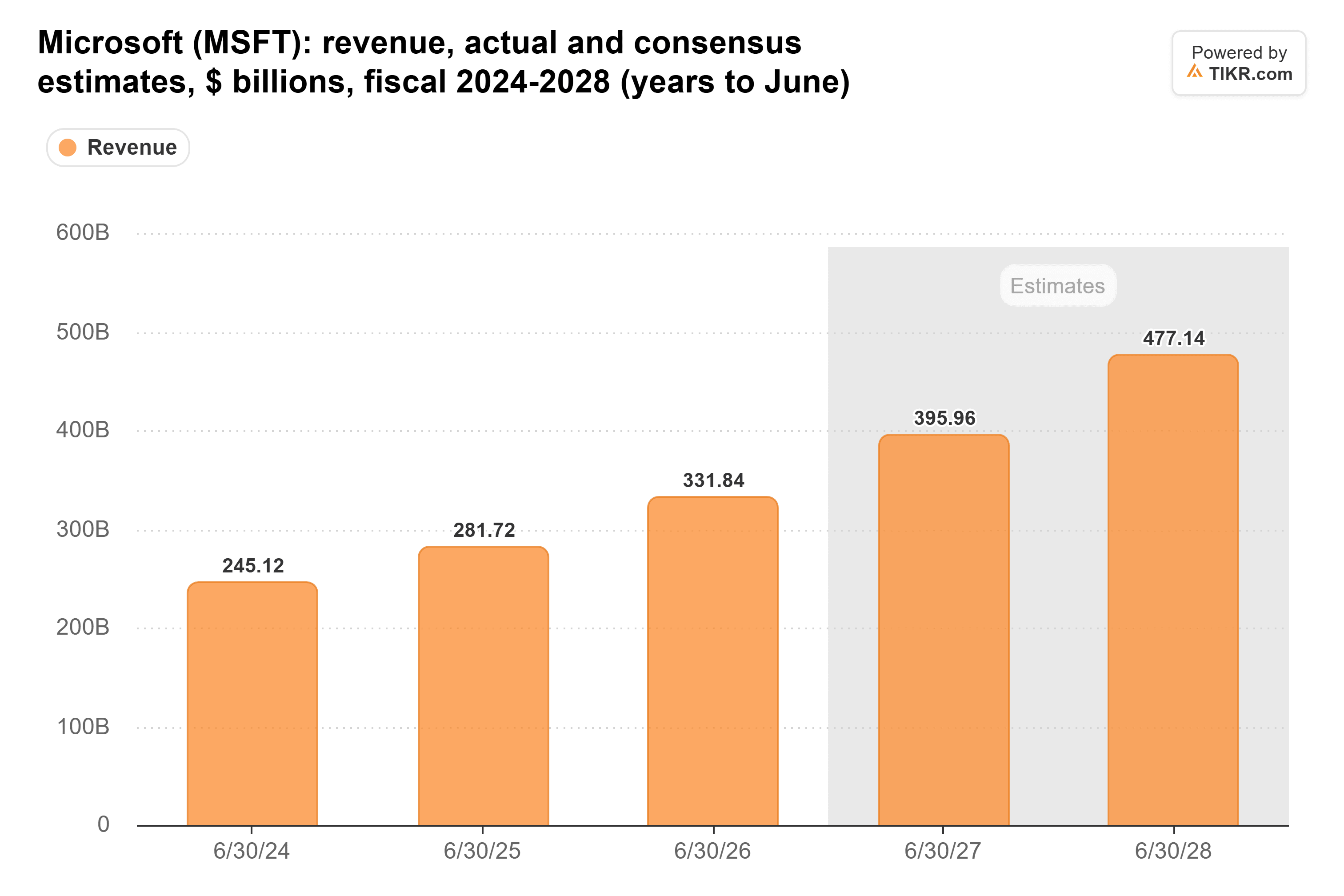
That’s $396 billion in fiscal 2027, which ends next June, and $477 billion the year after, or growth of about 19% and 20%. Intelligent Cloud, the segment that holds Azure, supplied $31.5 billion of fiscal 2026’s $50.1 billion revenue gain. And analysts’ fiscal 2027 earnings estimate has risen to $20.01 a share, from $19.76 in late October.
The open question for Microsoft is Microsoft 365 Copilot, which sells AI seats to the same kind of non-engineers Goldman just pulled the tools from. It passed 30 million paid seats by June 2026, against more than 450 million paid Microsoft 365 commercial seats at the end of 2025.
The margin has held up so far
Microsoft’s operating margin has kept rising through its AI build-out:
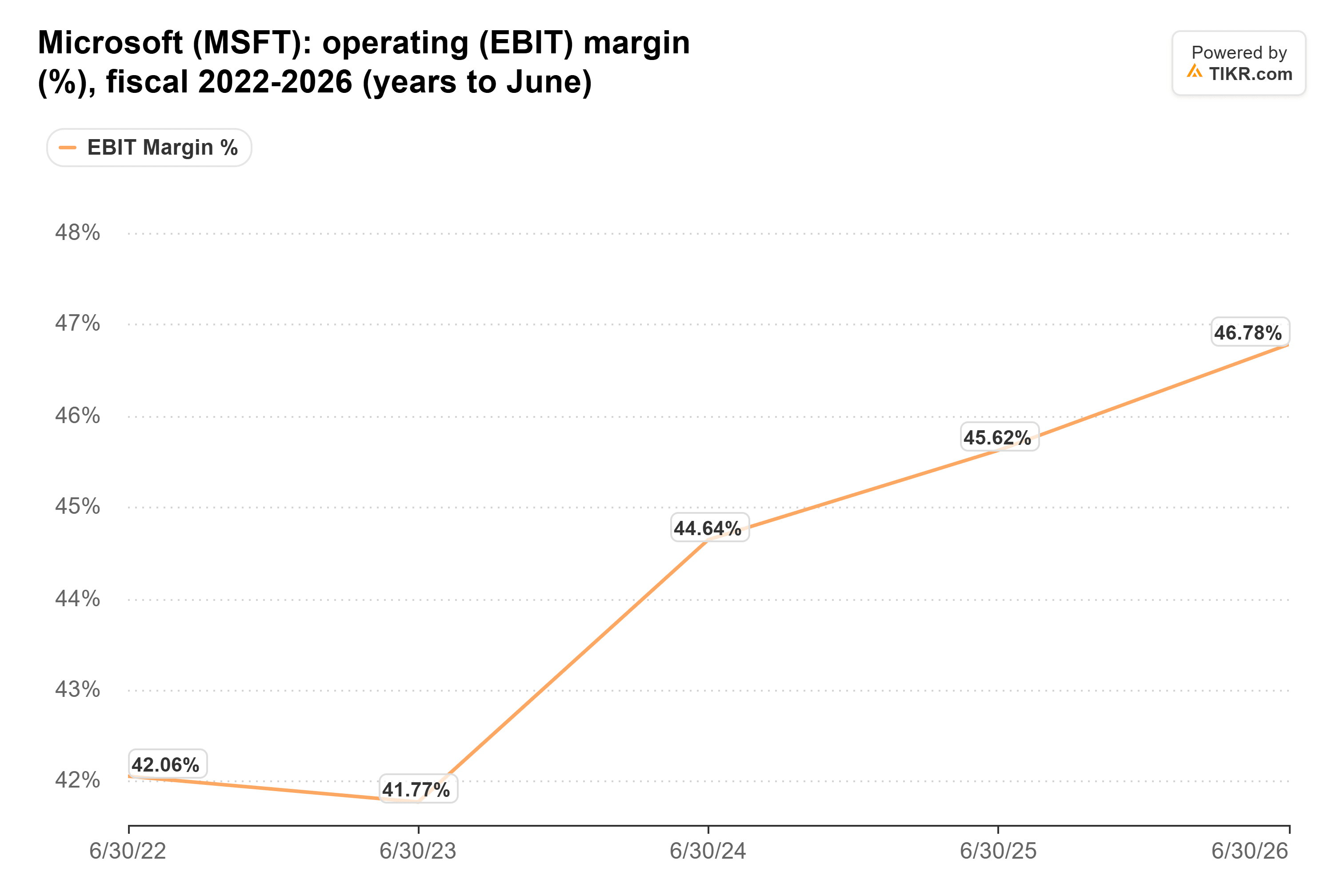
The cost of that build is still catching up. Depreciation and amortization rose from $29.4 billion in fiscal 2025 to $38.5 billion in fiscal 2026, and analysts expect $54.8 billion this fiscal year. Management guides fiscal 2027’s operating margin down by less than 1 point. If per-seat AI revenue slows while depreciation climbs that fast, Microsoft would have a harder time staying within that guide.
The way I see it, Goldman’s rollback is a bigger warning for Anthropic’s IPO than for Microsoft. Microsoft’s growth leans on Azure, and Anthropic’s $30 billion compute commitment pays Microsoft whether or not traders keep their seats.
Of course, one bank and one month of Ramp data don’t make a trend yet. Ramp’s November numbers and Microsoft’s next report in late January will show us whether engineering spend has really hit its ceiling.
So what is Microsoft stock actually worth?
TIKR lets you forecast the future price of any stock in less than a minute. Just enter a few assumptions into TIKR’s valuation model and see what Microsoft could be worth. Start from Wall Street consensus estimates, or adjust the inputs to reflect your own view of the business. It’s free to use.
Disclaimer:
Please note that the articles on TIKR are not intended to serve as investment or financial advice from TIKR or our content team, nor are they recommendations to buy or sell any stocks. We create our content based on TIKR Terminal’s investment data and analysts’ estimates. Our analysis might not include recent company news or important updates. TIKR has no position in any of the stocks mentioned. Thank you for reading, and happy investing!