Key Takeaways
- Brent crude settled 3% higher at almost $96 a barrel on Thursday after President Trump wrote that the U.S. doesn’t need a deal with Iran. Brent had fallen 24% in 10 days before the post.
- With the Gulf states also backing the naval blockade, Iranian oil stays off the market, which supports the crude prices behind ExxonMobil’s and Chevron’s big year.
- Analysts expect ExxonMobil’s normalized EPS to nearly double to $13.66 in 2026 from $6.99 in 2025, and Chevron earned $9.9 billion in the third quarter, up from $3.5 billion a year earlier.
- OPEC is pumping more oil, which limits how high prices can go. ExxonMobil already trades below its five-year average multiple, so the stock doesn’t need prices to keep climbing to work.
Brent crude settled 3% higher at almost $96 a barrel on Thursday after President Trump wrote that the U.S. no longer needs a deal with Iran. That’s good news for ExxonMobil (XOM) and Chevron (CVX), because both companies have had a big year on the back of expensive crude.
What exactly happened
Trump spent most of a Thursday morning post on Truth Social attacking Democrat-run states. Then he turned to Iran:
“We don’t need a deal with Iran. Those days have long since passed. We’ve got their money, Hundreds of Billions of Dollars, and we’ve got their Strait!”
That’s a sharp change from earlier in the week. Trump’s softer tone on Iran had pushed Brent down 24% in 10 days through Tuesday, to $90 a barrel. On Monday he said the war is “effectively over,” and oil settled at its lowest level since August that day.
The same day, after a call with Qatar’s prime minister, Trump wrote that “Qatar, Saudi Arabia, UAE, Bahrain, Kuwait, and others, would prefer the status quo, in other words, a continuation of the Greatest Naval Blockade in History, and the new Operation Iron Gate.”
So Washington and its Gulf allies both seem content to leave things as they are.
TIKR tracks 26 analysts on Chevron. How many say “Buy”?
See the full breakdown of Buy, Hold, and Sell ratings on Chevron, along with Wall Street’s revenue and earnings estimates, all in one place. More than 500,000 investors use TIKR to research stocks like this one. See Chevron’s Analyst Ratings
The blockade keeps Iran’s oil off the market
With no deal, the naval blockade of Iran’s ports stays in place. So does Iron Gate, which aims to cut off Iran’s trade by land and across the Caspian Sea. The market won’t be getting those barrels back any time soon, and that matters a lot to two companies whose year depends on the oil price.
ExxonMobil’s annual report estimates that every $1 a barrel on Brent is worth about $700 million a year in earnings. If Thursday’s gain of about $3 a barrel held, it would be worth roughly $2 billion a year to the company.
Analysts expect ExxonMobil’s normalized EPS to nearly double this year, from $6.99 in 2025 to $13.66, then ease to $10.40 by 2028:
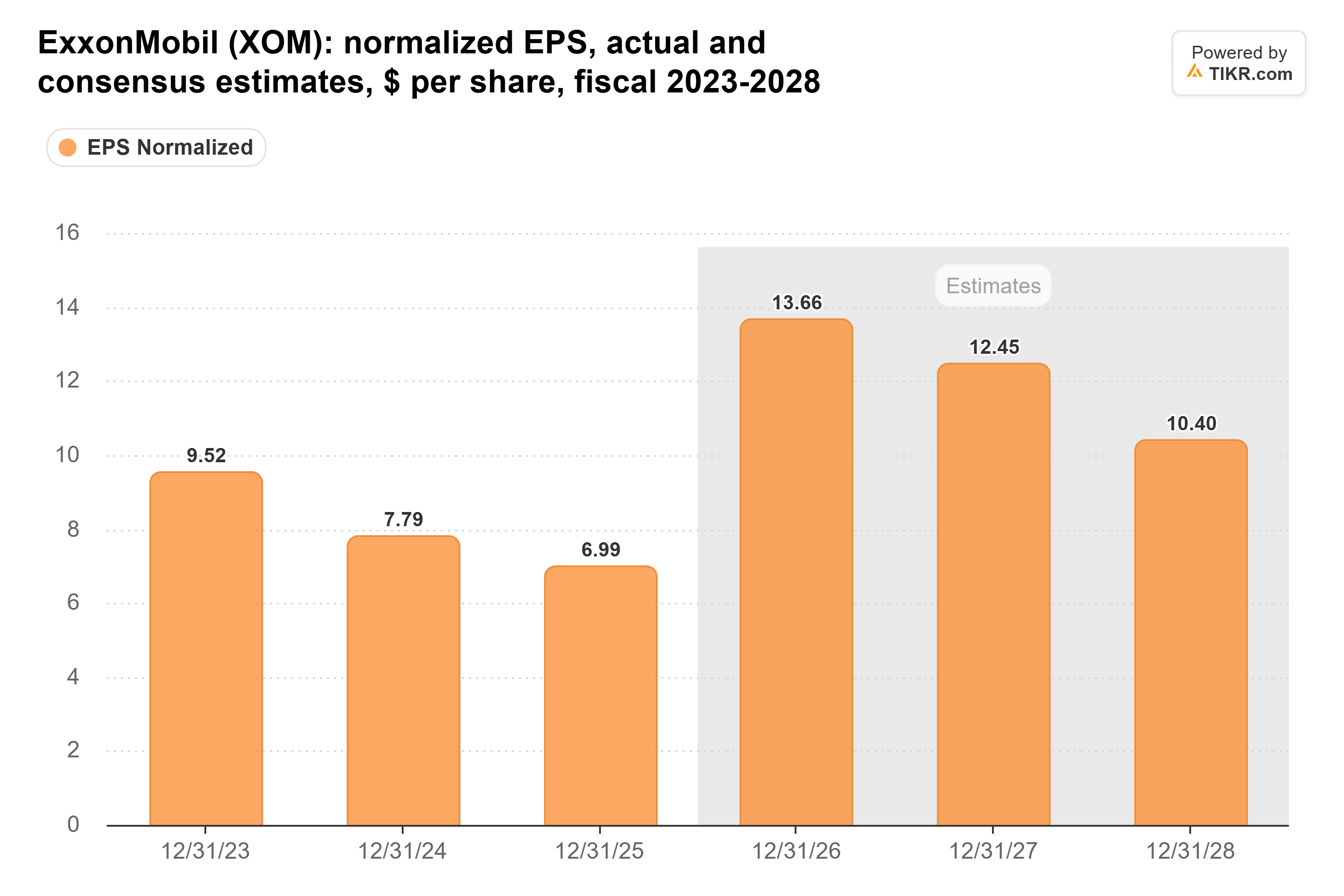
That decline is analysts taking the war premium back out, and TIKR’s consensus has ExxonMobil’s EPS falling every year through 2029. For as long as the blockade lasts, ExxonMobil earns closer to its 2026 level than its 2028 level.
Chevron’s cash flow shows what tight supply does for these companies. Its free cash flow jumped from $21.1 billion in 2021 to $37.6 billion in 2022, the last time supply got squeezed, and then fell back to $16.6 billion in 2025:
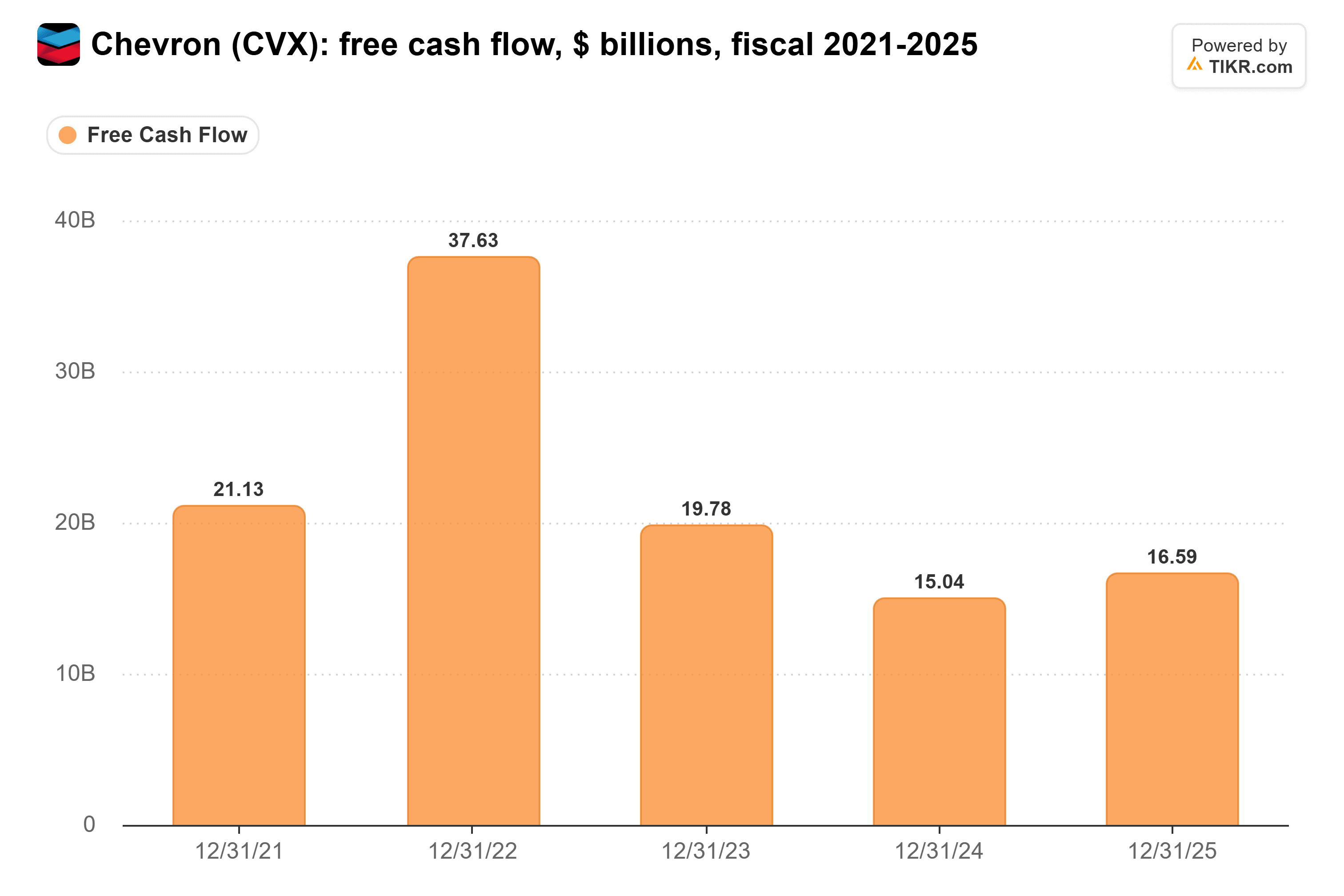
This year, Chevron’s earnings came to $24.2 billion in the first nine months, up from $9.5 billion in the same stretch of 2025.
The Gulf is pumping more of its own oil
There’s a catch, though. The Gulf states backing the blockade are pumping more oil themselves. OPEC’s output recently rose by 1.38 million barrels a day to 22.87 million, and crude was falling on Thursday on signs of higher Saudi exports until Trump posted.
My read: Qatar, Saudi Arabia and the UAE are happy to keep Iran’s oil off the market while they sell more of their own. With the blockade in place, I’d expect oil to hold up better than it would after a deal. I wouldn’t count on a return to the roughly $117 Brent hit at the end of October, though.
Both companies also have refining businesses to lean on if crude slides. Chevron’s U.S. refining and marketing business earned $3.58 billion in the third quarter, up from $638 million a year earlier.
Investors are already pricing in a decline
ExxonMobil trades at 12x forward earnings. That’s a bit below its five-year average of 13x and nowhere near the 23x high it hit in March:
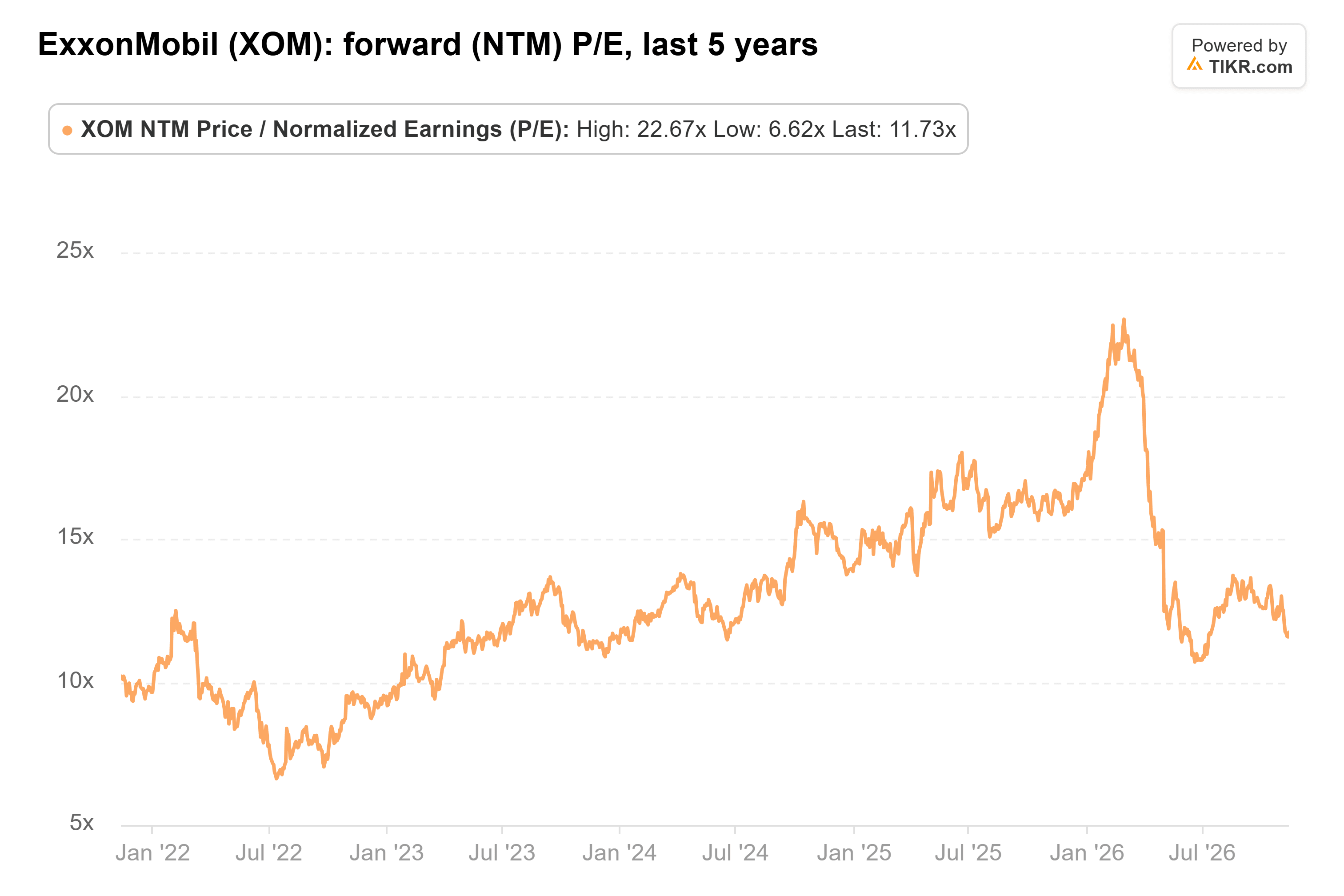
(Its low was 6.6x in July 2022, the last time investors priced in a windfall they expected to fade.)
Bottom line: Trump’s post is good news for both stocks. Investors already value ExxonMobil as if this year’s earnings won’t last. That means every quarter the blockade holds brings in windfall cash the stock price isn’t counting on.
Of course, Trump also wrote on Monday that “We are seeing positive momentum toward an end to this Conflict,” and his next post could say something different. ExxonMobil’s corporate plan update, expected in December, will show whether its 2030 targets still hold once the war premium is gone.
So what is ExxonMobil stock actually worth?
TIKR lets you forecast the future price of any stock in less than a minute. Just enter a few assumptions into TIKR’s valuation model and see what ExxonMobil could be worth. Start from Wall Street consensus estimates, or adjust the inputs to reflect your own view of the business. It’s free to use.
Disclaimer:
Please note that the articles on TIKR are not intended to serve as investment or financial advice from TIKR or our content team, nor are they recommendations to buy or sell any stocks. We create our content based on TIKR Terminal’s investment data and analysts’ estimates. Our analysis might not include recent company news or important updates. TIKR has no position in any of the stocks mentioned. Thank you for reading, and happy investing!