Key Takeaways
- Of the 460 big funds that have filed 13Fs for the quarter ended Sept. 30, 19 sold Texas Instruments and 14 bought it. George Soros’ fund was one of the sellers.
- On TIKR’s numbers, the buyers look right: analysts expect Texas Instruments’ earnings to more than double from fiscal 2025 to fiscal 2027, and the stock trades below its five-year average multiple.
- Rivals Analog Devices and Microchip Technology just reported revenue up 40% or more from a year earlier, a sign the recovery in analog chips is broad.
- The risk is that the estimates already assume a lot, and Texas Instruments’ fourth-quarter report in January is the next test.
George Soros sold out of Texas Instruments (TXN) last quarter, and 18 other big funds sold too. But 14 bought, and the stock now sits 21% below its 52-week high.
Those counts cover the 460 big funds that have filed 13Fs for the quarter ended Sept. 30 (funds readers know, or those with $1 billion or more of US stocks, quant and index funds aside). A sale is an exit or a cut of 20% or more, and a buy is a new position or 20% or more added. Another 65 held the stock at the quarter’s end.
Two rivals have already given us a read. Analog Devices (ADI) and Microchip Technology (MCHP) sell into the same industrial and automotive markets, and both just reported revenue up 40% or more from a year earlier.
TIKR tracks 35 analysts on Texas Instruments. How many say “Buy”?
See the full breakdown of Buy, Hold, and Sell ratings on Texas Instruments, along with Wall Street’s revenue and earnings estimates, all in one place. More than 500,000 investors use TIKR to research stocks like this one. See Texas Instruments’ Analyst Ratings
Soros barely owned it
Soros Fund Management sold all 6,640 of its shares, about $2 million, according to its 13F for the quarter ended Sept. 30, filed Nov. 13. That’s a tiny stake for a fund whose 13F holds $6.5 billion of US stocks.
The biggest sale came from Chris Davis’ Davis Advisors, a $30 billion firm. Its 13F, filed Nov. 10, shows it cut its stake 21% to 1.92 million shares, about $146 million sold. It still held $536 million of the stock at Sept. 30, 2.3% of its 13F stocks. FengHe Fund Management cut 78%, Dan Sundheim’s D1 Capital cut 74%, and Nearwater Capital Markets sold all 295,000 of its shares, about $88 million.
Ten of the 19 sellers bought or added to Microsoft in the same quarter, though there’s no telling from a 13F whether one paid for the other.
PointState leads the buyers
The three biggest buyers all opened new positions. PointState Capital, which manages $12 billion, bought 483,280 shares, about $135 million and 3.1% of its 13F stocks, according to its 13F filed Nov. 16. Larry Robbins’ Glenview Capital, a $6.4 billion firm, bought 142,465 shares, about $40 million, and Sora Investors took a $28 million stake, 2.2% of its 13F stocks. GQG Partners, which manages $164 billion, opened a $20 million position too.
Texas Instruments is down 6% since Sept. 30, the price those stakes are valued at. That’s only the stock’s move: a 13F doesn’t show what anyone paid, or whether they still own the shares.
Earnings are on the way back
In its third quarter, Texas Instruments’ revenue rose 28% from a year earlier to $6.06 billion, and CEO Haviv Ilan pointed to “continued broad growth in industrial, automotive and data center.” GAAP EPS came in at $2.62. The company guided fourth-quarter revenue to $5.80 billion to $6.30 billion, a range centered about where the third quarter landed.
Analysts expect the recovery to run for years. Normalized EPS slid from $7.03 in fiscal 2023 to $5.59 in fiscal 2025, and consensus has it at $9.09 this year, $11.63 in 2027 and $14.33 in 2028:
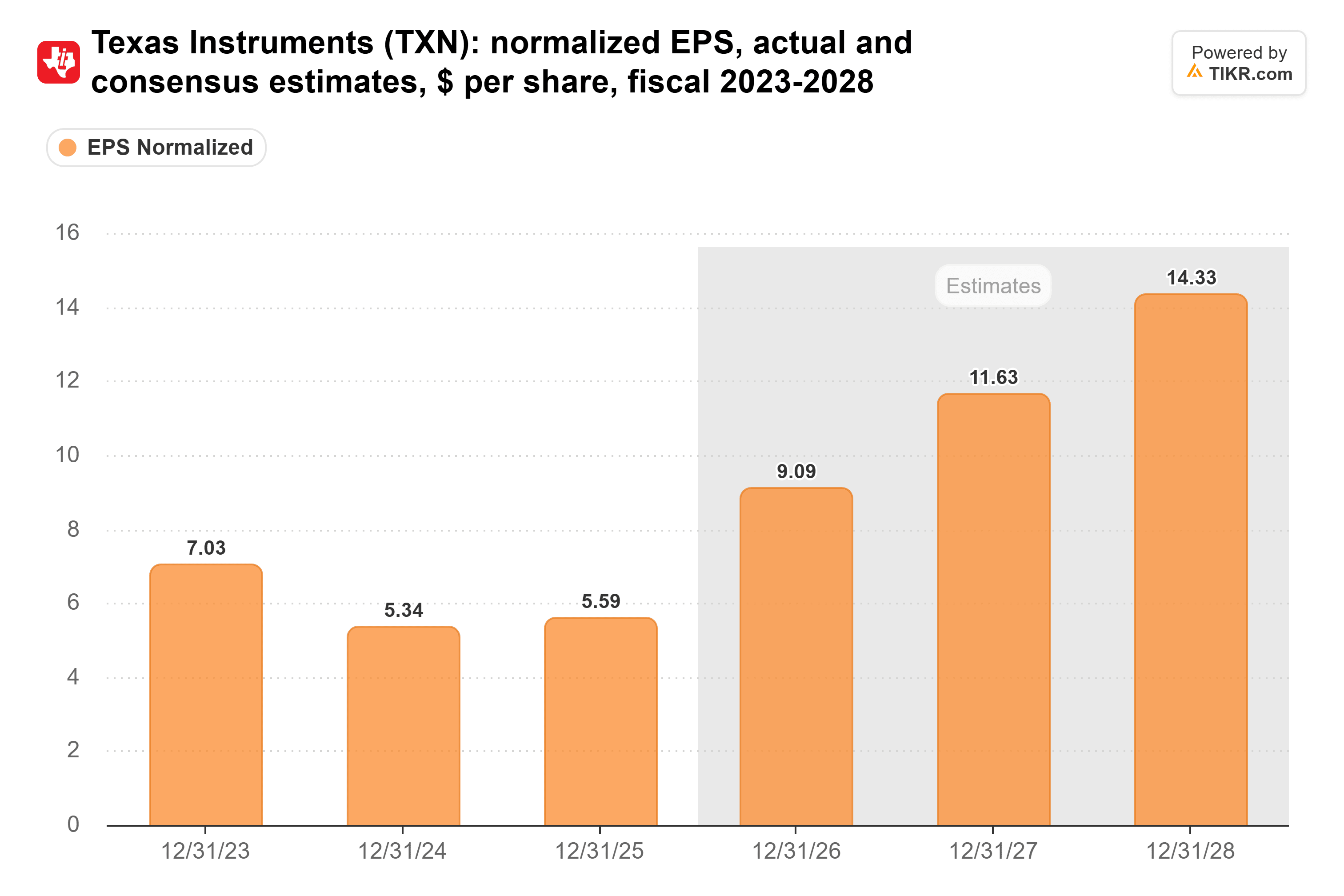
Those estimates were set after the October report, so they already take in the fourth-quarter guide.
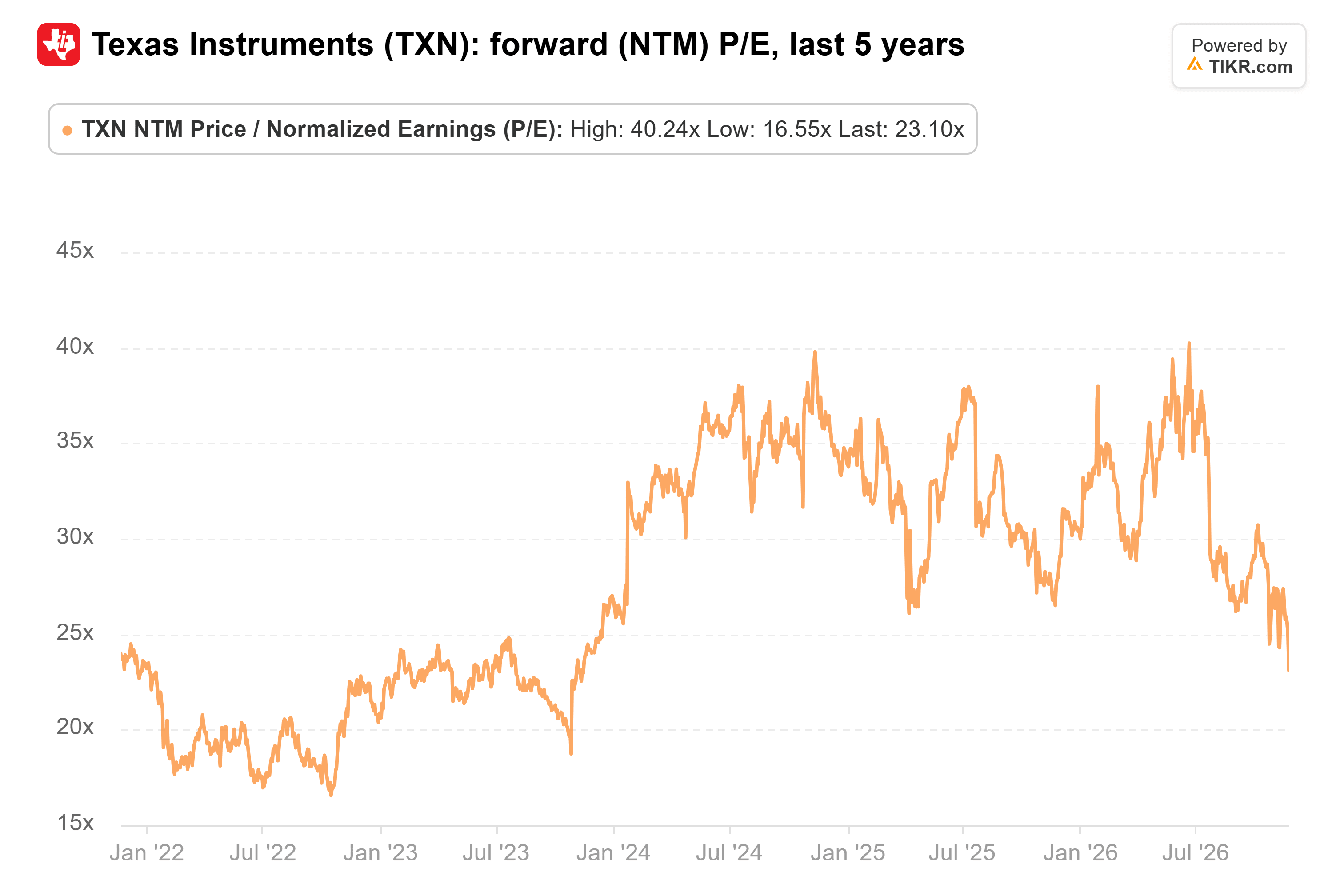
The stock is also cheaper than usual on those estimates. It trades at 23x forward earnings, against a five-year average of 28x and a high of 40x in June:
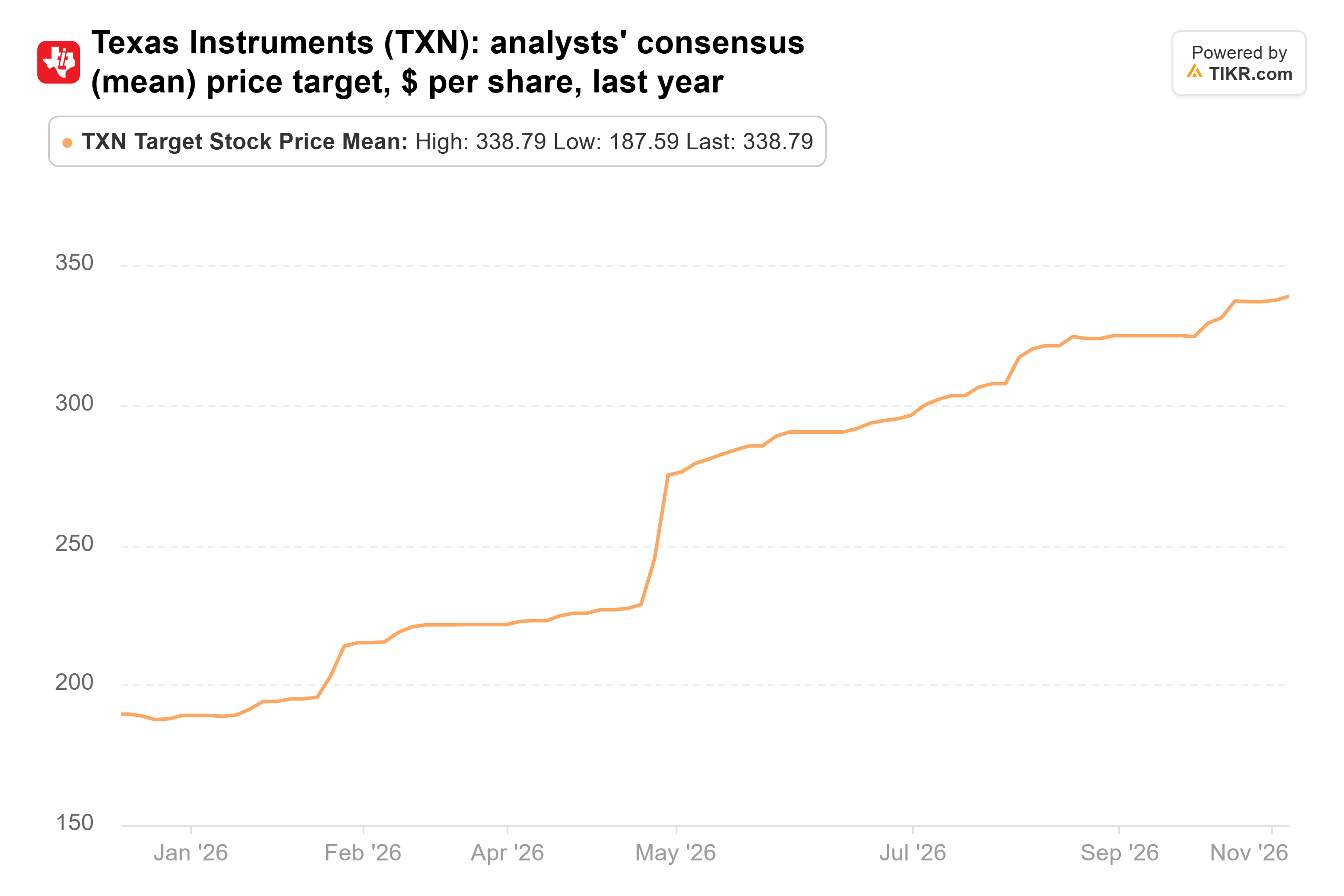
Analysts’ average price target has climbed to $338.79 from $189.56 a year ago, 28% above the last close:
The rivals are seeing it too
In its fiscal third quarter, which ended Aug. 1, Analog Devices brought in revenue of $4.02 billion, up 40% from a year earlier, and guided to a record $4.3 billion for the fourth quarter. CFO Richard Puccio said demand “continued to strengthen across our product portfolio and regions.” Its fiscal fourth-quarter report, due later this month, will show whether the customers it shares with Texas Instruments kept buying.
Microchip grew even faster in its September quarter: net sales rose 42.2% from a year earlier to $1.622 billion, and CEO Steve Sanghi said book-to-bill stayed well above one. He put the December-quarter guide at 5% to 7% better than normal seasonality. If the sellers were bracing for soft industrial demand, Microchip isn’t seeing it.
The buyers have the better case
I side with the buyers. Texas Instruments is growing again, its rivals are growing faster, and the stock trades below its usual multiple as estimates rise.
The risk is that analysts already expect a lot: EPS more than doubling from fiscal 2025 to fiscal 2027, after a fourth-quarter guide that centers on flat revenue. If the cycle cools, 23x won’t look cheap for long.
The next test is Texas Instruments’ fourth-quarter report in January. Revenue in the top half of that $5.80 billion to $6.30 billion range would back the buyers, and a miss would make the sellers look smart. The next round of 13Fs, due by mid-February, will show who stayed.
So what is Texas Instruments stock actually worth?
TIKR lets you forecast the future price of any stock in less than a minute. Just enter a few assumptions into TIKR’s valuation model and see what Texas Instruments could be worth. Start from Wall Street consensus estimates, or adjust the inputs to reflect your own view of the business. It’s free to use.
Value Texas Instruments for free
Disclaimer:
Please note that the articles on TIKR are not intended to serve as investment or financial advice from TIKR or our content team, nor are they recommendations to buy or sell any stocks. We create our content based on TIKR Terminal’s investment data and analysts’ estimates. Our analysis might not include recent company news or important updates. TIKR has no position in any of the stocks mentioned. Thank you for reading, and happy investing!