Key Takeaways
- The Fed’s Nov. 13 Financial Stability Report links high stock valuations partly to AI enthusiasm, and 87% of the market contacts it surveyed named AI as a salient risk.
- Microsoft has more to lose than Nvidia if AI earnings disappoint, since its 24x forward multiple still prices in two more years of strong growth.
- Nvidia trades at 11x forward earnings after a selloff and a CEO shake-up, while Amazon is priced much like Microsoft.
- Oracle’s borrowing leaves it most exposed to credit strain, and Microsoft’s free cash flow is the number to watch.
The Federal Reserve’s latest warning on stock prices points squarely at AI, and Microsoft (MSFT) shareholders have more to worry about than Nvidia (NVDA) shareholders.
In its Financial Stability Report on Nov. 13, the Fed said measures of equity valuations “have remained high, partly driven by market enthusiasm for super intelligence (SI).” Of the 23 market contacts New York Fed staff surveyed for the report, 87% named AI as a salient risk, up from 50% in the spring. They flagged the chance that lower-than-expected earnings could bring lower valuations and a market correction.
But the warning doesn’t land evenly. Nvidia has already been marked down hard, while Microsoft and Amazon (AMZN) are still priced for strong growth. Oracle (ORCL) is borrowing heavily to build AI data centers, and the cost of insuring its debt against default has hit records this fall.
Microsoft is still priced for AI to pay off
Consensus has Microsoft’s normalized EPS rising from $17.28 in fiscal 2026 (the year ended June 2026) to $20.03 this fiscal year and $24.23 the year after:

That’s about 16% growth this year and 21% the year after, and much of it depends on AI. Microsoft spent $115.9 billion of cash on capex in fiscal 2026, up from $64.6 billion.
The market has trimmed Microsoft’s multiple, but not to the lows. At 24x forward earnings, it trades below its five-year average of 29x but well above the 19x it hit in late June:
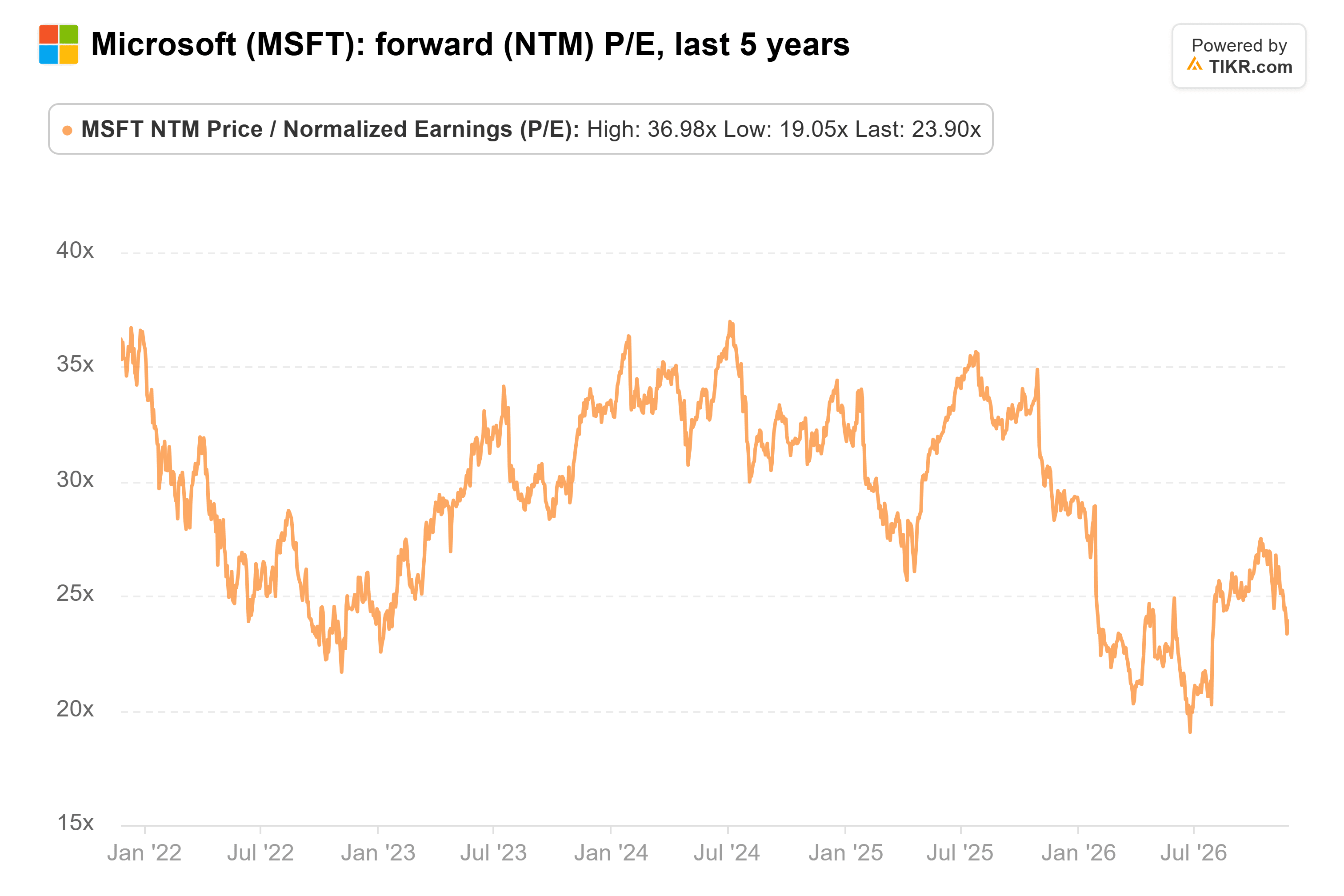
If AI earnings disappoint, Microsoft can lose twice: from lower estimates and from a lower multiple.
TIKR tracks 58 analysts on Microsoft. How many say “Buy”?
See the full breakdown of Buy, Hold, and Sell ratings on Microsoft, along with Wall Street’s revenue and earnings estimates, all in one place. More than 500,000 investors use TIKR to research stocks like this one. See Microsoft’s Analyst Ratings
Nvidia has already taken its lumps
Nvidia trades at 11x forward earnings, less than a third of its five-year average of 35x and not far above the 8.7x low it hit on Nov. 20:
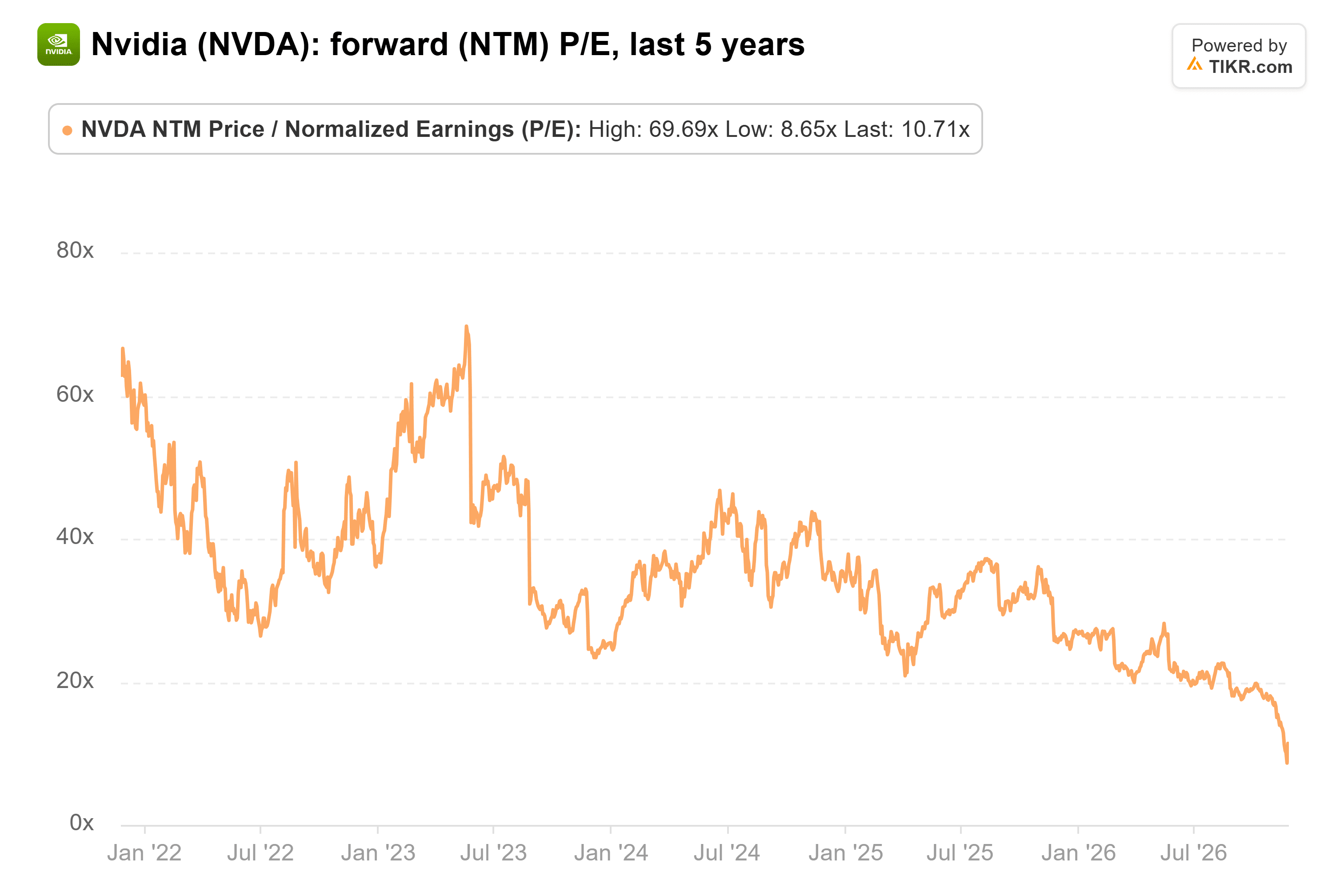
That low came after Nvidia reported on Nov. 17 that revenue more than doubled to $115.8 billion in the quarter ended Oct. 25, so the markdown isn’t about weak results.
Not all of it is about AI either. Jensen Huang resigned as CEO on Nov. 12 amid an investigation into his personal conduct, and the board reinstated him on Nov. 23. The stock had already fallen more than 20% in the month before he stepped down, and it hit that 8.7x low while the CEO seat sat empty.
Either way, Nvidia’s multiple has already compressed. Its customers would buy fewer chips if AI spending slowed, but investors are braced for that.
Watch the borrowers first
The Fed also said valuations were “moderated by concerns over firms’ capital expenditures and debt issuance plans.”
Oracle has the most exposure to those concerns. Its total debt, leases included, reached $169.1 billion at Aug. 31. Its free cash flow was negative $5 billion in its fiscal first quarter. At 13x forward earnings, it trades near the bottom of its five-year range.
Microsoft pays its own way. Operating cash flow of $182.9 billion in fiscal 2026 covered its capex with $67.0 billion to spare. That cushion leaves out leases: at June 30, Microsoft had signed another $329.1 billion of leases, mostly for data centers, that hadn’t started yet.
Amazon is valued about the same as Microsoft but has a thinner cash cushion: free cash flow was a $42.4 billion outflow over the twelve months to Sept. 30.
Microsoft has further to fall
If AI earnings come in light, Microsoft has more of its price left to give back than Nvidia or Oracle, which have already been marked down hard.
Microsoft’s December-quarter report, due in late January, is the next test. Consensus has $32.0 billion of free cash flow for the fiscal year. After the September quarter’s $18.6 billion, that leaves about $13.4 billion for the last three quarters. Falling short of even that lower bar would mean the spending is eating cash faster than Wall Street expects.
So what is Microsoft stock actually worth?
TIKR lets you forecast the future price of any stock in less than a minute. Just enter a few assumptions into TIKR’s valuation model and see what Microsoft could be worth. Start from Wall Street consensus estimates, or adjust the inputs to reflect your own view of the business. It’s free to use.
Disclaimer:
Please note that the articles on TIKR are not intended to serve as investment or financial advice from TIKR or our content team, nor are they recommendations to buy or sell any stocks. We create our content based on TIKR Terminal’s investment data and analysts’ estimates. Our analysis might not include recent company news or important updates. TIKR has no position in any of the stocks mentioned. Thank you for reading, and happy investing!