
Key Takeaways
- Cisco’s Jeetu Patel says attackers can exploit a newly announced software flaw within 10 to 15 minutes, while patching takes about 45 days.
- Patching faster brings its own risk, as recent outages at JPMorgan Chase and Microsoft show.
- CrowdStrike, which agreed to buy Zscaler, just added a record $419 million of net new ARR, while Palo Alto Networks competes for the same budgets.
- Analysts have barely raised CrowdStrike’s revenue estimates, and its January-quarter report, expected in early March, is the next test.
Cisco President and Chief Product Officer Jeetu Patel put a number on every security team’s problem on MTS this week:
“The exploit window is now, let’s say 10 to 15 minutes from the time that a vulnerability is announced. The patching cycle is about 45 days.”
Which, yikes.
And patching faster is breaking things at banks like JPMorgan Chase (JPM), while Microsoft (MSFT) just declared a code red over a flaw of its own. So the money is moving toward protection that doesn’t wait on a patch. Cue CrowdStrike (CRWD), which agreed to buy Zscaler (ZS), while Palo Alto Networks (PANW) goes after the same budgets.
Patching faster breaks things too
Patel says companies are “caught between two risks.” They can “leave the flaw exposed because they don’t have enough time to test the patch out,” or “they rush a fix and that could disrupt the business.”
Banks are living with the second one. Bloomberg reported that a flawed software update disrupted some JPMorgan customers’ money transfers in mid-November. Reuters reported that Microsoft’s code red followed a nearly 24-hour outage of Outlook, Teams and Copilot on Nov. 12 and 13, which Microsoft traced to a defect in its own Windows code.
TIKR tracks 49 analysts on CrowdStrike. How many say “Buy”?
See the full breakdown of Buy, Hold, and Sell ratings on CrowdStrike, along with Wall Street’s revenue and earnings estimates, all in one place. More than 500,000 investors use TIKR to research stocks like this one. See CrowdStrike’s Analyst Ratings
CrowdStrike just had a record quarter
That’s the opening for CrowdStrike, which watches for attacks on laptops, servers and cloud workloads whether or not the patch has landed. Its net new ARR jumped 58% to a record $419 million in the quarter ended Oct. 31, and it raised its guidance for full-year net new ARR growth to 45% at the midpoint, from 34% in August.
Analysts expect revenue to nearly double, from $4.81 billion in the year ended January 2026 to $9.30 billion in the year ending January 2029:
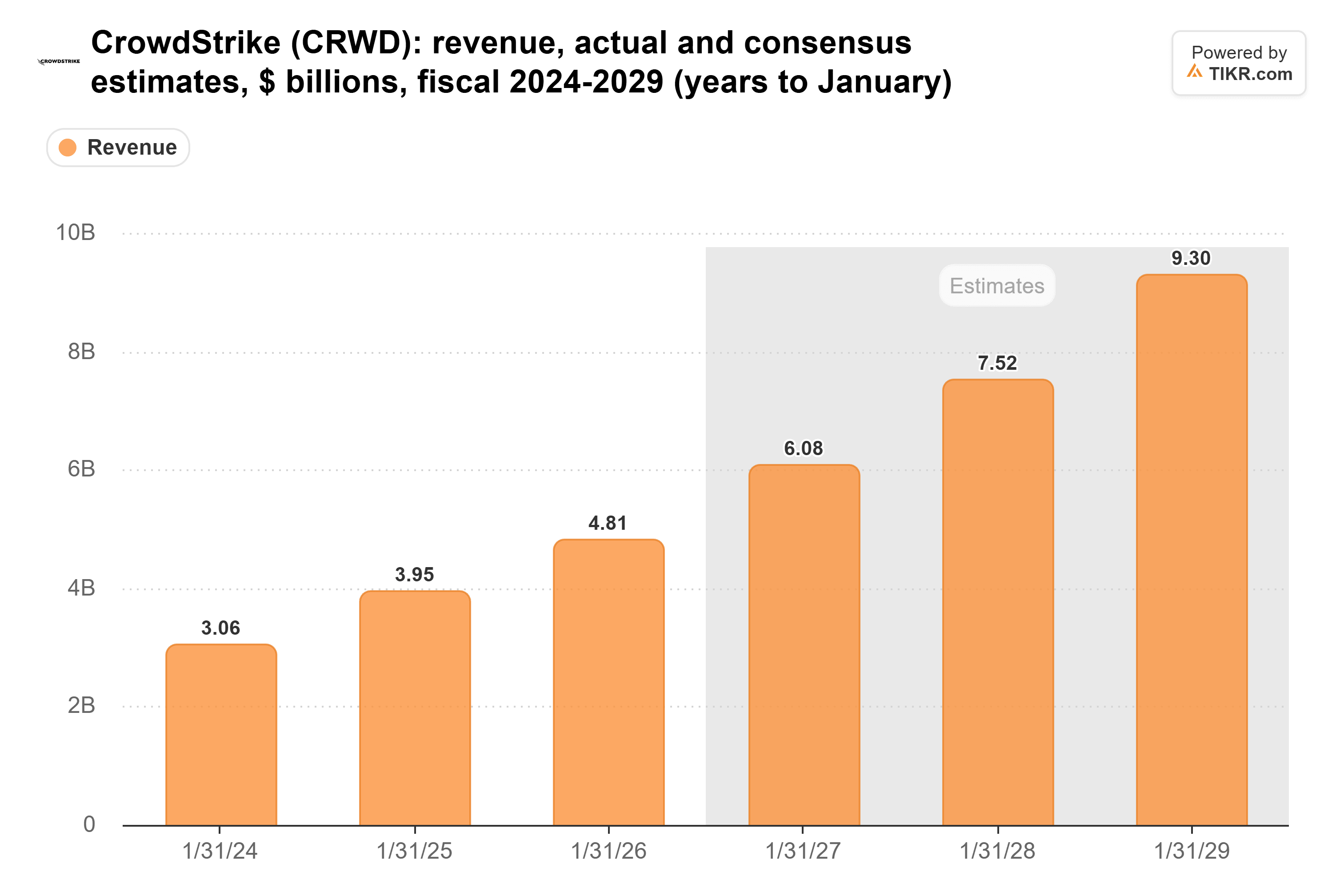
Those estimates barely moved after the record quarter: the revenue consensus for the year ending January 2028 is less than 2% above where it was in late October. If Patel’s 45-day gap is here to stay, I think they’re too low.
Zscaler takes the flaw off the internet
Zscaler gets around the patch queue by keeping applications invisible to the internet. As CEO Jay Chaudhry put it on CrowdStrike’s call, an “attacker, human or agent cannot breach what it cannot reach.” CrowdStrike agreed to buy Zscaler in a $43.9 billion deal.
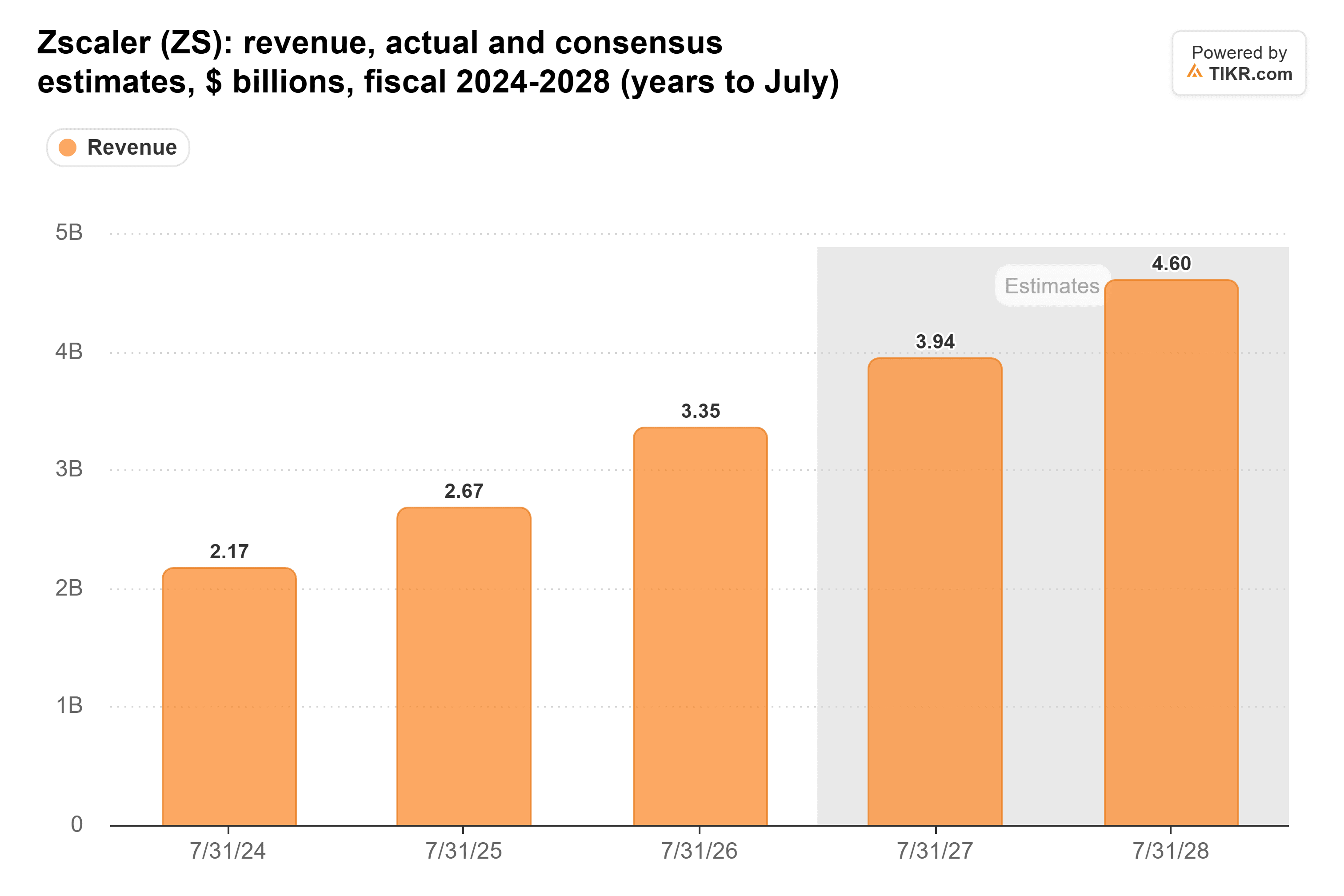
Analysts expect Zscaler’s yearly revenue to climb from $3.35 billion in the year ended July 2026 to $4.60 billion in the year ending July 2028:
Palo Alto and Microsoft want the same budgets
CrowdStrike won’t get all of this money. Palo Alto’s Next-Generation Security ARR grew 66% to $9.73 billion in its quarter ended Oct. 31. That figure includes CyberArk and Chronosphere, which Palo Alto bought in fiscal 2026.
Microsoft is the tougher rival over time, since it bundles security tools into software that companies already pay for. Still, net new ARR doesn’t jump 58% at a company that’s losing the big deals to bundled tools.
CrowdStrike is the cleanest way to play the gap
The way I see it, if Patel is right, companies can’t patch their way out of this, and CrowdStrike, with Zscaler on the way, is best placed to sell them what works in the meantime. Dilution is the cost: the Zscaler deal adds roughly 19% more CrowdStrike shares. Next comes CrowdStrike’s January-quarter report, expected in early March. Its raised guidance implies $452 million to $456 million of net new ARR for that quarter. After that, its first fiscal 2028 outlook needs to clear the net new ARR growth of at least 20% that it has already flagged without Zscaler.
So what is CrowdStrike stock actually worth?
TIKR lets you forecast the future price of any stock in less than a minute. Just enter a few assumptions into TIKR’s valuation model and see what CrowdStrike could be worth. Start from Wall Street consensus estimates, or adjust the inputs to reflect your own view of the business. It’s free to use.
Disclaimer:
Please note that the articles on TIKR are not intended to serve as investment or financial advice from TIKR or our content team, nor are they recommendations to buy or sell any stocks. We create our content based on TIKR Terminal’s investment data and analysts’ estimates. Our analysis might not include recent company news or important updates. TIKR has no position in any of the stocks mentioned. Thank you for reading, and happy investing!