

Key Takeaways
- Cloudflare CEO Matthew Prince said the company’s move to post-quantum cryptography may turn out to be “post-AI cryptography,” after an unverified rumor that AI labs’ math work could crack RSA encryption.
- Cloudflare has promised never to charge for that encryption, so it pays off through the paid products customers buy once their traffic runs on its network.
- Palo Alto Networks and Zscaler also sell protection against AI-driven threats, so the risk Prince describes strengthens the whole group’s pitch.
- Cloudflare trades at about 162x forward earnings and had operating losses every year from 2021 to 2025, so the stock still depends on its paid products growing on schedule.
Cloudflare (NET) CEO Matthew Prince thinks the encryption his company built to stop quantum computers may end up stopping AI first. If he’s right, Cloudflare won’t have the AI-security story to itself: Palo Alto Networks (PANW) launched a quantum-safe product this year, and Zscaler (ZS) is pitching its platform as the answer to AI-driven attacks.
On Nov. 25, Andrew Curran posted on X that a rumor about Anthropic’s and OpenAI’s math results had “persisted for about ten days.” His conclusion: “This would crack RSA,” the public-key method behind much of today’s encryption.
Prince’s response? “Feeling pretty good about @Cloudflare’s investments to move to post-quantum cryptography across all our services. Though maybe will turn out to be more appropriately called post-AI cryptography.”
Talk about good timing.
TIKR tracks 35 analysts on Cloudflare. How many say “Buy”?
See the full breakdown of Buy, Hold, and Sell ratings on Cloudflare, along with Wall Street’s revenue and earnings estimates, all in one place. More than 500,000 investors use TIKR to research stocks like this one. See Cloudflare’s Analyst Ratings
AI may get there first
The rumor is unverified, but the idea behind Prince’s quip has serious backing. Dmitri Alperovitch, co-founder and chairman of the Silverado Policy Accelerator, wrote on Nov. 20 that quantum computing is “perhaps one of the most overhyped technologies of our time,” and that one of the few things it’s sure to deliver is breaking public-key cryptography that isn’t quantum-resistant.
Then he went further: “it’s quite possible, perhaps even likely, that AI will break it long before we have a quantum computer with enough qubits to do it.”
If he’s right, the internet has a lot less time to upgrade its encryption than the quantum timeline suggests. Cloudflare has already done that work across every service it runs.
Cloudflare gives this one away
Don’t expect a “post-AI” line on Cloudflare’s income statement, though. When it made post-quantum cryptography free and on by default for all customers in March 2023, Prince promised “to never charge for it.”
My read: the payoff runs through the rest of the business. A company worried about AI cracking its encryption gets the fix free on Cloudflare’s network, and once it’s there, Cloudflare can sell it paid security, Zero Trust and developer products.
Cloudflare’s revenue grew 39% in the third quarter, and management raised its 2026 outlook for a third time, to $2.96 billion. Analysts expect revenue to more than double, from $2.17 billion in 2025 to $5.10 billion in 2028:
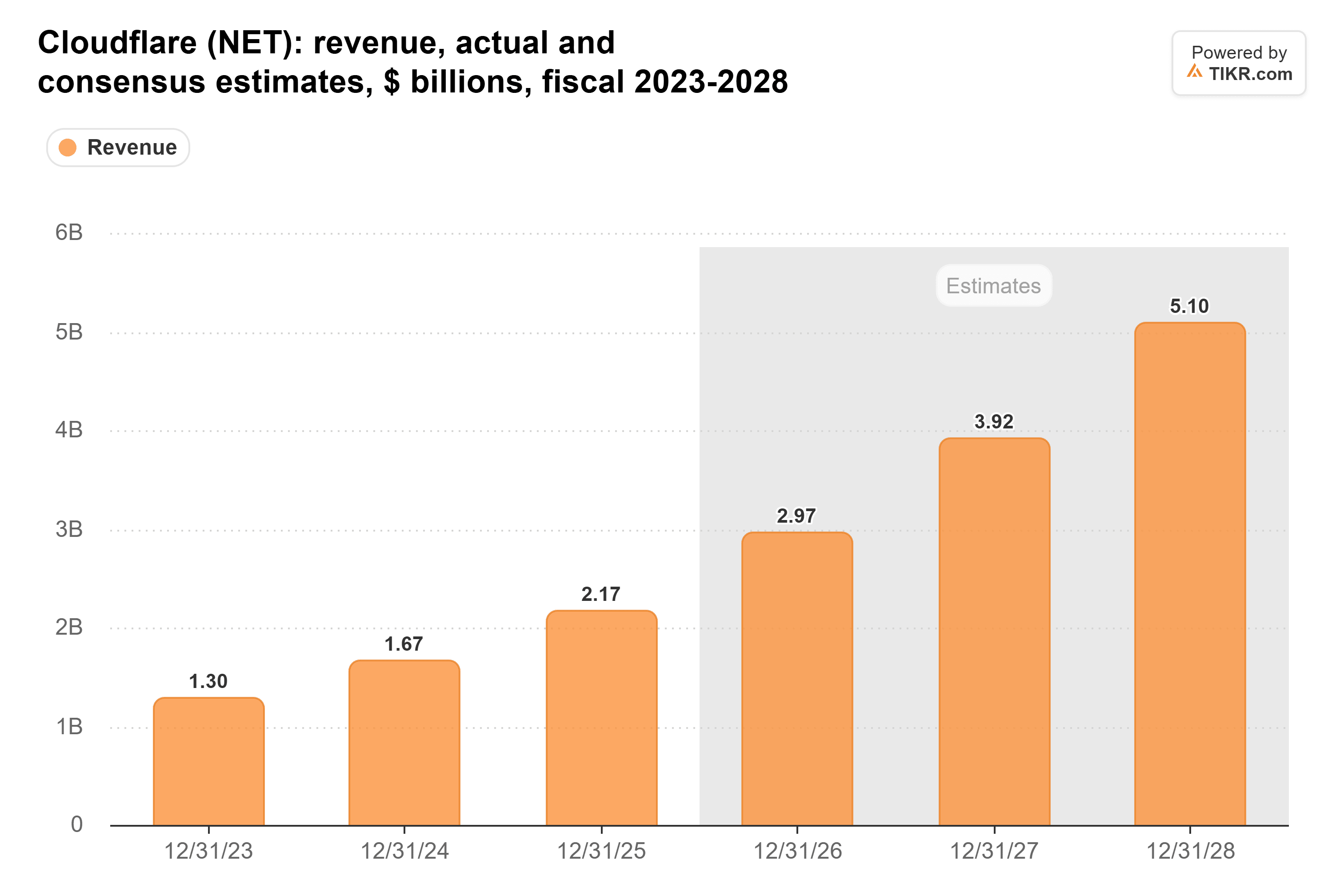
Those estimates came before Prince’s post, and with the encryption free, the post shouldn’t move them much.
The rest of the group sells the same fear
Palo Alto’s Quantum-Safe Security product, generally available since Jan. 30, 2026, finds outdated encryption on a company’s network and upgrades it. CEO Nikesh Arora said customers “turn to us to protect them against an unprecedented threat environment.”
Zscaler competes with Cloudflare for Zero Trust contracts, and CEO Jay Chaudhry said AI is “enabling malicious actors to execute automated exploits at unprecedented speed and scale.” On Nov. 23, Zscaler agreed to be bought by CrowdStrike for about $43.9 billion in stock, which would put a much bigger rival up against Cloudflare in Zero Trust deals.
Cloudflare’s edge is that its version is already running everywhere, at no charge.
Profits still have to show up
Cloudflare’s operating margin was negative every year from 2021 to 2025, and it was -9.1% in 2025.

And the stock isn’t cheap. At about 162x forward earnings, it trades a bit below the 173x average of its quarter-end readings since mid-2023.
Frankly, “post-AI cryptography” is a great line, and it makes Cloudflare’s network an even easier place for a nervous company to park its traffic. But the stock still depends on the paid products sold on top of it.
The fourth-quarter report, expected in February, is the next test. Watch for 2026 revenue at or above the $2.96 billion outlook. Management also now expects a GAAP profit in that quarter, well ahead of the 2028 deadline it set in June. And of course, the RSA rumor is still just a rumor.
So what is Cloudflare stock actually worth?
TIKR lets you forecast the future price of any stock in less than a minute. Just enter a few assumptions into TIKR’s valuation model and see what Cloudflare could be worth. Start from Wall Street consensus estimates, or adjust the inputs to reflect your own view of the business. It’s free to use.
Disclaimer:
Please note that the articles on TIKR are not intended to serve as investment or financial advice from TIKR or our content team, nor are they recommendations to buy or sell any stocks. We create our content based on TIKR Terminal’s investment data and analysts’ estimates. Our analysis might not include recent company news or important updates. TIKR has no position in any of the stocks mentioned. Thank you for reading, and happy investing!


