Key Stats for Eli Lilly Stock
- Current Price: $1,373.70
- Target Price (Mid): ~$2,340
- Street Target: ~$1,337
- Potential Total Return: ~70%
- Annualized IRR: ~14% / year
What Happened?
Eli Lilly (LLY) closed at a record $1,373.70 on October 29, up 6.63%, after lifting its 2026 revenue forecast to $91 billion to $92 billion. The midpoint now sits $10 billion above the range Lilly set in February. On the earnings call, an analyst asked Lilly to explain why its guidance keeps landing low. The answer, plus about $2 billion of 2026 revenue that management says will not recur, sets a higher bar for 2027.
Two Unknowns Broke Lilly’s Way
TD Cowen analyst Steve Scala said investors need to know “when the surprise factor runs its course.” Chair and CEO David Ricks named the two variables Lilly could not forecast at the start of the year: how fast Medicare’s GLP-1 Bridge program would ramp, and whether middle-income households abroad would pay cash for weight-loss drugs. Both broke Lilly’s way, adding roughly $10 billion to the forecast. Ricks noted Lilly is in the middle of “the largest new category expansion in the history of the pharmaceutical industry.”
More than 500,000 people have filled a Lilly prescription through Bridge since its July 1 launch. Lilly does not have the program to itself, but seven in 10 new Bridge patients start on a Lilly drug, and about 80% of Bridge patients are new to incretins, per Ilya Yuffa, President of Lilly U.S.A. and Global Customer Capabilities. As Ricks put it, “we’re beating on the up, that’s better than missing on the down.”
The third quarter added to the cushion. Revenue rose 39% to $24.4 billion, about $1.8 billion above TIKR’s consensus, though roughly $900 million was one-time. Adjusted EPS of $7.48 beat the $6.35 estimate, while GAAP EPS of $7.22 fell short of $8.01. Both absorbed $4.57 a share of acquired research charges, which trimmed the full-year adjusted EPS range to $35 to $36. TIKR’s 2026 revenue consensus, still updating, sits at about $90.3 billion, below the new range.

TIKR tracks 31 analysts on Eli Lilly. How many say “Buy”?
See the full breakdown of Buy, Hold, and Sell ratings on Eli Lilly, along with Wall Street’s revenue and earnings estimates, all in one place. More than 500,000 investors use TIKR to research stocks like this one. See Eli Lilly’s Analyst Ratings
2027 Starts From a $2 Billion Gap
CFO Lucas Montarce said about $2 billion of 2026 revenue came from one-time milestones and rebate-estimate changes that Lilly does not expect to recur. He expects net price to stay a headwind in 2027, more than offset by volume. U.S. price fell 10% in the third quarter excluding a favorable rebate adjustment, and Yuffa expects 2027 access gains to come mostly from lower-priced Medicare and Medicaid patients.
That makes the Street’s 2027 revenue estimate of around $103 billion harder than it looks: roughly 13% growth on the guidance midpoint, but about 15% once the $2 billion is removed. Ricks expects “fewer and fewer” never-before-seen variables, so guidance “can become more predictable.” For investors, that points to smaller raises.
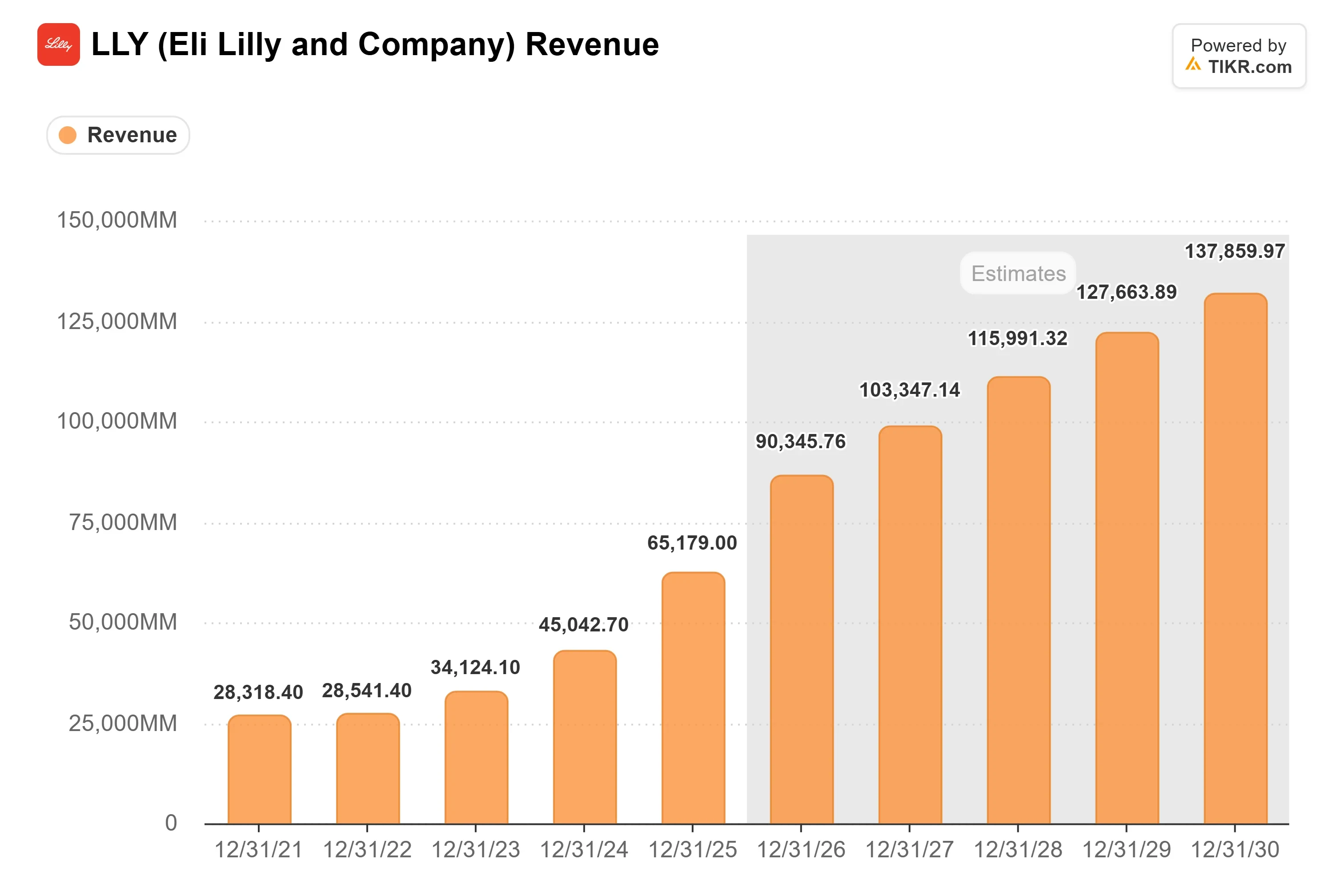
The runway still favors volume. Montarce said Lilly reaches about 1 in 10 U.S. patients and 2 in 100 elsewhere. A U.S. decision on Foundayo for type 2 diabetes is expected in the fourth quarter, and on October 28 Lilly reported topline results in which investigational retatrutide lowered A1C by 2.2% versus 1.8% for Novo Nordisk’s Ozempic, with more than double the weight loss. Investors already pay for that runway: Lilly trades at about 31x NTM P/E versus about 12x for Novo, per TIKR, and closed about 3% above the Street’s roughly $1,337 mean target, though Jefferies raised its target to $1,610 after the report.
TIKR Advanced Model Analysis
- Current Price: $1,373.70
- Target Price (Mid): ~$2,340
- Potential Total Return: ~70%
- Annualized IRR: ~14% / year

The mid case is the central scenario: around $2,340 by December 31, 2030, about 70% above the October 29 close, or roughly 14% a year. Its 2025-to-2035 inputs assume around 12% annual revenue growth, net margins around 45% and a slowly shrinking P/E. Bridge, international cash pay, Foundayo, and a potential retatrutide approval drive the revenue path. The main risk is Bridge itself: it is a pilot, and Ricks expects a shift into Medicare Part D for 2028, an expectation rather than a commitment. If volume keeps outrunning price, the mid case stays in reach. If the 2027 reset disappoints, a 31x multiple has room to compress.
Conclusion
The next test comes in January, when Lilly issues 2027 guidance on its fourth-quarter call. A revenue range centered near or above the Street’s roughly $103 billion would show volume absorbing the lost $2 billion and lower prices. A midpoint well below it would mean the easy raises are over.
So what is Eli Lilly stock actually worth?
TIKR lets you forecast the future price of any stock in less than a minute. Just enter a few assumptions into TIKR’s valuation model and see what Eli Lilly could be worth. Start from Wall Street consensus estimates, or adjust the inputs to reflect your own view of the business. It’s free to use.
Analyze Eli Lilly on TIKR Free →
Disclaimer:
Please note that the articles on TIKR are not intended to serve as investment or financial advice from TIKR or our content team, nor are they recommendations to buy or sell any stocks. We create our content based on TIKR Terminal’s investment data and analysts’ estimates. Our analysis might not include recent company news or important updates. TIKR has no position in any stocks mentioned. Thank you for reading, and happy investing!