Key Takeaways
- Evergy raised its quarterly dividend 4% on Nov. 5 and lifted its 2026 earnings guidance, and Duke Energy narrowed its own 2026 guidance toward the top end the same day.
- The two yield almost the same today, but Evergy’s dividend grew 5.7% a year from fiscal 2020 to fiscal 2025, against 2.0% for Duke Energy.
- Duke Energy paid out 67% of its fiscal 2025 normalized EPS and Evergy 70%, and analysts expect both shares to fall in fiscal 2026 as data-center demand lifts earnings.
- Both companies borrow heavily to fund record buildouts, with net debt at 5.5x EBITDA for Duke Energy and 5.0x for Evergy.
Evergy (EVRG) raised its quarterly dividend 4% on Nov. 5, the same day it lifted its 2026 earnings guidance.
Duke Energy (DUK) reported that day too. It narrowed its 2026 adjusted EPS guidance to $6.70 to $6.80 and said results should land near the top end.
Their yields are within a tenth of a point of each other. So if I could only put my dividend dollars in one of them for the next 20 years, which would it be?
| Metric | Duke Energy (DUK) | Evergy (EVRG) |
|---|---|---|
| Dividend yield | 3.4% | 3.3% |
| Dividend growth, fiscal 2020-2025 | 2.0% a year | 5.7% a year |
| Payout ratio of normalized EPS, fiscal 2025 | 67% | 70% |
| Payout ratio of normalized EPS, fiscal 2026 consensus | 65% | 63% |
| Net debt / EBITDA | 5.5x | 5.0x |
| Interest coverage (EBIT / interest) | 2.4x | 2.6x |
Source: TIKR. Yields at today’s prices; net debt and interest coverage over the last twelve months.
6 safe dividend stocks paying retirees 6%+ yields
There are over 100 stocks paying 6%+ annual dividends today.
But after an extensive investment review leveraging TIKR’s proprietary data, we now believe only six of them are truly safe for retirees.
They’re all yours as part of our new investment report. Learn more about how to get access right here.
Duke’s earnings are outrunning its dividend
Duke’s Electric Utilities and Infrastructure segment earned $1.82 billion in the third quarter of 2026, up from $1.66 billion a year earlier, on rate increases, higher sales, favorable weather and the build-out for data-center customers. On Nov. 16, the North Carolina Utilities Commission approved two-year rate plans for Duke’s two Carolinas utilities with a 9.8% return on equity, starting Jan. 1, 2027.
Duke paid out 67% of its fiscal 2025 normalized EPS, and consensus puts that at 65% in fiscal 2026. The ratio has fallen three years in a row, to 67% from 75.5% in fiscal 2022, as earnings outgrew the dividend:
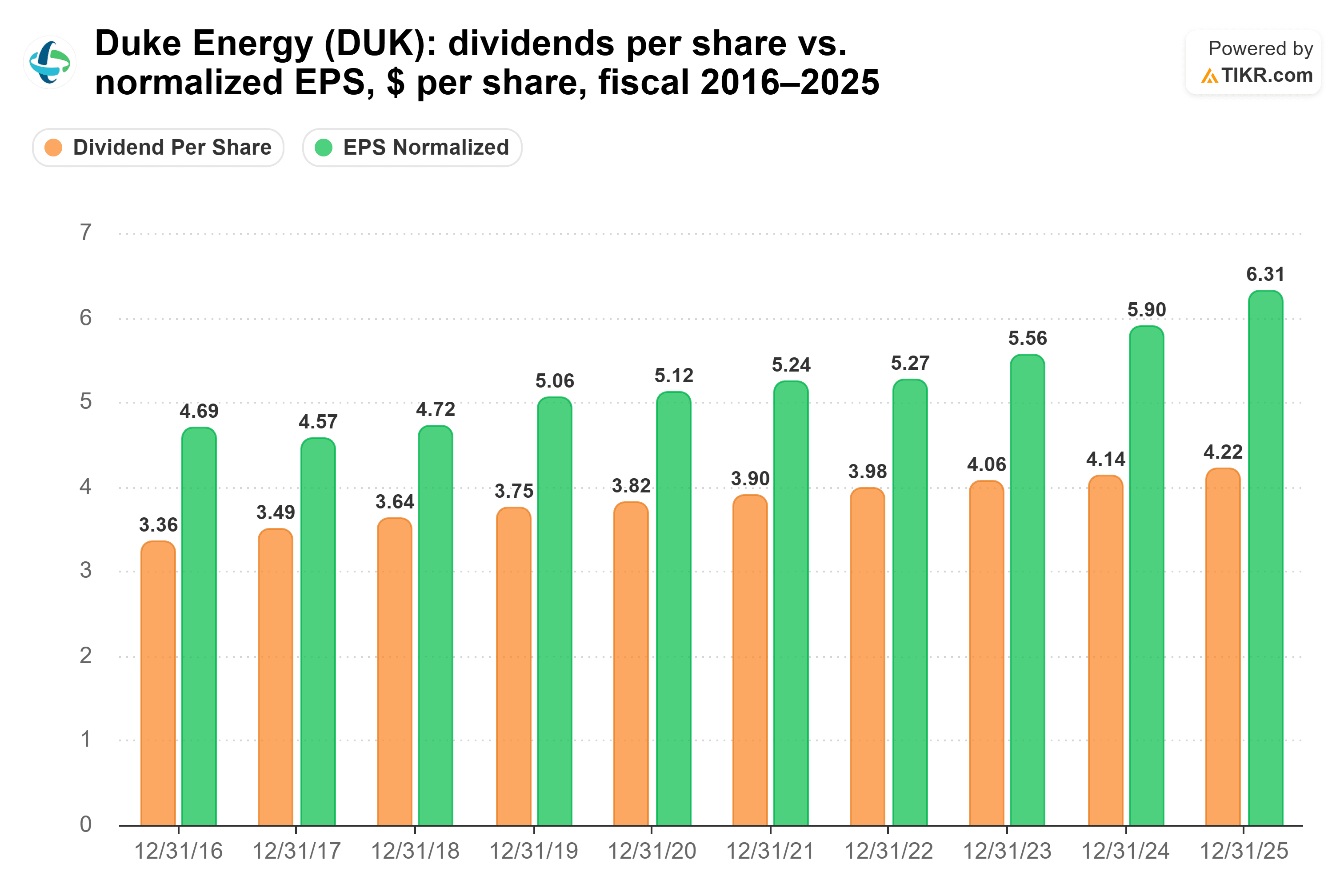
On its second-quarter call, Duke said its July raise of 2% “is consistent with growth in recent years.” Duke targets 5% to 7% yearly adjusted EPS growth through 2030, so its coverage should keep widening. The company says that raise marked over 20 years of consecutive annual increases. It borrows heavily to fund all this.
Evergy’s data-center pipeline keeps growing
Evergy is chasing the same demand in Kansas and Missouri. Weather-normalized retail demand rose 4.5% in the third quarter of 2026, and Evergy has five signed electric service agreements for about 2.6 gigawatts of peak load. On Nov. 5, it signed a letter of intent with Digital Realty for a 1.4 gigawatt expansion.
The same day, Evergy raised its 2026 adjusted EPS guidance to $4.35 to $4.50, from $4.14 to $4.34. The $4.42 consensus would be a 15% jump from fiscal 2025’s $3.83. That jump takes its payout ratio of normalized EPS to 63% from 70% in fiscal 2025. Evergy’s dividend rose every year from $1.52 in fiscal 2016 to $2.70 in fiscal 2025, while earnings climbed from $2.43 to $3.83:
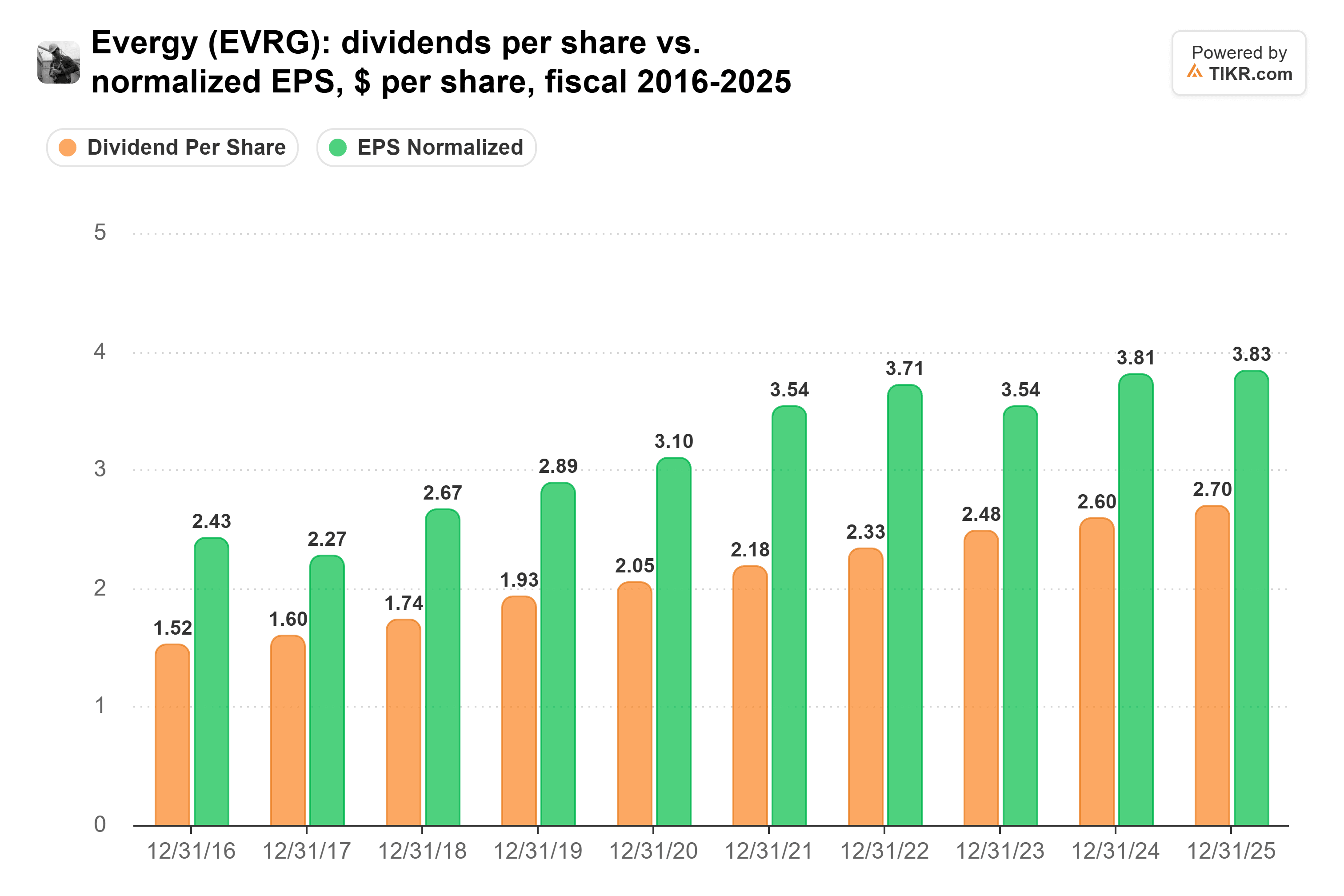
Evergy’s CEO said the 4% raise “supports our long-term payout ratio target range of 50% to 60%,” so Evergy is still paying out more than it wants to. Management also plans to issue some new stock alongside debt to fund its build.
So which dividend wins?
If I could only put my dividend dollars in one of these for the next 20 years, it’d be Evergy.
Over two decades, I care most about room to keep raising, and Evergy has more of it. Its payout ratio is heading toward its target, its debt is lighter, and it covers its interest 2.6x against Duke’s 2.4x.
The faster growth adds up, too. At each stock’s 5-year dividend growth rate, $10,000 in Evergy would pay about $11,708 over 20 years, against about $8,271 in Duke. By year 20, Evergy’s check would be about $940, a 9.4% yield on your original cash, against 5.0% for Duke. Evergy’s latest raise was 4%, in line with last year’s and below that 5-year pace. That’s still twice Duke’s 2%, and analysts expect Evergy’s earnings to keep climbing:
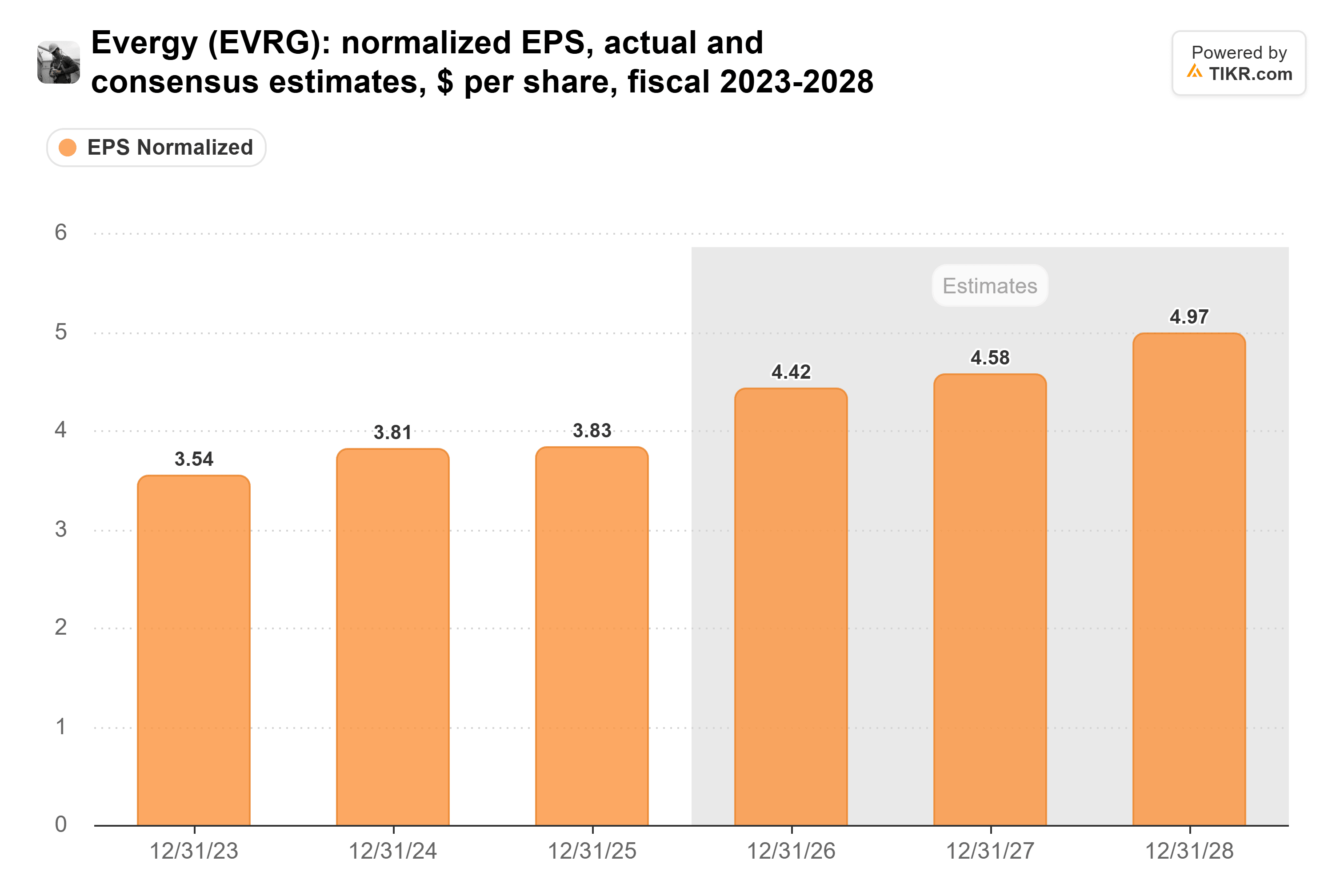
Management targets 6% to 8%-plus adjusted EPS growth through 2030, topping 8% from 2028 on. That leaves room for 4% raises while the payout ratio keeps falling.
This isn’t to say Duke’s dividend is at risk. Its coverage widens every year, its North Carolina rates are set for the next two years, and at 19x forward earnings it’s a bit cheaper than Evergy at 20x. It’s just that over 20 years, I’d rather own the check that grows twice as fast from the same starting yield.
Of course, much of Evergy’s growth depends on data-center deals it hasn’t signed yet. The tests are whether the Digital Realty letter of intent becomes a contract, and whether Evergy’s next raise comes in at 4% or better.
Forget Evergy: 6 safe 6%+ dividend yields you can buy right now
Dividends can hold the key to enormous wealth. But only if you buy the right ones.
Picking the right high-yield dividend stock can be the difference between a dream retirement…and scraping by every month, waiting for the next Social Security check to clear.
We’ve identified six stocks yielding 6%+ that we believe every retiree should know about right now. (And Evergy isn’t one of them.)
Disclaimer:
Please note that the articles on TIKR are not intended to serve as investment or financial advice from TIKR or our content team, nor are they recommendations to buy or sell any stocks. We create our content based on TIKR Terminal’s investment data and analysts’ estimates. Our analysis might not include recent company news or important updates. TIKR has no position in any of the stocks mentioned. Thank you for reading, and happy investing!