Key Takeaways
- J.P. Morgan reiterated its Buy rating and $200 price target on Oracle on Nov. 23, 83% above the stock’s latest close.
- Oracle has paid for its AI data centers with new stock and debt, and OpenAI, which S&P says is about half its backlog, is still raising money.
- The cost of insuring Oracle’s debt hit a record this week, alongside CoreWeave’s, so funding is still the main risk.
- On fiscal 2028 earnings estimates, $200 is 18x, below Oracle’s five-year average of 21x, which makes J.P. Morgan’s target a reasonable one.
Oracle (ORCL) closed at $109.51 on Nov. 24, 56% below its June 1 high. But on Nov. 23, J.P. Morgan analyst Samik Chatterjee reiterated his Buy rating and $200 price target, 83% above that close.
He’s held that target since August, when it sat about 30% above the stock’s $153.28.
The build-out got expensive
In the quarter that ended Aug. 31, Oracle’s revenue rose 30% to $19.3 billion, but capital spending hit $28.5 billion and free cash flow was negative $5 billion. Oracle sold $20 billion of stock to help pay for it, then raised about $10 billion more in stock and $10 billion in notes on Nov. 2. S&P says OpenAI accounts for about half of Oracle’s backlog, while OpenAI’s latest funding round has reached only half of its $30 billion target, CNBC reported.
J.P. Morgan hasn’t blinked
In August, J.P. Morgan projected that Oracle’s revenue would grow about 33% a year and its EPS about 29% a year through fiscal 2030. It argued that growth should earn Oracle a multiple closer to its AI infrastructure peers’. It reiterated the call the day Oracle’s stock jumped on the company’s statement that its OpenAI contract is fully funded. Others have pulled back: DBS cut its target to $290 from $310 on Nov. 12, keeping its Buy, and analysts’ average target has fallen from $349 a year ago to $236:
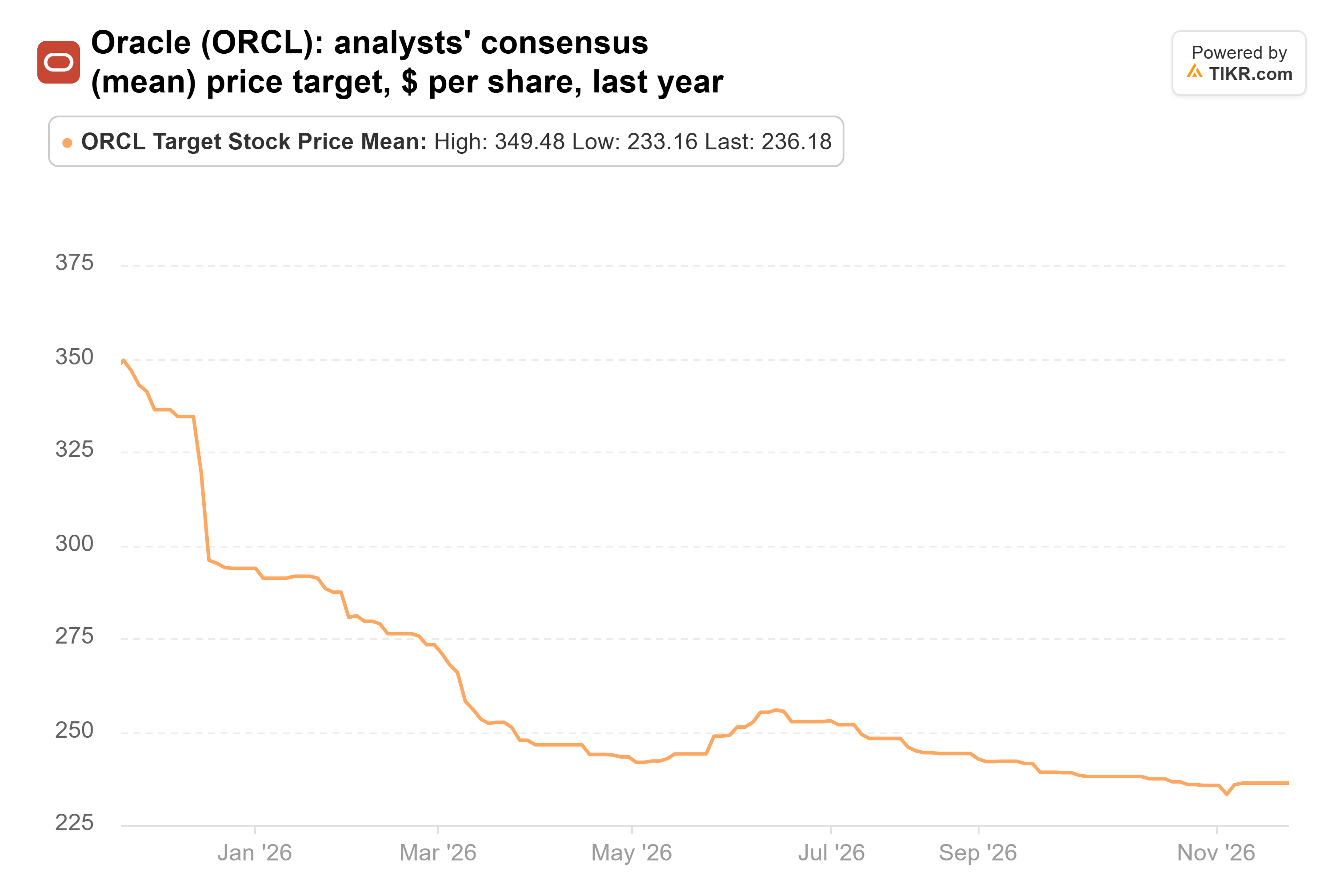
That’s still 136% above the price. Of the eight firms that weighed in this month, J.P. Morgan has the lowest target.
TIKR tracks 42 analysts on Oracle. How many say “Buy”?
See the full breakdown of Buy, Hold, and Sell ratings on Oracle, along with Wall Street’s revenue and earnings estimates, all in one place. More than 500,000 investors use TIKR to research stocks like this one. See Oracle’s Analyst Ratings
$200 needs about 18x
Analysts expect normalized EPS of $11.06 in fiscal 2028, which ends in May 2028, up from $10.91 three months ago:

On that $11.06, $200 is 18x earnings (our math: J.P. Morgan hasn’t published its method). Oracle trades at 13x forward earnings today, against a five-year average of 21x:

So the target needs 30% earnings growth, which analysts already expect, and a multiple that rises from 13x to 18x. That’s hardly heroic. Oracle traded between 12x and 17x from 2014 to early 2021, when its revenue grew about 1% a year, and analysts now expect revenue to nearly double from fiscal 2026 to fiscal 2028.
The most modest Buy, and the easiest to defend
The catch is the debt. Oracle says free cash flow tops $30 billion in fiscal 2029, while analysts expect $17.5 billion. And on Nov. 25, the cost of insuring Oracle’s debt hit a record, alongside CoreWeave (CRWV), whose spread implies a 68% chance of default within five years. Until credit markets stop lumping the two together, a higher multiple will be hard to earn.
Still, I think J.P. Morgan has this one right. Its $200 needs a multiple below Oracle’s five-year average, on estimates that are still edging up. If the funding holds, 18x a year out is a reasonable landing spot.
Oracle’s second-quarter report in mid-December is the next test. Non-GAAP EPS within its $1.85-$1.93 guide, with non-GAAP operating margin holding near the first quarter’s 42%, would back the call.
So what is Oracle stock actually worth?
TIKR lets you forecast the future price of any stock in less than a minute. Just enter a few assumptions into TIKR’s valuation model and see what Oracle could be worth. Start from Wall Street consensus estimates, or adjust the inputs to reflect your own view of the business. It’s free to use.
Disclaimer:
Please note that the articles on TIKR are not intended to serve as investment or financial advice from TIKR or our content team, nor are they recommendations to buy or sell any stocks. We create our content based on TIKR Terminal’s investment data and analysts’ estimates. Our analysis might not include recent company news or important updates. TIKR has no position in any of the stocks mentioned. Thank you for reading, and happy investing!