
Key Takeaways
- Morgan Stanley raised its Disney price target to $138 from $133 and kept its Overweight rating, after updating its estimates for Disney’s fiscal 2026 results.
- Disney beat its own guidance for fiscal 2026 and guided to double-digit adjusted EPS growth in fiscal 2027, excluding an extra week.
- Disney drew more park guests while Comcast pointed to headwinds at its theme parks, but Disney’s streaming margin is still far below Netflix’s.
- On fiscal 2028 estimates, $138 is 16x earnings, the same multiple Disney trades at today, so Disney only has to hit analysts’ numbers to get there.
Disney (DIS) closed at a 52-week high on Nov. 18 after its fiscal fourth-quarter report, and Morgan Stanley thinks it has further to go. On Nov. 19, the firm raised its price target to $138 from $133 and kept its Overweight rating, 14% above today’s price.
Disney is pulling ahead of one rival and still chasing another. It drew 4% more global park guests in the quarter, excluding the extra week, while the co-CEOs of Comcast (CMCSA) pointed to “near-term cyclical headwinds in Theme Parks” in October. But Disney’s 11.5% streaming margin for fiscal 2026 is a long way from the 31.5% operating margin Netflix (NFLX) expects this year.
Disney beat its own guidance
Fourth-quarter revenue rose 16% to $25.9 billion, and adjusted EPS jumped to $1.77 from $1.11. For fiscal 2026, adjusted EPS rose 16% excluding the 53rd week, ahead of the roughly 12% Disney had guided. It raised its dividend 33%, guided to double-digit adjusted EPS growth in fiscal 2027 on the same basis, and set a goal of about $3 billion of annual savings by fiscal 2029. CEO Josh D’Amaro said on the call that “most of those savings will be used to fund future growth.”
TIKR tracks 32 analysts on Disney. How many say “Buy”?
See the full breakdown of Buy, Hold, and Sell ratings on Disney, along with Wall Street’s revenue and earnings estimates, all in one place. More than 500,000 investors use TIKR to research stocks like this one. See Disney’s Analyst Ratings
Morgan Stanley is following the earnings
Analyst Sean Diffley raised the target after updating his estimates for those results. It’s his second raise this month: on Nov. 4, he lifted it to $133 from $125. That earlier note also forecast a 1.4% drop in international park attendance next year, and D’Amaro expects the pressure at Shanghai and Hong Kong to continue into fiscal 2027.
Does $138 add up?
Wall Street’s average is lower. TIKR’s consensus target was $128 on Nov. 18, 6% above the price and down from $132.50 a year earlier, even as the stock climbed 15%:
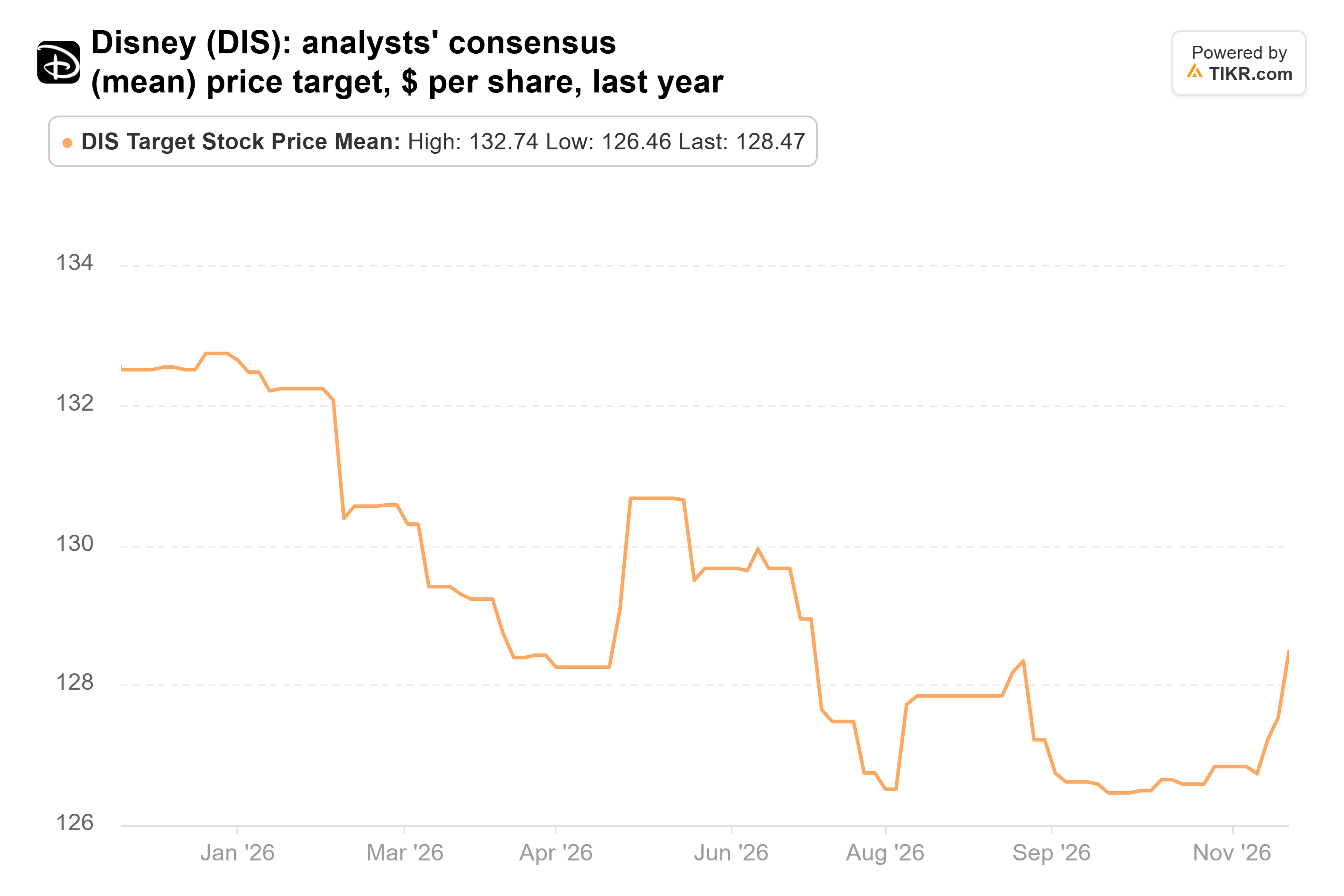
Morgan Stanley’s $138 is 7% above it, and the highest of the 31 targets is $144. Analysts’ estimates are rising too, with fiscal 2028 adjusted EPS at $8.52, up from $8.28 three months ago:
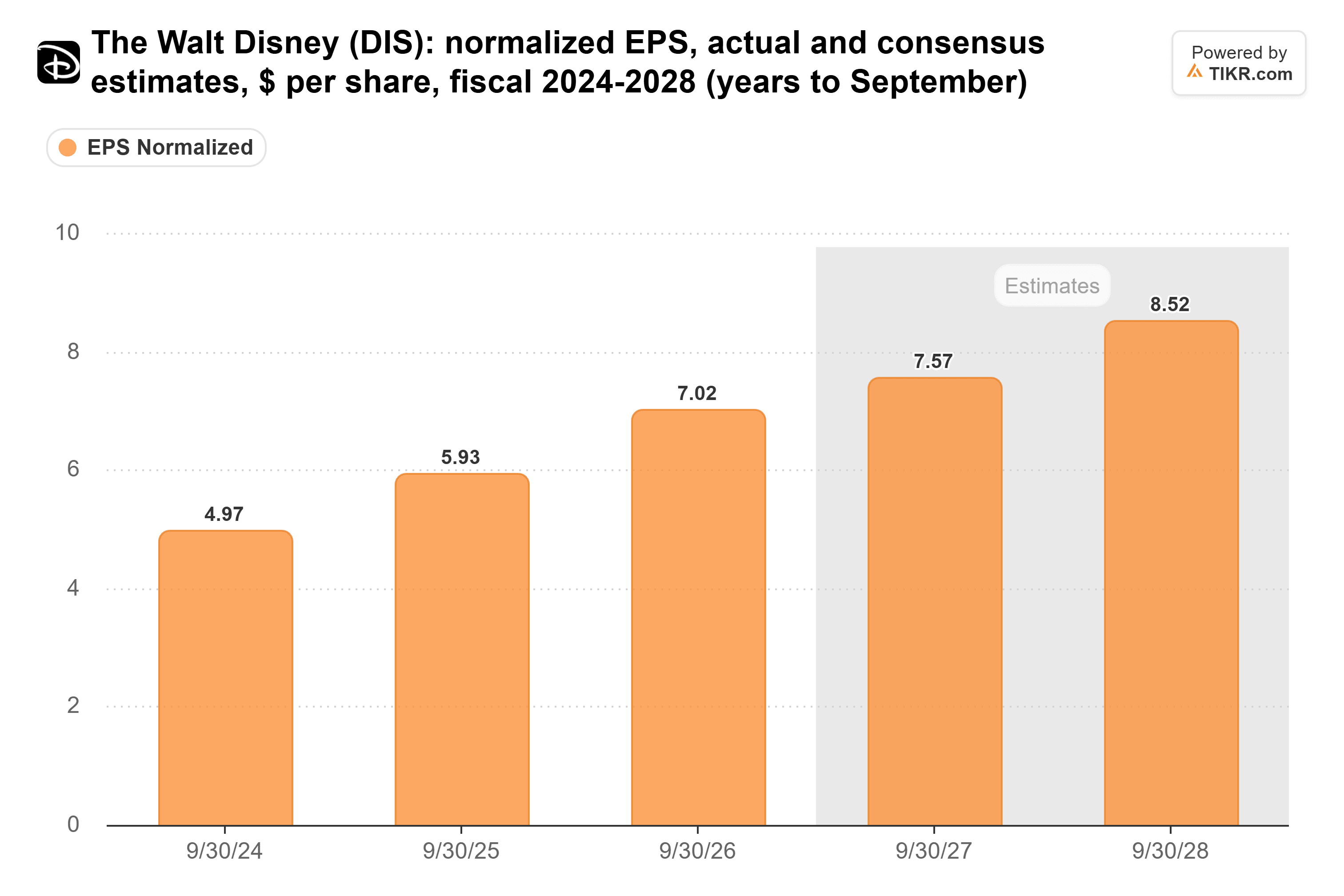
Morgan Stanley hasn’t said how it gets to $138, so the math here is mine. On fiscal 2028 estimates, $138 is 16x earnings, the same multiple Disney trades at today. So the target needs only the roughly 13% earnings growth analysts already expect. And 16x is low for Disney against its five-year average of 20x:
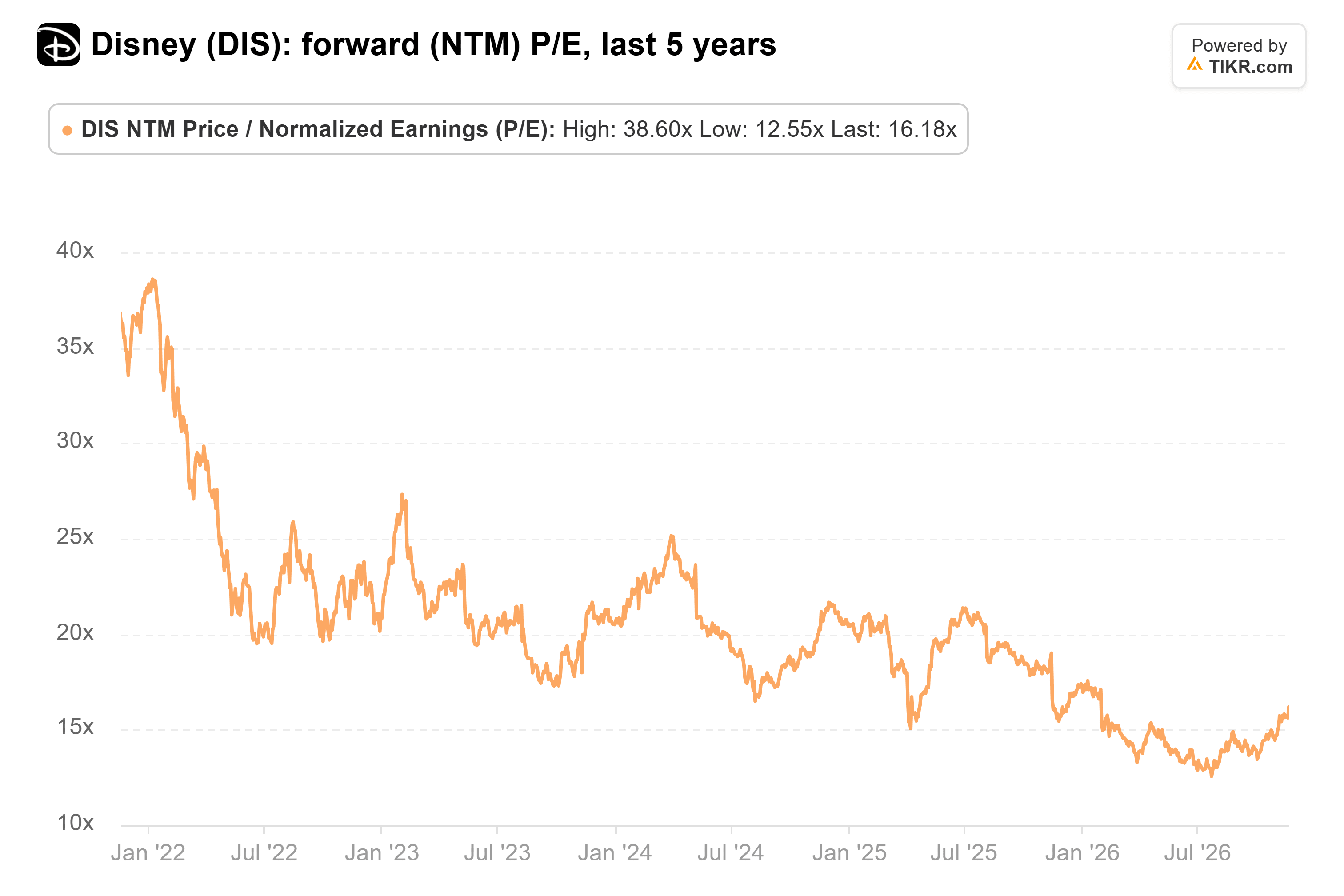
That average includes a 39x peak in January 2022. Over the past year, Disney has averaged closer to 15x, so I wouldn’t count on a re-rating either.
Disney has to hit the estimates
The risk is spending: Disney plans more streaming content and marketing in fiscal 2027, which could keep it far behind Netflix on margin.
Frankly, $138 is a fair target. Disney gets there by earning what analysts already expect at today’s multiple, and those estimates are rising. The first test is first-quarter results in early February. Disney guided to about $5.4 billion of segment operating income for the quarter, and its parks will show whether the gap with Comcast’s Universal holds.
So what is Disney stock actually worth?
TIKR lets you forecast the future price of any stock in less than a minute. Just enter a few assumptions into TIKR’s valuation model and see what Disney could be worth. Start from Wall Street consensus estimates, or adjust the inputs to reflect your own view of the business. It’s free to use.
Disclaimer:
Please note that the articles on TIKR are not intended to serve as investment or financial advice from TIKR or our content team, nor are they recommendations to buy or sell any stocks. We create our content based on TIKR Terminal’s investment data and analysts’ estimates. Our analysis might not include recent company news or important updates. TIKR has no position in any of the stocks mentioned. Thank you for reading, and happy investing!