Key Takeaways
- Notes from a Deutsche Bank space summit see a “launch deficit” of up to 100 Falcon 9-equivalent launches by 2030 if SpaceX keeps Starship for itself.
- SpaceX’s launch customers, like AST SpaceMobile and Planet Labs, would need other rides.
- Rocket Lab stands to pick up some of that demand, but filling much of the gap depends on Neutron, which hasn’t flown.
- At 26x forward sales, Rocket Lab trades right at its three-year average, far below the 89x it hit in May.
SpaceX (SPCX) got the green light on Nov. 25 to put up to 1 million satellites in orbit.
“Today, in a historic first, the FCC approved SpaceX’s request for 1 million satellites (orbital compute modules) to create data centers in space,” FCC Chairman Brendan Carr posted on X. The approval is conditional, and SpaceX’s plans for limiting space debris still need the FCC’s sign-off.
Every one of those satellites needs a ride. According to a summary of notes from Deutsche Bank’s Global Space & Defense Tech Summit on Nov. 17-18, posted on X by @SpacBobby, there could be a “launch deficit” of up to 100 Falcon 9-equivalent launches by 2030 if Starship’s capacity is dedicated “exclusively to internal needs.” That’s a secondhand summary, not the bank’s own report.
That’s bad news for SpaceX customers like AST SpaceMobile (ASTS) and Planet Labs (PL). And it’s an opening for Rocket Lab (RKLB), which, per the same notes, is “already in discussions with hyperscalers regarding orbital data centres.”
TIKR tracks 41 analysts on SpaceX. How many say “Buy”?
See the full breakdown of Buy, Hold, and Sell ratings on SpaceX, along with Wall Street’s revenue and earnings estimates, all in one place. More than 500,000 investors use TIKR to research stocks like this one. See SpaceX’s Analyst Ratings
Electron is already busy
Rocket Lab’s 22nd launch of 2026, on Nov. 27, was “a new annual launch record for Electron,” as the company put it on X. That’s up from 21 in all of 2025, and shares closed up 8.21% at $50.88 that day.
After SpaceX reportedly stopped taking Falcon 9 rideshare bookings beyond late 2028, CFO Adam Spice said in an interview on the Dave G Investing YouTube channel that “you can have a very strong uplift in pricing” for Electron, probably within six to nine months.
Analysts expect revenue to nearly triple, from $602 million in 2025 to $1.76 billion in 2028:

SpaceX needs its own rockets
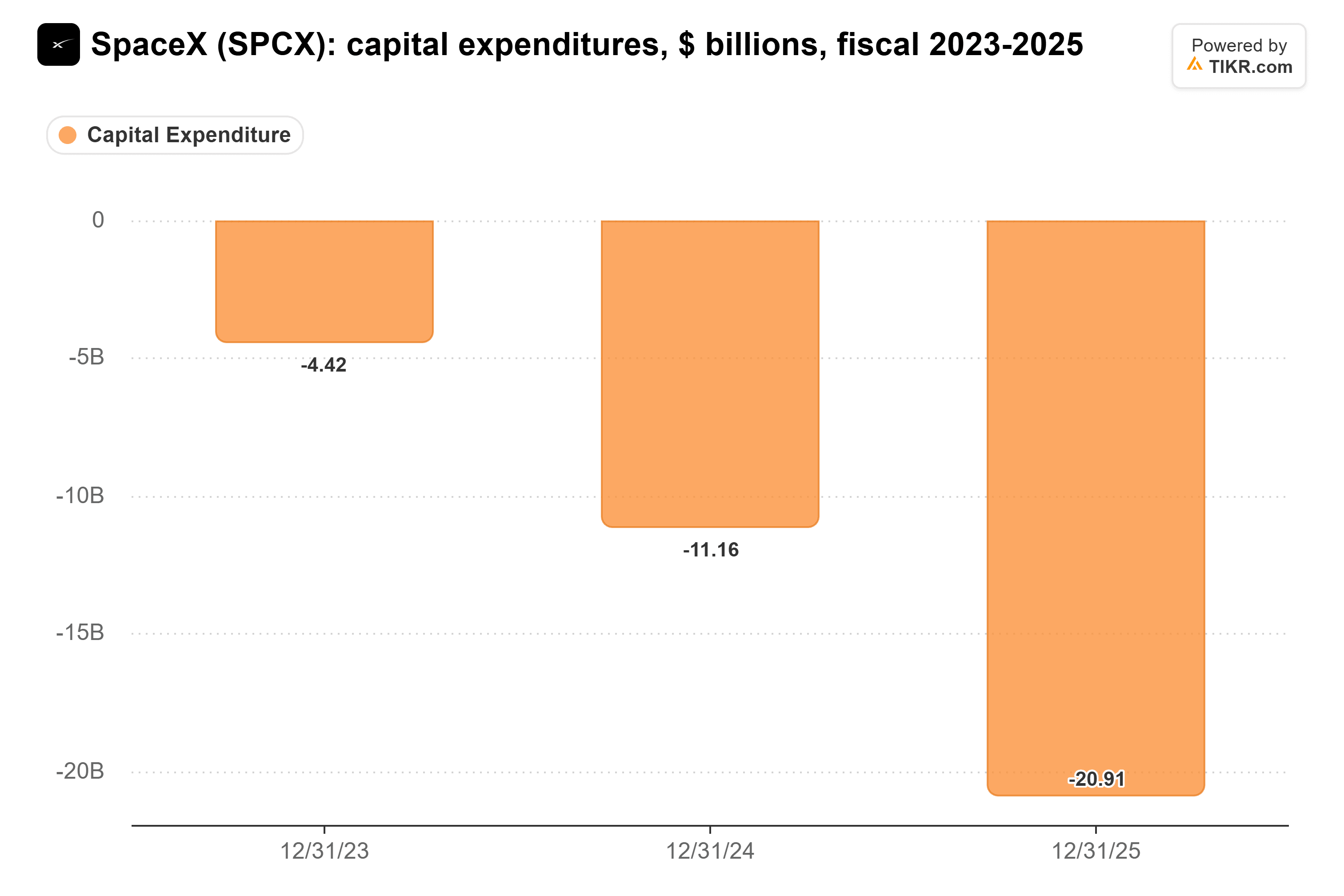
SpaceX’s capital spending rose from $4.42 billion in 2023 to $20.9 billion in 2025:
Starlink accounted for about 79% of Falcon 9 missions in 2026 through early August, up from 54% in 2020, according to a Reuters analysis. A million orbital compute modules would only lengthen the queue.
AST SpaceMobile is already stuck in it. Its Nov. 9 third-quarter release had BlueBirds 14, 15 and 16, shipped to Cape Canaveral in September, still “awaiting SpaceX launch date confirmation.” AST is also building its own 20-ton reusable rocket, Blacklift, for late 2028 “to provide greater control over launch availability,” as CEO Abel Avellan put it. That leaves Rocket Lab less to win from AST after 2028.
Planet Labs put its Tanager-2 satellite and 18 SuperDoves into orbit on SpaceX’s Transporter-18 rideshare on Oct. 1, and it has signed Isar Aerospace to launch one Pelican satellite. Where its satellites fly after 2028 is a fair question for its Dec. 10 report.
Neutron has to show up
Electron carries only small satellites, so a 100-launch gap needs Neutron, Rocket Lab’s medium-lift rocket, which hasn’t flown. The latest delay, announced Oct. 14 after inspections found voids in a first-stage tank dome, pushed its first launch into 2027 with no specific date yet. And its launch site is licensed for two Neutron missions a year, according to its latest annual report.
Satellites are already most of Rocket Lab’s business: Space Systems brought in $214.8 million, about 80% of third-quarter revenue. That points to Rocket Lab’s likely pitch to hyperscalers: it can build the spacecraft now and, once Neutron flies, launch them too, without relying on SpaceX, which plans its own Starmind network.
The stock isn’t paying for it yet
Rocket Lab trades at 26x forward sales, right at its three-year average and less than a third of the 89x it hit in May:
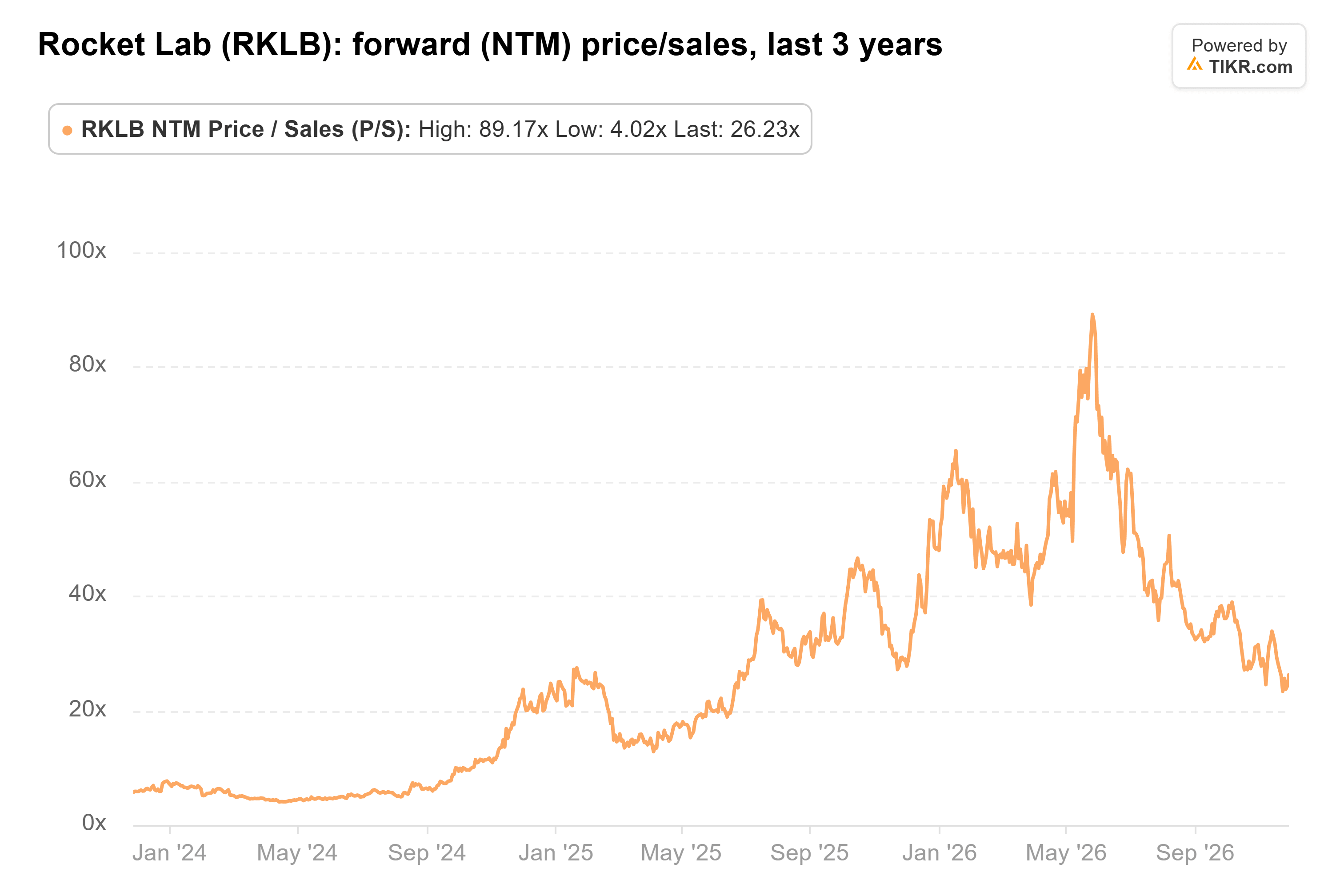
A SpaceX that keeps Starship for itself would be the best thing that could happen to Rocket Lab’s pricing. But that upside only counts for investors already willing to bet on Neutron, and today’s multiple sits at its three-year average, not at a premium.
Of course, SpaceX hasn’t said it will keep Starship for itself. Rocket Lab’s fourth-quarter results early next year are the next test. Twenty-five or more Electron launches for 2026, the roughly 20% growth the CFO pointed to, plus a named quarter for Neutron’s first flight would go a long way.
So what is Rocket Lab stock actually worth?
TIKR lets you forecast the future price of any stock in less than a minute. Just enter a few assumptions into TIKR’s valuation model and see what Rocket Lab could be worth. Start from Wall Street consensus estimates, or adjust the inputs to reflect your own view of the business. It’s free to use.
Disclaimer:
Please note that the articles on TIKR are not intended to serve as investment or financial advice from TIKR or our content team, nor are they recommendations to buy or sell any stocks. We create our content based on TIKR Terminal’s investment data and analysts’ estimates. Our analysis might not include recent company news or important updates. TIKR has no position in any of the stocks mentioned. Thank you for reading, and happy investing!