Key Takeaways
- Bristol Myers Squibb yields 4.4% and Coca-Cola yields 2.3%, and both raised parts of their 2026 guidance in late October.
- Bristol Myers Squibb’s dividend took 55% of its free cash flow over the trailing 12 months, compared with 79% at Coca-Cola.
- Bristol Myers Squibb expects a $1.5 billion to $2 billion drop in Eliquis sales in 2027, and Coca-Cola’s free cash flow fell short of its dividend in fiscal 2024 and fiscal 2025.
- The next tests are Bristol Myers Squibb’s milvexian readout, expected in early 2027, and both companies’ 2027 guidance.
Bristol Myers Squibb (BMY) and Coca-Cola (KO) both raised their 2026 guidance in the last week of October.
The two checks are very different, though. Bristol Myers Squibb yields 4.4% on its $2.52 annual dividend, nearly twice Coca-Cola’s 2.3% on $2.12.
Bristol Myers Squibb has to replace sales of Eliquis, its biggest drug. Coca-Cola’s free cash flow is covering its dividend again after two years when it didn’t. So which one pays you more over the next 10 years?
| Metric | Bristol Myers Squibb (BMY) | Coca-Cola (KO) |
|---|---|---|
| Dividend yield | 4.4% | 2.3% |
| Annual dividend | $2.52 | $2.12 |
| Dividend growth, fiscal 2020-2025 | 6.2% a year | 4.5% a year |
| Cash dividend payout ratio (TTM) | 55% | 79% |
| Net debt/EBITDA | 1.7x | 1.5x |
| Interest coverage | 9.9x | 10.7x |
| Forward P/E | 9.1x | 28x |
Source: TIKR; annual dividend from StockAnalysis. Payout ratios cover the 12 months to Sept. 30, 2026 (BMY) and Oct. 2, 2026 (KO).
6 safe dividend stocks paying retirees 6%+ yields
There are over 100 stocks paying 6%+ annual dividends today.
But after an extensive investment review leveraging TIKR’s proprietary data, we now believe only six of them are truly safe for retirees.
They’re all yours as part of our new investment report. Learn more about how to get access right here.
Bristol Myers Squibb’s new drugs are doing the heavy lifting
In the third quarter of 2026, Bristol Myers Squibb’s revenue rose 7% from a year earlier to $13.1 billion. Its Growth Portfolio grew 12% to $7.7 billion. On Oct. 29, management raised its 2026 revenue guidance to $49.75-$50.25 billion, from $49.0-$50.0 billion.
Over the 12 months to Sept. 30, the dividend took a comfortable 55% of free cash flow. Free cash flow has run between $12.0 billion and $15.2 billion a year since fiscal 2020, well above the dividend.
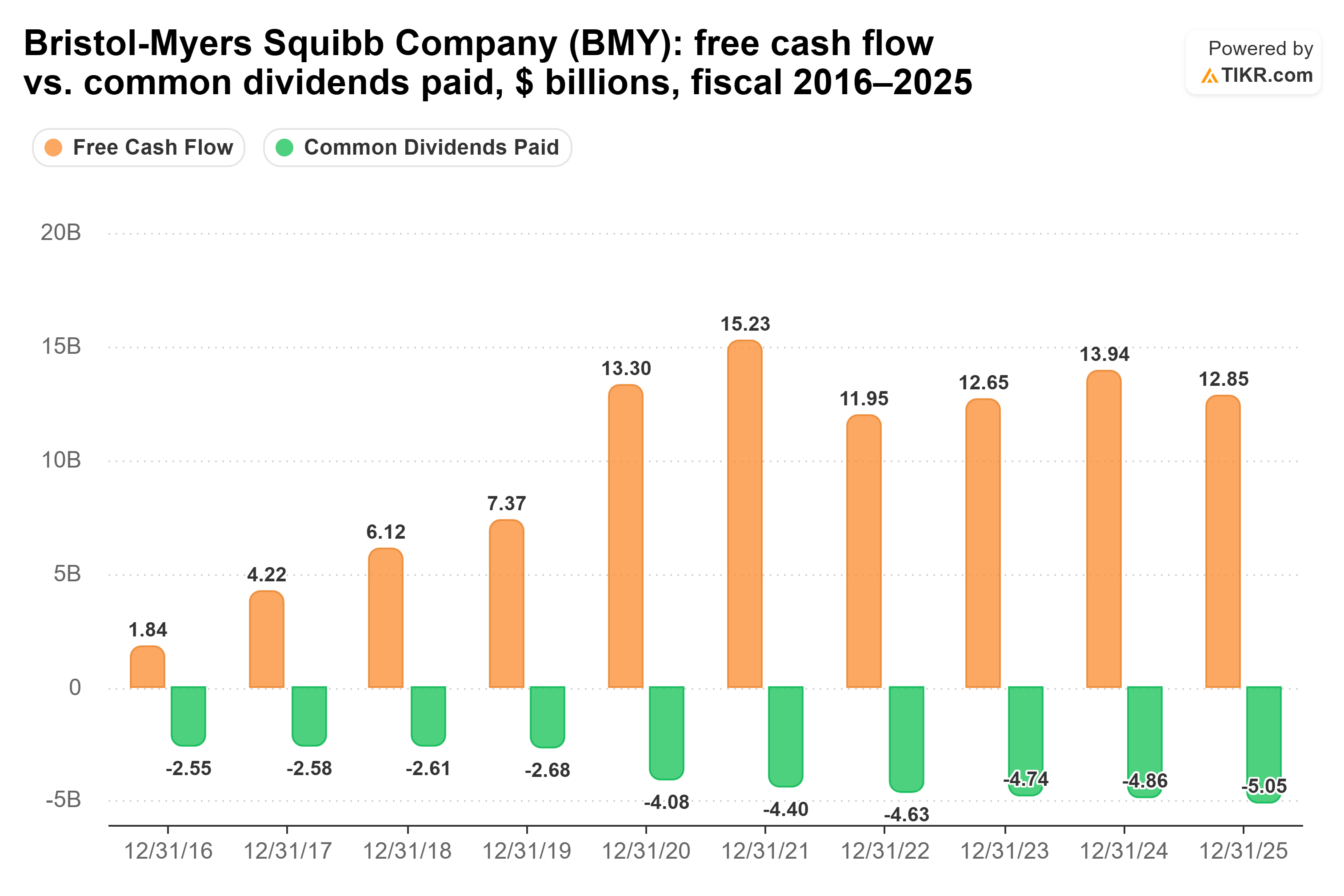
The coverage backs up CFO David Elkins, who said on the third-quarter call that the company is “continuing to return cash to our shareholders through our commitment to the dividend.”
The risk is Eliquis, which brought in 30% of fiscal 2025 revenue. It loses exclusivity in Europe this quarter, and management expects a $1.5 billion to $2 billion step-down in its sales in 2027.
Coca-Cola’s cash is catching back up
Coca-Cola doesn’t have a patent to replace. Its question is the cash behind the dividend. Revenue rose 7% to $13.4 billion in the third quarter of 2026, and unit case volume grew 5%.
The dividend’s cover is the weak spot. Free cash flow fell from $9.75 billion in fiscal 2023 to $4.74 billion in fiscal 2024 and $5.30 billion in fiscal 2025. That was well short of the $8.36 billion and $8.78 billion it paid in dividends in those two years.
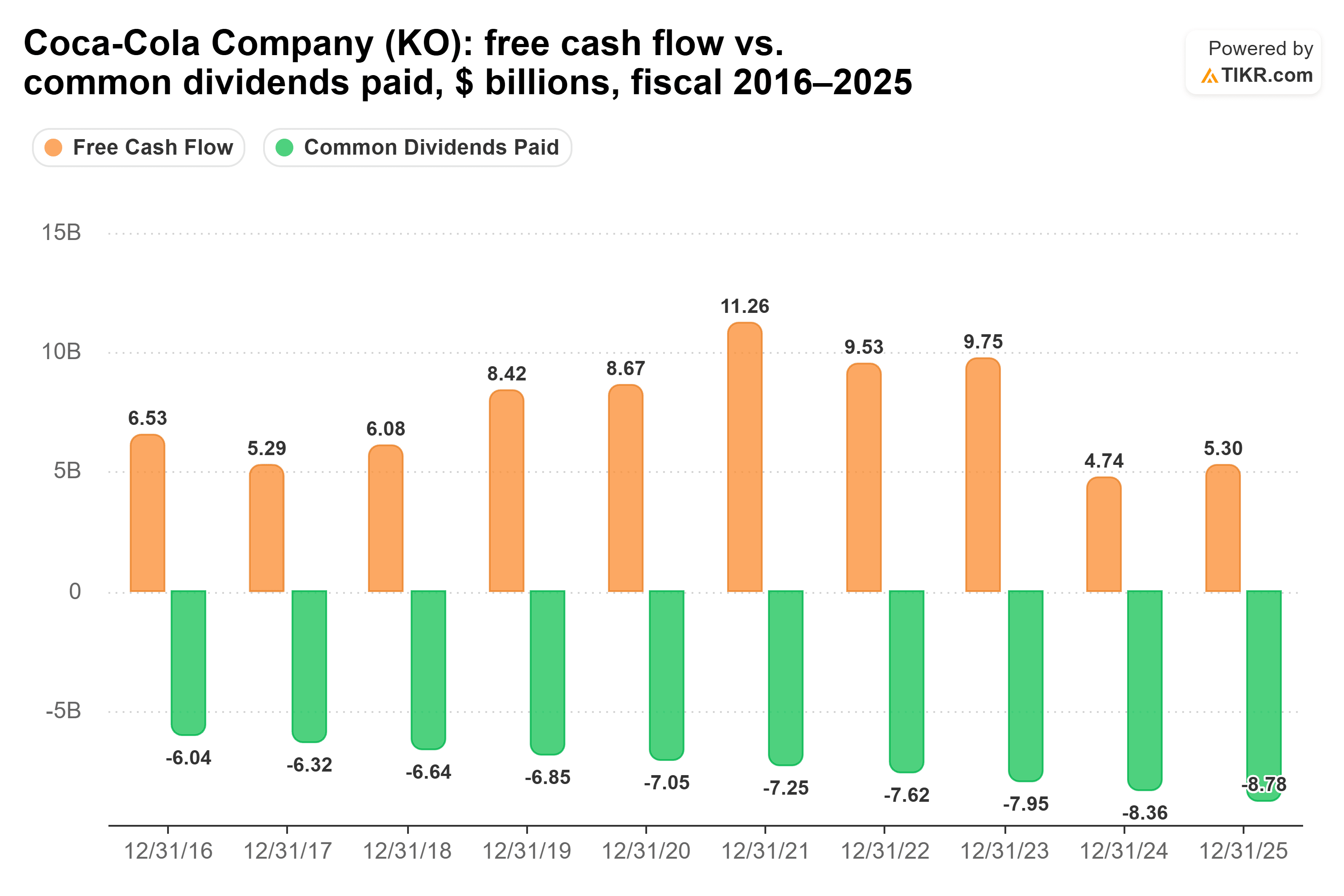
This year has turned that around. Over the 12 months to Oct. 2, dividends took 79% of free cash flow. That’s covered, but with a thinner cushion than Bristol Myers Squibb’s. On Oct. 27, Coca-Cola raised its full-year free cash flow guide to at least $13.0 billion, from about $12.4 billion.
“I believe our balance sheet today is in as good a shape as it’s been for many years,” CFO John Murphy said on the third-quarter call.
So which dividend wins?
Bristol Myers Squibb pays you more over the next 10 years, by a wide margin. At its 6.2% five-year growth rate, $10,000 invested in it pays about $5,865 in dividends over the decade. The same $10,000 in Coca-Cola pays about $2,821 at its 4.5% rate.
The answer doesn’t change at each dividend’s current pace of growth, 2.9% for Bristol Myers Squibb and 5.2% for Coca-Cola. Bristol Myers Squibb still pays about $5,019 to Coca-Cola’s $2,914. Coca-Cola’s yearly check wouldn’t pass Bristol Myers Squibb’s until around 2056.
Can Bristol Myers Squibb keep raising through the Eliquis step-down? I think it can. A 55% payout leaves room, the Growth Portfolio is growing 12%, and the head start is too big to lose even if raises stay near 2.9%.
You’re also not paying up for that income. Bristol Myers Squibb trades at 9.1x forward earnings, right around its five-year average of 9.3x.

My read: that price already assumes a tough 2027.
Coca-Cola’s dividend is still a good one. At its five-year rate, it would pay about $341 in year 10, a 3.4% yield on your cash today. That’s not much on its own, but the stock’s 36% gain over the past year shows the other half of Coca-Cola’s return. Still, over 10 years, a check nearly twice as big, with more room under it, is too much income to give up.
Of course, Bristol Myers Squibb’s milvexian readout in atrial fibrillation is expected in the first quarter of 2027, and it’s the company’s shot at a successor to Eliquis. A miss would leave less to offset that $1.5 billion to $2 billion hit.
Forget Bristol Myers Squibb: 6 safe 6%+ dividend yields you can buy right now
Dividends can hold the key to enormous wealth. But only if you buy the right ones.
Picking the right high-yield dividend stock can be the difference between a dream retirement…and scraping by every month, waiting for the next Social Security check to clear.
We’ve identified six stocks yielding 6%+ that we believe every retiree should know about right now. (And Bristol Myers Squibb isn’t one of them.)
Disclaimer:
Please note that the articles on TIKR are not intended to serve as investment or financial advice from TIKR or our content team, nor are they recommendations to buy or sell any stocks. We create our content based on TIKR Terminal’s investment data and analysts’ estimates. Our analysis might not include recent company news or important updates. TIKR has no position in any of the stocks mentioned. Thank you for reading, and happy investing!