
Key Takeaways
- Dell Technologies (DELL) stock fell approximately 16% from October 26 to November 2, closing near $393 as higher memory costs and weakening PC demand pressured shares.
- Intel (INTC) projected PC unit declines of approximately 12% in 2026 and 10% in 2027, raising concerns about a prolonged downturn.
- HP (HPQ) generated approximately 75% of quarterly revenue from Personal Systems, while Super Micro Computer (SMCI) subsequently reported $19.9 billion in quarterly sales, highlighting continued AI infrastructure demand.
- Dell traded at an estimated 14x forward earnings on November 2, but its $4.1 billion first-half free cash flow remains a concern despite strong server profitability.
What Happened?
Dell Technologies (DELL) stock dropped approximately 16% in the week ended November 2, falling from around $467 to $393 as investors weighed weakening PC demand against the company’s expanding AI infrastructure business.
Much of the decline followed Intel’s October 29 earnings discussion, when management warned that rising memory prices and supply constraints were weakening PC demand.
Intel CFO David Zinsner projected PC unit declines of approximately 12% in 2026 and another 10% in 2027, suggesting the downturn could continue into next year.
Dell had already anticipated the pressure. At Citi’s September 10 technology conference, CFO David Kennedy said the PC market “is compressed for the rest of this year, like I said, minus double digit.”
According to Dell’s fiscal second-quarter results, Client Solutions Group contributed just 19% of segment operating income in the July quarter, down from 35% a year earlier. Infrastructure Solutions Group generated the remaining 81%.
Competitor HP faces greater PC exposure. Its fiscal third-quarter results showed $11.8 billion in Personal Systems revenue out of approximately $15.7 billion in total sales.
Dell’s AI server business provides an important offset, with Infrastructure Solutions Group operating margins improving to 15.0% from 8.8% a year earlier.
Meanwhile, AI server competitor Super Micro reported $19.9 billion in quarterly sales on November 3, providing further evidence of strong infrastructure demand despite PC market weakness.
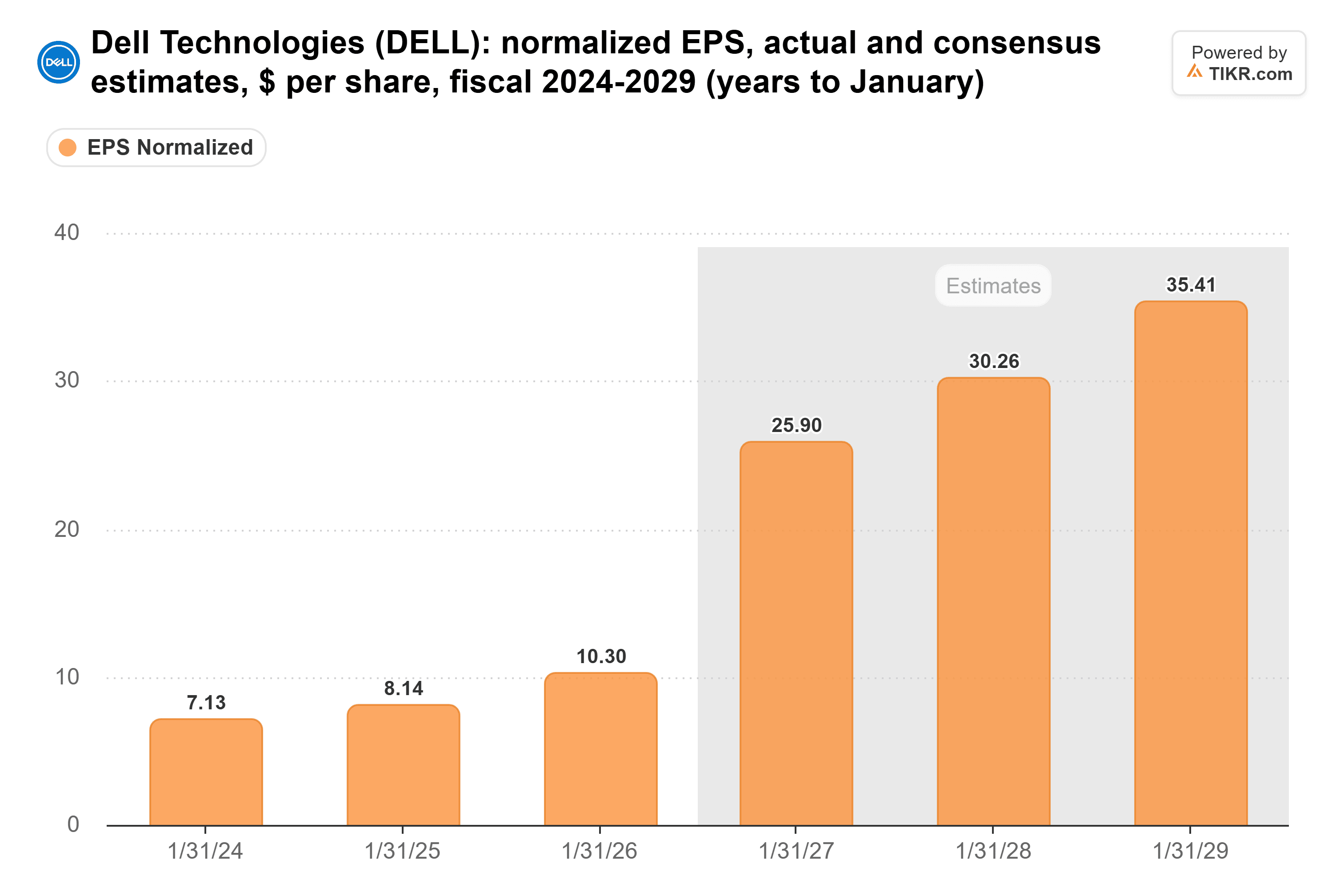
TIKR’s October 27 consensus estimates projected Dell’s normalized EPS increasing from $25.90 for the year ending January 2027 to $30.26 in January 2028 and $35.41 in January 2029. These forecasts predated Intel’s warning.
The Cash Has to Show Up on Nov. 24
Dell’s biggest challenge is converting strong earnings into cash. According to its quarterly financial results, the company generated $7.6 billion in net income during the first half of fiscal 2027, compared with $4.1 billion in free cash flow.
Changes in financing receivables had an approximately $6.4 billion negative impact on operating cash flow, weighing on conventional cash generation despite strong infrastructure profitability. Dell also reported $11.3 billion in adjusted free cash flow, which treats financing-related cash movements differently.
Analysts previously expected approximately $12 billion in full-year free cash flow, highlighting the importance of stronger cash conversion during the second half of fiscal 2027. However, differences between reported and adjusted free cash flow make the underlying measures important to monitor.
Dell’s scheduled November 24 earnings report will provide an important test of whether strong AI infrastructure earnings are translating into improved cash generation.
Is Dell Stock Undervalued or Overvalued?
Dell appeared potentially undervalued at its November 2 closing price, although weaker cash conversion and uncertainty surrounding PC demand justified caution.
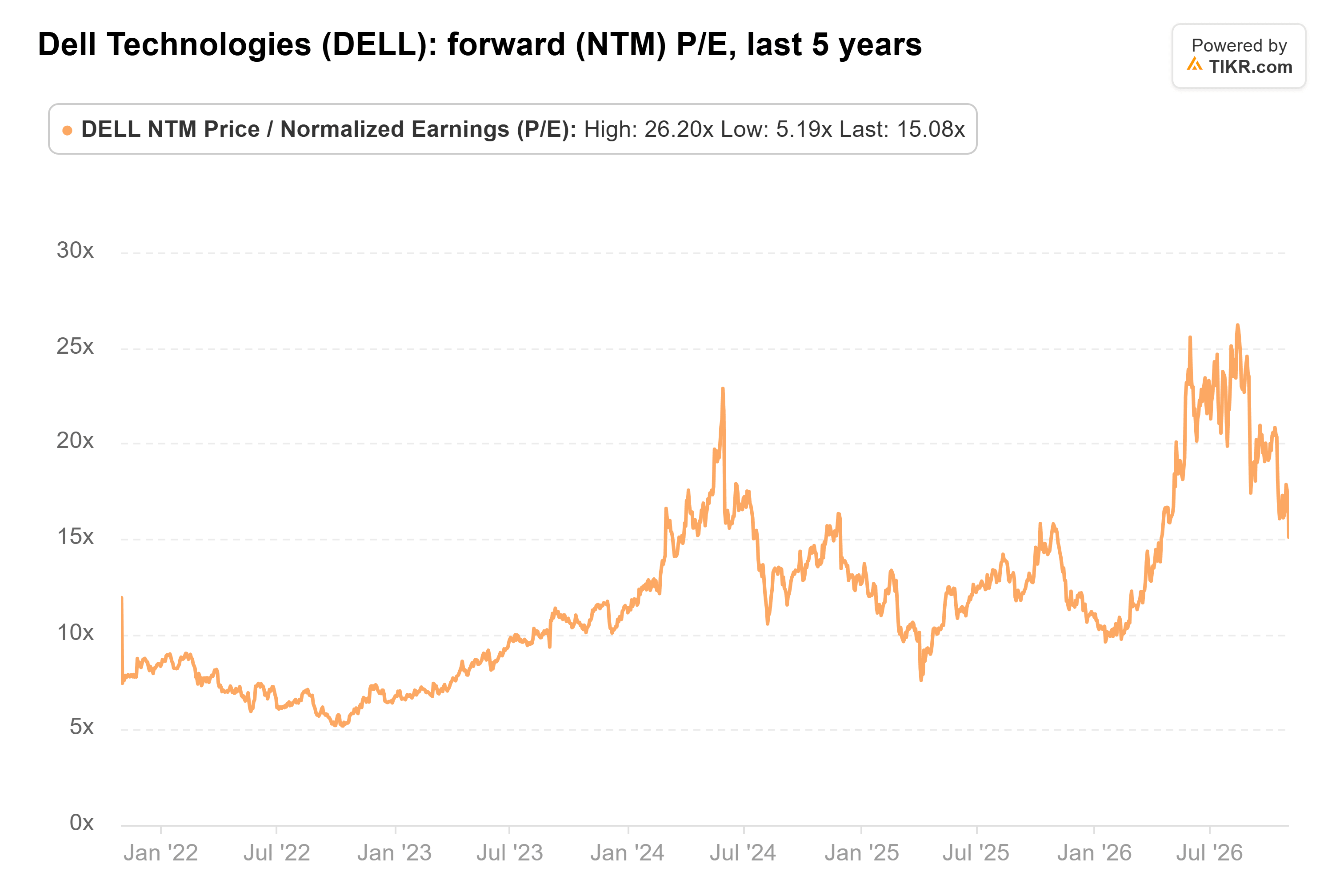
Dell’s forward P/E declined from approximately 26x in August to 15.1x on October 30 and an estimated 14x on November 2, approaching its five-year average of 11.7x.
At its November 2 closing price of $392.78, Wall Street’s late-October consensus price target of approximately $595 implied 51% upside. This historical comparison does not reflect subsequent changes in Dell’s stock price or analyst estimates.
Over the next 12 months, Dell’s earnings growth will depend on sustained AI server demand, infrastructure margins, PC market stabilization, and stronger cash conversion.
With AI servers contributing most of Dell’s segment profit and earnings estimates pointing higher, its November 2 valuation appeared attractive. However, persistent cash-flow weakness or component shortages could limit potential upside, making the November 24 earnings report a critical test of the investment case.
So what is Dell stock actually worth?
TIKR lets you forecast the future price of any stock in less than a minute. Just enter a few assumptions into TIKR’s valuation model and see what Dell could be worth. Start from Wall Street consensus estimates, or adjust the inputs to reflect your own view of the business. It’s free to use.
Disclaimer:
Please note that the articles on TIKR are not intended to serve as investment or financial advice from TIKR or our content team, nor are they recommendations to buy or sell any stocks. We create our content based on TIKR Terminal’s investment data and analysts’ estimates. Our analysis might not include recent company news or important updates. TIKR has no position in any of the stocks mentioned. Thank you for reading, and happy investing!