Key Takeaways
- David Tepper’s Appaloosa added 28% to its Micron stake in the third quarter, making Micron its biggest holding at 17.6% of its 13F stocks.
- Tepper also added to NVIDIA and SpaceX, so three of his six biggest positions are bets on the AI build-out.
- Micron trades at 4.1x forward earnings, near the bottom of its history, a price that assumes record memory profits won’t last.
- The numbers back Tepper, and Micron’s December report is the next test of how long memory stays scarce.
Micron (MU) is David Tepper’s biggest bet. Appaloosa’s 13F for the quarter ended Sept. 30, filed Nov. 16, shows it held 1.25 million Micron shares worth $1.33 billion at quarter’s end, or 17.6% of its 13F stocks, after it added 28% to its share count in the third quarter.
Tepper’s top holding got a lot cheaper
Appaloosa, which manages $20.4 billion in all, bought more than memory. It added 31% to its NVIDIA (NVDA) shares, now its No. 6 position at 6.0% of its 13F stocks, and it raised its SpaceX (SPCX) share count by 1,626%, making SpaceX its No. 4 at 7.4%. So three of its six biggest positions are tied to the AI build-out.
Two of them have had a rough stretch since. Micron and NVIDIA have each fallen 32% since Sept. 30, and Micron now sits 43% below its 52-week high after tighter US chip export rules and a memory selloff ahead of NVIDIA’s earnings hit the group. A 13F only shows what a fund held on the last day of the quarter, so we can’t tell what Tepper paid or whether he still holds every share.
TIKR tracks 50 analysts on Micron. How many say “Buy”?
See the full breakdown of Buy, Hold, and Sell ratings on Micron, along with Wall Street’s revenue and earnings estimates, all in one place. More than 500,000 investors use TIKR to research stocks like this one. See Micron’s Analyst Ratings
The market is pricing in a peak
Analysts expect Micron’s normalized EPS to more than double from fiscal 2026’s $75.52 to $176.50 in fiscal 2027, then reach $207.76 in fiscal 2028:
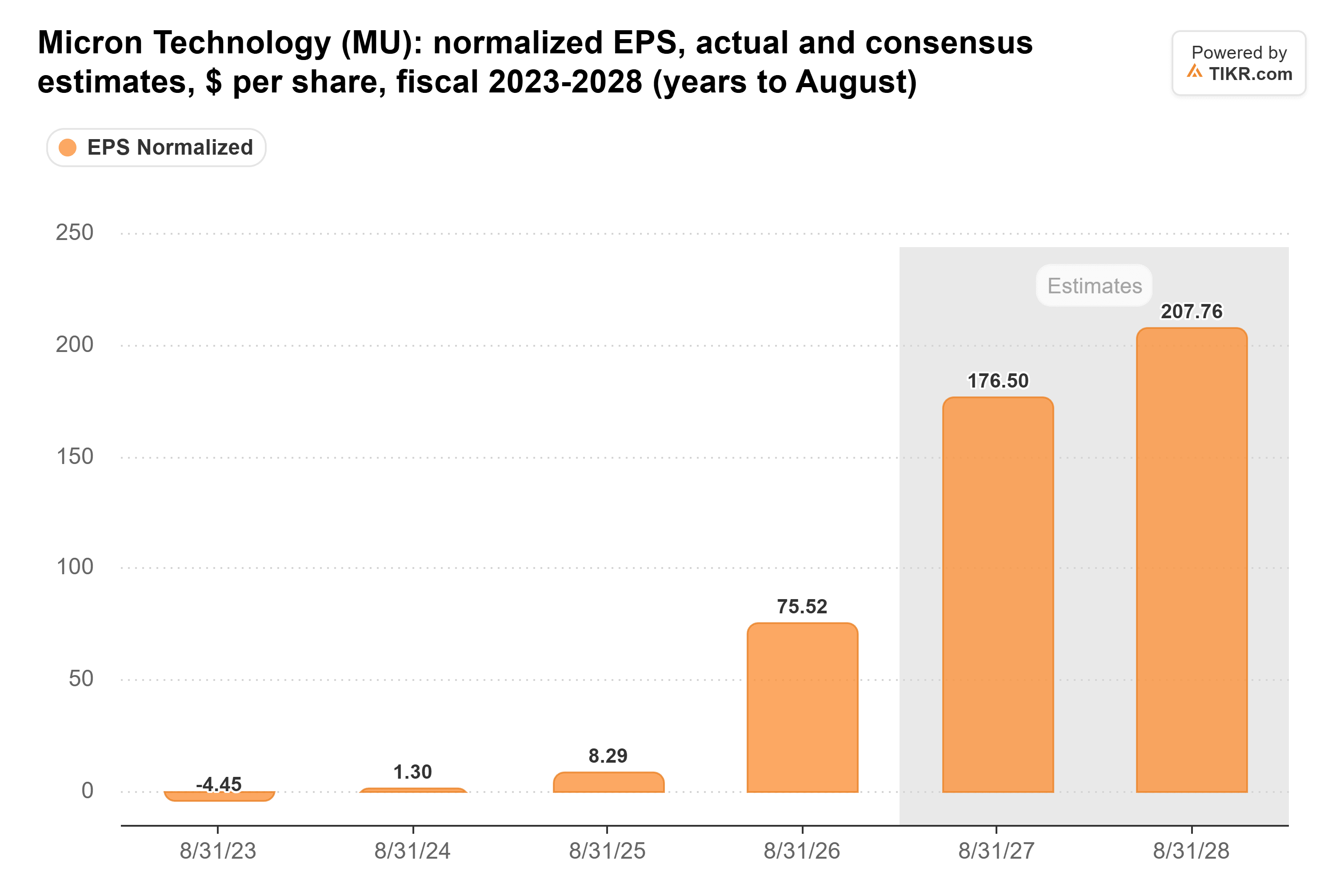
Even so, Micron trades at just 4.1x forward earnings. That’s close to its readings of 2017 and 2018, when the last memory cycle peaked, and after that peak its earnings per share fell 79%, from $11.51 in fiscal 2018 to $2.37 in fiscal 2020.
The worries this time are real. Micron’s own new fabs start output in 2027 and 2028, and so do China’s CXMT’s. The consensus already has Micron’s gross margin falling from 87.0% in fiscal 2027 to 65.5% in fiscal 2030. Kioxia warned last week that NAND price increases are slowing. And SpaceX CEO Elon Musk said on X that a fast ramp by Chinese memory makers would make 2028 “a different story.”
Wall Street still sees the stock doubling
Analysts haven’t given up on Micron. Their average target has climbed from $213 a year ago to $1,562:
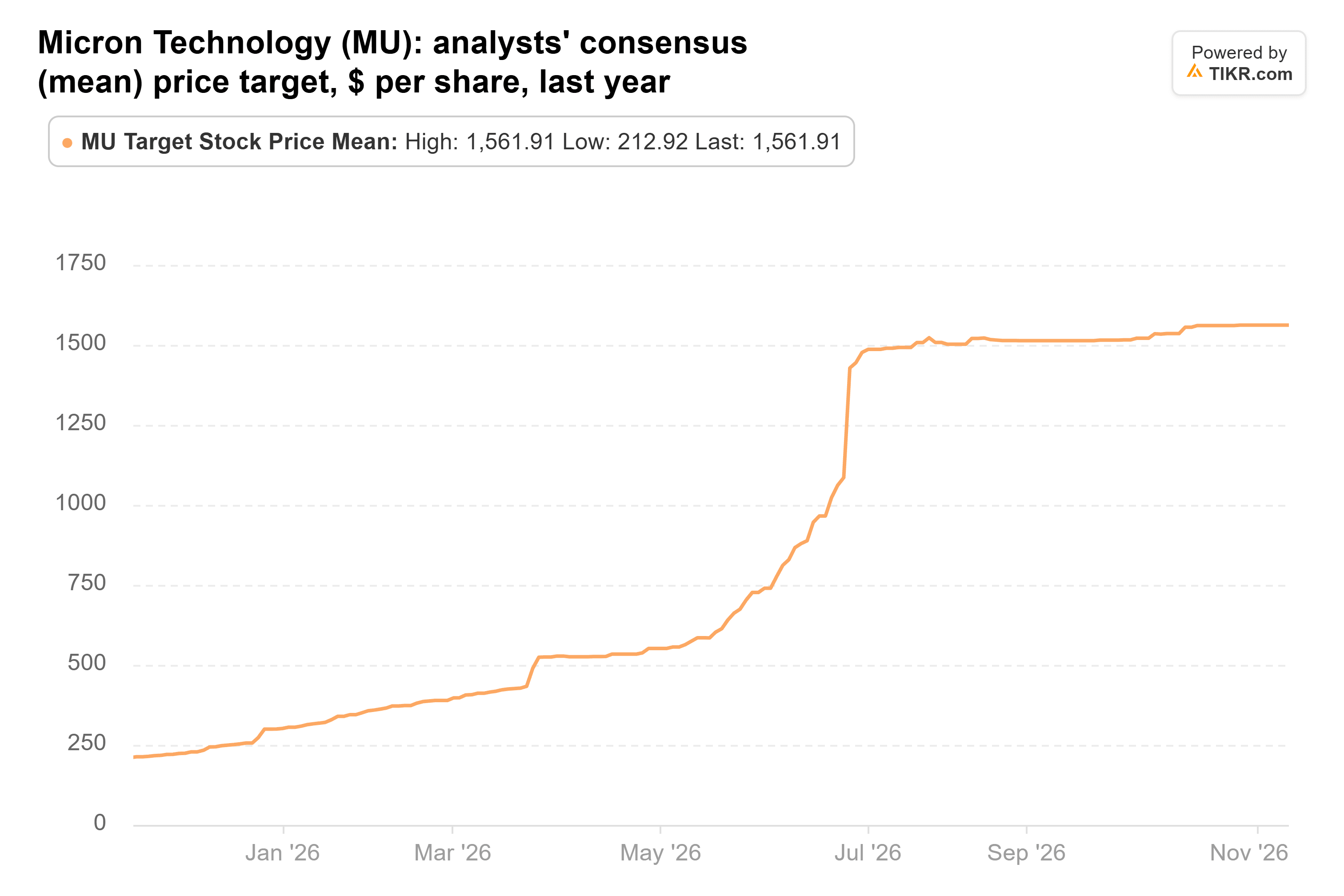
That’s 117% above the last close. The 49 analysts covering the stock have targets that run from $361 to $3,000.
The case for a longer cycle rests on contracts. Micron has signed 26 multi-year take-or-pay agreements that management estimates will cover over 35% of revenue through 2030, and it says over 75% of its 2027 output is committed. It also held $73.45 billion of cash and investments against $5.2 billion of debt at Sept. 3, and buybacks of up to $35.16 billion can start Dec. 9.
The price of memory is also a cost for Tepper’s other chip bet. In August, NVIDIA’s management said it expects gross margin to bottom at 71% to 72% in the January 2027 quarter as memory prices climb. NVIDIA reports this week, and its margin outlook will show us whether memory costs are still rising faster than it planned for.
I’d side with Tepper
The contracts cover only a minority of Micron’s sales, so most of its revenue still reprices with the market. Only about a quarter of the roughly $134 billion of contracted revenue on its books comes due in the next 12 months.
Still, I think the numbers back Tepper. At 4.1x forward earnings, Micron is priced for a downturn that hasn’t shown up in its results or its near-term estimates, and its contracts and cash give it a cushion if prices turn. Earnings could come in well short of the consensus, and the stock would still look cheap against its own history.
Micron’s fiscal first-quarter report, due in mid-December, is the next test. Management has guided to $61.5 billion of revenue, plus or minus $1.5 billion, and an 86.25% gross margin, and it calls that quarter the floor for fiscal 2027’s margin. Appaloosa’s next 13F, due in mid-February, will show whether Tepper held on.
So what is Micron stock actually worth?
TIKR lets you forecast the future price of any stock in less than a minute. Just enter a few assumptions into TIKR’s valuation model and see what Micron could be worth. Start from Wall Street consensus estimates, or adjust the inputs to reflect your own view of the business. It’s free to use.
Disclaimer:
Please note that the articles on TIKR are not intended to serve as investment or financial advice from TIKR or our content team, nor are they recommendations to buy or sell any stocks. We create our content based on TIKR Terminal’s investment data and analysts’ estimates. Our analysis might not include recent company news or important updates. TIKR has no position in any of the stocks mentioned. Thank you for reading, and happy investing!