Key Takeaways
- NVIDIA (NVDA) fell approximately 12.7% over five trading sessions, closing at $162.85 on November 13 after Jensen Huang resigned as CEO, raising concerns about the company’s leadership and growth outlook.
- Dan Ives of Yorkville Ives & Co. valued NVIDIA at $225 per share without Huang, implying approximately 38% potential upside from its latest closing price, compared with his $300 valuation with Huang.
- NVIDIA traded at approximately 14x forward earnings before the resignation announcement, compared with its 10-year average of roughly 37x, while consensus normalized EPS is projected to reach $21.34 in fiscal 2029.
- NVIDIA had approximately $235 billion remaining under its share repurchase authorization as of September 28, while the upcoming November 17 earnings report will test whether its growth outlook remains intact.
What Happened?
NVIDIA (NVDA) closed at $162.85 on Friday, November 13, extending its five-session decline to approximately 12.7% after founder Jensen Huang resigned as CEO amid reports concerning his personal conduct and potential national security implications.
According to NVIDIA’s November 12 announcement, Huang stepped down as president, CEO, and board member, effective immediately. Chief Financial Officer Colette Kress became interim CEO, while longtime director Harvey Jones was appointed the company’s first board chair.
Shares fell as low as $148.80 on November 12 before recovering some of their losses. The leadership change prompted investors to reassess Huang’s central role in NVIDIA’s AI strategy, customer relationships, and long-term growth prospects.
Dan Ives of Yorkville Ives & Co. estimated NVIDIA was worth $225 per share without Huang, compared with $300 if he remained CEO.
In his November 12 assessment, Ives argued that NVIDIA’s leading position in AI chips would remain intact despite the leadership uncertainty.
The $75 difference between his estimates highlights the substantial premium he placed on Huang’s leadership and relationships with major AI customers.
At Friday’s closing price, the lower $225 valuation implies approximately 38% potential upside, although an analyst’s estimate does not guarantee future stock performance.
NVIDIA’s underlying business entered the transition with substantial growth momentum.
The company reported second-quarter fiscal 2027 revenue of $96.2 billion, up 106% year over year, while data center revenue increased 117% to $89 billion.
These results demonstrate NVIDIA’s scale in AI infrastructure, although they predate the leadership change.
The central question for shareholders is whether NVIDIA can maintain that momentum without the executive who helped establish its dominant position in accelerated computing.
Is NVIDIA Stock Undervalued or Overvalued?
NVIDIA appears undervalued relative to its historical earnings multiples and existing Wall Street forecasts, although the leadership transition introduces significant uncertainty.
According to TIKR data through November 11, NVIDIA traded at approximately 14x forward earnings, compared with its 10-year average of roughly 37x and a historical peak of 71x.
Consensus normalized EPS is projected to reach $15.91 in fiscal 2028 and $21.34 in fiscal 2029, based on estimates available before Huang’s resignation.

These projections suggest analysts expect substantial earnings growth, supported by continued AI infrastructure investment and demand for NVIDIA’s accelerated computing platforms.
However, those estimates may need to be revised as investors assess the financial implications of the leadership transition.
Ives’s $225 valuation represents approximately 14 times NVIDIA’s projected fiscal 2028 normalized EPS of $15.91. However, this calculation uses a different earnings period from the historical forward P/E chart, so the multiples are not directly comparable.

The compression in NVIDIA’s valuation multiple suggests investors are demanding a larger discount for management uncertainty, potential regulatory restrictions, and concerns about future execution.
Importantly, the historical 14x multiple reflects November 11 data, before the full market reaction, rather than a newly calculated November 13 valuation.
NVIDIA’s substantial share repurchase program could provide another source of support.
In September, NVIDIA announced an additional $150 billion in repurchase authorization, increasing its remaining authorized amount to approximately $235 billion as of September 28.
Using the September authorization balance as an illustrative example, $235 billion could theoretically repurchase approximately 1.44 billion shares at $162.85 per share, equivalent to roughly 6% of NVIDIA’s fiscal 2026 weighted-average diluted share count of approximately 24.5 billion.
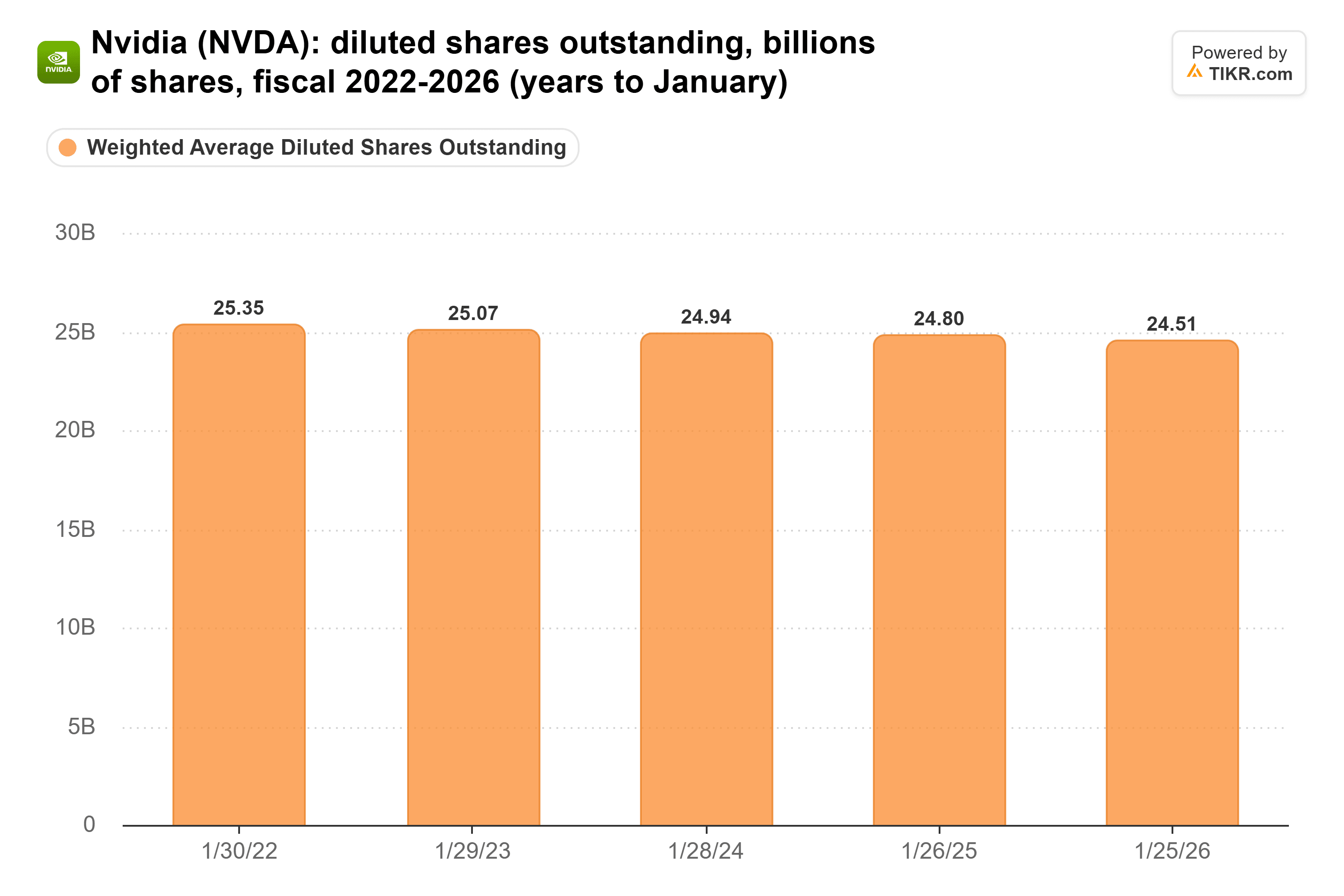
This is not a forecast of actual repurchases. The amount spent and shares retired will depend on the remaining authorization, available cash, future share prices, and management’s capital allocation priorities.
A lower share count could support earnings per share over time, particularly if NVIDIA maintains its expected earnings growth.
The company’s November 17 earnings report will provide a more immediate test.
NVIDIA previously guided for approximately $108 billion in fiscal third-quarter revenue, plus or minus 2%, following its $96.2 billion second-quarter performance.
Kress, who has served as CFO since 2013, provides management continuity during the transition.
In NVIDIA’s November 12 announcement, new board chair Harvey Jones stated, “The Board has full confidence in Colette and the leadership team.”
Nevertheless, potential export restrictions, regulatory investigations, and uncertainty surrounding NVIDIA’s permanent CEO appointment could affect revenue growth and investor confidence.
At $162.85, NVIDIA appears undervalued relative to its historical earnings multiples, with Ives’s $225 valuation suggesting approximately 38% potential upside.
Over the next 12 months, continued AI infrastructure investment, earnings growth, and share repurchases could support a recovery in NVIDIA’s valuation.
However, weaker guidance or additional regulatory setbacks could lead analysts to reduce earnings forecasts, making the stock’s seemingly inexpensive multiple less attractive.
The November 17 earnings report will therefore be crucial in determining whether NVIDIA’s recent decline represents a valuation opportunity or a broader reassessment of its growth prospects.
So what is NVIDIA stock actually worth?
TIKR lets you forecast the future price of any stock in less than a minute. Just enter a few assumptions into TIKR’s valuation model and see what NVIDIA could be worth. Start from Wall Street consensus estimates, or adjust the inputs to reflect your own view of the business. It’s free to use.
Disclaimer:
Please note that the articles on TIKR are not intended to serve as investment or financial advice from TIKR or our content team, nor are they recommendations to buy or sell any stocks. We create our content based on TIKR Terminal’s investment data and analysts’ estimates. Our analysis might not include recent company news or important updates. TIKR has no position in any of the stocks mentioned. Thank you for reading, and happy investing!