Key Takeaways
- CVS Health plans to split into two companies by the first half of 2028 and hasn’t said how its $2.66-a-share dividend will be divided between them.
- British American Tobacco yields 5.6% to CVS’s 3.0%, though its dividend has grown more slowly over the past five years.
- CVS’s dividend took 29% of free cash flow over the twelve months to June 30, against 78% for BAT.
- The choice comes down to a bigger check today against far more room to cover it.
On Nov. 4, CVS Health (CVS) gave income investors a lot to think about: it said it plans to split into two publicly traded companies by the first half of 2028.
British American Tobacco (BTI) spent the fall standing pat instead. At its Sept. 29 Capital Markets Day, it stood by its 2026 guidance and its goal of more than £50 billion of free cash flow from 2024 through 2030.
One yields 3.0%, the other 5.6%. If you could hold only one for the next 10 years, which dividend should it be?
| Metric | CVS Health | British American Tobacco |
|---|---|---|
| Dividend yield | 3.0% | 5.6% |
| Dividend growth, fiscal 2020-2025 | 5.9% a year | 2.2% a year |
| Dividend growth, fiscal 2015-2025 | 6.6% a year | 4.5% a year |
| Cash dividend payout ratio (TTM) | 29% | 78% |
| Net debt/EBITDA (LTM) | 3.0x | 2.9x |
| Interest coverage (LTM) | 3.9x | 5.2x |
| Forward P/E | 11x | 12x |
6 safe dividend stocks paying retirees 6%+ yields
There are over 100 stocks paying 6%+ annual dividends today.
But after an extensive investment review leveraging TIKR’s proprietary data, we now believe only six of them are truly safe for retirees.
They’re all yours as part of our new investment report. Learn more about how to get access right here.
CVS has room to spare, and a breakup ahead
CVS’s business is on the mend. Third-quarter revenue rose 5.4% from a year earlier to $108.4 billion. Management expects at least $8.65 of adjusted EPS in 2027, about 13% growth.
The dividend is well-covered, taking just 29% of free cash flow over the twelve months to June 30, 2026. Free cash flow fell from $15.8 billion in fiscal 2021 to $6.33 billion in fiscal 2024 while the dividend kept climbing. It began to recover in fiscal 2025:
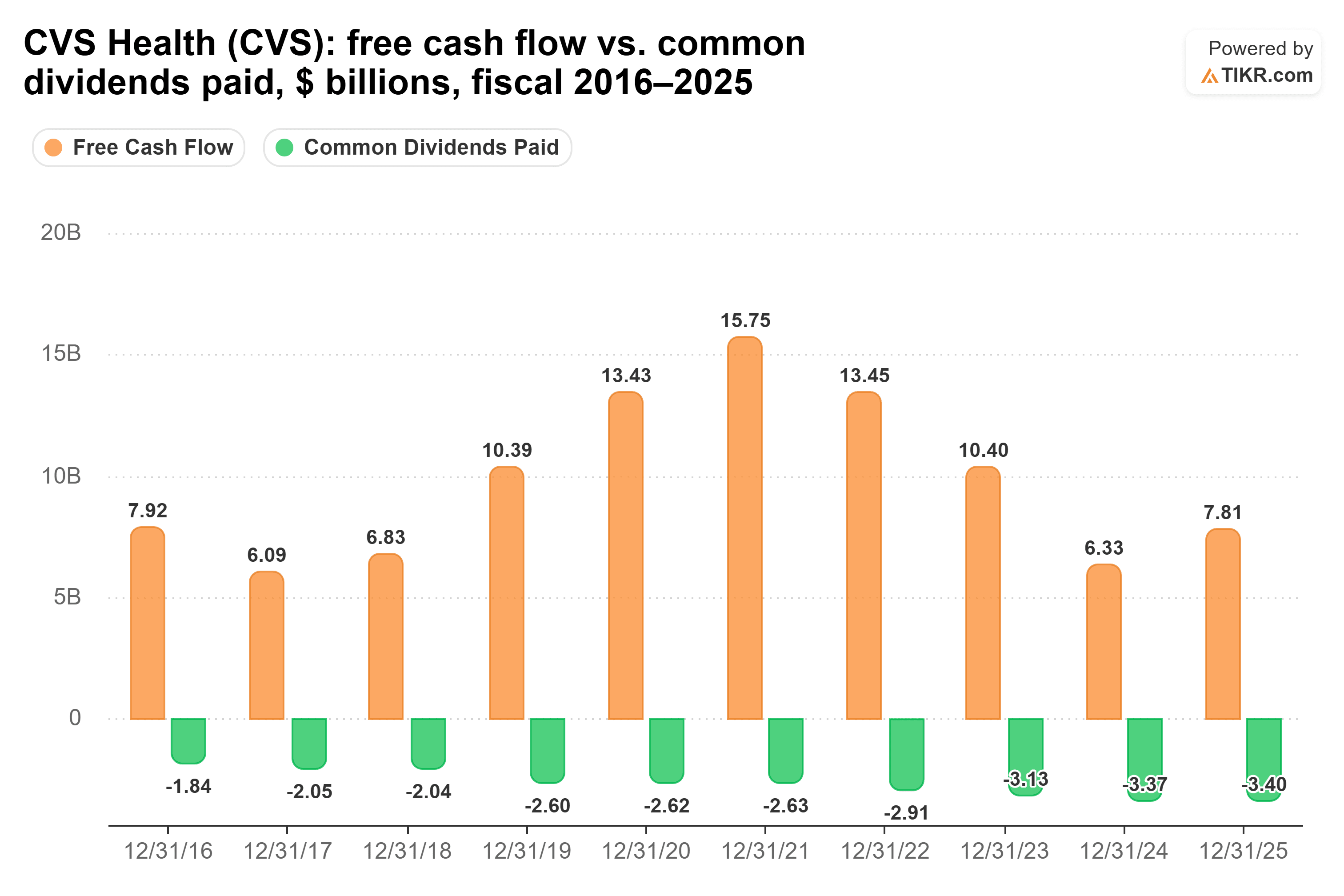
Management just raised its 2026 cash flow from operations guidance to at least $15.5 billion, from at least $11.5 billion.
The dividend itself is the problem. CVS didn’t raise it in fiscal 2025, and its Sept. 30 declaration kept the quarterly payment at $0.665 a share. CVS said in its Nov. 4 release that both companies are expected to have the balance sheet and free cash flow to pay an attractive dividend. But it didn’t say how today’s $2.66 a share will be divided between them.
BAT pays more, with a lot less slack
BAT is the opposite case. Its dividend is set in pounds, so its US-dollar amount moves with the currency. In pounds, it grew 2.2% a year from £2.99 in fiscal 2020 to £3.34 in fiscal 2025.
Velo nicotine pouches are growing in the US, where BAT now leads in 11 states. BAT expects 2026 EPS growth toward the middle of its 5%-8% range, and on Oct. 19 it said it plans to stop making cigarettes in South Africa as legal cigarettes lose share to contraband.
Over the twelve months to June 30, 2026, the dividend took 78% of free cash flow, which is covered but tight. From fiscal 2021 to fiscal 2024, it took 50% to 55% of free cash flow each year. Then free cash flow fell to £5.79 billion in fiscal 2025 from £9.64 billion, and the payout jumped to 91%:
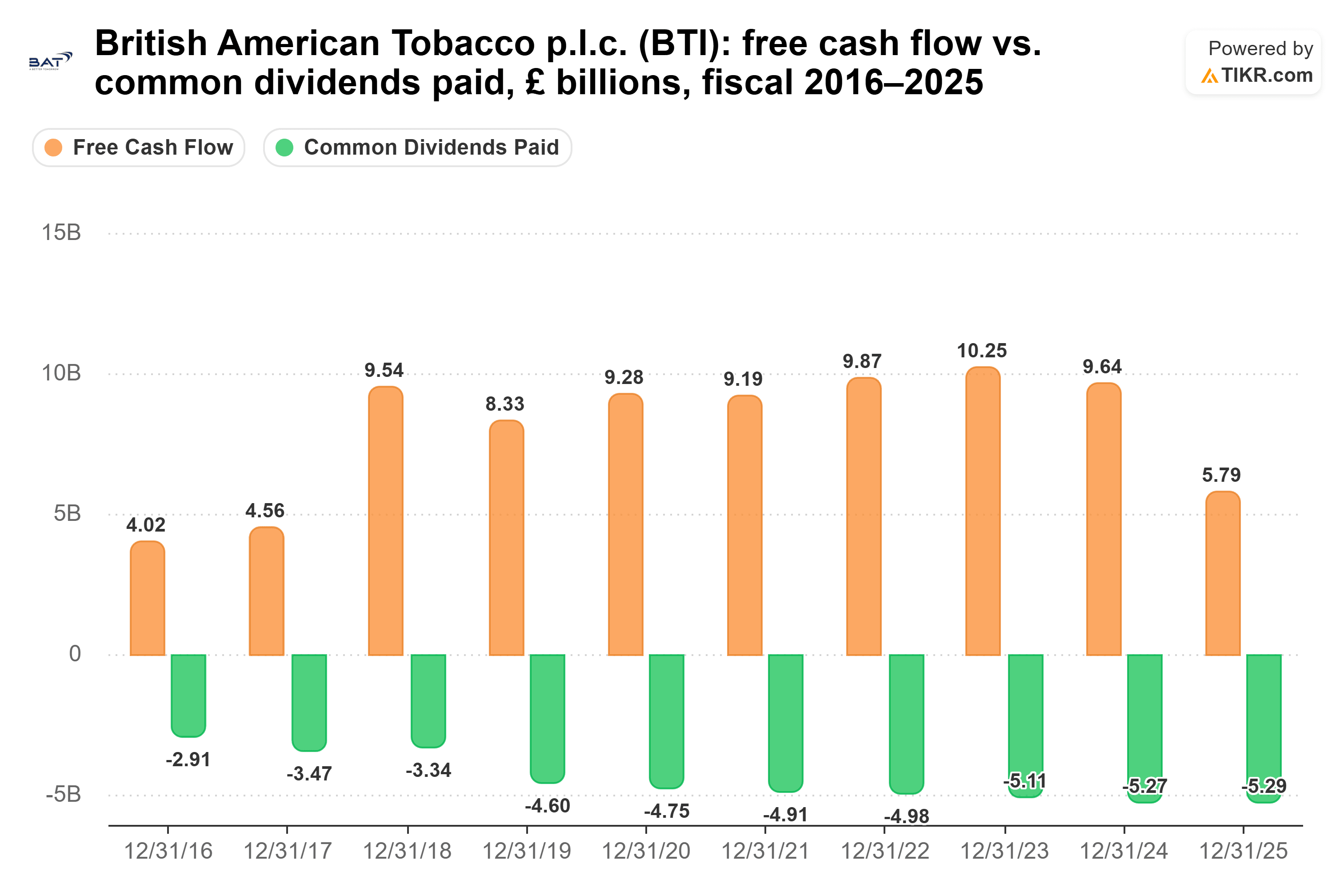
BAT calls its dividend progressive, and 78% leaves room for the modest growth it’s delivered. The main risk is illicit trade, from contraband cigarettes to cheap vapes that BAT says it can’t compete with on cost.
So which dividend wins?
I’d hold British American Tobacco for the next 10 years. At each stock’s 5-year dividend growth rate, $10,000 in BAT would pay about $6,199 over the decade, against about $3,930 from CVS. At the pace each dividend is growing now, it’s about $5,711 against $3,000. (BAT’s math is figured in pounds.) Even at its 5-year rate, CVS wouldn’t pass BAT until about 2044.
BAT only needs to grow its dividend 2.2% a year, and its balance sheet has gotten stronger. Net debt to EBITDA fell from 3.2x in fiscal 2022 to 2.6x in fiscal 2023, and held there through fiscal 2025:
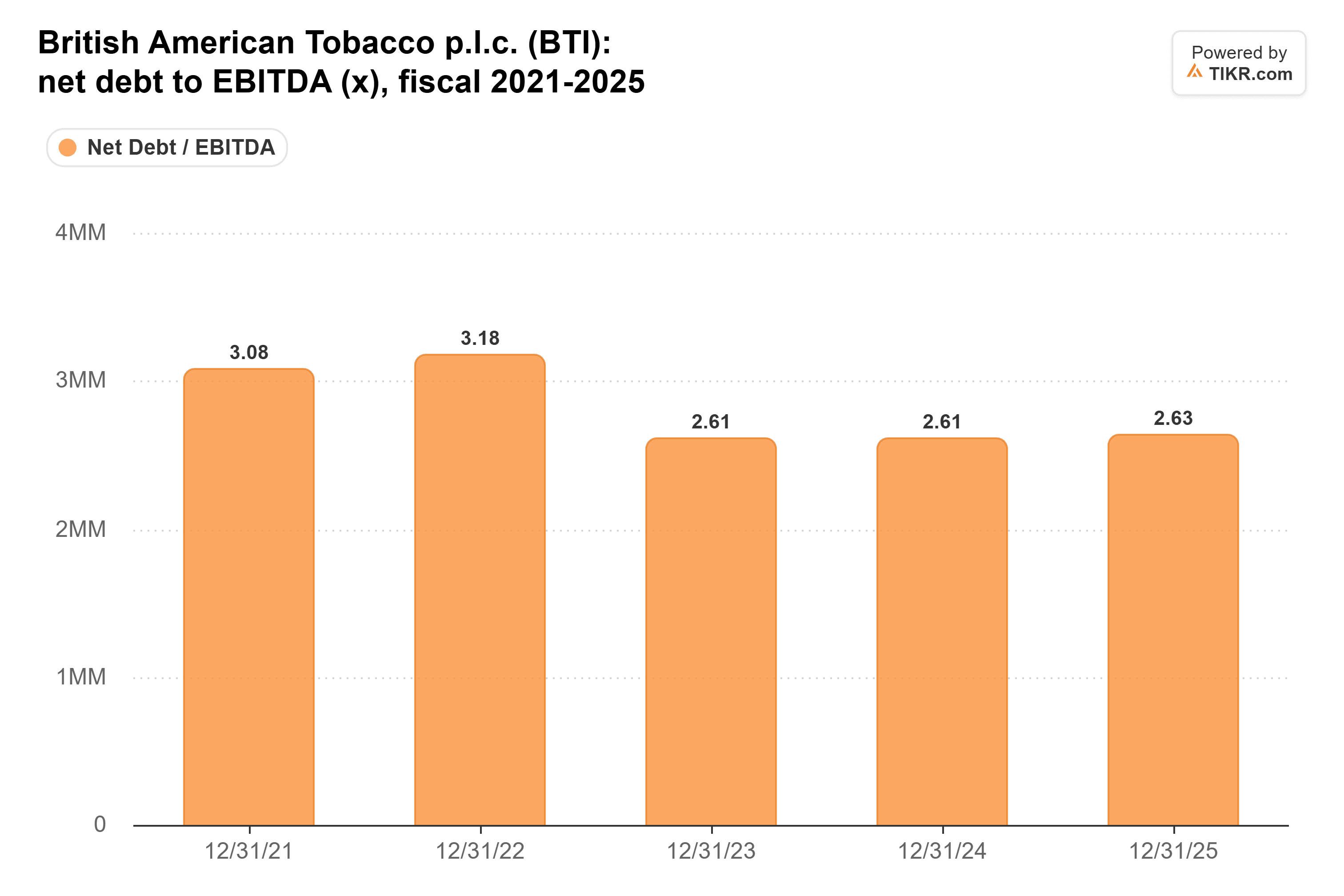
It’s 2.9x over the latest twelve months, so BAT still has work to do to reach the 2.0-2.5x range it expects by the end of 2026.
That doesn’t make CVS’s dividend unsafe. Its coverage is wide, earnings are recovering, and at 11x forward earnings the stock is cheaper than BAT at 12x. But its dividend is about to be split between two companies on terms CVS hasn’t spelled out. That’s a harder check to plan a decade around.
Of course, if BAT’s free cash flow slides back toward fiscal 2025’s level, a 91% payout leaves little room to keep raising. Its full-year results are the next thing I’d check.
Forget British American Tobacco: 6 safe 6%+ dividend yields you can buy right now
Dividends can hold the key to enormous wealth. But only if you buy the right ones.
Picking the right high-yield dividend stock can be the difference between a dream retirement…and scraping by every month, waiting for the next Social Security check to clear.
We’ve identified six stocks yielding 6%+ that we believe every retiree should know about right now. (And British American Tobacco isn’t one of them.)
Disclaimer:
Please note that the articles on TIKR are not intended to serve as investment or financial advice from TIKR or our content team, nor are they recommendations to buy or sell any stocks. We create our content based on TIKR Terminal’s investment data and analysts’ estimates. Our analysis might not include recent company news or important updates. TIKR has no position in any of the stocks mentioned. Thank you for reading, and happy investing!