Key Takeaways
- CrowdStrike shares fell nearly 12% in the past week, mostly on its $43.9 billion all-stock deal for Zscaler, announced Nov. 23.
- Investors looked past a record quarter, with net new ARR up 58% to $419 million.
- The deal adds roughly 19% more CrowdStrike shares, the kind of dilution Palo Alto Networks took on for its own deals.
- The selloff looks overdone, though the deal isn’t expected to close until the second half of CrowdStrike’s fiscal 2028, which ends in January 2028.
CrowdStrike (CRWD) stock is down 11.7% in the past week, most of it on Nov. 23, when it fell 8.9% after agreeing to buy Zscaler (ZS) for $43.9 billion in stock. The deal takes it into network security against Palo Alto Networks (PANW).
A record quarter got buried
CrowdStrike also reported its third quarter that morning. Net new ARR jumped 58% to a record $419 million, well above the roughly $345 million guidance implied, and ending ARR grew 27% to $6.26 billion. Analysts expect revenue to nearly double, from $4.81 billion in the year ended January 2026 to about $9.3 billion in the year ending January 2029, before any Zscaler revenue:

Investors balked at the bill
Zscaler holders get 1.135 CrowdStrike shares for each of their shares, a 34% premium to Zscaler’s Nov. 20 close. They’d own 15.9% of the combined company, which works out to roughly 19% more CrowdStrike shares. CEO George Kurtz’s answer is how few customers the two share: “We only overlap in 2,000 accounts. They’ve got about 10,000 accounts,” he told Jim Cramer on Mad Money.
For Zscaler holders, the payout moves with CrowdStrike’s stock: at the Nov. 25 close, 1.135 CrowdStrike shares were worth about $238, down from about $260 when the deal was announced. Zscaler’s ARR grew 21% to $3.88 billion last quarter, slower than CrowdStrike’s 27%.
Palo Alto has lived with this kind of dilution: it paid for CyberArk, a $21.1 billion deal at closing, mostly in stock. In fiscal 2026, its non-GAAP net income grew 25%, but its diluted share count rose to 764 million from 702 million, so non-GAAP EPS grew only 15%. Its next-generation security ARR rose 66% last quarter, helped by CyberArk and Chronosphere, which it didn’t own a year earlier. The lesson for CrowdStrike holders: a deal can pay off for the business before it pays off per share.
TIKR tracks 48 analysts on CrowdStrike. How many say “Buy”?
See the full breakdown of Buy, Hold, and Sell ratings on CrowdStrike, along with Wall Street’s revenue and earnings estimates, all in one place. More than 500,000 investors use TIKR to research stocks like this one. See CrowdStrike’s Analyst Ratings
Is CrowdStrike a buy after the drop?
CrowdStrike traded at about 139x forward earnings on Nov. 24. That’s down from about 160x in mid-November, but still above its five-year average of 109x:
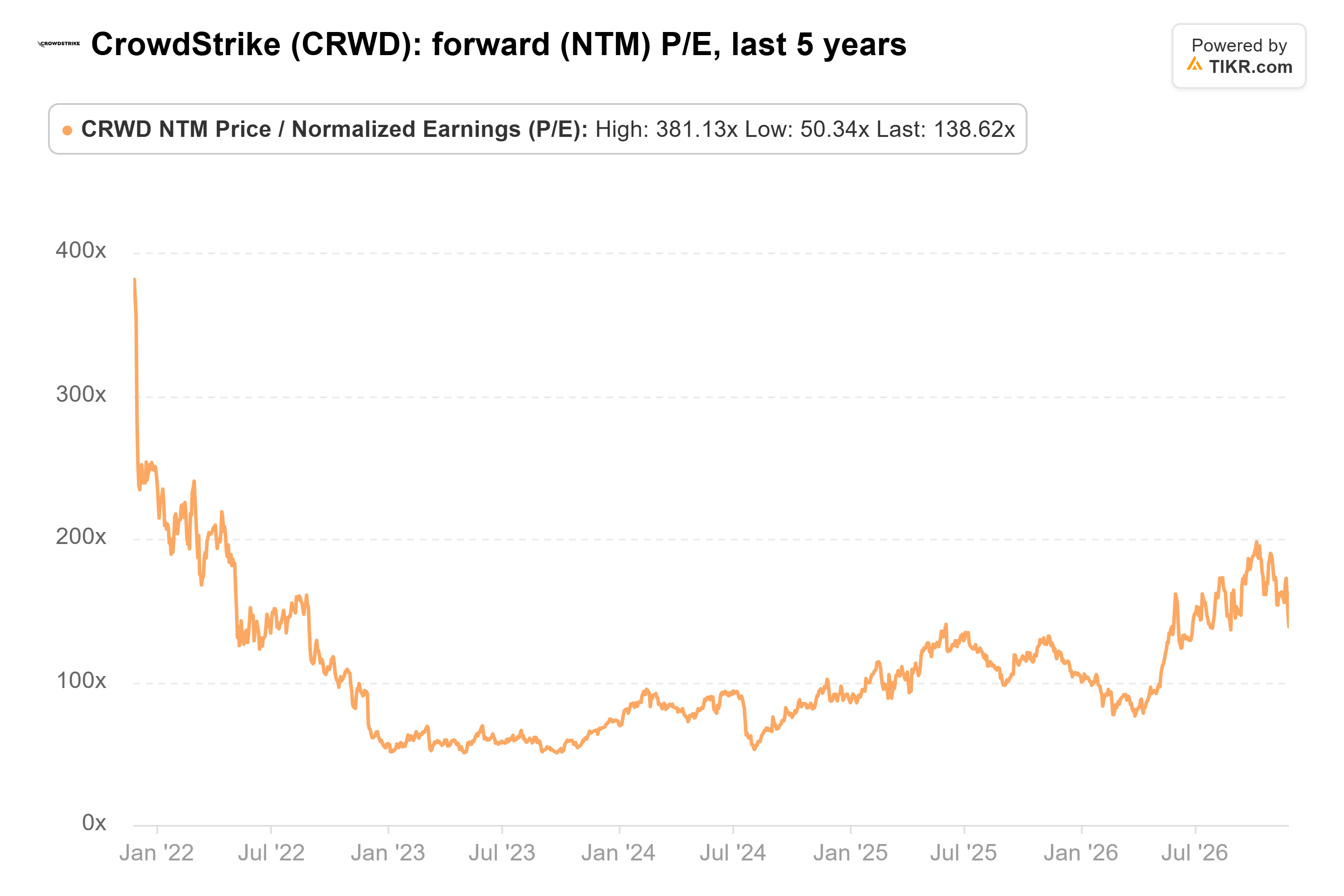
The selloff charges CrowdStrike too much for the dilution. A business that’s still speeding up is buying a path to about 8,000 Zscaler customers that don’t use CrowdStrike yet. The risk is time: the deal is expected to close in the second half of CrowdStrike’s fiscal 2028, which runs from August 2027 to January 2028. The first test is the January-quarter report, expected in early March, where management has guided for a record $452 million to $456 million of net new ARR.
So what is CrowdStrike stock actually worth?
TIKR lets you forecast the future price of any stock in less than a minute. Just enter a few assumptions into TIKR’s valuation model and see what CrowdStrike could be worth. Start from Wall Street consensus estimates, or adjust the inputs to reflect your own view of the business. It’s free to use.
Disclaimer:
Please note that the articles on TIKR are not intended to serve as investment or financial advice from TIKR or our content team, nor are they recommendations to buy or sell any stocks. We create our content based on TIKR Terminal’s investment data and analysts’ estimates. Our analysis might not include recent company news or important updates. TIKR has no position in any of the stocks mentioned. Thank you for reading, and happy investing!