Key Takeaways
- CrowdStrike agreed on Nov. 23 to buy Zscaler in an all-stock deal valued at about $43.9 billion, a 34% premium to Zscaler’s Nov. 20 close.
- The discount survived the premium: at the offer, Zscaler goes for roughly 53x forward earnings, about half its five-year average.
- Adding Zscaler would help CrowdStrike match Palo Alto Networks and put more pressure on Fortinet.
- The risks are roughly 19% dilution and a distracting integration, and the deal still needs Zscaler shareholder and regulatory approval.
CrowdStrike (CRWD) agreed to buy Zscaler (ZS) on Monday, Nov. 23, three days after Bloomberg reported the talks. Zscaler holders will get 1.135 CrowdStrike shares for each share, worth $260.41 at Friday’s close. Zscaler closed Monday up 17.7%, and CrowdStrike fell 8.9%, which cut the offer’s value to about $237.
Before the report, Zscaler had a market value of $32 billion and was down 13% this year, while Palo Alto Networks (PANW) had nearly doubled. The deal adds Zscaler’s cloud network security to CrowdStrike’s endpoint business, giving it a much better shot at matching Palo Alto, and at taking on Fortinet (FTNT) for network security budgets.
Palo Alto is winning on platforms
On its Nov. 18 call, Palo Alto said it added about 170 net new platform deals in its fiscal first quarter, more than its previous two first quarters combined. CEO Nikesh Arora told Jim Cramer on Mad Money that “this approach that they had to spray and pray is not going to work. They’re going to have to go consolidate into platforms.”
Palo Alto has also bought its way into new categories, closing its CyberArk acquisition in February. Zscaler gives CrowdStrike the same kind of shortcut.
Fortinet makes the same consolidation pitch from the network side. In its third-quarter release, it reported revenue up 20% to $2.08 billion and billings up 29% to $2.34 billion, and it raised its 2026 billings guidance for the third time this year. A CrowdStrike that owns Zscaler would be one more big platform chasing the same budgets.
TIKR tracks 54 analysts on CrowdStrike. How many say “Buy”?
See the full breakdown of Buy, Hold, and Sell ratings on CrowdStrike, along with Wall Street’s revenue and earnings estimates, all in one place. More than 500,000 investors use TIKR to research stocks like this one. See CrowdStrike’s Analyst Ratings
The “50% discount” checks out
Stephanie Link, chief investment strategist at Hightower, has been adding to her Zscaler position. On Friday’s Halftime Report on CNBC, hours before Bloomberg’s report, she said the stock is “at a 50% discount” to its historical average, calling it “the laggard that I think can play catch up.”
The business hasn’t stalled. Zscaler’s normalized EPS rose 28% to $4.21 in fiscal 2026 (the year ended July), and consensus has it reaching $5.63 by fiscal 2028. On Monday, it also reported fiscal first-quarter revenue up 20% to $949.3 million:

But the stock hasn’t kept up. Before the report, Zscaler traded at 40x forward earnings, against a five-year average of 108x:
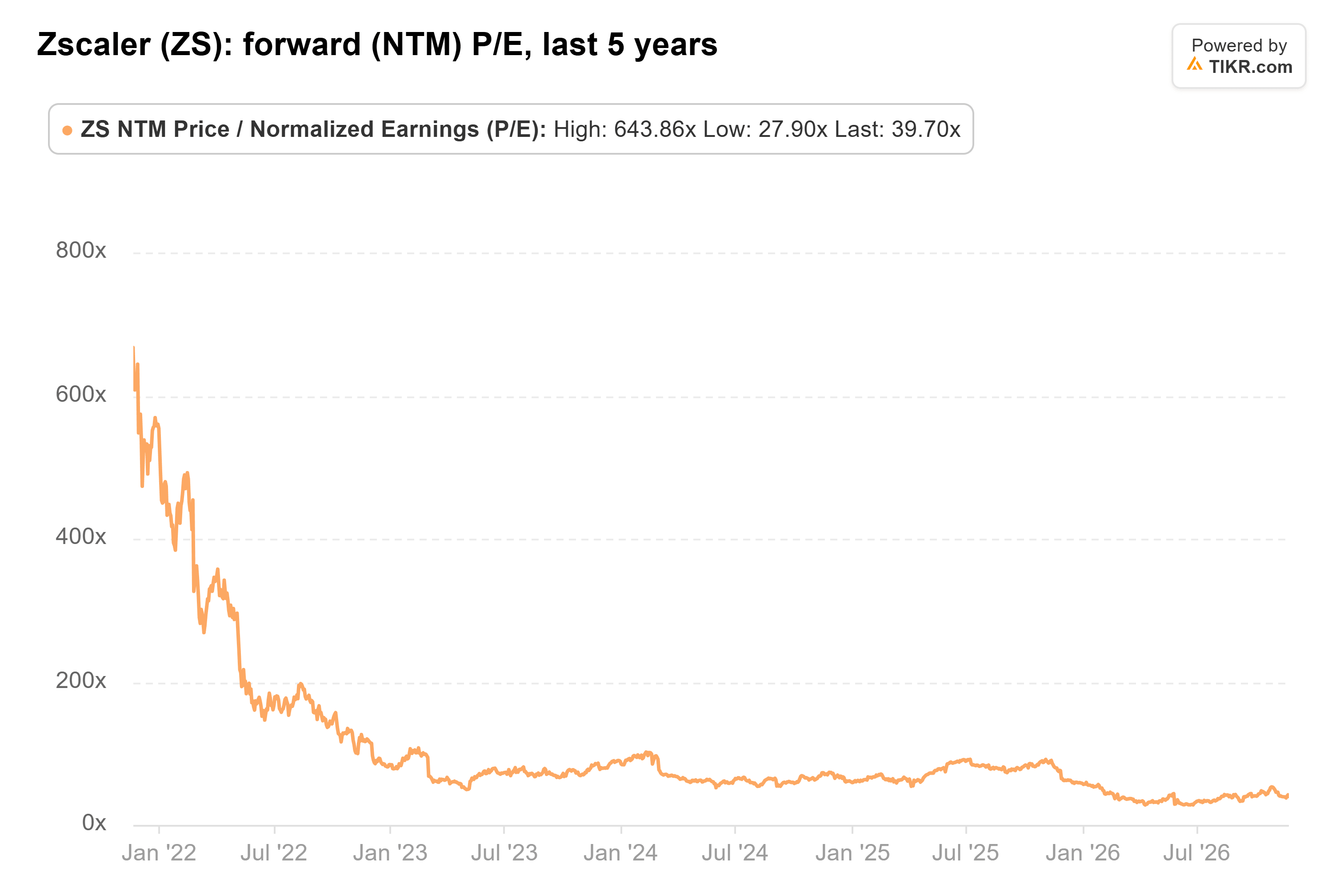
On that measure, the discount is even bigger than Link’s 50%, partly because the multiple topped 600x in late 2021. Monday’s jump takes it to about 47x, and CrowdStrike’s offer works out to roughly 53x, still about half the five-year average.
CrowdStrike would pay with pricier stock
CrowdStrike’s own forward P/E averaged about 125x over the past year, against Zscaler’s 40x before the report, which makes its stock a strong currency for a deal. It’s paying entirely in stock: CrowdStrike had $5.37 billion of cash at Oct. 31, and the $43.9 billion price is more than 8x that.
CrowdStrike’s free cash flow has nearly tripled since fiscal 2022, reaching $1.31 billion in fiscal 2026 (the year ended January):

That’s strong, but nowhere near enough to pay cash for Zscaler.
The risks are dilution and distraction. CrowdStrike’s diluted share count already climbed from 909 million in fiscal 2022 to 1 billion in fiscal 2026, and Zscaler holders will own about 15.9% of the combined company, which means roughly 19% more shares. The integration also lands at a peak: net new ARR jumped 58% to a record $419.2 million in the quarter to Oct. 31, well above the $343 million to $347 million CrowdStrike had guided.
The discount survived a 34% premium
At the offer price, CrowdStrike gets a business that analysts expect to grow EPS 34% over the next two fiscal years at roughly half its five-year average multiple, and it pays with stock the market values far more richly. The market still marked CrowdStrike down 8.9%, which suggests investors weigh the 19% dilution and the integration more heavily than the discount.
The deal still needs Zscaler shareholders and regulators, though founder Jay Chaudhry and his affiliates, with about 34% of the shares, have agreed to vote for it. CrowdStrike expects to close in the second half of its fiscal 2028. The nearer checkpoint is its report for the quarter ending Jan. 31: CrowdStrike now guides to 45% net new ARR growth for fiscal 2027 at the midpoint, and falling short of that while it plans the integration would be the first sign the deal is costing it focus.
So what is Zscaler stock actually worth if the deal doesn’t go through?
TIKR lets you forecast the future price of any stock in less than a minute. Just enter a few assumptions into TIKR’s valuation model and see what Zscaler could be worth. Start from Wall Street consensus estimates, or adjust the inputs to reflect your own view of the business. It’s free to use.
Disclaimer:
Please note that the articles on TIKR are not intended to serve as investment or financial advice from TIKR or our content team, nor are they recommendations to buy or sell any stocks. We create our content based on TIKR Terminal’s investment data and analysts’ estimates. Our analysis might not include recent company news or important updates. TIKR has no position in any of the stocks mentioned. Thank you for reading, and happy investing!