Key Takeaways
- Uber Eats’ first drone delivery with Zipline is live in Spring, Texas, and Uber’s president is targeting one million drone deliveries a day by the end of 2029.
- Uber is building one delivery network of couriers, sidewalk robots and drones, and cheaper modes are a path to fatter delivery margins.
- Delivery earned 3.9 cents of segment profit per booking dollar in 2025, less than half the 8.1 cents rides earned.
- Drone delivery at this scale is unproven, so watch how quickly the service reaches Dallas and the dozens of cities after it.
Uber Technologies (UBER) just added a new icon to the Uber Eats app: a drone.
Customers in Spring, Texas, a Houston suburb, can now have their food lowered to the door by a Zipline drone. It’s the partnership’s first commercial launch. Dallas is next, and Uber and Zipline plan to add dozens more U.S. cities after that.
Uber President and COO Andrew Macdonald summed up the plan on X: “Couriers, sidewalk robots and drones. One network. The right mode for every order.”
Then came the number: “Just getting started: 1M drone deliveries a day by the end of 2029.”
A million a day is smaller than it sounds
For a drone company, a million deliveries a day would be huge. At Uber’s scale, it’s modest. A million a day comes to 365 million deliveries a year. Uber completed 13.6 billion trips in 2025, counting rides and food orders together. So even if Zipline hit the target tomorrow, drones would carry under 3% of last year’s volume.
And Uber’s volume keeps growing. Analysts expect revenue to climb from $52.0 billion in 2025 to $76.8 billion in 2028:
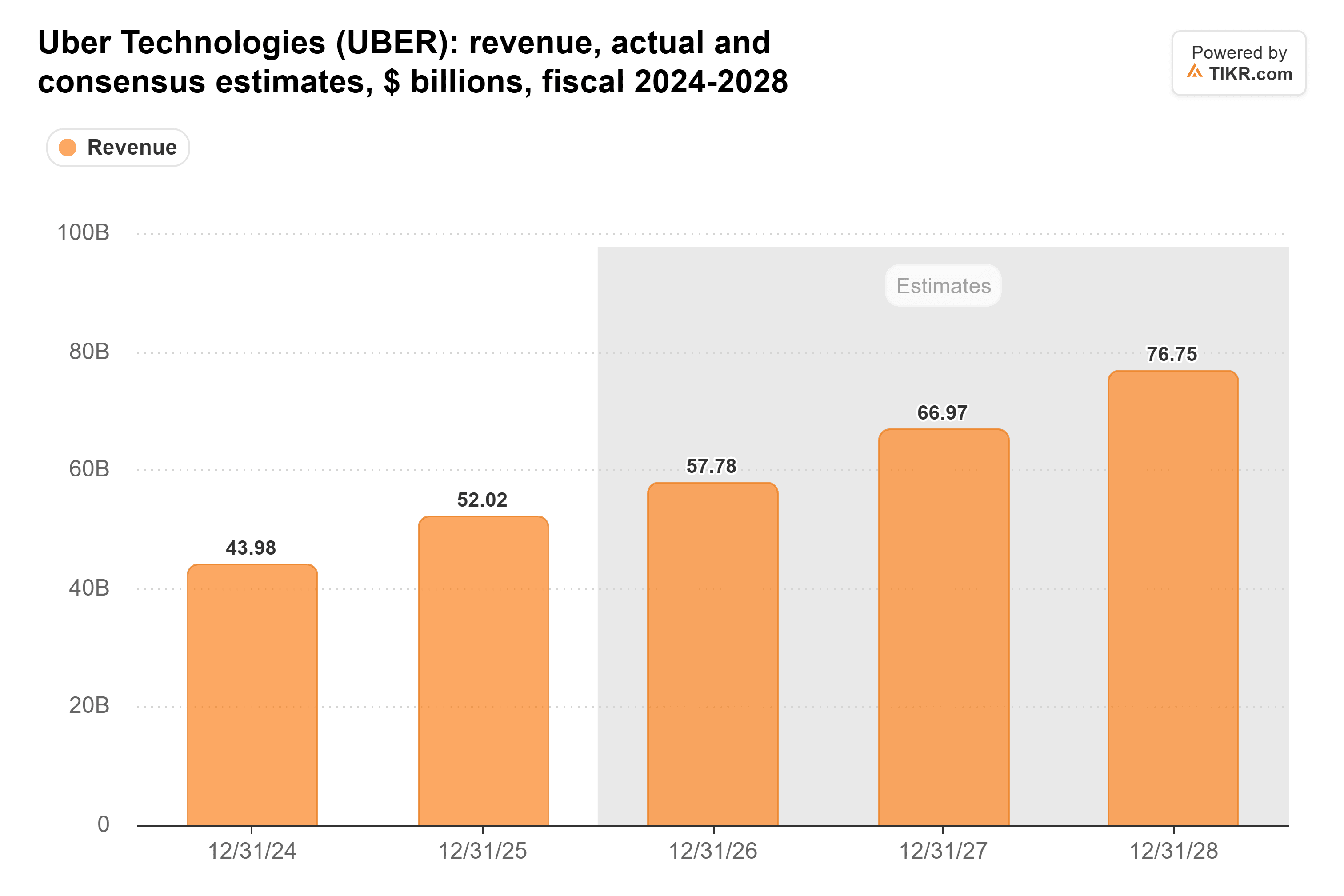
A drone launch in one Houston suburb won’t move those estimates, and it shouldn’t. Any payoff from drones is years away.
TIKR tracks 50 analysts on Uber. How many say “Buy”?
See the full breakdown of Buy, Hold, and Sell ratings on Uber, along with Wall Street’s revenue and earnings estimates, all in one place. More than 500,000 investors use TIKR to research stocks like this one. See Uber’s Analyst Ratings
Delivery has the thinner margin, and the most to gain
Uber’s GAAP operating margin has come a long way, from -22.0% in 2021 to 10.7% in 2025:
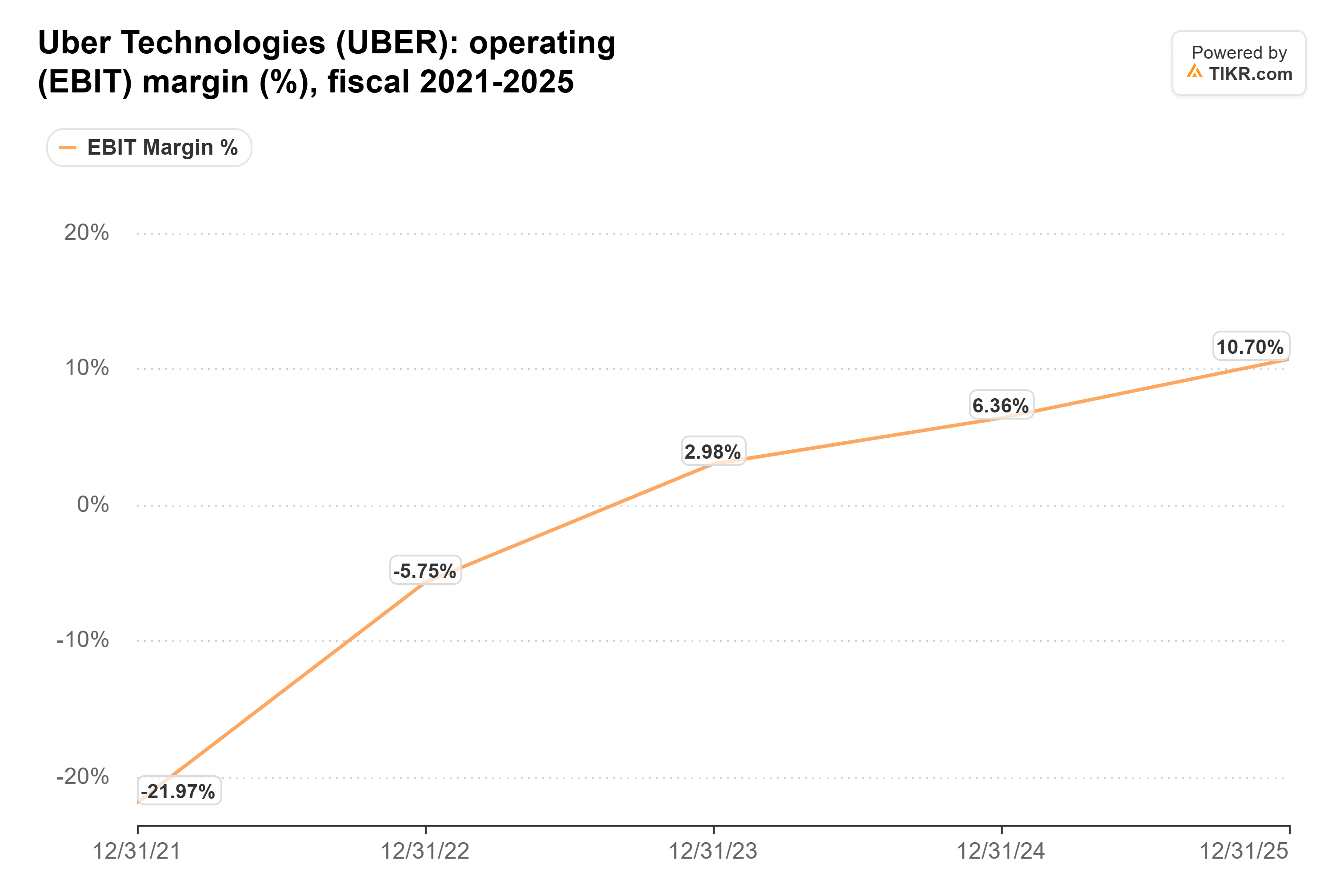
Most of that profit still comes from rides. In 2025, Delivery earned 3.9 cents of segment adjusted EBITDA on each dollar of bookings, up from 3.3 cents in 2024. Mobility earned 8.1 cents. With $90.9 billion of Delivery bookings last year, every extra tenth of a cent is worth about $90 million a year.
My read: that’s what “the right mode for every order” is really about. Neither company has said what a drone drop costs compared with a courier. But any order a drone or a sidewalk robot can handle for less leaves Uber more to keep, or more room to cut fees and win orders.
Zipline owns the drones, and Uber owns a piece of Zipline
Of course, nobody has run drone delivery at this scale yet. Zipline, Alphabet’s Wing and Amazon’s Prime Air have been at it for years. In some places, their plans have run into residents worried about noise, safety and privacy.
The drones are also Zipline’s, so Uber splits the economics of every drop with its partner, and neither company has said how. But Uber also backed Zipline’s $1.5 billion funding round, announced earlier this month, so it gets a share of Zipline’s upside too. (Neither company has disclosed how much Uber put in.)
And Uber can afford the bet. Free cash flow went from negative $740 million in 2021 to $9.8 billion in 2025:
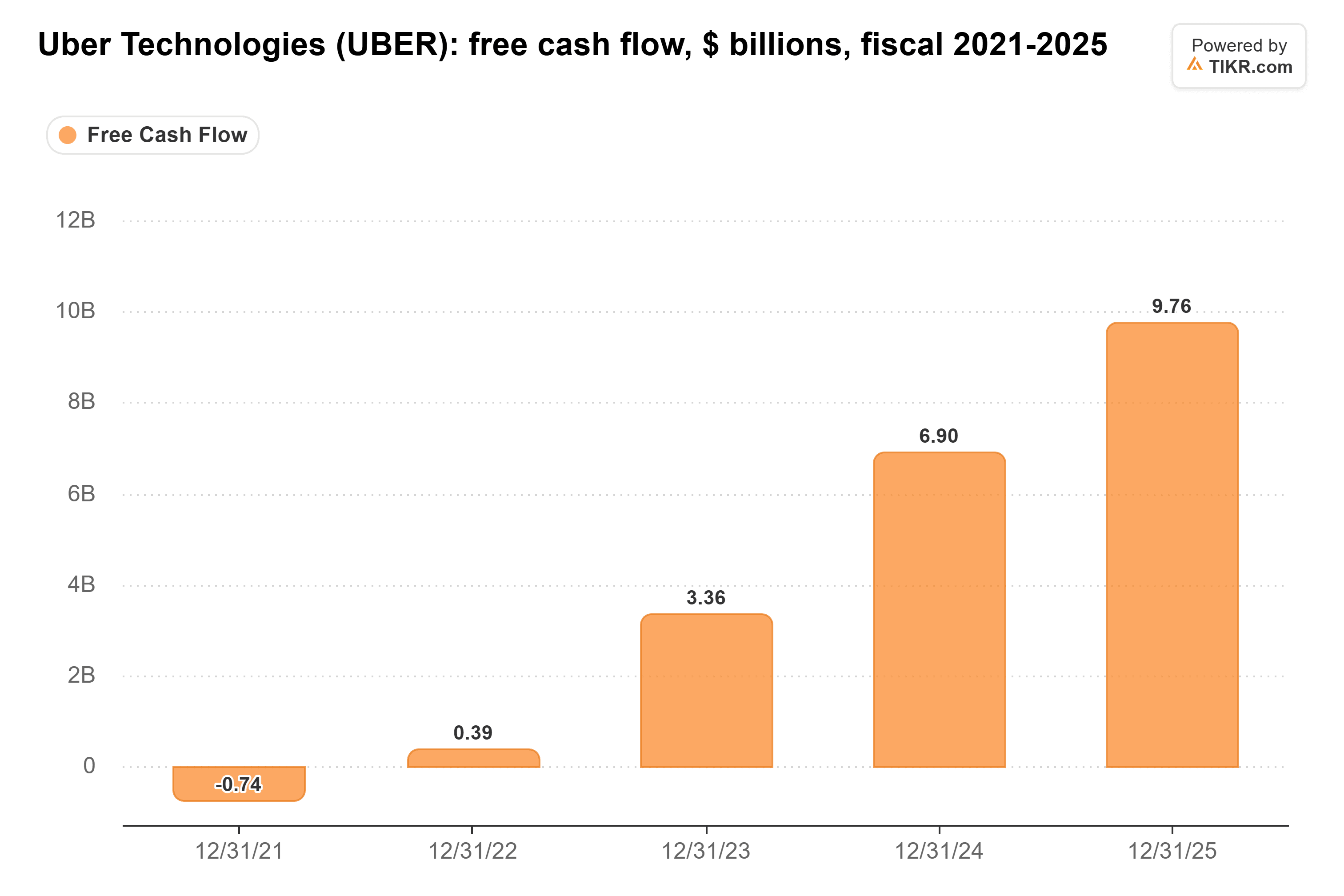
Over the twelve months through September, it reached a record $10.4 billion.
Uber doesn’t need the full million
The way I see it, a million drone drops a day by the end of 2029 is a long way from one Houston suburb today. But Uber doesn’t need the full target for this to pay off: every order a cheaper mode takes helps close delivery’s margin gap with rides.
Of course, it’s early, and the next test is how fast the drones spread beyond Houston. If those launches drag, the “right mode for every order” will still mostly be a courier for years.
So what is Uber stock actually worth?
TIKR lets you forecast the future price of any stock in less than a minute. Just enter a few assumptions into TIKR’s valuation model and see what Uber could be worth. Start from Wall Street consensus estimates, or adjust the inputs to reflect your own view of the business. It’s free to use.
Disclaimer:
Please note that the articles on TIKR are not intended to serve as investment or financial advice from TIKR or our content team, nor are they recommendations to buy or sell any stocks. We create our content based on TIKR Terminal’s investment data and analysts’ estimates. Our analysis might not include recent company news or important updates. TIKR has no position in any of the stocks mentioned. Thank you for reading, and happy investing!