Key Takeaways
- CoreWeave’s banks are reportedly getting ready to sell a $4.5 billion loan secured by the GPUs for its Meta contract, with early pricing talk of 7% to 7.5%.
- CoreWeave’s 2031 bonds yield nearly 18%, so lenders are pricing its debt by the customer behind each dollar.
- The cheap loan pays for Meta’s capacity, but the unsecured bonds and the stock carry the risk of the rest of the business.
- IREN’s backlog is mostly with investment-grade customers, and the same split will set what its remaining funding costs.
CoreWeave (CRWV) can still borrow cheaply, as long as Meta Platforms (META) is the customer behind the loan.
CoreWeave’s bankers at Morgan Stanley and MUFG are getting ready to sell a $4.5 billion loan as soon as next week, Bloomberg reported on Wednesday. The loan is secured by the GPUs CoreWeave is buying for its Meta contract, and early pricing talk is 7% to 7.5%.
On the same day, CoreWeave’s 9% bonds due 2031 hit record lows, yielding nearly 18%.
That gap matters beyond CoreWeave. I’d expect lenders to price IREN (IREN)‘s next raises the same way.
Lenders are pricing the customer
The loan is expected to get investment-grade ratings because Meta’s contract backs it, even though CoreWeave itself is rated junk. Even this cheap tier has gotten more expensive, though: CoreWeave’s investment-grade loan in March priced below 6%. The rest of CoreWeave’s debt is priced as if it belonged to a different company. Five-year default swaps cost 1,332 basis points, according to FactSet, and reportedly price in a better than 70% chance of default within five years.
TIKR tracks 41 analysts on CoreWeave. How many say “Buy”?
See the full breakdown of Buy, Hold, and Sell ratings on CoreWeave, along with Wall Street’s revenue and earnings estimates, all in one place. More than 500,000 investors use TIKR to research stocks like this one. See CoreWeave’s Analyst Ratings
Bondholders are betting on everything else
The GPU loans sit in subsidiaries that get paid from the contracts behind them. CoreWeave’s unsecured notes and convertibles, $20.8 billion of principal at Sept. 30, sit at the parent and get paid from whatever the whole business earns. Analysts expect EBITDA to climb from $3.09 billion in 2025 to $29.6 billion in 2028:
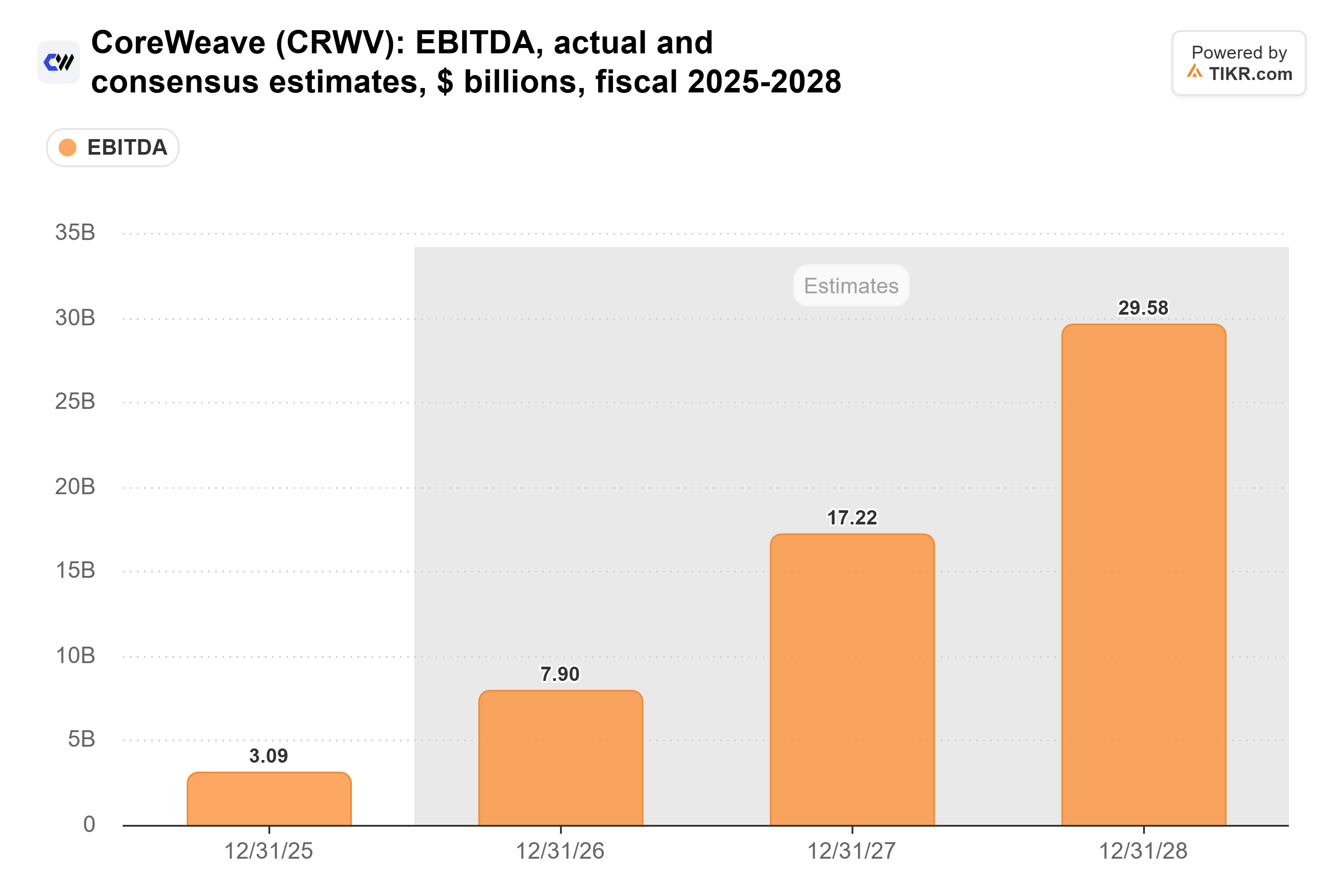
A loan sale shouldn’t change those estimates, though it does lower what part of the build behind them costs. Bond buyers aren’t taking that growth on faith. On Monday, CoreWeave stock jumped 22%, but its 2031 bonds fell.
The interest bill grows with the debt
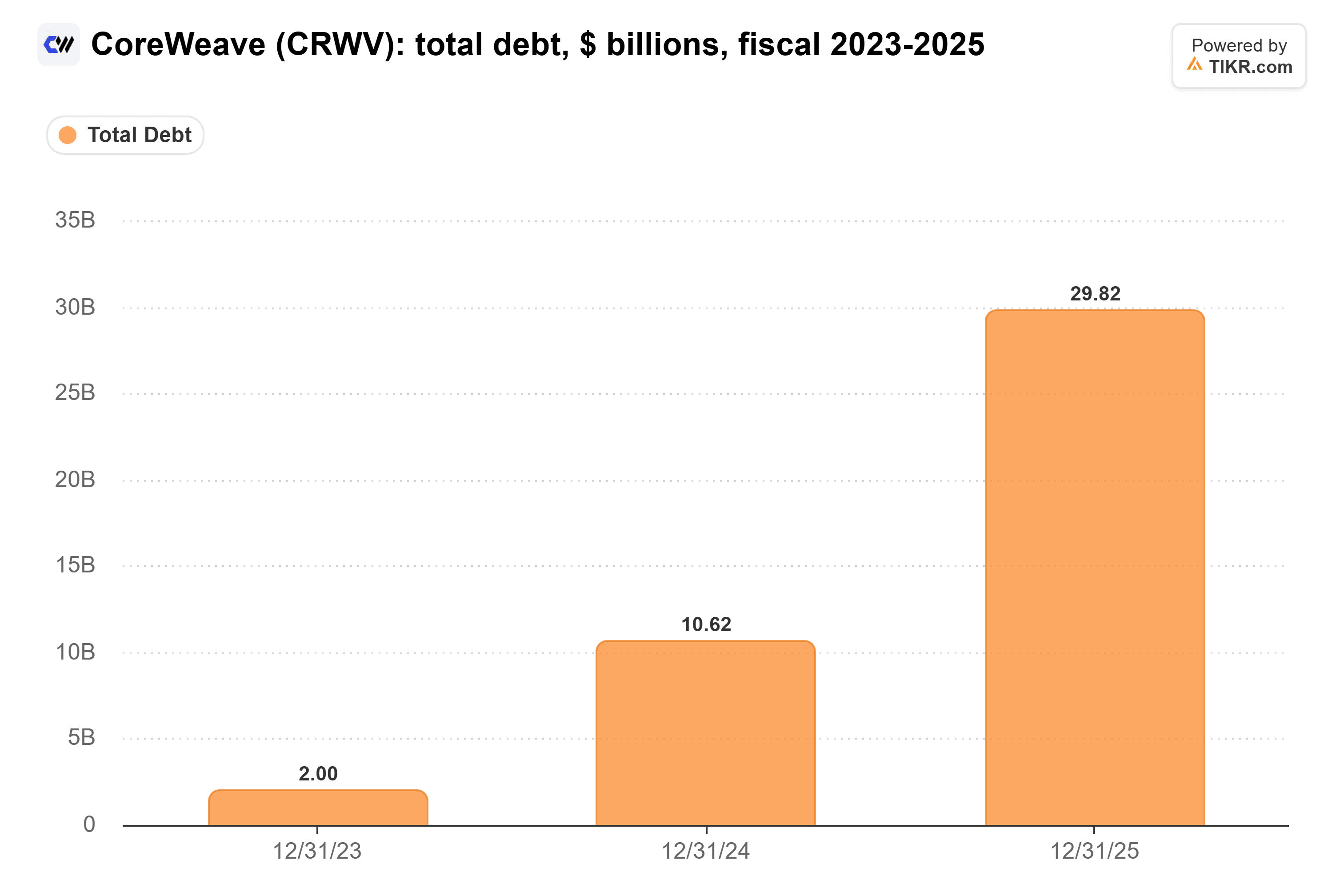
CoreWeave has piled on debt to build capacity. On TIKR, its total debt, which includes lease liabilities, went from $2.0 billion in 2023 to $29.8 billion in 2025:
The interest bill grew along with it, from $28.0 million of interest expense in 2023 to $1.23 billion in 2025:
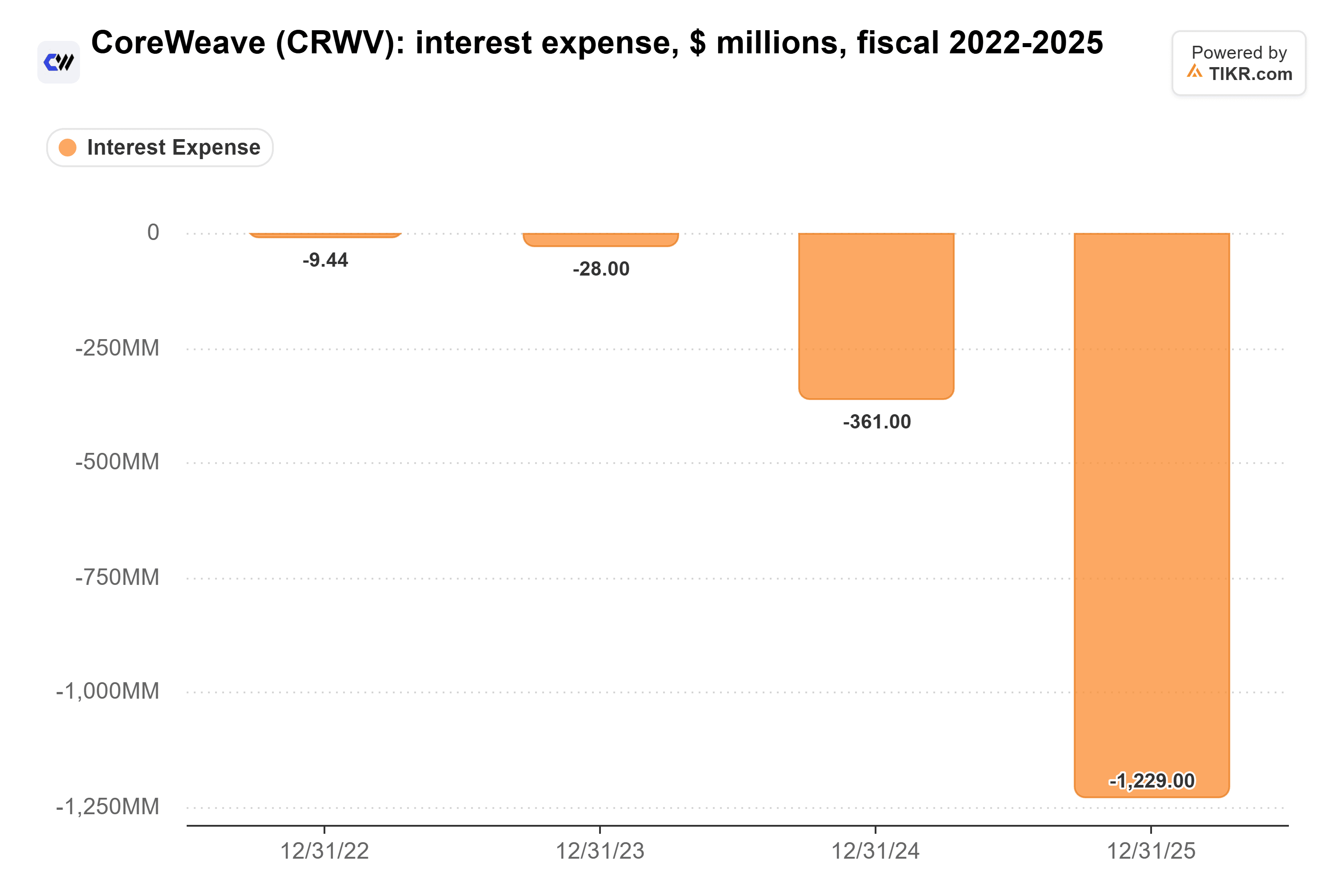
That 2025 bill took about 40% of the year’s EBITDA. So every point of interest CoreWeave saves counts, and on $4.5 billion, the Meta loan saves a lot of them.
But none of the $4.5 billion goes toward the unsecured bonds. When CoreWeave needs money at the parent, it has to borrow at rates near where those bonds trade, or sell stock.
IREN still has $6 billion to raise
Every neocloud with a big build to fund now faces the same split. In its Nov. 5 results release, IREN reported a $20.3 billion backlog at Sept. 30, about two-thirds of it with investment-grade customers. Cash, committed GPU financing and customer prepayments cover $9 billion of its $15 billion of fiscal 2027 capex (its fiscal year ends in June). The other $6 billion is still to come, partly from corporate-level sources. The question for its next report, around mid-February, is how much of that has to be raised at the corporate level, where lenders are charging CoreWeave nearly 18%.
Good for the build, less so for shareholders
Bottom line: the Meta loan shows CoreWeave can still fund the capacity its biggest customers have signed for. But shareholders stand behind the unsecured bonds, and until CoreWeave can borrow at the parent much closer to its contract-backed rate, I’d give the bond price more weight than the loan price.
The first test comes next week, if the loan prices at or under 7.5%. The bigger one is CoreWeave’s next parent-level raise: a new unsecured deal priced well below where the 2031 bonds trade would show lenders coming back, and one priced near 18% would confirm the bond market’s read.
So what is CoreWeave stock actually worth?
TIKR lets you forecast the future price of any stock in less than a minute. Just enter a few assumptions into TIKR’s valuation model and see what CoreWeave could be worth. Start from Wall Street consensus estimates, or adjust the inputs to reflect your own view of the business. It’s free to use.
Disclaimer:
Please note that the articles on TIKR are not intended to serve as investment or financial advice from TIKR or our content team, nor are they recommendations to buy or sell any stocks. We create our content based on TIKR Terminal’s investment data and analysts’ estimates. Our analysis might not include recent company news or important updates. TIKR has no position in any of the stocks mentioned. Thank you for reading, and happy investing!