Key Stats for COIN Stock
- Past week performance: -3.0%
- 52-week range: $139 to $402
- Valuation model target price: $245
- Implied upside: 25.3% over 4.3 years
Measure Coinbase’s recovery odds with 5 years of analyst forecasts (It’s free) >>>
Bitcoin’s Round Trip Drags Coinbase Lower
Coinbase Global (COIN) shares fell about 3.0% over the past week, closing Friday near $195. Crypto stocks rallied early in the week after bitcoin hit a multi-month high. However, those gains faded once bitcoin pulled back. Because Coinbase earns fees when customers trade, its stock tends to move with crypto prices.
Regulators delivered mixed news. The SEC approved a five-year exemption allowing qualifying platforms to trade tokenized U.S. stocks, which are blockchain versions of regular shares. Coinbase has said it wants to offer them once permitted. Meanwhile, New York sued Polymarket over prediction markets, a fight the state already extended to Coinbase in April.
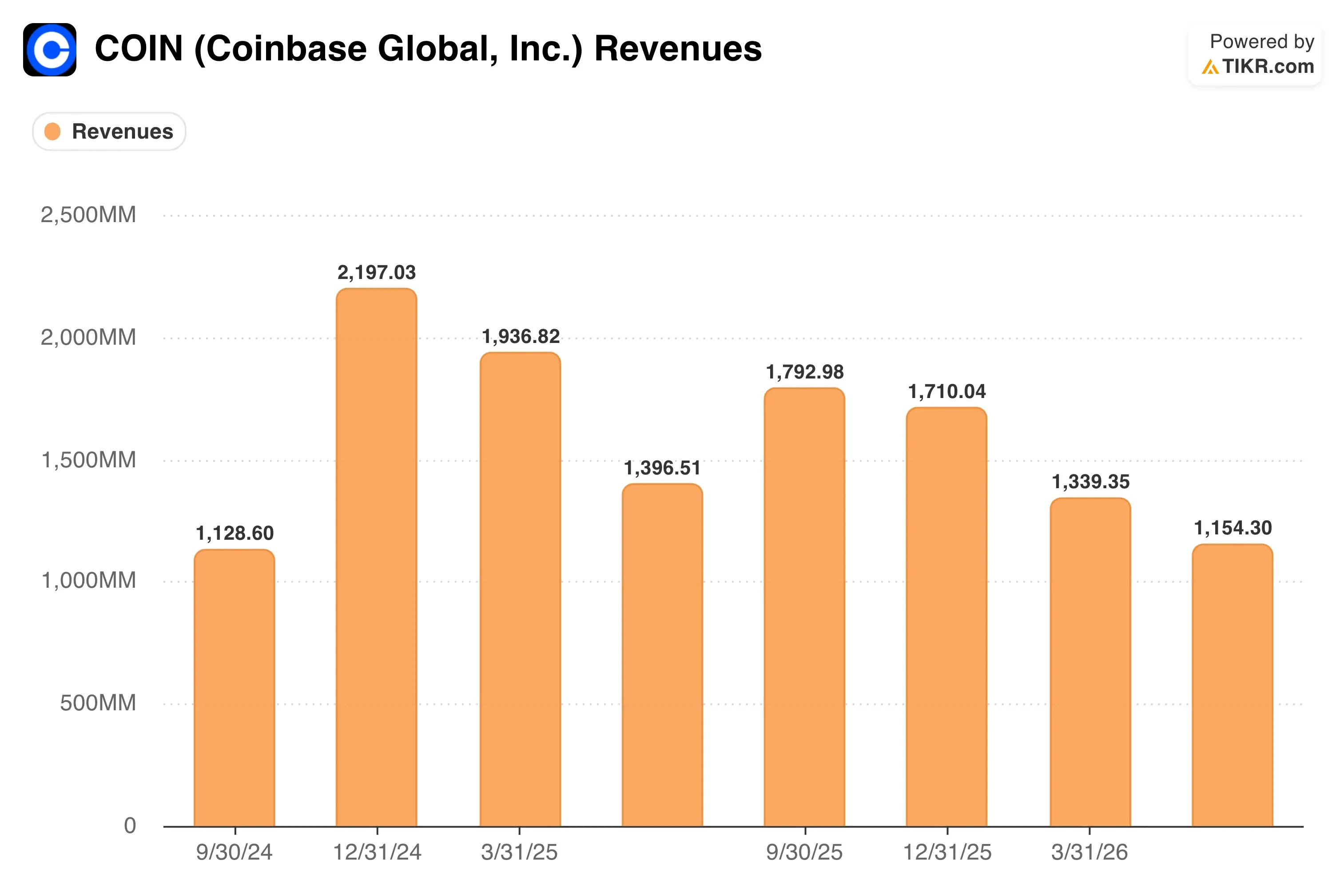
The backdrop is a tough 2026. Q2 revenue fell 19% to $1.22 billion, and the company posted a $359 million net loss. Still, CEO Brian Armstrong pointed to progress on the earnings call. “We’re diversifying revenue both on the trading fee side and on subscription and services with non-trading fees,” he said.
Investors are rethinking the setup rather than panicking. Coinbase reached a record 10.3% share of global crypto trading volume in Q2. If COIN stock is going to recover, those share gains must turn into higher revenue once trading activity returns.
Track how analysts are resetting Coinbase targets after a weak Q2 (It’s free) >>>
Cheaper, but Not Yet a Bargain
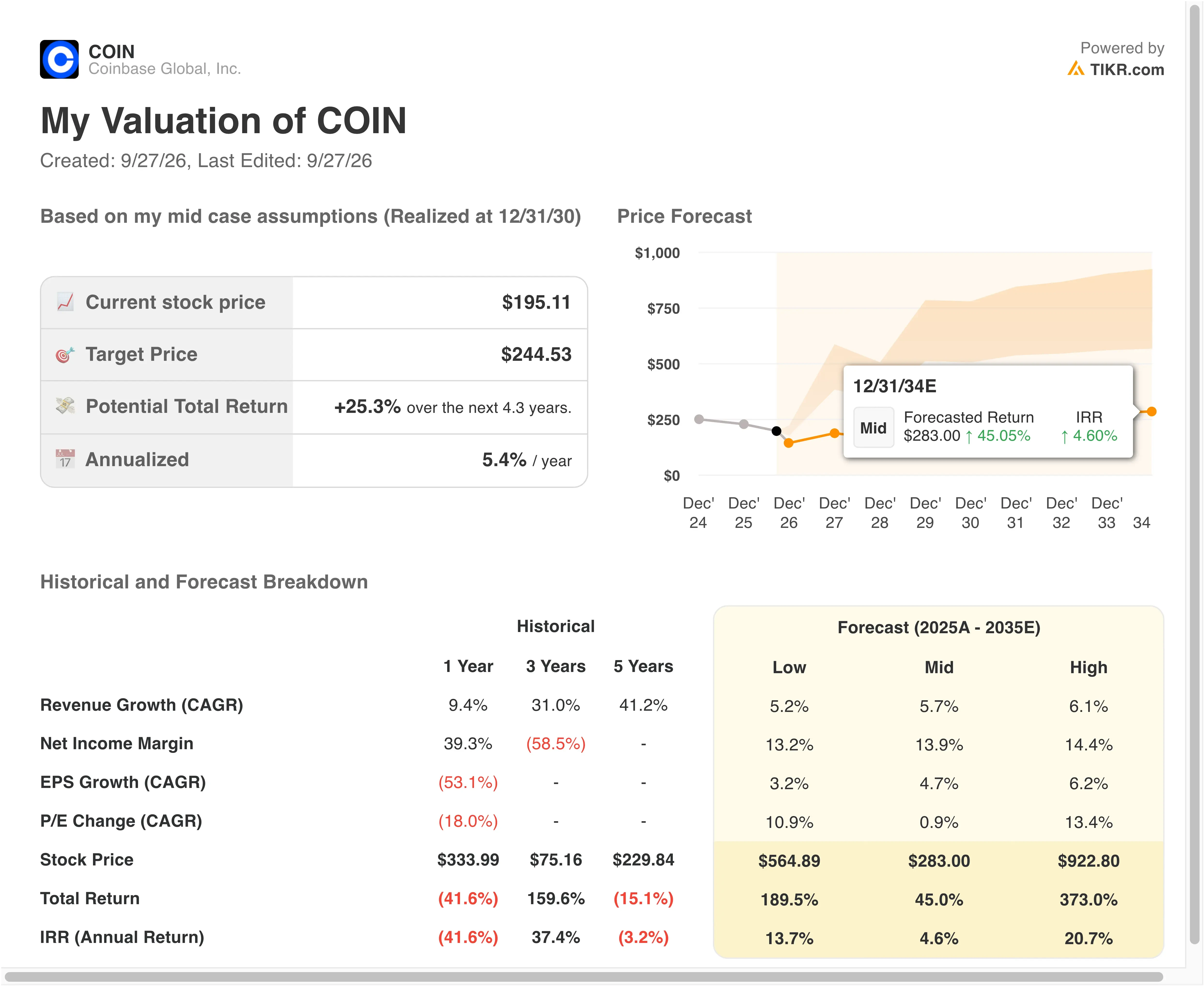
- Revenue Growth (CAGR): 5.7%
- Net Income Margins: 13.9%
- P/E Change (CAGR): 0.9%
Based on these inputs, the model estimates a target price of $245, implying a 25.3% total return from the current share price of $195 and an annualized return of 5.4% over the next 4.3 years.
This is a drawdown story. Coinbase trades about 51% below its 52-week high of $402. Yet the model still produces only 5.4% a year through 2030, which signals limited upside even after the drop.
Growth assumptions explain the caution. Revenue grew 31.0% a year over the past three years but only 9.4% last year. Analysts now expect sales to shrink about 2.1% a year over the next two years, so 5.7% growth through 2030 assumes a gradual rebound.
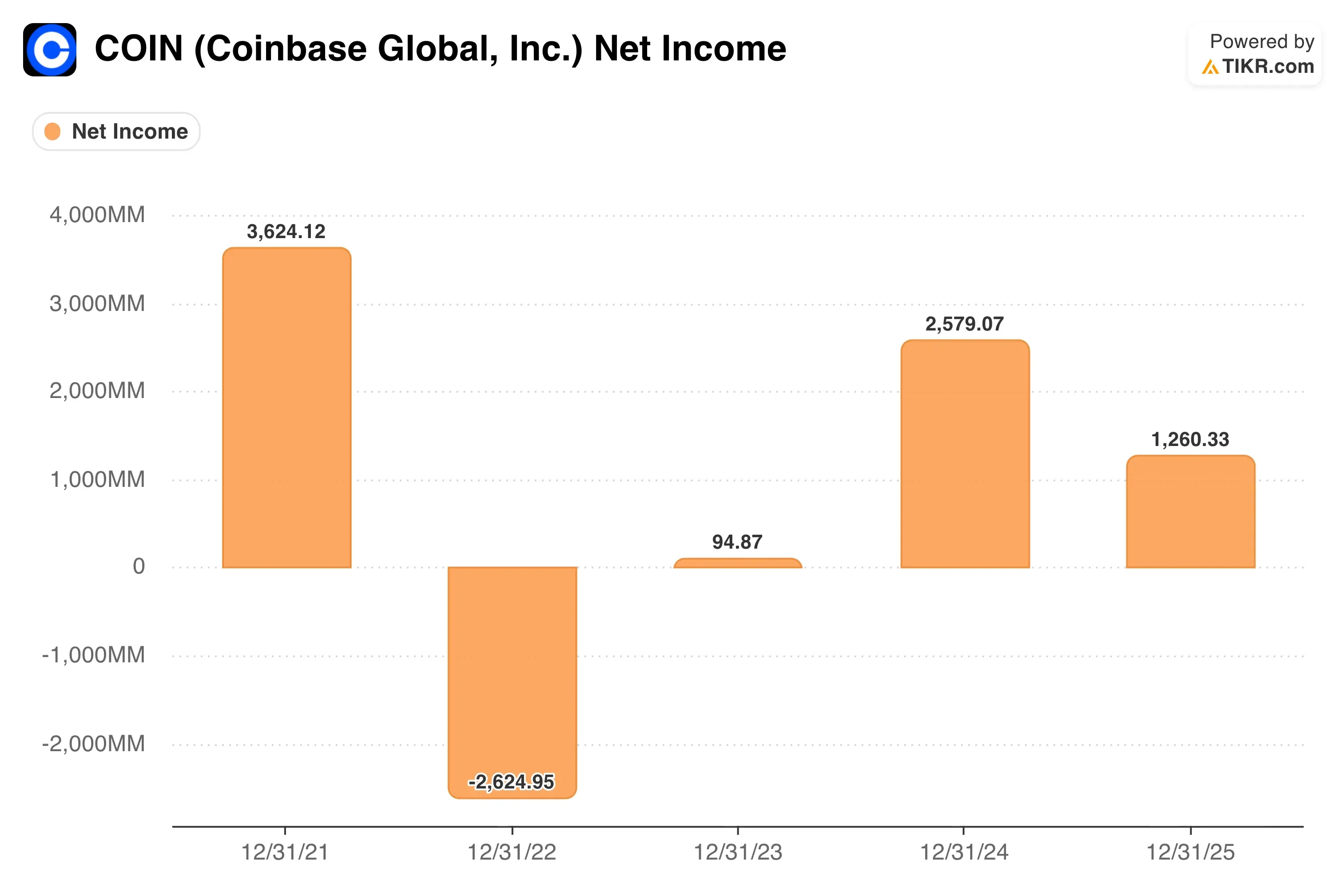
Profitability is the swing factor. The model assumes a 13.9% net income margin, well below the 39.3% Coinbase earned last year. That conservatism reflects how quickly profits vanish when trading slows, as the Q2 loss showed.
Product breadth could improve those numbers. Subscription and services revenue, which includes stablecoin income and staking rewards, made up 48% of net revenue in Q2. Robinhood Markets, by contrast, grew total revenue 32% thanks to a wider product mix. Still, Coinbase trades near 194x forward earnings, so investors are already paying heavily for a recovery.
Test Coinbase’s upside if crypto volumes rebound (Free with TIKR) >>>
Coinbase Versus the Brokerages Crowding Into Crypto
Robinhood (HOOD) is Coinbase’s closest rival for retail traders. Its Q2 revenue rose 32% to a record $1.31 billion, while Coinbase’s revenue fell 19%. The difference comes down to mix. Robinhood earns most of its trading revenue from options, stocks, and event contracts rather than crypto.
Crypto was weak for both firms. Robinhood’s crypto revenue dropped 38% year over year to $100 million. Coinbase’s transaction revenue fell 22% to $599 million over the same period. So Coinbase is losing less ground in crypto, although Robinhood’s other businesses carry it.
Prediction markets are the new battleground. These platforms let users trade contracts on real-world outcomes like elections or sports. Robinhood generated $156 million from event contracts in Q2, more than ten times its level a year earlier. Coinbase’s prediction market revenue more than doubled from Q1 and passed $100 million annualized, which leaves it behind but gaining fast.
Gemini Space Station (GEMI) is a smaller exchange rival facing the same New York lawsuit. Coinbase’s edge lies in regulation and stablecoins. It won conditional approval for a federal trust charter, and average USDC held in its products reached a record $20 billion, over 30% of all USDC. Brokerages cannot easily copy that position.
What’s Driving COIN Stock Going Forward?
Crypto prices remain the biggest near-term driver. Coinbase generated about $130 million of transaction revenue through July 26, but management warned against reading too much into early figures. It guided Q3 subscription and services revenue to $500 million to $580 million.
Tokenized stocks could open a new market. The SEC’s exemption lasts five years, and each token must carry the same rights as the underlying share, including dividends and votes. A launch would let Coinbase compete more directly with traditional brokers.
Legal risk is the main overhang. New York argues that prediction markets are unlicensed gambling, while federal regulators treat them as regulated contracts. A loss in court could shut Coinbase out of a fast-growing product in a major state.
Costs are the final lever. Coinbase cut about 14% of its workforce in May and narrowed its 2026 expense range. Going forward, a leaner cost base means any trading rebound could flow quickly into profits.
Compare Coinbase with Robinhood and other trading platforms side by side (Free with TIKR) >>>
Should You Invest in Coinbase Global?
The only way to really know is to look at the numbers yourself. TIKR gives you free access to the same institutional-quality financial data that professional analysts use to answer exactly that question.
Pull up COIN, and you’ll see years of historical financials, what Wall Street analysts expect for revenue and earnings in the quarters ahead, how valuation multiples have moved over time, and whether price targets are trending up or down.
You can build a free watchlist to track COIN alongside every other stock on your radar. No credit card required. Just the data you need to decide for yourself.
Analyze COIN stock on TIKR Free→
Disclaimer:
Please note that the articles on TIKR are not intended to serve as investment or financial advice from TIKR or our content team, nor are they recommendations to buy or sell any stocks. We create our content based on TIKR Terminal’s investment data and analysts’ estimates. Our analysis might not include recent company news or important updates. TIKR has no position in any stocks mentioned. Thank you for reading, and happy investing!