Key Takeaways
- Of the 456 big funds that have filed 13Fs for the third quarter, 17 bought Netflix, Cathie Wood’s ARK Invest among them, and 20 sold, including George Soros’ fund.
- The biggest moves came from less famous firms: Harris Associates added about $556 million of Netflix stock at quarter-end prices, while Sands Capital sold about $184 million.
- Netflix trades at 17x forward earnings, about half its five-year average and close to Disney’s multiple, and analysts still expect its earnings to grow.
- The buyers have the better case at this price, but falling earnings estimates are the risk to watch going into Netflix’s January report.
Cathie Wood’s ARK Invest owned 29% more Netflix (NFLX) shares on Sept. 30 than three months earlier, according to its 13F for the third quarter, filed Nov. 13. George Soros’ Soros Fund Management went the other way and cut its Netflix stake 74%, according to the 13F it filed the same day.
Plenty of other funds took sides too. Of the 456 big funds that have filed 13Fs for the quarter so far (well-known names, or funds with $1 billion or more of US stocks, not counting quant and index funds), 17 bought Netflix by opening a position or adding 20% or more to one. Another 20 sold out or cut their stake by 20% or more, and 58 held the stock at the quarter’s end.
TIKR tracks 51 analysts on Netflix. How many say “Buy”?
See the full breakdown of Buy, Hold, and Sell ratings on Netflix, along with Wall Street’s revenue and earnings estimates, all in one place. More than 500,000 investors use TIKR to research stocks like this one. See Netflix’s Analyst Ratings
Cathie Wood’s buy was one of the smallest
ARK’s purchase came to about $4 million at quarter-end prices. That left it with 289,011 shares, just 0.1% of its 13F stocks. Soros’ sale was about $2 million. The real money moved further down the list.
Bill Nygren’s Harris Associates, the firm behind the Oakmark funds, manages $109 billion. It added 73% to its stake, about $556 million worth, and ended the quarter with 19.00 million shares worth $1.32 billion, or 2% of its 13F stocks. Jeremy Grantham’s GMO, an $81 billion firm, added 32%, or about $228 million, and Netflix is now 2.0% of its 13F stocks. BLS Capital opened a new position worth $135 million. That’s 5.4% of its 13F stocks and its ninth-largest holding.
So far, the stock has gone against them. Netflix is down 13% from its Sept. 30 price.
The sellers have real reasons
Sands Capital, which manages $44 billion, made the biggest sale: it cut its stake 49%, about $184 million at quarter-end prices. Edgewood Management, a $22 billion firm, sold 32% of its shares, about $129 million. Even so, Netflix was still Edgewood’s 10th-largest holding on Sept. 30, at 4.4% of its 13F stocks. Harding Loevner cut its stake 69%, and Comgest sold all 918,975 of its shares.
Netflix’s own figures show why. Revenue growth has slowed every quarter, from 17.6% in the fourth quarter of 2025 to 11.8% in the third quarter of 2026, and management guides 11.5% for the fourth quarter. View hours grew just 2% in the first half of 2026. In October, Netflix cut its 2026 ad revenue forecast to about $2.7 billion from about $3 billion. Cash paid for content rose 18.5% in the first nine months of 2026, nearly twice the 9.5% rise in content amortization, so higher expenses are likely on the way for 2027 and 2028.
At 17x, the slowdown is already in the price
Analysts still expect Netflix’s earnings to grow, though more slowly than before:
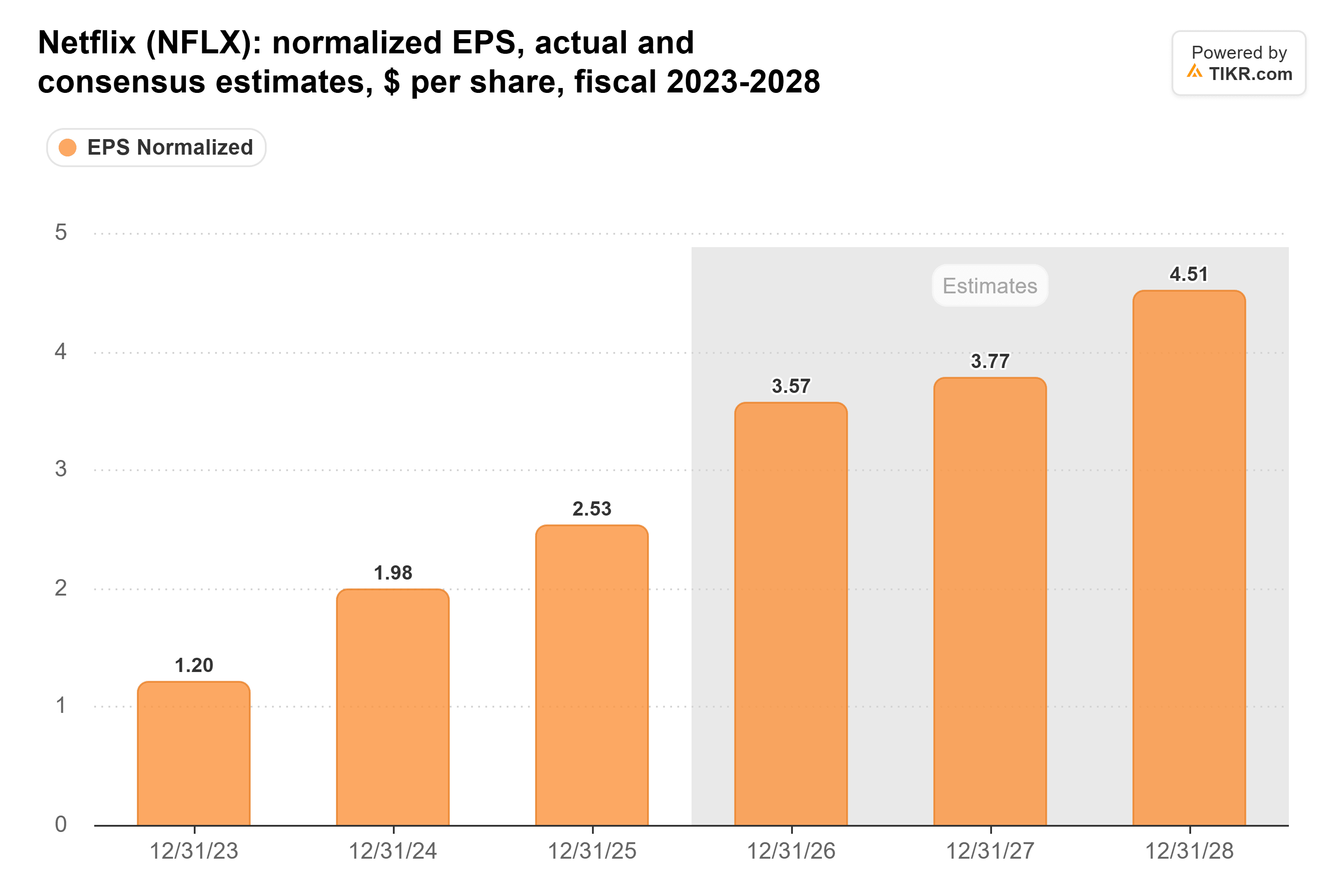
Normalized EPS more than doubled from $1.20 in fiscal 2023 to $2.53 in fiscal 2025, and the consensus has it reaching $4.51 by fiscal 2028. (The fiscal 2026 estimate of $3.57 includes the $2.8 billion fee Netflix collected when its Warner Bros. Discovery deal fell apart. That inflates 2026 and makes the step up to 2027 look small.) The estimates have slipped, though: the fiscal 2027 figure was $3.94 at the end of September 2025 and is $3.77 now.
The multiple investors pay for those earnings has fallen much further:
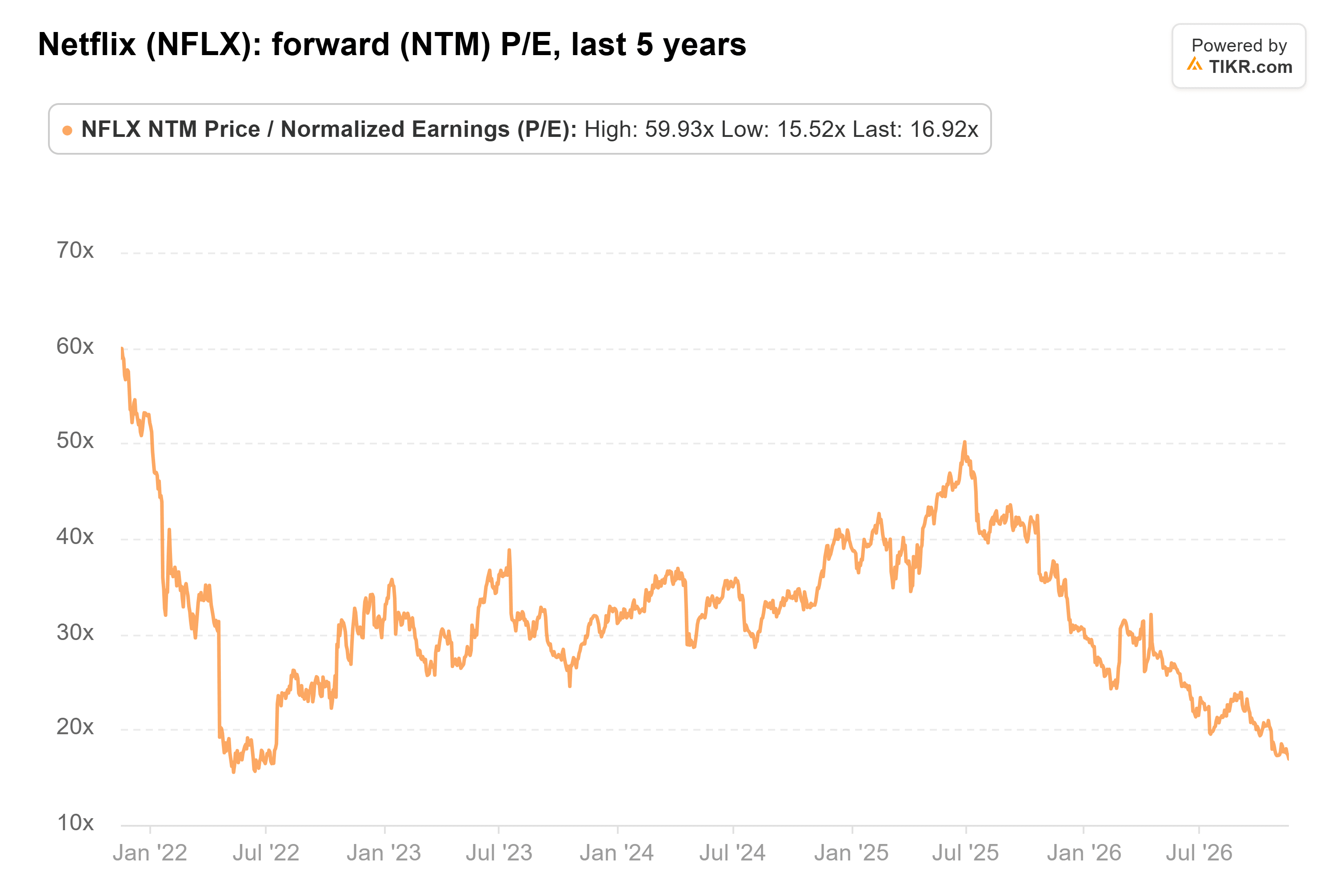
Netflix trades at 17x forward earnings, against a five-year average of 32x and a five-year low of 16x in May 2022. That’s close to Disney (DIS), at about 16x. But Disney’s stock is 2% below its 52-week high, and Netflix’s is 47% below its own.
Wall Street has cut its targets along the way:
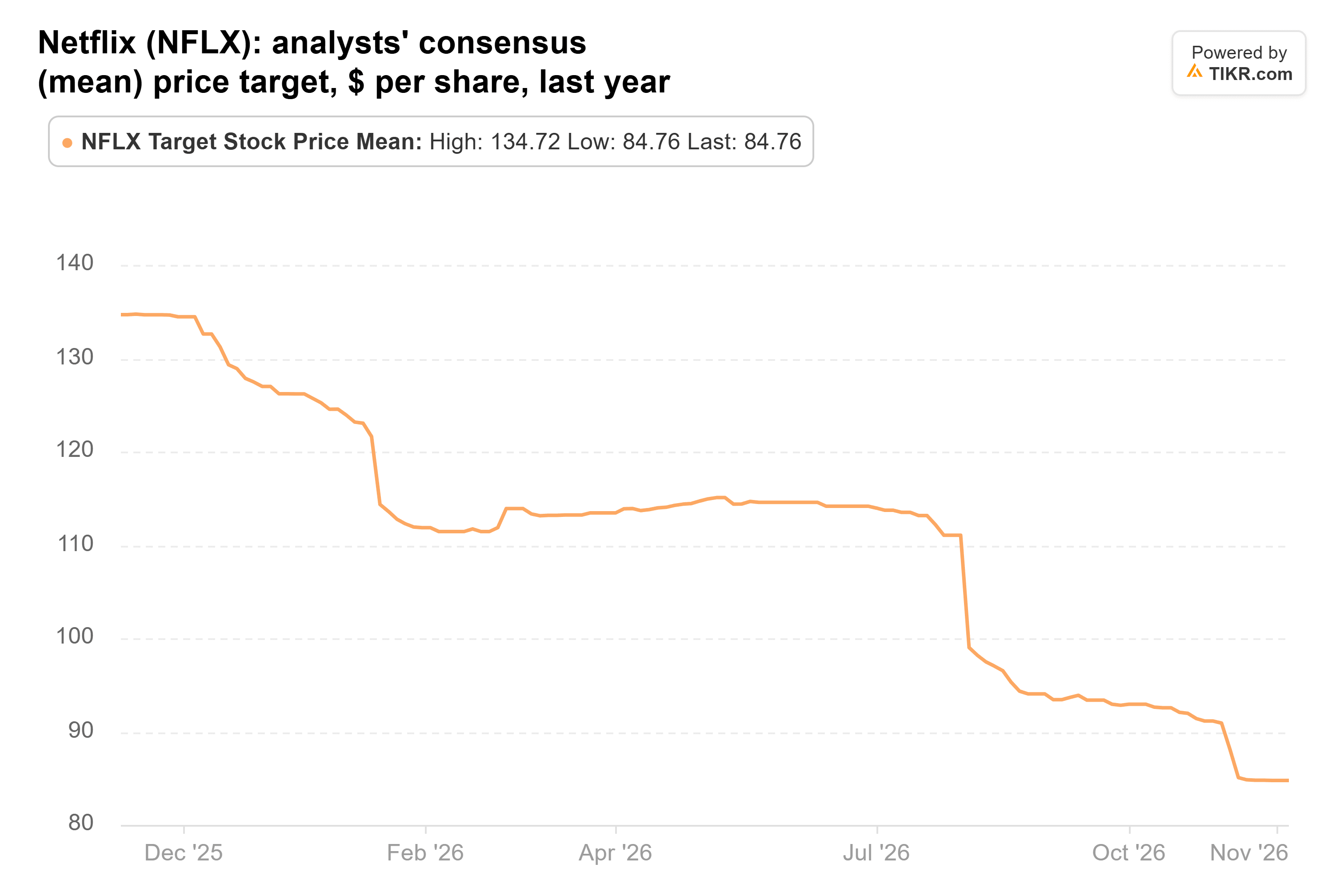
The 51 analysts covering Netflix have an average target of $85. That’s down from $135 a year ago but still 40% above the last close of $60.75. Even the lowest target, $57, is only a few dollars below that close.
I’d side with the buyers
At 17x, Netflix is priced about like Disney. Yet Netflix still grew revenue 11.8% last quarter, and analysts expect it to earn $4.51 a share by 2028. The sellers’ worries are real, but a multiple barely above its five-year low already reflects most of them.
Netflix seems to agree. It bought back $4.8 billion of its own stock in the third quarter, at average monthly prices of $72 to $77 a share. That’s more than any single fund on either list put in.
The risk is the estimates. If viewing keeps growing slowly and content costs keep climbing, the 2027 and 2028 figures could keep sliding, and every cut makes the stock look less cheap. Netflix gives its 2027 revenue and margin guidance with its fourth-quarter report, expected in mid-to-late January, and that will be the first real test of which side got it right.
So what is Netflix stock actually worth?
TIKR lets you forecast the future price of any stock in less than a minute. Just enter a few assumptions into TIKR’s valuation model and see what Netflix could be worth. Start from Wall Street consensus estimates, or adjust the inputs to reflect your own view of the business. It’s free to use.
Disclaimer:
Please note that the articles on TIKR are not intended to serve as investment or financial advice from TIKR or our content team, nor are they recommendations to buy or sell any stocks. We create our content based on TIKR Terminal’s investment data and analysts’ estimates. Our analysis might not include recent company news or important updates. TIKR has no position in any of the stocks mentioned. Thank you for reading, and happy investing!