Key Takeaways
- Of 460 big funds that have filed 13Fs for the quarter ended Sept. 30, 15 sold Deere, Cathie Wood’s ARK Invest among them, and 10 bought.
- The sellers moved far more money: four sales of about $150 million or more each, against a biggest buy of about $57 million.
- Deere trades at 31x forward earnings against a five-year average of 20x, and its fiscal 2027 guidance fell short of what analysts expected.
- The numbers side with the sellers, and Caterpillar, which some of the same funds also traded, looks like the better value at about 18x.
Fifteen big funds sold Deere (DE) in the third quarter, and 10 bought, according to their 13Fs for the quarter ended Sept. 30. Cathie Wood’s ARK Invest, in its 13F filed Nov. 13, was one of the sellers.
Those counts cover the 460 big funds that have filed for the quarter: funds readers know, or ones with $1 billion or more of US stocks in their 13Fs, with quant and index funds left out. A buy is a new position or 20% or more added, a sale is a full exit or a cut of 20% or more, and another 39 funds held Deere at the quarter’s end.
Some of the same funds moved on Caterpillar (CAT) too. ARK cut its Caterpillar stake 43% and Covalis Capital 33%, while NS Partners more than doubled its own. Caterpillar has fallen 33% since Sept. 30.
The sellers wrote the bigger checks
Stockbridge Partners, a firm managing $5.4 billion, made the biggest sale: it cut its Deere stake 49%, about $185 million at quarter-end prices, and Deere is still its No. 10 holding at 4.7% of its 13F stocks. ARK, which manages $17.4 billion, sold 61%, about $162 million, leaving 151,701 shares worth $102 million, 0.6% of its 13F stocks. John W. Bristol & Co., which holds $6.6 billion of US stocks in its 13F, sold 98% of its stake, about $152 million. And Bill Nygren’s Harris Associates, the $109 billion firm behind the Oakmark funds, cut 72%, about $151 million.
TIKR tracks 26 analysts on Deere. How many say “Buy”?
See the full breakdown of Buy, Hold, and Sell ratings on Deere, along with Wall Street’s revenue and earnings estimates, all in one place. More than 500,000 investors use TIKR to research stocks like this one. See Deere’s Analyst Ratings
One buyer made a real bet
Cartenna Capital, a firm managing $2.7 billion, opened the biggest new position: 85,000 shares, about $57 million at quarter-end prices and 2.1% of its 13F stocks, its No. 20 holding. That’s smaller than each of the four biggest sales. The next buyers, Covalis Capital ($4.8 billion) and NS Partners ($5.9 billion), bought about $6 million and $5 million, new stakes of 0.5% and 0.2% of their 13F stocks. And GQG Partners, a $164 billion firm, opened a position of about $3 million.
Neither side has much to show for it yet, with Deere down 5% since Sept. 30.
The rebound is already in the price
Deere reported its fiscal 2026 results on Nov. 25. Net income fell to $4.86 billion, or $17.95 a share, from $18.50 in fiscal 2025, even as sales and revenues rose 4% to $47.7 billion. Big farm machines are still the drag: Production & Precision Agriculture sales fell 15% in the fourth quarter, while construction and forestry sales rose 12%.
CEO John May said Deere is seeing “early signs of improvement in large agriculture, led by North America.” But Deere guided fiscal 2027 net income of $4.50 billion to $5.25 billion, short of what analysts expected, against $4.86 billion in fiscal 2026. That range includes a one-time pension settlement charge of $250 million to $400 million.
Deere’s normalized EPS fell from $34.69 in fiscal 2023 to $17.95 in fiscal 2026, and analysts expect $19.55 in fiscal 2027 before a jump to $27.24 in fiscal 2028:
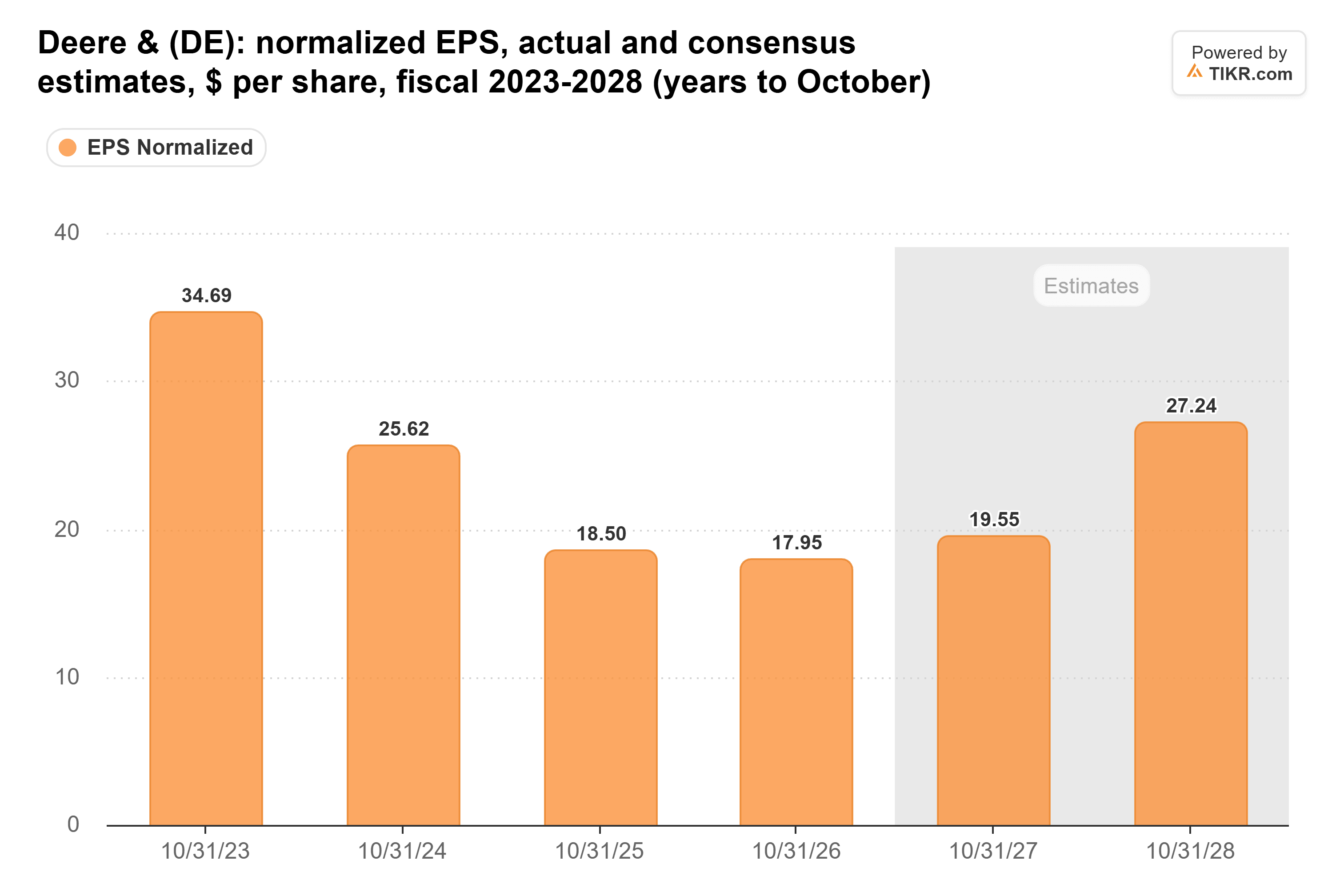
Those estimates came before the guide, so fiscal 2027’s $19.55 looks more likely to come down from here.
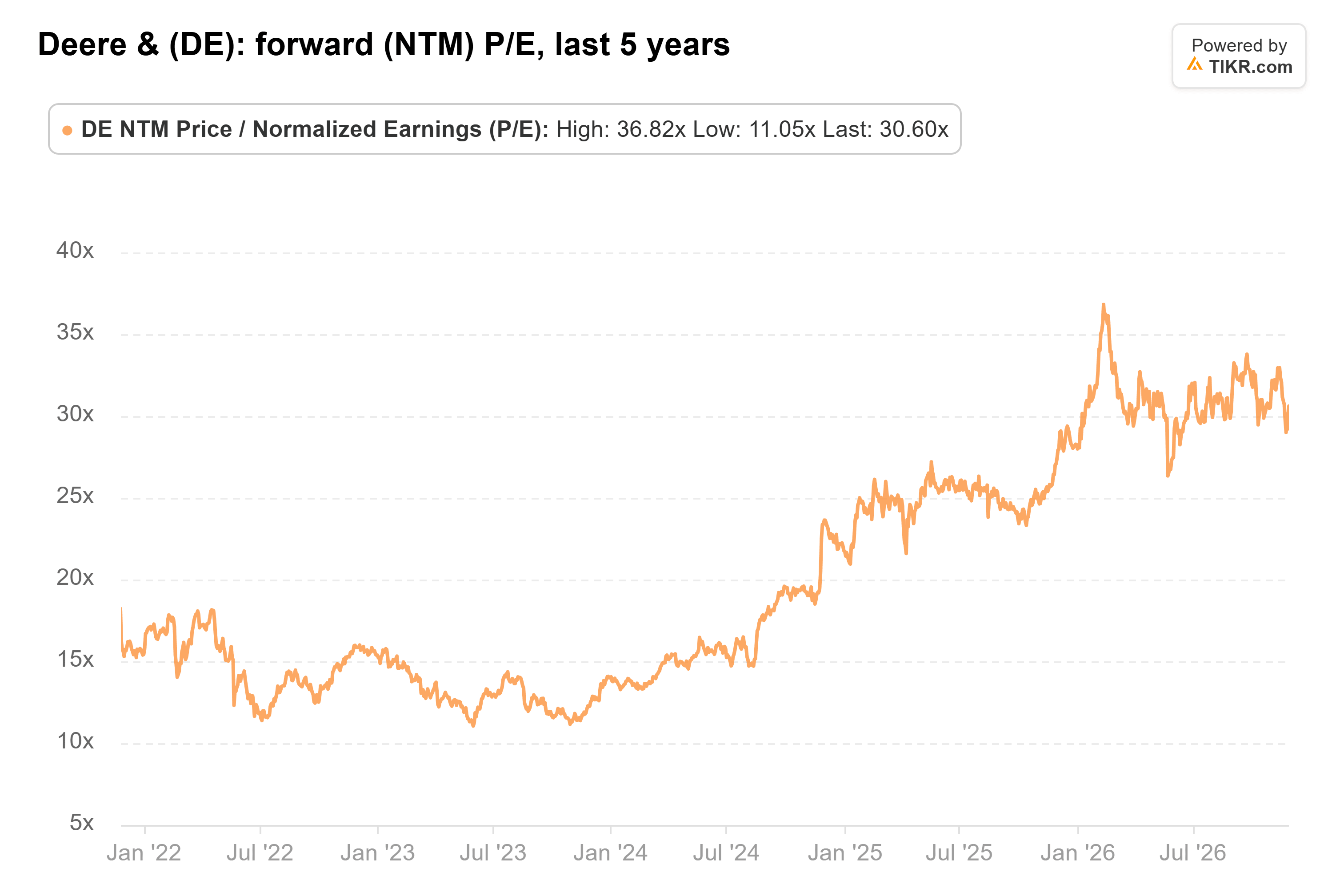
Yet investors are already paying for that rebound. Deere trades at 31x forward earnings, well above its five-year average of 20x, though below its 37x peak in February:
Analysts have raised their price targets all year, to an average of $694 from $526 a year ago. But that average sits less than 10% above Deere’s last close of $641, and the targets run from $500 to $813:

The sellers have it
Caterpillar, the other machinery maker these funds traded, looks very different after its fall. It trades at about 18x forward earnings, below its quarter-end average of 19x since 2014, and analysts’ $807 average target sits 48% above its $544 close. It also has a record $78 billion backlog. Its 2027 earnings estimates have slipped since its third-quarter report, but Deere’s own guide, construction and forestry sales flat to up 10% in fiscal 2027, doesn’t point to a construction slump.
So who’s right? On TIKR’s numbers, the sellers. Deere’s earnings have nearly halved since fiscal 2023, its guidance pushes the recovery out another year, and the stock still trades far above its usual multiple. If I wanted a machinery maker today, I’d take Caterpillar at 18x over Deere at 31x.
The buyers’ case rests on demand for big farm machines recovering faster. Deere’s fiscal first-quarter report, due in February, is the next test: large-ag sales growth near the top of the 5%-15% guide would start to back Cartenna. The funds’ 13Fs for the quarter ending Dec. 31 are due by mid-February too.
So what is Deere stock actually worth?
TIKR lets you forecast the future price of any stock in less than a minute. Just enter a few assumptions into TIKR’s valuation model and see what Deere could be worth. Start from Wall Street consensus estimates, or adjust the inputs to reflect your own view of the business. It’s free to use.
Disclaimer:
Please note that the articles on TIKR are not intended to serve as investment or financial advice from TIKR or our content team, nor are they recommendations to buy or sell any stocks. We create our content based on TIKR Terminal’s investment data and analysts’ estimates. Our analysis might not include recent company news or important updates. TIKR has no position in any of the stocks mentioned. Thank you for reading, and happy investing!