Key Stats for Carvana Stock
- Current Price: $65.11
- Target Price (Mid): ~$116
- Street Target: ~$83
- Potential Total Return: ~78%
- Annualized IRR: ~14% / year
Now Live: Discover how much upside your favorite stocks could have using TIKR’s new Valuation Model (It’s free) >>>
What Happened?
Carvana Co. (CVNA) closed at $65.11 on September 18, down about a third from its 52-week high of $97.38 and back near the low end of its range, after posting the strongest quarter in its history. Part of that decline is self-inflicted: after the July 29 print, a light full-year profit guide sent shares down as much as 15% in a session. But the most recent leg was a macro one. On September 16, the Federal Reserve raised its benchmark rate to 3.75%-4.00%, its first hike since 2023, and reignited a fear that has followed the used-car sector all year, that subprime borrowers are falling behind on their car loans at a record pace.
So investors are weighing whether that September fear belongs to Carvana specifically or to the industry it sits in. The company grew retail units 38% while the used-vehicle industry shrank, and did it while posting record profitability.
The September Selloff Is About Credit
Reported July 29, second-quarter revenue hit $7.376 billion, up 52% year over year and a quarterly record. Adjusted EBITDA reached a record $769 million, GAAP operating income was $680 million, and net income hit a record $513 million, up $205 million year over year for a 7.0% margin. Retail units grew 38% to 197,325 against a used-vehicle industry that contracted low-to-mid single digits, and revenue beat the Street’s $6.91 billion estimate by 6.8%.
The stock fell after that print anyway, because the full-year adjusted EBITDA guide landed below where the Street sat. That was a company-specific stumble. In September, the pressure came from outside the company. According to Fitch Ratings, the share of subprime borrowers at least 60 days past due on their auto loans reached the highest level on record earlier this year, running near 7% before a seasonal dip, the worst readings in roughly three decades. That data hangs over every used-car lender, and it is not purely someone else’s problem: Carvana finances a large share of the cars it sells, and a meaningful slice of that book is non-prime. So when the Fed hiked on September 16 and signaled another increase was possible this year, the read-through was immediate, because higher rates squeeze exactly those borrowers.

See historical and forward estimates for Carvana stock (It’s free!) >>>
The Rate the Market Is Watching, in the CFO’s Own Words
At the J.P. Morgan Automotive Conference in August, CFO Mark Jenkins named the specific benchmark that drives Carvana’s customer loan pricing. “The 2-year Treasury rate is a key benchmark rate that impacts the customer-facing rate on auto loans,” Jenkins said, adding that as it moves, “we generally speaking, look to pass on that rate into our customer rates,” with variability in timing and degree.
Jenkins was candid that rates and fuel cost the company in the quarter, with higher fuel prices alone adding roughly $75 per car. Carvana still posted record EBITDA with both drags active, which argues they are cyclical rather than structural. He was equally clear that the business runs on many dials: sticker prices, trade-in offers, shipping fees, marketing, and interest rates all flex quarter to quarter to hit a targeted balance of volume and profit. On supply, Jenkins framed the flip side of the credit strain as a positive, since more used-car supply “has the opportunity to make used cars a little bit more affordable for customers.”
A Premium That Growth Has to Justify
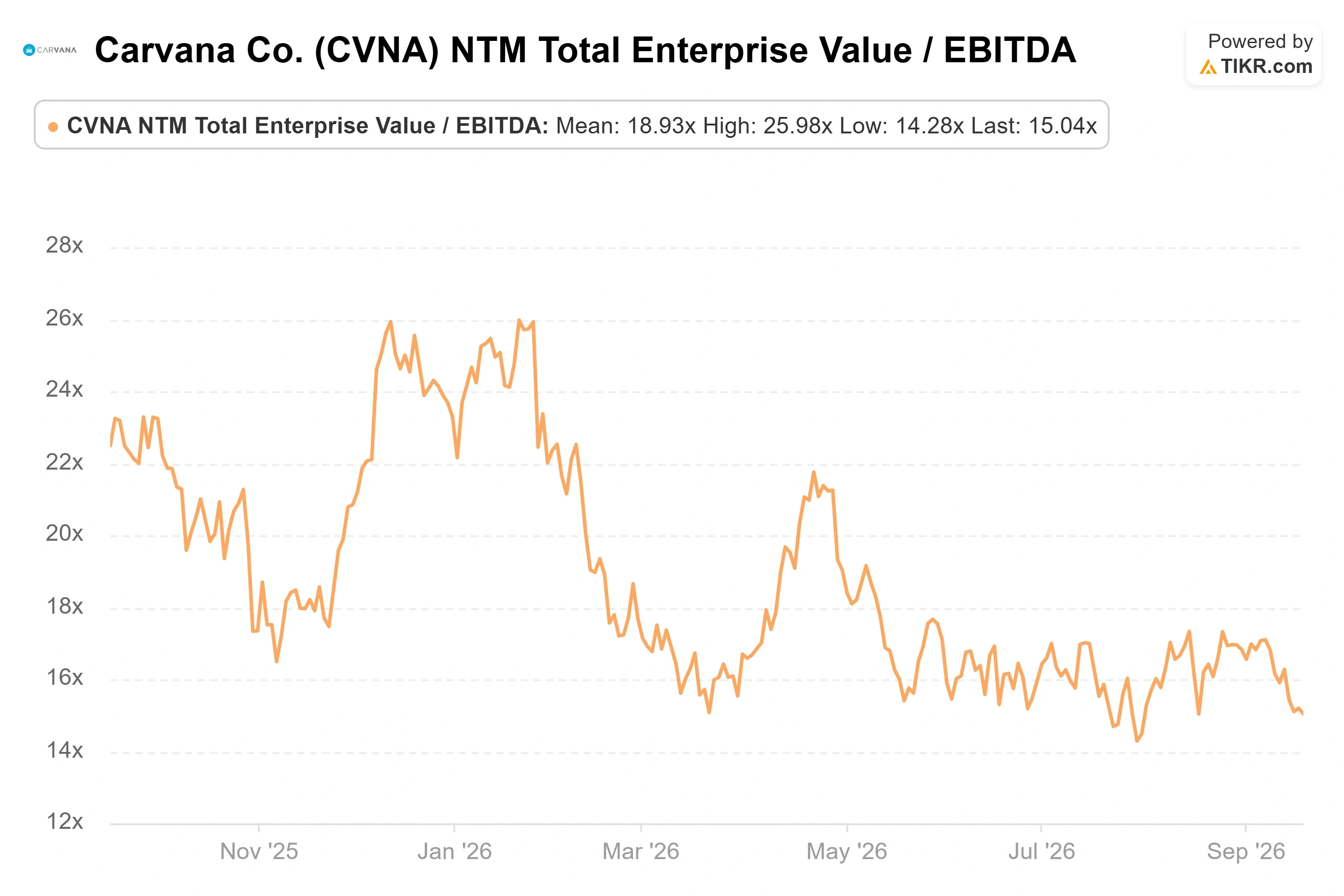
On next-twelve-months EV/EBITDA, the stock trades near 15 times, above Lithia Motors near 13.6 times, roughly in line with Penske near 15.3 times, and well below CarMax, the closest used-car comparison, near 27.9 times on depressed forward earnings. The premium to the cheaper dealers is real. The reason to test it rather than dismiss it is the growth gap behind it. Those dealers grow retail units in the low single digits when they grow at all, and CarMax’s comparable used units have been shrinking. Carvana grew units 38% into an industry that contracted.
If the credit cycle turns hard enough to slow unit growth, or the guided softer second-half margins prove structural rather than a passing fuel-and-rate squeeze, the multiple compresses and the stock revisits the lower end of its range, near the 52-week low around $55 that it last touched in March.
See how Carvana performs against its peers in TIKR (It’s free!) >>>
TIKR Advanced Model Analysis
- Current Price: $65.11
- Target Price (Mid): ~$116
- Potential Total Return: ~78% over roughly 4.3 years
- Annualized IRR: ~14% / year

See analysts’ growth forecasts and price targets for Carvana stock (It’s free!) >>>
The model reaches that target while assuming the P/E contracts, so the upside is earned by fundamentals. The two revenue drivers are reconditioning capacity, the lever Jenkins tied to 55% sales growth in the regions where production grew most, and rising online penetration, with auto retail still in the low single digits of e-commerce against roughly 20% for retail overall. The margin driver is operating leverage across an underutilized fixed-cost base in technology, corporate, and facilities. The primary risk is the one the market is already pricing: a credit cycle severe enough to pressure financing economics and slow unit growth at once.
- Upside: throughput keeps recovering and units compound in the high teens to twenties while fixed costs leverage, clearing the mid-case target.
- Downside: the credit cycle bites into demand and margins, and shares drift back toward their 52-week low near $55.
Conclusion
CarMax reports its next quarter in late September, and its credit commentary and loan-loss reserves will either confirm the sector-wide deterioration bears expect or show it stabilizing; Carvana tends to trade on that read-through. Then Carvana’s own Q3 report, due October 29, gives the direct answer. Consensus already has revenue growing better than 30% into the back half, so watch whether the adjusted EBITDA margin holds as units keep compounding. A margin that holds with growth intact says September’s selloff priced an industry fear into a company outrunning it. A margin that slips while growth cools says the bears read the credit cycle right. The Fed just made the backdrop harder, and the October print shows whether Carvana’s numbers care.
See what stocks billionaire investors are buying so you can follow the smart money with TIKR.
Should You Invest in Carvana?
The only way to really know is to look at the numbers yourself. TIKR gives you free access to the same institutional-quality financial data that professional analysts use to answer exactly that question.
Pull up Carvana, and you’ll see years of historical financials, what Wall Street analysts expect for revenue and earnings in the quarters ahead, how valuation multiples have moved over time, and whether price targets are trending up or down.
You can build a free watchlist to track Carvana alongside every other stock on your radar. No credit card required. Just the data you need to decide for yourself.
Analyze Carvana on TIKR Free →
Looking for New Opportunities?
- See what stocks billionaire investors are buying so you can follow the smart money.
- Analyze stocks in as little as 5 minutes with TIKR’s all-in-one, easy-to-use platform.
- The more rocks you overturn… the more opportunities you’ll uncover. Search 100K+ global stocks, global top investor holdings, and more with TIKR.
Disclaimer:
Please note that the articles on TIKR are not intended to serve as investment or financial advice from TIKR or our content team, nor are they recommendations to buy or sell any stocks. We create our content based on TIKR Terminal’s investment data and analysts’ estimates. Our analysis might not include recent company news or important updates. TIKR has no position in any stocks mentioned. Thank you for reading, and happy investing!