Reece Limited (REH) is one of the largest plumbing, waterworks, and HVAC-R distributors in Australia, New Zealand, and the United States. The company operates more than 900 branches across both regions and has built a long track record of steady expansion, supported by bolt-on acquisitions and continued investment in its network. Fiscal year 2025 broke that rhythm, as earnings came under real pressure as both the ANZ (Australia/New Zealand) and US markets slowed, creating a challenging backdrop across nearly every major business line.
Find out what a stock’s really worth in under 60 seconds with TIKR’s new Valuation Model (It’s free)>>>
Management acknowledged the softness in end-market demand but emphasized its long-term approach. Reece continued to add branches, integrate acquisitions, and invest in digital capabilities even as sales and margins contracted. This strategy reflects the company’s focus on strengthening its competitive position through the cycle rather than responding reactively to short-term volatility. That message came through clearly in commentary from the FY25 results release.

Looking ahead, Reece expects market conditions to stay muted in the near term. ANZ housing activity remains weak, and the US residential market faces affordability challenges that could extend well into FY26. Even so, the company continues to point to long-term structural tailwinds, including housing undersupply, population growth, and ongoing infrastructure demand across both regions. Those factors underpin its multiyear growth outlook.
Quickly value any stock with TIKR’s powerful new Valuation Model (It’s free!) >>>
Financial Story
Fiscal year 2025 results reflected the reality of a downturn across Reece’s key markets. Sales revenue fell 1% to $8.98B as low demand weighed on volumes in both ANZ and the US. EBITDA declined 11% to $901M, and EBIT dropped 20% to $548M. Cost inflation, branch expansion, and integration of acquisitions added pressure at a time when revenue was not growing. Earnings per share fell 24% to $0.49, reflecting both softer profit and investment-linked expense growth.
| Metric | FY25 Result | YoY Change |
|---|---|---|
| Sales Revenue | $8.98B | down 1% |
| EBITDA | $901M | down 11% |
| EBIT | $548M | down 20% |
| NPAT | $317M | down 24% |
| EPS | $0.49 | down 24% |
| Return on Capital | 11.8% | down 365 bps |
| Final Dividend | 11.86 cents | down from 25.75 cents |
| Capex to Sales | 2.9% | flat YoY |
Reece responded by tightening discretionary spending and initiating streamlined support-center changes during the second half. Those shifts are expected to show benefits in FY26. However, higher operating costs and branch expansion continued to weigh on margins during FY25, particularly in the US business, where competitive pressure intensified. Despite the earnings contraction, the balance sheet remained sound, supported by $600M of operating cash inflow and a moderate net leverage ratio of 0.8x.
The long-term investment cycle remains intact. Capital expenditure held steady at $258M, funding network expansion, refurbishments, and technology capability. Net working capital increased slightly, with inventory investments supporting availability across a growing branch footprint. Management reiterated its view that Reece operates in large, resilient markets where structural housing underbuild and population growth should translate into demand as conditions normalize. That remains the core of the investment thesis as FY26 begins.
Look up Reece Limited’s full financial results & estimates (It’s free)>>>
Broader Market Context
Fiscal year 2025 was a challenging year for companies exposed to residential construction. In Australia, elevated interest rates and affordability constraints weighed heavily on new housing activity. Renovation demand softened as households delayed larger discretionary projects. In the US, Reece faced additional pressure as residential new construction decelerated and competitive intensity rose across plumbing and HVAC distribution. The result was a broad slowdown that affected both top-line momentum and profitability.
Heading into 2026, macro visibility remains limited. Rate cuts could support improved activity, but timing remains uncertain, and affordability issues are unlikely to be resolved quickly. That said, many companies in the building products and distribution sectors are approaching what could be the bottom of their earnings cycle. If activity stabilizes and demand begins improving by late FY26, the sector could see a more meaningful recovery into FY27.
1. ANZ Business Stability and Long-Term Demand
Reece’s ANZ performance held up better than that of the US arm, despite a soft market. Sales grew 1% to $3.88B, supported by acquisitions and modest pricing resilience. EBIT fell 17% to $339M as operating costs rose and demand remained subdued. While performance was not strong, the region continues to benefit from a structurally tight housing supply and population growth, which should eventually translate into higher volumes as conditions normalize.
Across FY25, Reece added 15 net new branches in ANZ, demonstrating ongoing confidence in long-term customer demand despite near-term challenges. Management continues to emphasize capability, training, and network depth as competitive advantages. If ANZ housing activity lifts during FY26 or FY27, this segment could lead the company’s earnings recovery. The normal cycle of renovations and replacement demand also provides a more stable base, reducing downside risk relative to new construction exposure.
2. US Expansion, Margin Pressure, and Rebrand Integration
The US business faced a tougher year. Sales fell 5% to USD $3.3B due to lower volumes and deflation in certain categories. EBIT declined 23% to USD 136M as the company continued to invest in its network and rebranding while managing softer demand. Competition intensified, particularly in residential plumbing and HVAC distribution, creating a challenging backdrop for margin retention during the year.
Still, Reece added 24 net new US branches, completing the rebrand of plumbing, bath+kitchen, and HVAC locations under the Reece name. This strategic investment aims to deepen customer recognition and support long-term growth in a still-fragmented market. As affordability improves and new-construction cycles recover, the US business could become a stronger contributor to earnings. The footprint expansion completed during FY25 positions Reece to capitalize on that rebound whenever conditions stabilize.
Value stocks like Reece Limited in less than 60 seconds with TIKR (It’s free) >>>
3. Balance Sheet Strength and Through-the-Cycle Strategy
Despite the downturn, Reece maintained a disciplined approach to capital management. Operating cash inflow of $600M supported continued investment in capability and network expansion. Net debt rose modestly to $590M, but leverage remains low at 0.8x EBITDA. This financial position gives the company flexibility to keep investing across both regions while navigating slow market conditions.
Management reinforced that the company’s long-term focus is unchanged. Bolt-on acquisitions, digital investments, and operational efficiency improvements remain central to the strategy. Given the scale advantages and customer relationships Reece has built across ANZ and the US, the company is structured to outperform as demand eventually strengthens. While FY25 faced genuine headwinds, the business’s foundations remain intact.
The TIKR Takeaway
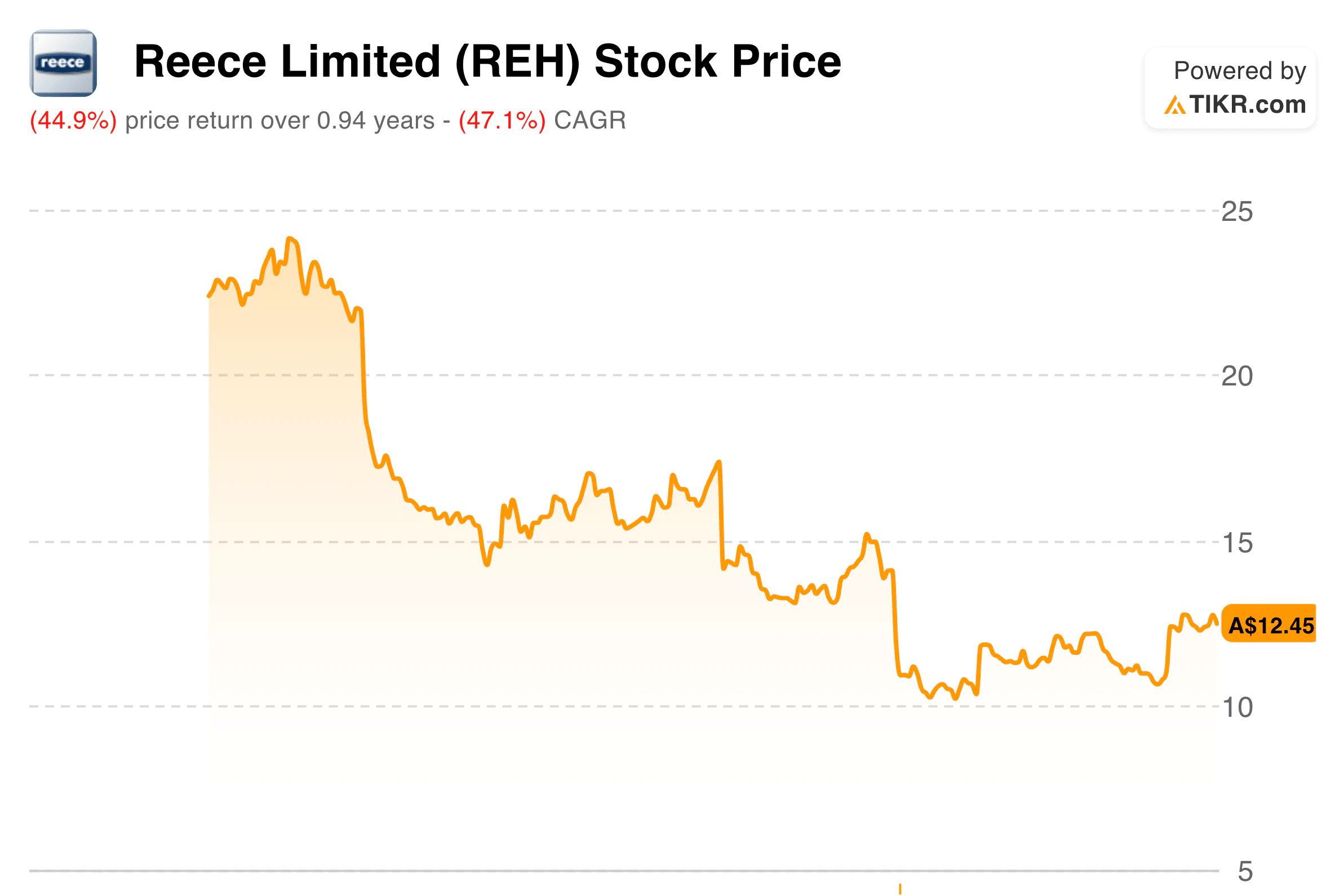
TIKR’s tools make it easy to evaluate whether Reece’s earnings dip represents a cyclical low or a deeper structural concern. Investors can compare margins over multiple cycles, model revenue recovery scenarios, and track region-level performance using long-term financial history. Reece’s valuation today reflects meaningful pessimism, but multi-year fundamentals tied to housing undersupply and infrastructure demand still support a recovery case.
Should You Buy, Sell, or Hold Reece Limited Stock in 2025?
Reece enters 2026 from a weak earnings base, making near-term results likely to remain volatile. The business model, however, is built for scale, and both geographic segments have long-term catalysts that support improvement over time. For investors comfortable with cyclical businesses, Reece may represent a patient hold while waiting for demand to turn. Anyone seeking near-term certainty may find better opportunities elsewhere, but the long-term story remains intact.
How Much Upside Does Reece Limited Stock Have From Here?
With TIKR’s new Valuation Model tool, you can estimate a stock’s potential share price in under a minute.
All it takes is three simple inputs:
- Revenue Growth
- Operating Margins
- Exit P/E Multiple
If you’re not sure what to enter, TIKR automatically fills in each input using analysts’ consensus estimates, giving you a quick, reliable starting point.
From there, TIKR calculates the potential share price and total returns under Bull, Base, and Bear scenarios so you can quickly see whether a stock looks undervalued or overvalued.
Find out what your favorite stocks are really worth (Free with TIKR) >>>
Looking for New Opportunities?
- See what stocks billionaire investors are buying so you can follow the smart money.
- Analyze stocks in as little as 5 minutes with TIKR’s all-in-one, easy-to-use platform.
- The more rocks you overturn… the more opportunities you’ll uncover. Search 100K+ global stocks, global top investor holdings, and more with TIKR.
Disclaimer:
Please note that the articles on TIKR are not intended to serve as investment or financial advice from TIKR or our content team, nor are they recommendations to buy or sell any stocks. We create our content based on TIKR Terminal’s investment data and analysts’ estimates. Our analysis might not include recent company news or important updates. TIKR has no position in any stocks mentioned. Thank you for reading, and happy investing!