Key Takeaways
- Broadcom fell 10% on November 5 as a post-election chip selloff hit Nvidia and Qualcomm too, with no company news behind the drop.
- Its latest quarter showed revenue up 86% to $29.6 billion and AI semiconductor revenue up 221% to $16.7 billion.
- Broadcom reported $179.2 billion of remaining performance obligations, though its fourth-quarter operating margin guide of about 66% sits below the prior quarter.
- The December 9 report will show whether Broadcom hit its $21.7 billion AI revenue target and how its next guide treats the data center buildout.
Broadcom (AVGO) fell 10% on Thursday, November 5, as a post-election selloff ripped through chip stocks. But the company released no news of its own.
Investors worried that a Democratic sweep of Congress could slow the data center buildout. Nvidia (NVDA) lost 9% that day, while Qualcomm (QCOM) also slid 9% after a weaker-than-expected outlook.
The iShares Semiconductor ETF had its worst session since March 2020. Chip stocks then led a rebound on Monday, and Broadcom set its fiscal fourth-quarter report for December 9.
So did anything actually change at Broadcom? Its own numbers say no, at least so far.
Washington moved the stock
Broadcom’s last update came on September 2, and it was strong. Here is what the third quarter, ended August 2, delivered:
- Revenue rose 86% to $29.6 billion, ahead of the company’s own $29.4 billion guidance.
- AI semiconductor revenue jumped 221% to $16.7 billion.
- Free cash flow reached $13.7 billion, and cash climbed to $24.0 billion.
“Demand for our custom AI accelerators and networking continues to be very strong,” CEO Hock Tan said in the release.
Nothing the company has said since contradicts that. Yet the stock now trades as though the AI spending cycle might stall…
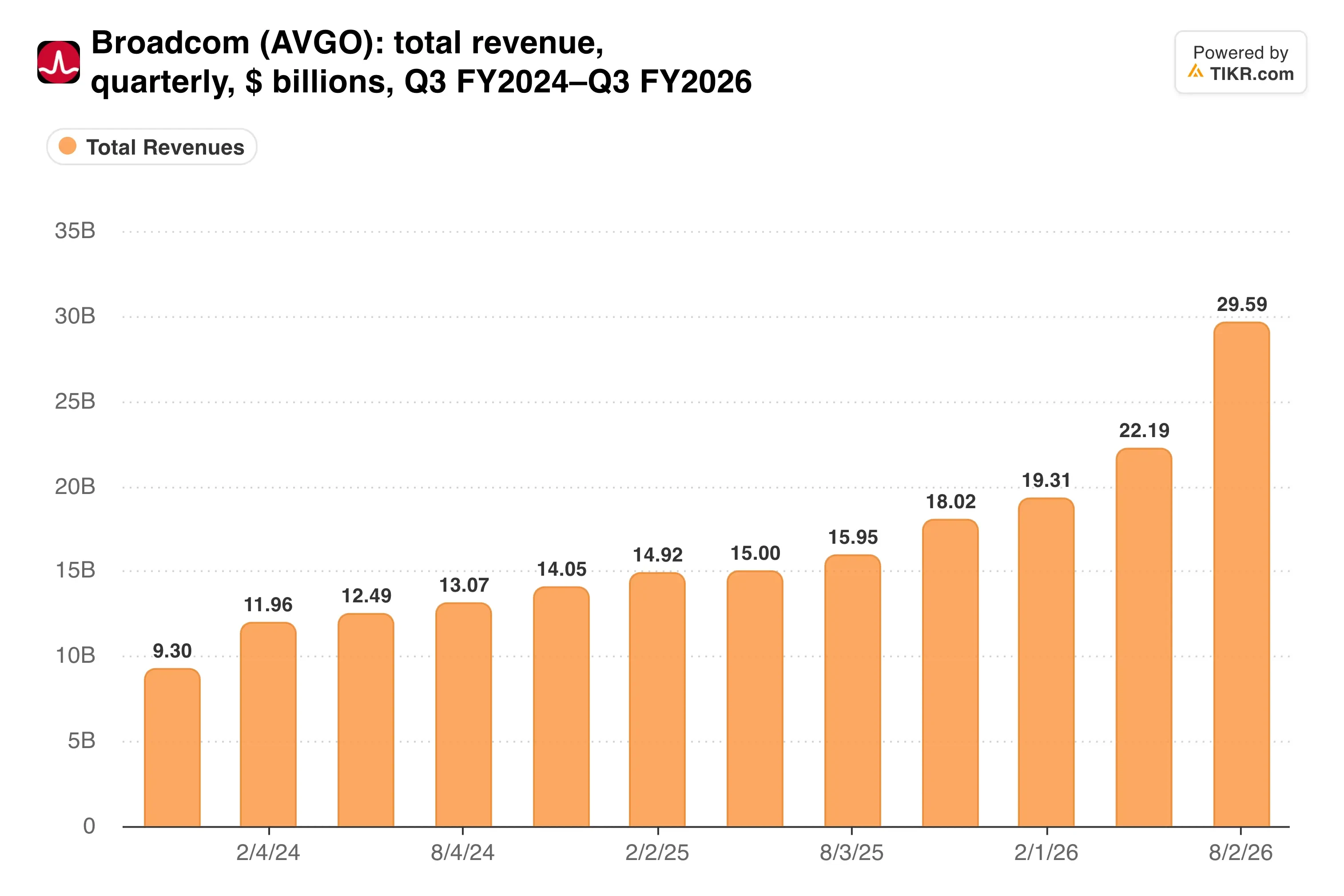
Quarterly revenue nearly doubled from $15.95 billion a year earlier. And that is the trend Thursday’s sellers are betting will bend.
Custom silicon does the heavy lifting
Most of that growth comes from one place. Semiconductor solutions revenue rose 127% to $20.8 billion, about 70% of the total.
Infrastructure software grew 29% to $8.75 billion. AI chips, by my math, accounted for about 84% of the year-over-year revenue gain, so the mix keeps tilting.
Where does that leave the business?

The bigger cushion against a policy shock sits in Broadcom’s contracts. The company reported $179.2 billion of remaining performance obligations in its latest 10-Q. That figure includes a long-term custom AI accelerator contract signed earlier this year.
Broadcom expects to recognize about 25% of it over the next 12 months. Because those commitments are firm, new permitting rules would hit future orders before they touch current revenue.
TIKR tracks 50 analysts on Broadcom. How many say “Buy”?
See the full breakdown of Buy, Hold, and Sell ratings on Broadcom, along with Wall Street’s revenue and earnings estimates, all in one place. More than 500,000 investors use TIKR to research stocks like this one. See Broadcom’s Analyst Ratings
Margins face the December test
Guidance for the fourth quarter is aggressive. Broadcom expects revenue of about $34.8 billion, up 93%, with AI semiconductor revenue reaching $21.7 billion.
However, the roughly 66% non-GAAP operating margin guide sits below the third quarter’s 67.9%. Faster growth in AI hardware than in software is the likely reason, and that mix shift will keep pressuring margins.
That contrast with Qualcomm, which guided below expectations, is hard to miss. And Thursday’s drop knocked the valuation down another notch.
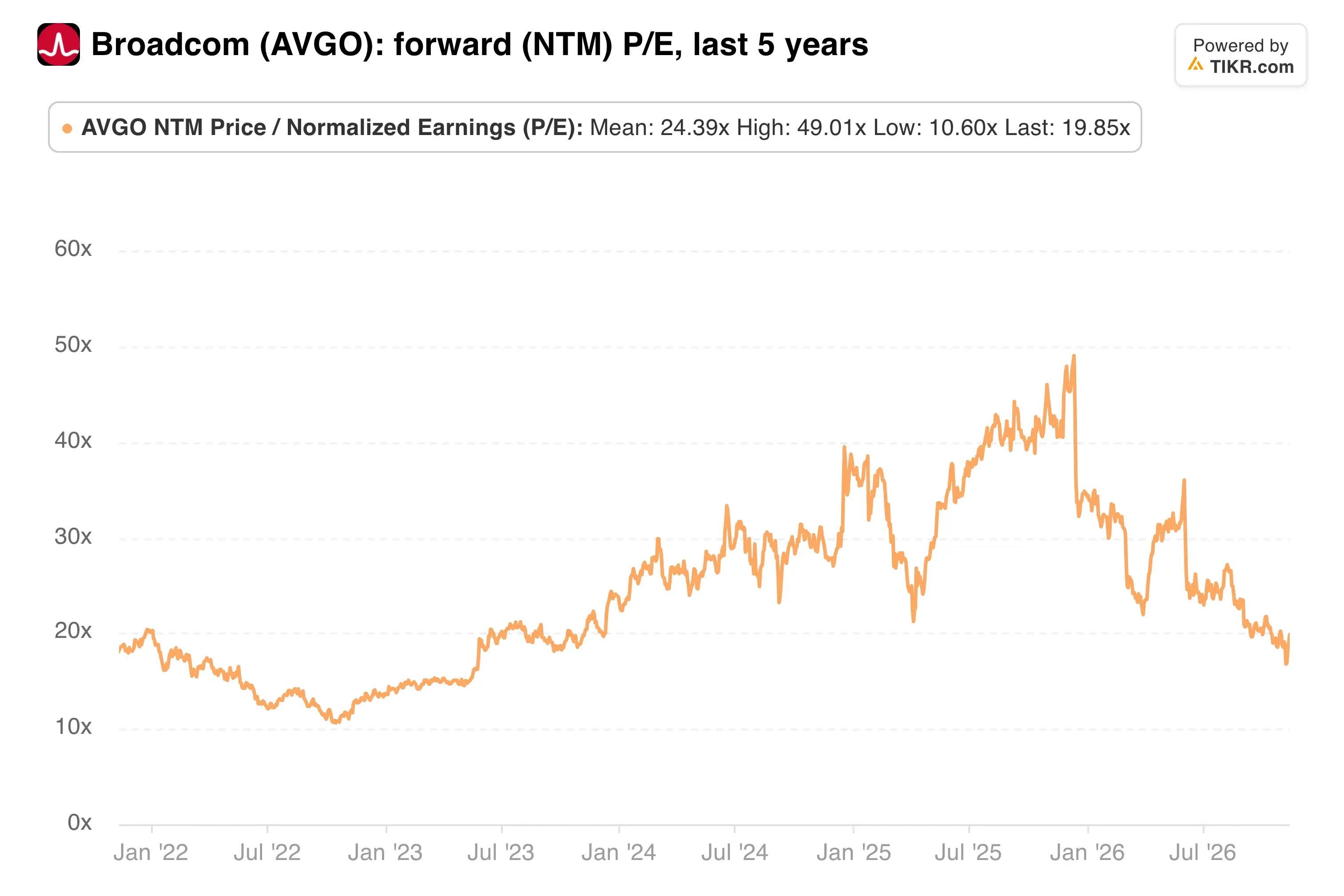
Broadcom’s forward multiple has come down a long way since summer, while the business kept accelerating.
My take: I think Thursday’s drop priced in a policy risk, but Broadcom’s numbers do not yet show it. The committed backlog and a 93% growth guide give it more cover than most chip names. Still, the risks are real: heavy reliance on a few hyperscale customers, slower data center permitting, and a margin that is drifting lower. I’d start a position before December 9 and add if the guide holds.
The report lands after the close on December 9. It will show whether Broadcom hit its $21.7 billion AI target and whether first-quarter fiscal 2027 guidance still assumes the buildout keeps going.
So what is Broadcom stock actually worth?
TIKR lets you forecast the future price of any stock in less than a minute. Just enter a few assumptions into TIKR’s valuation model and see what Broadcom could be worth. Start from Wall Street consensus estimates, or adjust the inputs to reflect your own view of the business. It’s free to use.
Disclaimer:
Please note that the articles on TIKR are not intended to serve as investment or financial advice from TIKR or our content team, nor are they recommendations to buy or sell any stocks. We create our content based on TIKR Terminal’s investment data and analysts’ estimates. Our analysis might not include recent company news or important updates. TIKR has no position in any stocks mentioned. Thank you for reading, and happy investing!