


Key Takeaways
- Clorox yields 4.6% and Truist Financial yields 4.2%, and their dividends are covered very differently.
- Truist’s dividend took 52% of its fiscal 2025 normalized EPS, and analysts’ fiscal 2026 estimates put that at 45%, though the dividend has held at $2.08 a share since fiscal 2023.
- Clorox paid out 133% of its free cash flow over the twelve months to Sept. 30, 2026, and its 74% forward ratio depends on free cash flow reaching $828 million in fiscal 2027.
- Clorox gets a new CEO on Jan. 5, 2027, and this fiscal year’s free cash flow will show whether its coverage recovers.
Clorox (CLX) stock has climbed 24% over its last 10 trading days, and it still yields 4.6%. That’s a big check from a company whose dividends cost more than its free cash flow over the past year.
Truist Financial (TFC) pays a bit less, a 4.2% yield, on a dividend its earnings cover with room to spare. But that dividend has sat at $2.08 a share since fiscal 2023.
So which is the better high-yield dividend stock?
| Metric | Truist Financial (TFC) | Clorox (CLX) |
|---|---|---|
| Dividend yield | 4.2% | 4.6% |
| Annual dividend | $2.08 a share | $5.00 a share |
| 5-year dividend growth | 2.9% a year (fiscal 2020-2025) | 2.0% a year (fiscal 2021-2026) |
| Coverage, last reported | 52% of normalized EPS (fiscal 2025) | 133% cash dividend payout ratio (TTM to Sept. 30, 2026) |
| Coverage, forward | 45% of normalized EPS (fiscal 2026 consensus) | 74% cash dividend payout ratio (fiscal 2027 consensus) |
| Net debt/EBITDA | n/a (bank) | 3.8x |
| Valuation | 1.6x tangible book | 19x forward earnings |
Source: TIKR, at today’s prices; annual dividends from StockAnalysis.
6 safe dividend stocks paying retirees 6%+ yields
There are over 100 stocks paying 6%+ annual dividends today.
But after an extensive investment review leveraging TIKR’s proprietary data, we now believe only six of them are truly safe for retirees.
They’re all yours as part of our new investment report. Learn more about how to get access right here.
Truist has the room, and it’s spending it on buybacks
Truist is in the middle of a cleanup: it sold its RAC loan portfolio, agreed to sell LightStream and stopped making Marine/RV loans, yet adjusted EPS of $1.16 still rose 12% from the third quarter of 2025.
Truist’s dividend took a comfortable 52% of fiscal 2025’s normalized EPS. The payout ran around 40% from fiscal 2016 to fiscal 2019, then rose to 58% in fiscal 2023, from 40% in fiscal 2022, as normalized EPS fell to $3.59:
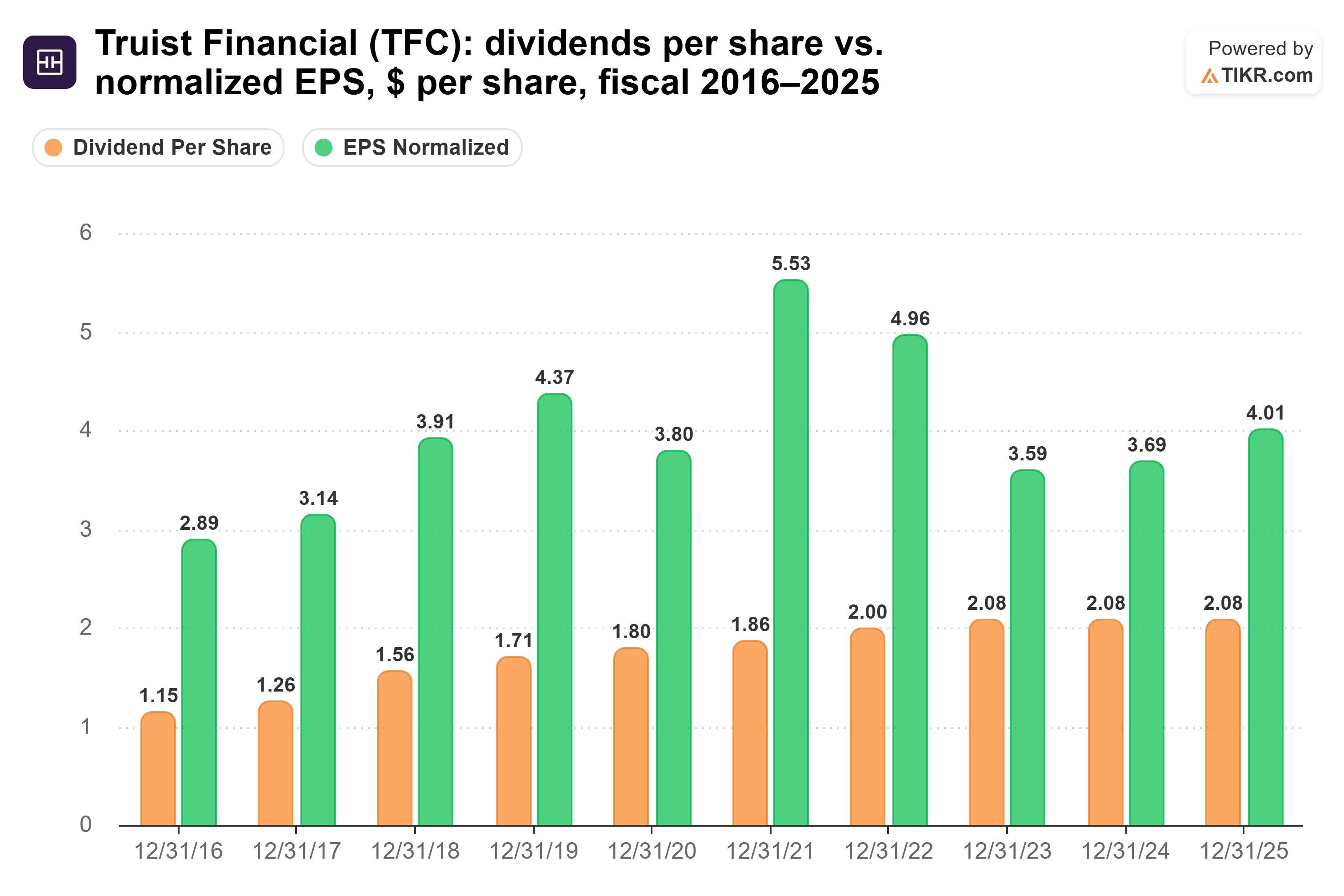
Normalized EPS recovered from $3.59 in fiscal 2023 to $4.01 in fiscal 2025, and 19 analysts expect $4.67 for fiscal 2026, which would bring the payout down to 45%.
Truist puts the extra capital into buybacks: $1.2 billion of stock in the third quarter, against $632 million of dividends. The risk is credit: its net charge-off ratio rose to 0.77% in the third quarter from 0.50% in the second.
Clorox is counting on a margin rebuild
Where Truist has held its dividend still, Clorox keeps raising: its rate is now $5.00 a year. “Dividend has increased annually for a decade. And for now, you should expect this to continue,” management said on its August call.
In the first quarter of fiscal 2027, net sales rose 33% to $1.91 billion, helped by the GOJO acquisition. But gross margin fell to 40.4% from 41.7% a year before, on higher commodity, manufacturing and logistics costs.
Dividends paid rose from $412 million in fiscal 2017 to $602 million in fiscal 2026, and free cash flow fell short of them in three of the last five years:
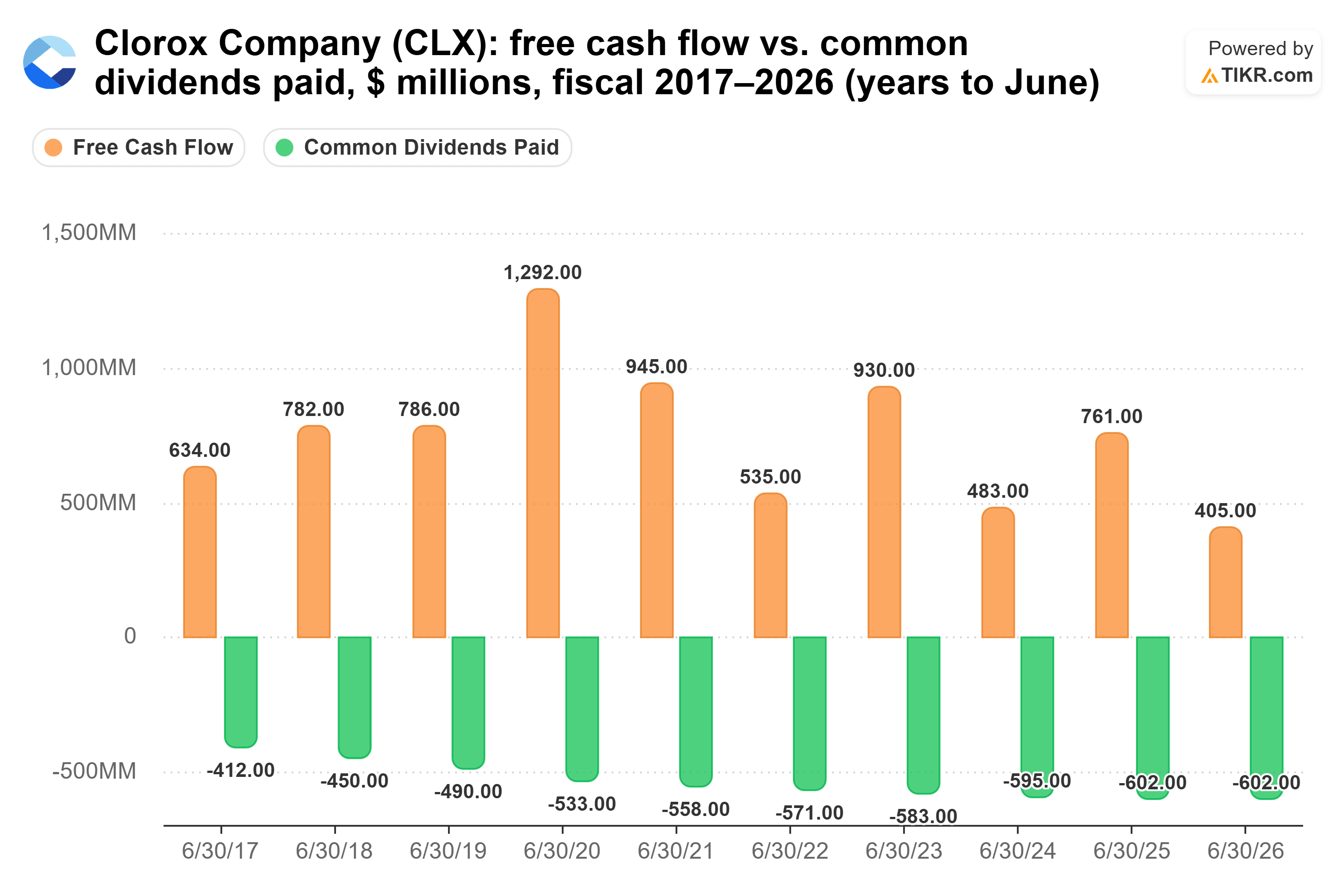
Over the twelve months to Sept. 30, 2026, Clorox paid $602 million in dividends against $453 million of free cash flow, a stretched 133% payout. Management sees it as “something more transitory as we rebuild our gross margin and not something structural.”
So which dividend wins?
Truist is the better high-yield dividend stock. Its dividend is well covered, analysts expect that coverage to widen, and it still has capital left over for buybacks.
Clorox’s dividend rests on a cash rebound. Analysts expect free cash flow of $828 million in fiscal 2027 and $843 million in fiscal 2028:
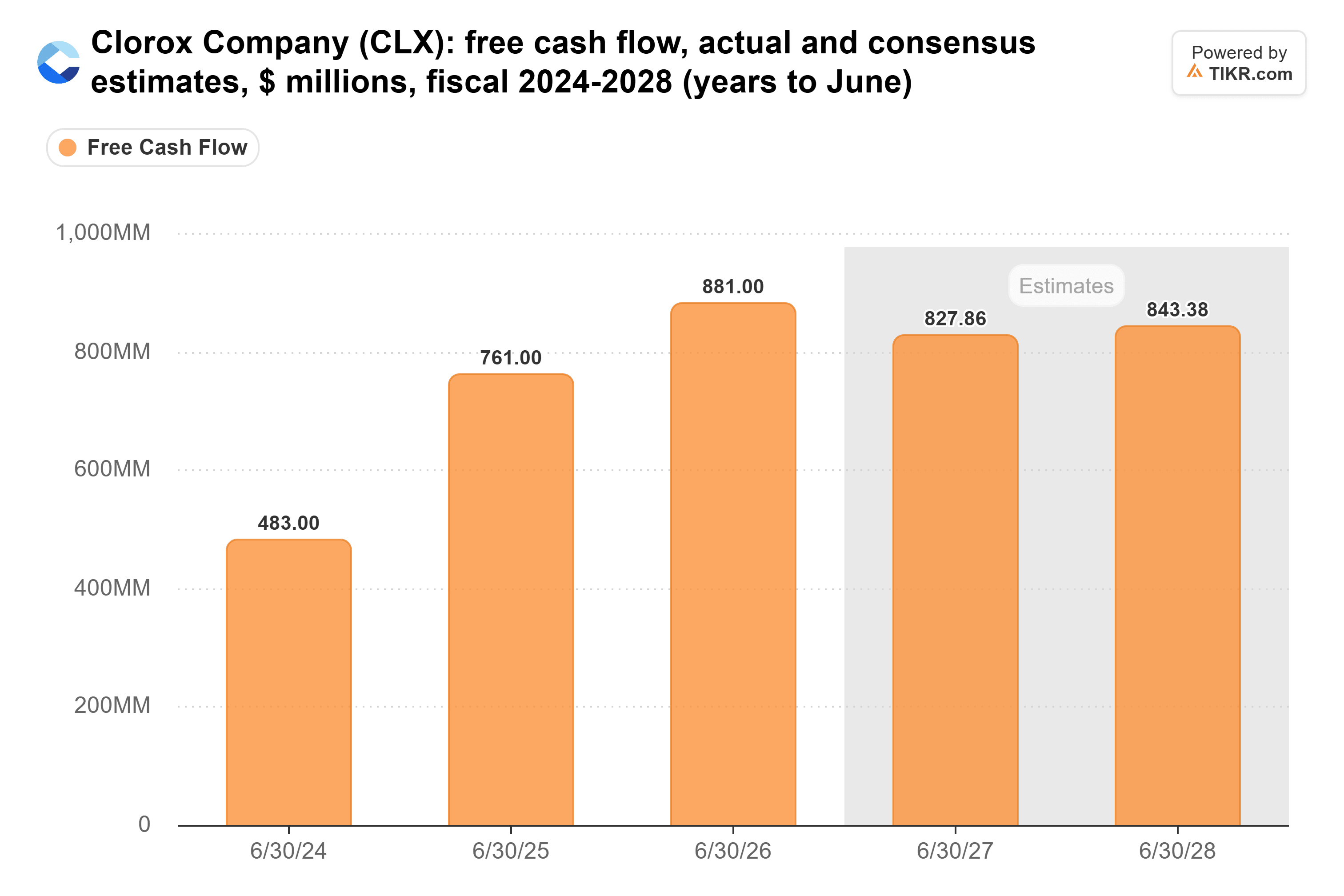
Five analysts make that estimate, and last year’s final consensus missed the actual by 18%.
This isn’t to say Clorox’s dividend is in trouble. It pays the bigger check, and at each dividend’s pace now, $10,000 in Clorox would pay about $532 in year 10, against about $420 from Truist. Truist would only catch up, around 2037, if it got back to its 5-year rate of 2.9% a year. But Clorox is paying that check out of more than its free cash flow, and I’d rather own the dividend that doesn’t need a rebound to stay safe.
Of course, if Clorox’s free cash flow lands near $828 million in fiscal 2027, its dividend would be covered at 74%, and the bigger, growing check would look a lot better. Fabian Garcia, who takes over as CEO on Jan. 5, 2027, will be the one to deliver it. And if the takeover talk of Nov. 11 ever became a deal, the standalone dividend case wouldn’t matter.
Forget Truist Financial: 6 safe 6%+ dividend yields you can buy right now
Dividends can hold the key to enormous wealth. But only if you buy the right ones.
Picking the right high-yield dividend stock can be the difference between a dream retirement…and scraping by every month, waiting for the next Social Security check to clear.
We’ve identified six stocks yielding 6%+ that we believe every retiree should know about right now. (And Truist Financial isn’t one of them.)
Disclaimer:
Please note that the articles on TIKR are not intended to serve as investment or financial advice from TIKR or our content team, nor are they recommendations to buy or sell any stocks. We create our content based on TIKR Terminal’s investment data and analysts’ estimates. Our analysis might not include recent company news or important updates. TIKR has no position in any of the stocks mentioned. Thank you for reading, and happy investing!


