Key Takeaways
- AT&T yields 5.2% and General Mills yields 7.0%, and both companies plan to hold their dividends flat for now.
- AT&T’s dividend used 44% of its free cash flow over the last twelve months, while General Mills’ used 85%.
- AT&T expects free cash flow of $21 billion or more by 2028, while General Mills guides for lower operating profit this fiscal year as it pays down debt.
- SpaceX’s push into wireless is the main new risk to AT&T’s cash flow, and General Mills’ debt sits above its own target.
General Mills (GIS) declared another $0.61 quarterly dividend on Sept. 29. That’s the same rate as before, a 7.0% yield.
AT&T (T) isn’t raising its dividend either. With its third-quarter results on Oct. 21, it said it plans to keep paying $1.11 a share a year, a 5.2% yield.
So with neither dividend growing, which is the better high-yield buy?
| Metric | AT&T (T) | General Mills (GIS) |
|---|---|---|
| Dividend yield | 5.2% | 7.0% |
| Annual dividend | $1.11 | $2.44 |
| Dividend growth, 5 years | -11.8% a year (fiscal 2020-2025) | 3.9% a year (fiscal 2021-2026) |
| Cash dividend payout ratio, TTM | 44% | 85% |
| Cash dividend payout ratio, forward | 46% (fiscal 2026) | 76% (fiscal 2027) |
| Net debt/EBITDA | 3.3x | 3.7x |
6 safe dividend stocks paying retirees 6%+ yields
There are over 100 stocks paying 6%+ annual dividends today.
But after an extensive investment review leveraging TIKR’s proprietary data, we now believe only six of them are truly safe for retirees.
They’re all yours for free as part of our new investment report, which you can access right here.
AT&T is trading copper for fiber
AT&T’s dividend per share fell from $2.08 in fiscal 2020 to $1.11 in fiscal 2025, which explains the negative 5-year rate. What’s left is well-covered. It used 44% of free cash flow over the twelve months to Sept. 30, 2026, and 46% on analysts’ fiscal 2026 consensus. Since fiscal 2023, the dividend has cost just over $8 billion a year, under half of free cash flow every year:

That cash comes from a business that’s moving from copper to fiber. Third-quarter revenue rose 5.3% from a year earlier to $32.3 billion. AT&T had a record 769,000 internet net adds in what it calls Advanced Connectivity, while Legacy revenue fell 24.5%.
On the third-quarter call, CEO John Stankey called “a fiber-fed broadband customer with a great wireless service on top of it” the industry’s most durable combination. SpaceX wants to compete for the wireless half of that. AT&T stock fell 8% on Oct. 23 after Bloomberg reported that SpaceX is in talks for access to at least 80,000 US cell sites.
General Mills is paying down debt first
General Mills is also holding its dividend flat, but its reason is debt. CFO Kofi Bruce said on the Sept. 23 first-quarter call, “we remain fully committed to our dividend, and in the near term, we expect to maintain the current rate per share while we prioritize deleverage.” He expects it to take “at least a couple of years” to get back to the company’s 3x net debt to EBITDA target.
General Mills’ dividend used 85% of free cash flow over the twelve months to Aug. 30, 2026, though analysts’ fiscal 2027 consensus brings that down to 76%. Free cash flow fell to $1.63 billion in fiscal 2026 (the year to May) from $2.29 billion in fiscal 2025, while the dividend cost $1.32 billion:

First-quarter organic sales were flat. For fiscal 2027, management guides for adjusted operating profit to fall 8% to 13% in constant currency, even with at least $750 million in cost savings. General Mills and its predecessor company have paid dividends without interruption for 128 years, according to its Sept. 29 release. But if profit falls further than guided, that dividend has little cushion.
So which dividend wins?
AT&T is the better high-yield dividend stock. Analysts expect its cash to keep growing, in line with management’s outlook of $18 billion+ in 2026 and $21 billion+ in 2028:
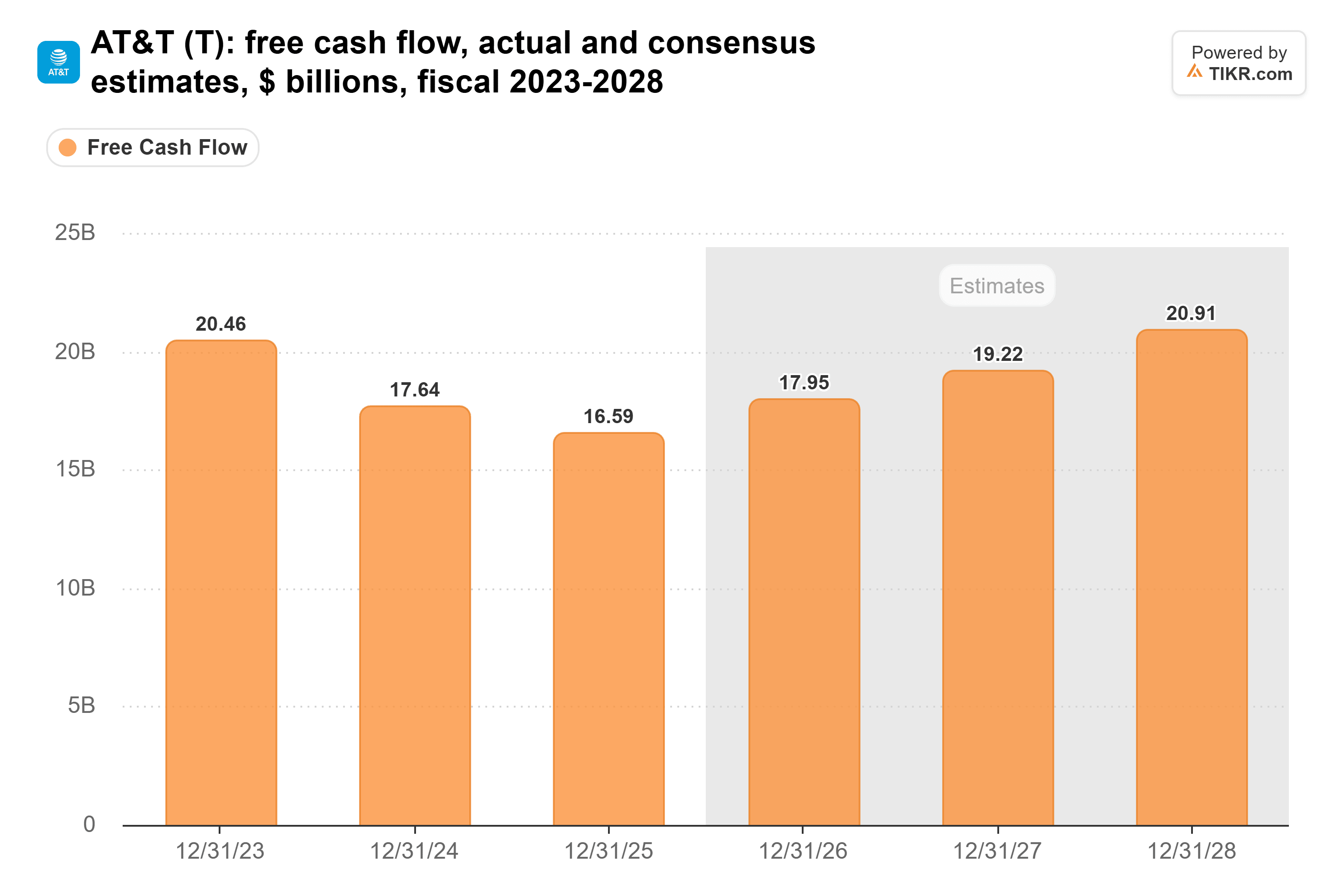
This year, that cash covers the $8 billion dividend and about $10 billion of buybacks. I’d expect AT&T to trim the buybacks long before it touched the dividend.
General Mills’ case is a strong one. On $10,000, its 7.0% yield pays $700 a year against $520 from AT&T, and at each dividend’s current pace, AT&T’s income never catches up. A 76% forward payout ratio is still covered, and I’d expect management to work hard to keep a 128-year record going.
Still, I want a high yield with plenty of cash behind it. AT&T’s dividend costs 44% of free cash flow, against 85% at General Mills, where profit is set to shrink this fiscal year.
Of course, if SpaceX turns into a real nationwide carrier, AT&T’s wireless cash flow could take a hit. The Washington Post reported on Oct. 30 that SpaceX is in talks to buy Boost Mobile or use its network, and that’s the story I’d watch.
Forget AT&T: 6 safe 6%+ dividend yields you can buy right now
Dividends can hold the key to enormous wealth. But only if you buy the right ones.
Picking the right high-yield dividend stock can be the difference between a dream retirement…and scraping by every month, waiting for the next Social Security check to clear.
We’ve identified six stocks yielding 6%+ that we believe every retiree should know about right now. (And AT&T isn’t one of them.)
Disclaimer:
Please note that the articles on TIKR are not intended to serve as investment or financial advice from TIKR or our content team, nor are they recommendations to buy or sell any stocks. We create our content based on TIKR Terminal’s investment data and analysts’ estimates. Our analysis might not include recent company news or important updates. TIKR has no position in any of the stocks mentioned. Thank you for reading, and happy investing!