
Key Takeaways
- Iron Mountain raised its quarterly dividend 15% on Nov. 5, then its stock fell more than 10% twice in November.
- Realty Income yields 5.7% against Iron Mountain’s 3.9%, but its dividend grew 2.9% a year from fiscal 2020 to fiscal 2025, against 5.5% for Iron Mountain.
- Iron Mountain paid out 62% of its AFFO in fiscal 2025, against 75% at Realty Income, though it carries more debt relative to its EBITDA.
- After the selloff, Iron Mountain trades at 16x forward AFFO, below its five-year average of 17x.
Iron Mountain (IRM) raised its quarterly dividend 15% on Nov. 5, and its stock fell 11% the same day. On Nov. 20, it fell another 10% as real estate stocks sold off.
After both drops, Iron Mountain yields 3.9%. That’s still well short of the 5.7% that Realty Income (O) pays. Realty Income raised its monthly dividend again on Nov. 10, extending a record it describes this way: “Since our founding, we have declared 677 consecutive monthly dividends and are a member of the S&P 500 Dividend Aristocrats ® index for having increased our dividend for over 32 consecutive years.”
So which is the better dividend stock: the bigger check today, or the faster-growing one?
| Metric | Realty Income (O) | Iron Mountain (IRM) |
|---|---|---|
| Dividend yield | 5.7% | 3.9% |
| Dividend growth, fiscal 2020-2025 | 2.9% a year | 5.5% a year |
| Dividend record, the company’s count | Raised for over 32 consecutive years | 5 raises in the past 4 years |
| AFFO payout ratio, fiscal 2025 | 75% | 62% |
| AFFO payout ratio, fiscal 2026 consensus | 73% | 60% |
| Net debt / EBITDA | 5.8x | 6.0x |
| Interest coverage | 2.4x | 1.8x |
Source: TIKR; dividend records from the companies’ own releases and calls.
6 safe dividend stocks paying retirees 6%+ yields
There are over 100 stocks paying 6%+ annual dividends today.
But after an extensive investment review leveraging TIKR’s proprietary data, we now believe only six of them are truly safe for retirees.
They’re all yours as part of our new investment report. Learn more about how to get access right here.
Realty Income’s cushion keeps getting wider
Realty Income’s AFFO rose 3.7% to $1.12 a share in the third quarter of 2026, from the same quarter a year earlier, and it raised its 2026 AFFO guidance to $4.45-$4.46 a share.
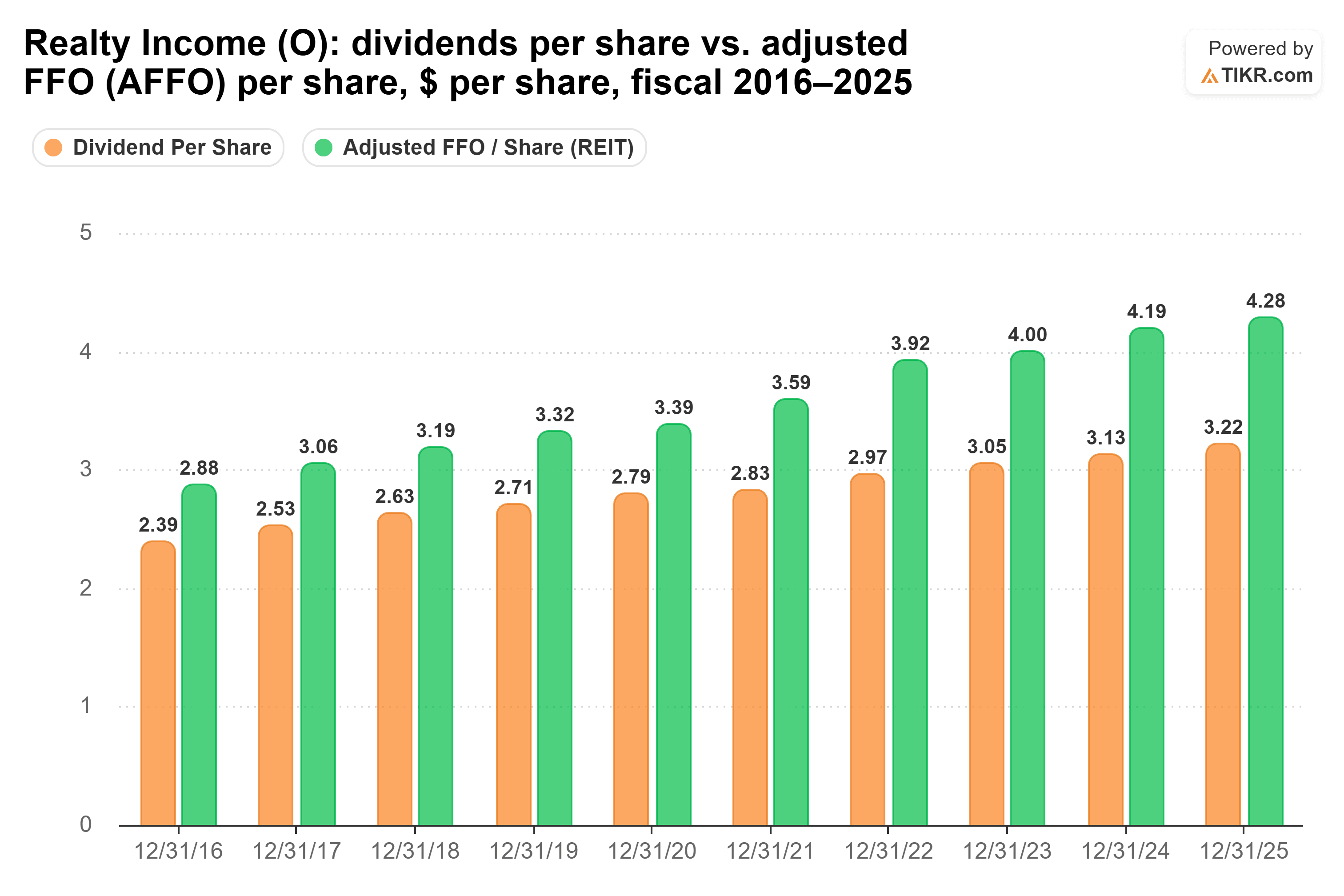
Its AFFO payout ratio was a comfortable 75% in fiscal 2025, and consensus has 73% for fiscal 2026. AFFO grew from $2.88 a share in fiscal 2016 to $4.28 in fiscal 2025, faster than the dividend’s rise from $2.39 to $3.22, so the payout ratio came down from 83%:
The catch is the pace: the dividend grew 2.9% a year from fiscal 2020 to fiscal 2025. And on Nov. 12, Realty Income said Neil Abraham, its chief strategy officer, will leave at the end of the year, with no successor named.
Iron Mountain’s raise has the AFFO behind it
Iron Mountain’s dividend just took a much bigger step, and its AFFO is moving even faster. Third-quarter AFFO rose 17% to $1.53 a share from the same quarter a year earlier.
It guides 2026 AFFO to $5.94-$6.00 a share, about 15% growth at the midpoint, and consensus has $5.98, up 16% from fiscal 2025’s $5.17. Investors sold on Nov. 5 because the midpoint of its full-year revenue guidance came in below Wall Street’s roughly $8.04 billion consensus.
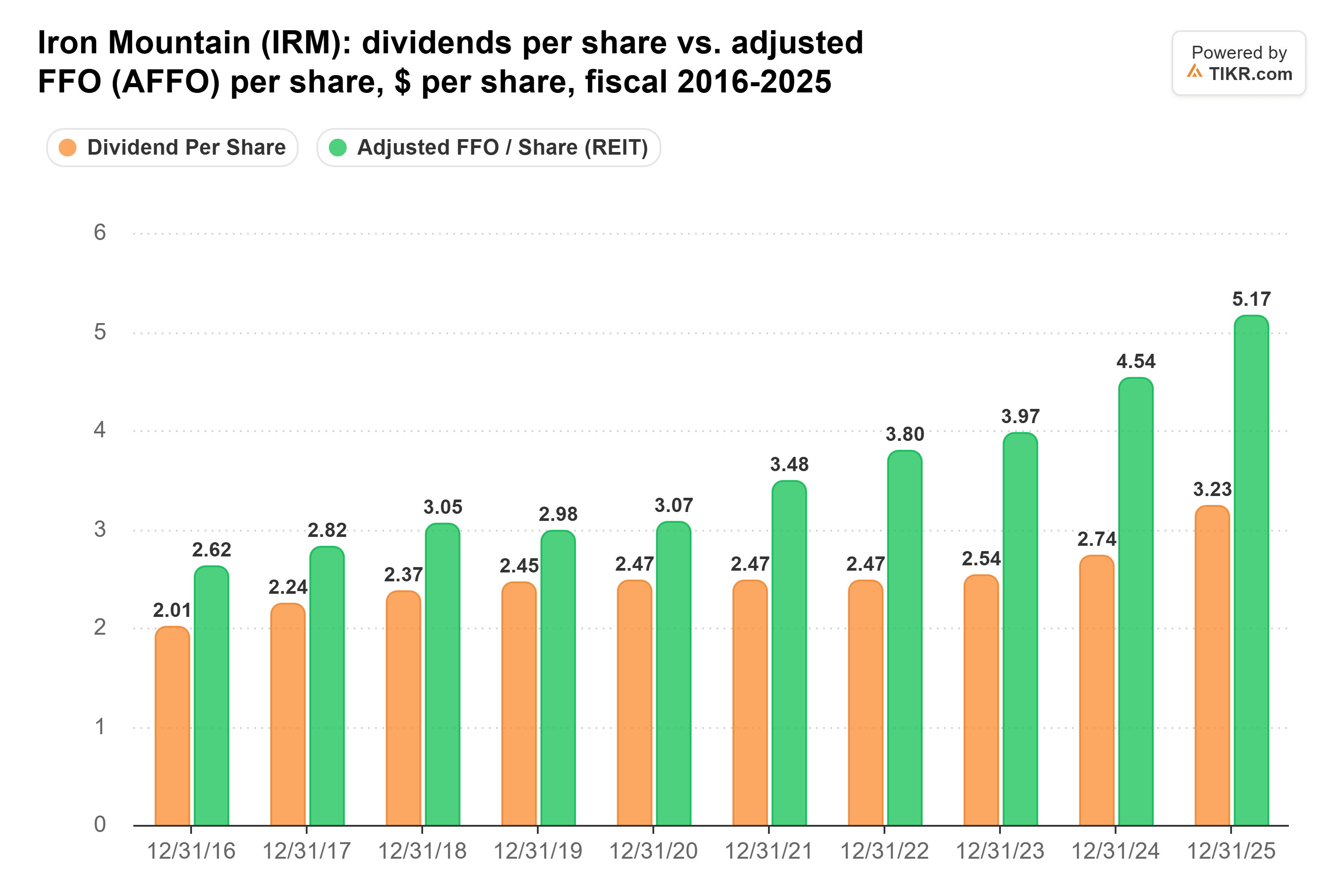
The raise took the dividend to $0.993 a share a quarter from $0.864, following the policy management laid out on Iron Mountain’s third-quarter call: “growing the dividend in line with AFFO per share and maintaining a payout ratio of low 60s percent.” The payout was 62% in fiscal 2025 and 60% in fiscal 2026 consensus, down from 82% in fiscal 2019. Part of that drop came from three years with the dividend held at $2.47 a share, from fiscal 2020 to fiscal 2022, while AFFO rose from $3.07 to $3.80:
Iron Mountain carries more debt to fund that growth: net debt is 6.0x EBITDA, and its EBIT covers interest 1.8x, against 2.4x at Realty Income.
So which dividend wins?
Iron Mountain is the better dividend stock. Its dividend takes a smaller share of AFFO, and AFFO is growing about 15% this year, against 4% at Realty Income, which leaves more room to keep raising.
Iron Mountain’s 5.5% five-year rate includes three flat years, and its dividend rose 18.3% in fiscal 2025. At that pace, against Realty Income’s 2.9%, Iron Mountain’s income on $10,000 passes Realty Income’s around 2029. By year 10, it would pay about $1,772 against about $736. (That pace may slow, since management ties raises to AFFO growth.)
After November’s two drops, you aren’t overpaying for that growth either. Iron Mountain trades at 16x forward AFFO, below its five-year average of 17x:
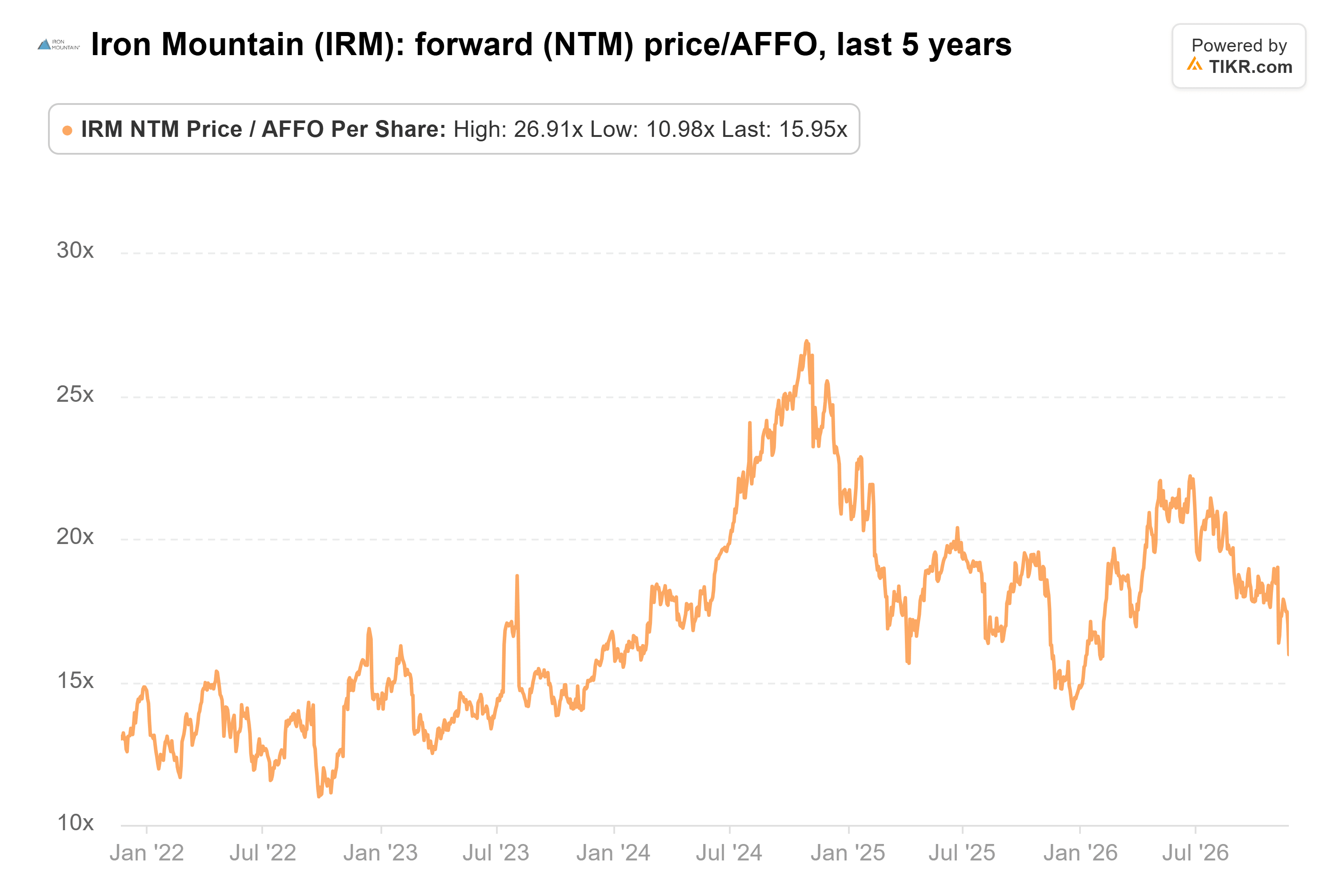
(It peaked near 27x in October 2024 and bottomed near 11x in September 2022.)
Realty Income still has a strong case. It pays the bigger check, has the longer record, carries less debt and, at 13x forward AFFO, is the cheaper stock. For someone who needs the most income right now, 5.7% is hard to pass up. It’s just that, when it comes down to it, I’d rather own the dividend with more room under it and the faster-growing business behind it.
Of course, Iron Mountain has to keep leasing data center space for this to work. It has guided to about $1.57 of AFFO a share in the fourth quarter, and its report in early 2027 will show whether it got there.
Forget Iron Mountain: 6 safe 6%+ dividend yields you can buy right now
Dividends can hold the key to enormous wealth. But only if you buy the right ones.
Picking the right high-yield dividend stock can be the difference between a dream retirement…and scraping by every month, waiting for the next Social Security check to clear.
We’ve identified six stocks yielding 6%+ that we believe every retiree should know about right now. (And Iron Mountain isn’t one of them.)
Disclaimer:
Please note that the articles on TIKR are not intended to serve as investment or financial advice from TIKR or our content team, nor are they recommendations to buy or sell any stocks. We create our content based on TIKR Terminal’s investment data and analysts’ estimates. Our analysis might not include recent company news or important updates. TIKR has no position in any of the stocks mentioned. Thank you for reading, and happy investing!