Key Takeaways
- Truist yields 4.2% and PNC yields 3.5%, but Truist’s dividend has held at $2.08 a share a year since fiscal 2023, while PNC raised its quarterly dividend 18% to $2.00 in July.
- Both banks pay out well under their earnings: Truist paid out 52% of normalized EPS in fiscal 2025 and PNC 40%, with analysts expecting 45% and 38% for fiscal 2026.
- Truist took $1.4 billion of securities losses in the third quarter as part of an overhaul, while PNC expects full-year 2026 revenue to rise about 13.7%.
- Truist’s 2027 outlook, due in January, is the next test of whether its dividend can start growing again.
Any retiree hunting for bank dividends is going to look at Truist Financial (TFC) and PNC Financial Services Group (PNC). Right now, they offer very different deals.
Truist yields 4.2%, and on Oct. 27 it declared another $0.52 quarterly dividend, the same rate it has paid since fiscal 2023. Whereas back in July, PNC raised its quarterly dividend 18% to $2.00 a share, for a 3.5% yield.
So which is the better dividend stock for retirees who need a check they can count on?
| Metric | Truist (TFC) | PNC (PNC) |
|---|---|---|
| Dividend yield | 4.2% | 3.5% |
| Annual dividend, current rate | $2.08 | $8.00 |
| Dividend growth, fiscal 2020-2025 | 2.9% a year | 7.5% a year |
| Payout ratio of normalized EPS, fiscal 2025 | 52% | 40% |
| Payout ratio of normalized EPS, fiscal 2026 consensus | 45% | 38% |
| Price/tangible book (LTM) | 1.6x | 1.9x |
Source: TIKR, Nov. 5, 2026; current dividend rates from StockAnalysis.
6 safe dividend stocks paying retirees 6%+ yields
There are over 100 stocks paying 6%+ annual dividends today.
But after an extensive investment review leveraging TIKR’s proprietary data, we now believe only six of them are truly safe for retirees.
They’re all yours for free as part of our new investment report, which you can access right here.
Truist’s bigger check hasn’t grown since 2023
Truist’s normalized EPS fell from $5.53 in fiscal 2021 to $3.59 in fiscal 2023, and the board kept the dividend at $2.08 a share through the slump. Earnings recovered to $4.01 in fiscal 2025, for a payout ratio of 52%. That’s up from 40.3% in fiscal 2022, but still a comfortable level. Analysts expect $4.60 of normalized EPS for fiscal 2026, which would bring the ratio down to 45%.
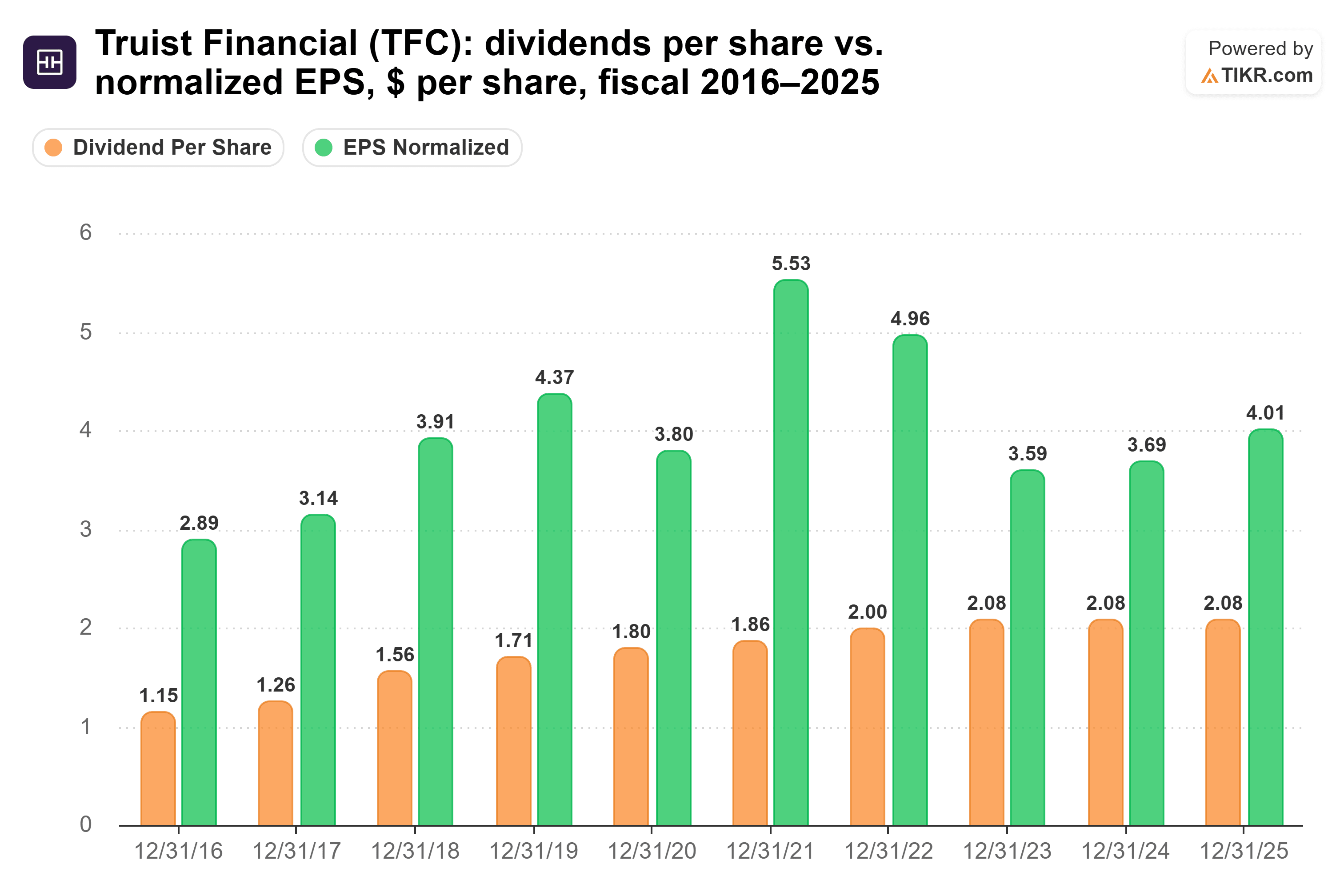
Truist is in the middle of an overhaul under CEO Michael Lyons. On Oct. 14, it agreed to sell its RAC dealer-related business, $7.7 billion of assets. It also repositioned its securities, booking $1.4 billion of realized losses. That cut third-quarter diluted EPS to $0.56 and its CET1 ratio by 20 basis points, to 10.7%.
Adjusted diluted EPS of $1.16 was up 12% from a year earlier and covered the $0.52 dividend more than twice. On Oct. 16, Truist also reshuffled its consumer and small business leadership, and longtime executive Dontá Wilson is leaving.
“It’s about creating a stronger foundation for both sustainable growth and higher returns over time,” Lyons said on the third-quarter call.
For now, Truist favors buybacks. Of the $1.8 billion it returned in the third quarter, $1.2 billion went to repurchases and $632 million to the dividend. Its loan book is also shrinking: average loans fell $3.6 billion from the second quarter as Truist sold or ran off less profitable lending.
PNC keeps raising, even in a bad year
PNC’s dividend, by contrast, keeps growing. Its dividends per share rose every fiscal year from $2.12 in fiscal 2016 to $6.60 in fiscal 2025. That includes fiscal 2020, when normalized EPS fell to $6.21 and the payout ratio jumped to 74.1%.
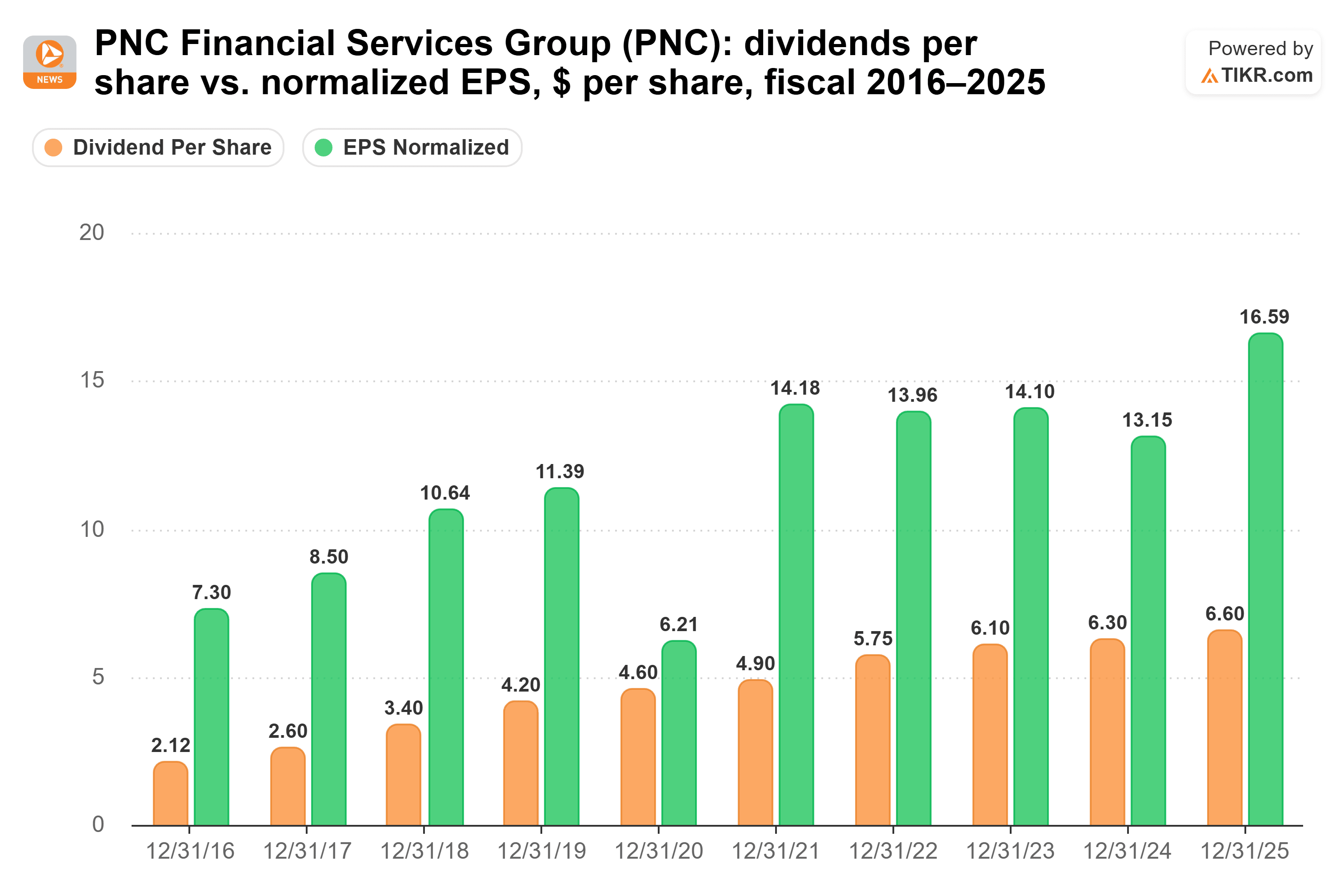
That ratio was 39.8% in fiscal 2025, as normalized EPS climbed to $16.59 from $13.15 in fiscal 2024. Analysts expect 38% for fiscal 2026: $7.40 a share in dividends against $19.32 of normalized EPS.
PNC’s growth comes from commercial lending, especially in expansion markets such as the Southwest, Florida and California, which are growing two to three times faster than its legacy markets. It expects full-year 2026 average loans to rise about 13.5% and revenue about 13.7%.
Third-quarter net income came to $2.1 billion. PNC returned $1.4 billion to shareholders: $0.8 billion in dividends and $0.6 billion in buybacks. Its CET1 ratio of 9.8% sits just under its 10% target, because loans grew faster than it expected.
On Oct. 14, the OCC said PNC was among nine large banks whose reputation-risk policies from 2020 to September 2025 contributed to denying or limiting services over customers’ political or religious beliefs. It issued no fines, so PNC’s dividend coverage doesn’t change today. The OCC said it’s considering further rules.
So which dividend wins?
For retirees, PNC is the better dividend stock. It pays out a smaller share of its earnings, and its board is still raising.
At each dividend’s pace now, $10,000 in PNC pays $350 a year against Truist’s $420. Even if PNC grew only 4.8% a year, its fiscal 2025 rise, its income would pass Truist’s flat check in about 3.9 years (2030) and reach about $532 in year 10. July’s raise was far bigger than that.
Analysts expect PNC’s normalized EPS to climb from $16.59 in fiscal 2025 to $23.46 in fiscal 2028, which leaves plenty of room for more raises:
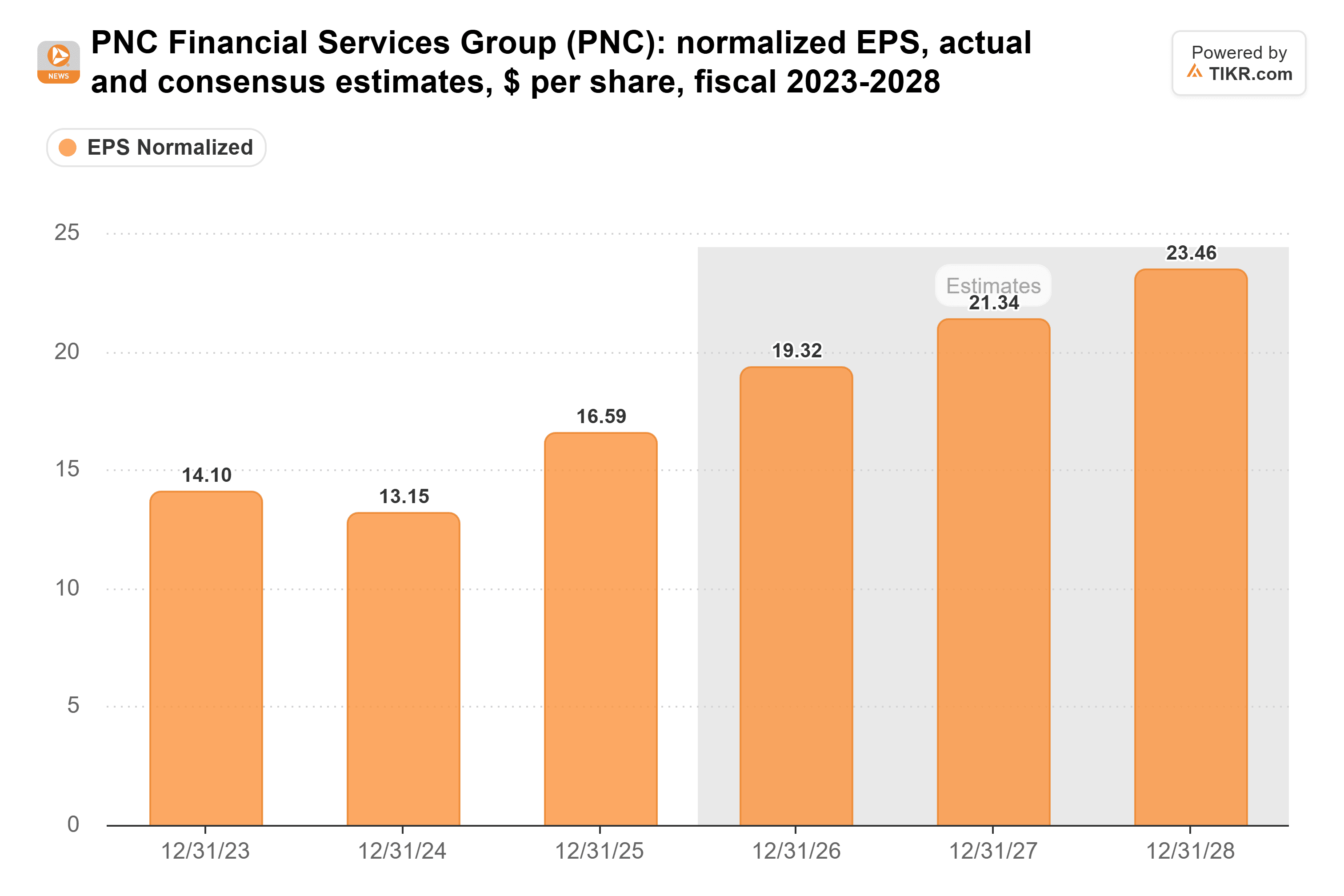
That isn’t to say Truist’s dividend is in trouble. Its payout ratio is heading down to 45%, and $10,000 pays $70 more a year today. It’s also cheaper, at 1.6x tangible book against PNC’s 1.9x. It’s just that, when it comes down to it, I’d rather own the bank that pays out less and is still raising its dividend.
Of course, Truist plans to give a fuller look at 2027 in January. A return to raises there would make this a much closer call.
Forget PNC Financial Services Group: 6 safe 6%+ dividend yields you can buy right now
Dividends can hold the key to enormous wealth. But only if you buy the right ones.
Picking the right high-yield dividend stock can be the difference between a dream retirement…and scraping by every month, waiting for the next Social Security check to clear.
We’ve identified six stocks yielding 6%+ that we believe every retiree should know about right now. (And PNC Financial Services Group isn’t one of them.)
Disclaimer:
Please note that the articles on TIKR are not intended to serve as investment or financial advice from TIKR or our content team, nor are they recommendations to buy or sell any stocks. We create our content based on TIKR Terminal’s investment data and analysts’ estimates. Our analysis might not include recent company news or important updates. TIKR has no position in any of the stocks mentioned. Thank you for reading, and happy investing!