


Key Takeaways
- Duke Energy raised its quarterly dividend 2% in July 2026 and yields 3.8%, against 3.3% for Xcel Energy.
- Xcel raised its dividend 5.8% a year from fiscal 2020 to fiscal 2025, against 2% a year at Duke.
- Both dividends are well covered, with Xcel paying out 60% of fiscal 2025 normalized EPS and Duke paying out 67%.
- Xcel carries more debt, at 6.3x net debt to EBITDA against 5.4x at Duke.
Any retiree hunting for a dividend check they can count on is going to look at utilities like Duke Energy (DUK) and Xcel Energy (XEL).
Duke raised its quarterly dividend 2% in July, which it said on its Aug. 4 call marked “over 20 years of consecutive annual dividend increases.” Xcel, for its part, reaffirmed its 2026 guidance for $4.04 to $4.16 of ongoing earnings per share on July 30.
Both fund their data center builds with new debt and stock, so each is judged on the share of its normalized earnings it pays out. So which is the better dividend stock for retirees?
| Metric | Duke Energy (DUK) | Xcel Energy (XEL) |
|---|---|---|
| Dividend yield | 3.8% | 3.3% |
| Dividend growth, fiscal 2020 to fiscal 2025 | 2.0% a year | 5.8% a year |
| Payout ratio of normalized EPS, fiscal 2025 | 67% | 60% |
| Payout ratio of normalized EPS, fiscal 2026 consensus | 65% | 58% |
| Net debt / EBITDA | 5.4x | 6.3x |
| Interest coverage (EBIT / interest) | 2.35x | 1.87x |
| Forward P/E (NTM) | 17.1x | 17.2x |
Duke Energy: steady raises, more room every year
Duke’s growth is coming from data centers: it has 7.8 gigawatts of signed electric service agreements with data center customers. Adjusted EPS rose to $1.43 in the second quarter of 2026, up from $1.25 a year before.
Earnings have outgrown the dividend for years. From fiscal 2018 to fiscal 2025, normalized EPS rose from $4.72 to $6.31 while the dividend went from $3.63 to $4.22 a share. That took the payout ratio from 76.9% down to a comfortable 66.9%.

Management called July’s raise “consistent with growth in recent years,” and the record bears that out: 2.0% a year from fiscal 2020 to fiscal 2025, from $3.82 to $4.22 a share. With Duke guiding to 5% to 7% EPS growth through 2030, the payout ratio has room to keep falling.
For a retiree, the catch is the pace. At 2.0% a year, $10,000 paying $380 today pays about $455 in year 10.
Xcel Energy: faster raises, more debt
Xcel is chasing the same data center demand. It has 1 gigawatt of data centers in operation or under construction, plus another gigawatt under signed agreements. Ongoing EPS rose to $0.93 in the second quarter of 2026, up from $0.75 a year before.
Xcel’s dividend has moved in step with its earnings. The dividend rose from $1.36 a share in fiscal 2016 to $2.28 in fiscal 2025, and the payout ratio stayed between 60.0% and 62.6% every year.
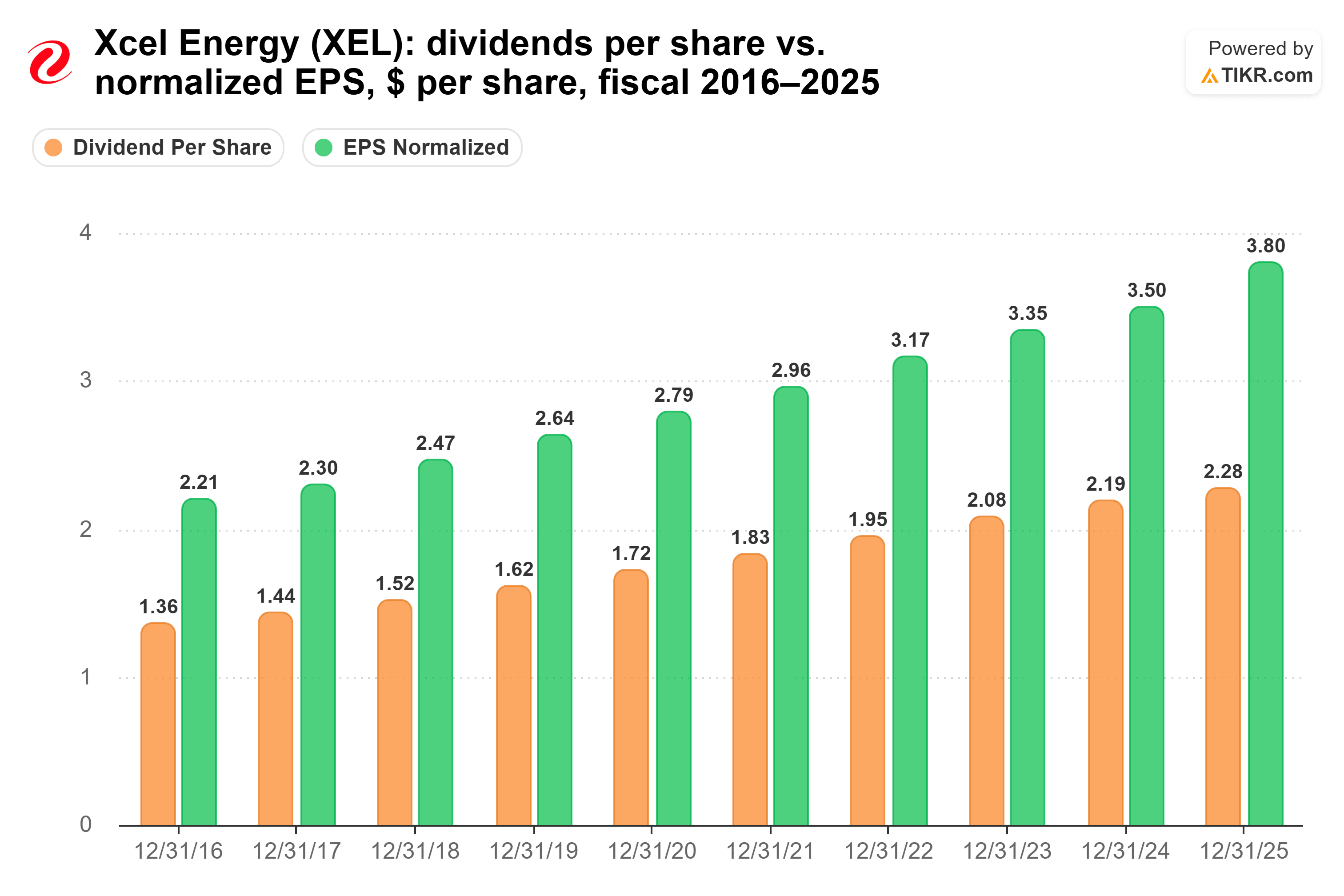
So the faster raises haven’t cost Xcel any coverage. It paid out a well-covered 60% of normalized EPS in fiscal 2025, and consensus has it at 58% for fiscal 2026.
The catch is the balance sheet. Xcel’s net debt is 6.3x EBITDA, and its EBIT covers interest a thinner 1.87x, against 5.4x and 2.35x at Duke. Xcel also needs $7 billion of new equity in its base five-year plan, though it has already lined up about $6 billion of it.
So which dividend wins?
Xcel Energy is the better dividend stock for retirees, because its check grows faster and is better covered. At each company’s 5-year rate, $10,000 in Xcel pays $330 a year now and about $548 in year 10. That’s a 5.5% yield on the original cash, against about $455 at Duke. Xcel’s income would pass Duke’s in about 3.9 years, around 2030.
The earnings behind those raises are expected to keep climbing, too. Consensus has normalized EPS rising from $3.80 in fiscal 2025 to $5.01 in fiscal 2028.

Xcel itself expects more than 9% average EPS growth through 2030, so those estimates aren’t running ahead of management.
That isn’t to say Duke is a bad pick. It pays the bigger check today, $380 against $330 on the same $10,000, and it carries less debt. On its May call, it also celebrated “our 100th consecutive year of paying a quarterly cash dividend.” Still, a retiree living on this check for the next decade needs it to grow. Xcel’s has grown nearly three times as fast while paying out less of its earnings.
Of course, Xcel’s faster growth leans on landing that data center load while it carries more debt. The 1 gigawatt it expects to sign by the end of this year is the first number to watch.
So what is Xcel Energy stock actually worth?
TIKR lets you forecast the future price of any stock in less than a minute. Just enter a few assumptions into TIKR’s valuation model and see what Xcel Energy could be worth. Start from Wall Street consensus estimates, or adjust the inputs to reflect your own view of the business. It’s free to use.
Disclaimer:
Please note that the articles on TIKR are not intended to serve as investment or financial advice from TIKR or our content team, nor are they recommendations to buy or sell any stocks. We create our content based on TIKR Terminal’s investment data and analysts’ estimates. Our analysis might not include recent company news or important updates. TIKR has no position in any of the stocks mentioned. Thank you for reading, and happy investing!


