


Key Takeaways
- Truist Financial yields 4.6% and KeyCorp 4.3%, and both paid the same dividend in fiscal 2025 as in fiscal 2023: $2.08 and $0.82 a share.
- Both dividends are well-covered: 52% of normalized EPS for Truist and 55% for KeyCorp in fiscal 2025, falling to 44% and 45% on fiscal 2026 consensus.
- KeyCorp’s payout ratio hit 93% in fiscal 2023, while Truist’s peaked at 58% over the past decade.
- KeyCorp expects 7% to 8% revenue growth in 2026, against 3.5% to 4% at Truist.
Truist Financial (TFC) grew its diluted EPS 37% from a year earlier in the second quarter of 2026, and KeyCorp (KEY) grew its second-quarter earnings 26%. Neither has handed shareholders a bigger dividend for it. Truist paid $2.08 a share in each of fiscal 2023, 2024 and 2025, KeyCorp paid $0.82, and both pay the same rates today.
That leaves income investors weighing Truist’s 4.6% yield against KeyCorp’s 4.3%, at the Oct. 7, 2026 close. So which is the better dividend stock?
| Metric | Truist Financial (TFC) | KeyCorp (KEY) |
|---|---|---|
| Dividend yield (Oct. 7, 2026) | 4.6% | 4.3% |
| Annual dividend | $2.08 | $0.82 |
| Dividend growth, fiscal 2020–2025 | 2.9% a year | 2.1% a year |
| Dividend growth, fiscal 2015–2025 | 7.1% a year | 11.0% a year |
| Payout ratio of normalized EPS, fiscal 2025 | 52% | 55% |
| Payout ratio of normalized EPS, fiscal 2026 consensus | 44% | 45% |
| Price/tangible book (LTM) | 1.4x | 1.5x |
Truist’s cushion has held up
Truist’s dividend is well-covered by earnings, the measure that fits a bank. It took 52% of normalized EPS in fiscal 2025 ($2.08 against $4.01), and that falls to a roomier 44% on the 19 analysts’ fiscal 2026 consensus of $4.75. (Last year’s consensus landed within 1% of the actual.)
That cushion has been steady for a decade. The dividend rose from $1.15 a share in fiscal 2016 to $2.08 in fiscal 2023, and the payout ratio never went above 58%.

Part of the earnings growth comes from pruning. Truist has stopped making marine and RV loans and cut back sharply on auto lending, moving that capital into higher-quality commercial loans. On the second-quarter call, Chairman and CEO William Rogers said: “While some of these choices may create near-term trade-offs in individual growth metrics, they’re producing the outcomes we intended and are driving stronger profitability and improved financial performance.”
Truist pays for it in net interest income. It now expects that line to grow 1% to 1.5% in 2026, down from 2% to 3%, as depositors chase higher rates. Management ranks the dividend ahead of buybacks, and the second quarter shows that order: dividends took 42% of earnings, with $1.2 billion of buybacks on top.
KeyCorp is growing faster, from a shakier base
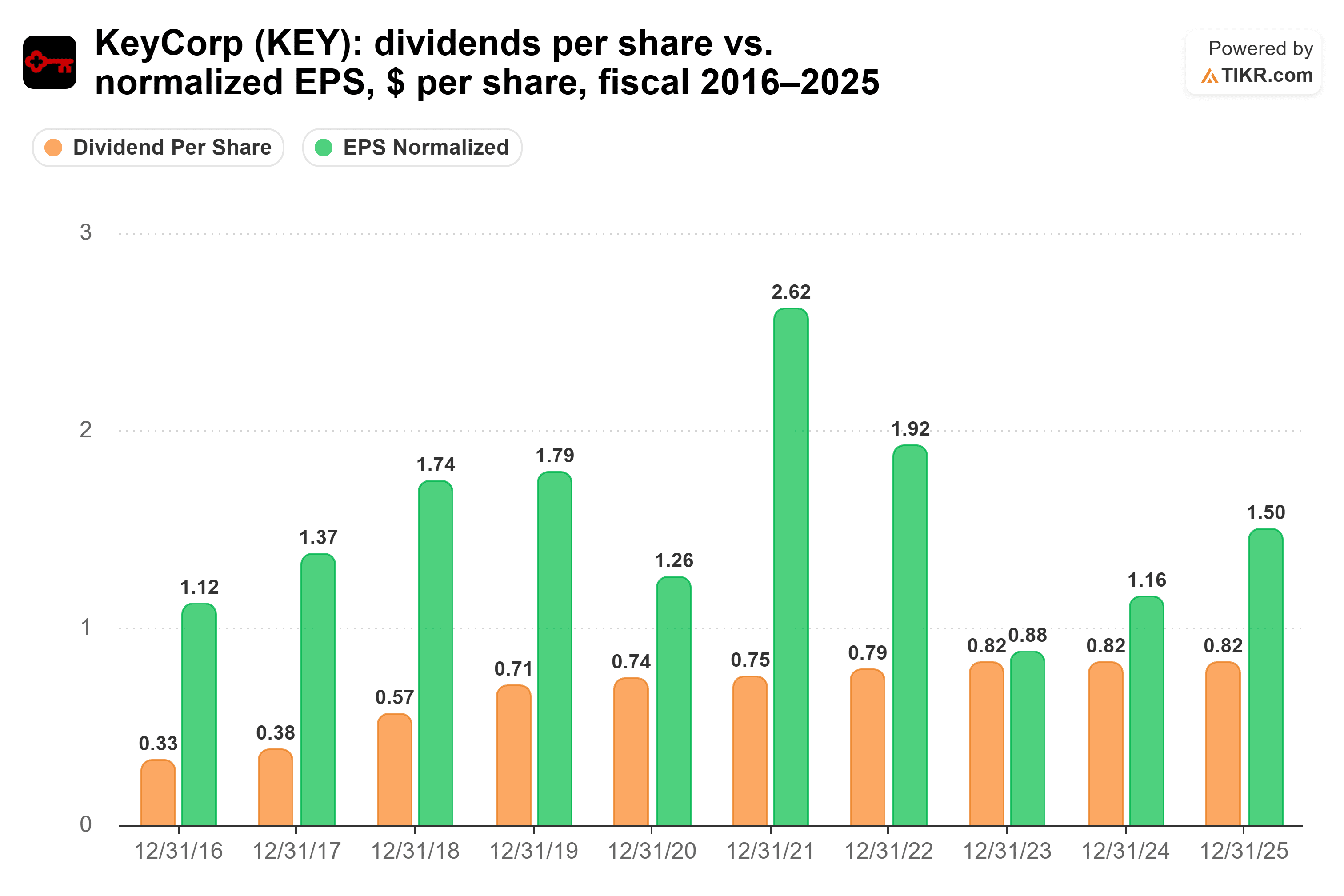
KeyCorp’s dividend has stood still just as long, and its coverage today looks a lot like Truist’s: 55% of normalized EPS in fiscal 2025 ($0.82 against $1.50), falling to 45% on the 15 analysts’ fiscal 2026 consensus of $1.84.
The record behind it is bumpier. The dividend rose from $0.33 a share in fiscal 2016 to $0.82 in fiscal 2023. That was the year normalized EPS fell to $0.88 from $1.92 in fiscal 2022, and the payout ratio jumped to a risky 93%.
The business has more momentum now. Second-quarter 2026 revenue rose 7% from a year earlier to $1.96 billion. KeyCorp also raised its 2026 guidance to 7% to 8% revenue growth and 9% to 11% net interest income growth.
Chairman and CEO Christopher Gorman puts clients and investment in the business first, saying: “Third would be our dividend. And then lastly would be share repurchases.” With at least $1.3 billion of 2026 buybacks still planned, there’s room for both. Credit is the risk to watch: net charge-offs rose to 42 basis points in the second quarter, from 39 a year earlier.
So which dividend wins?
Truist is the better dividend stock. Neither dividend was higher in fiscal 2025 than in fiscal 2023, so what decides it is the check you collect and the earnings behind it. Truist leads on both. $10,000 in Truist pays $460 a year at its 4.6% yield, against $430 from KeyCorp. Truist’s payout ratio also peaked at 58% over the last decade, where KeyCorp’s hit 93%.
Each stock’s 5-year growth rate only widens the lead. At those rates, Truist’s income reaches about $597 in year 10, a 6.0% yield on your cash. KeyCorp’s reaches about $517, and it never catches up.
KeyCorp still has a good case. Its fiscal 2026 consensus payout ratio of 45% is nearly Truist’s 44%, and its 2026 revenue guidance is twice Truist’s. It also grew its dividend 11.0% a year from fiscal 2015 to fiscal 2025, against 7.1% at Truist. It’s just that a dividend that isn’t growing pays what it pays today. Truist pays more, from a cushion that held up better when bank earnings fell.
Of course, that faster growth is what would fund a KeyCorp raise, so its next dividend announcement is the one to watch.
So what is Truist stock actually worth?
TIKR lets you forecast the future price of any stock in less than a minute. Just enter a few assumptions into TIKR’s valuation model and see what Truist could be worth. Start from Wall Street consensus estimates, or adjust the inputs to reflect your own view of the business. It’s free to use.
Disclaimer:
Please note that the articles on TIKR are not intended to serve as investment or financial advice from TIKR or our content team, nor are they recommendations to buy or sell any stocks. We create our content based on TIKR Terminal’s investment data and analysts’ estimates. Our analysis might not include recent company news or important updates. TIKR has no position in any of the stocks mentioned. Thank you for reading, and happy investing!


