Key Takeaways
- Eversource Energy yields 4.6% and raised its dividend every fiscal year from 2016 to 2025. CVS Health yields 3.0% and didn’t raise its dividend in fiscal 2025.
- CVS’s dividend took 29% of its free cash flow over the twelve months to June 30, 2026, and Eversource’s took 63% of its normalized EPS in fiscal 2025.
- CVS plans to split into two companies in the first half of 2028, and Eversource carries the heavier debt load, at 5.8x EBITDA.
- Eversource trades at 15x forward earnings, below its five-year average, and Connecticut regulators are expected to rule on its first CL&P rate case since 2018 next June.
CVS Health (CVS) gave its shareholders a lot to take in on Nov. 4: a third-quarter beat, a raised outlook, and a plan to split into two companies by the first half of 2028.
The same day, Eversource Energy (ES) reported a weaker quarter but raised the midpoint of its 2026 earnings guidance. It also pays the bigger yield, 4.6% against CVS’s 3.0%.
So which one is the better dividend stock?
| Metric | Eversource Energy (ES) | CVS Health (CVS) |
|---|---|---|
| Dividend yield | 4.6% | 3.0% |
| Annual dividend | $3.15 | $2.66 |
| Dividend growth, fiscal 2020-2025 | 5.8% a year | 5.9% a year |
| Payout ratio, on its measure | 63% of normalized EPS (fiscal 2025) | 29% cash dividend payout ratio (TTM to June 30, 2026) |
| Net debt/EBITDA (LTM) | 5.8x | 3.0x |
| Interest coverage (LTM) | 2.3x | 3.9x |
Source: TIKR; annual dividend from StockAnalysis. Yields at today’s prices.
6 safe dividend stocks paying retirees 6%+ yields
There are over 100 stocks paying 6%+ annual dividends today.
But after an extensive investment review leveraging TIKR’s proprietary data, we now believe only six of them are truly safe for retirees.
They’re all yours as part of our new investment report. Learn more about how to get access right here.
Eversource keeps the raises coming
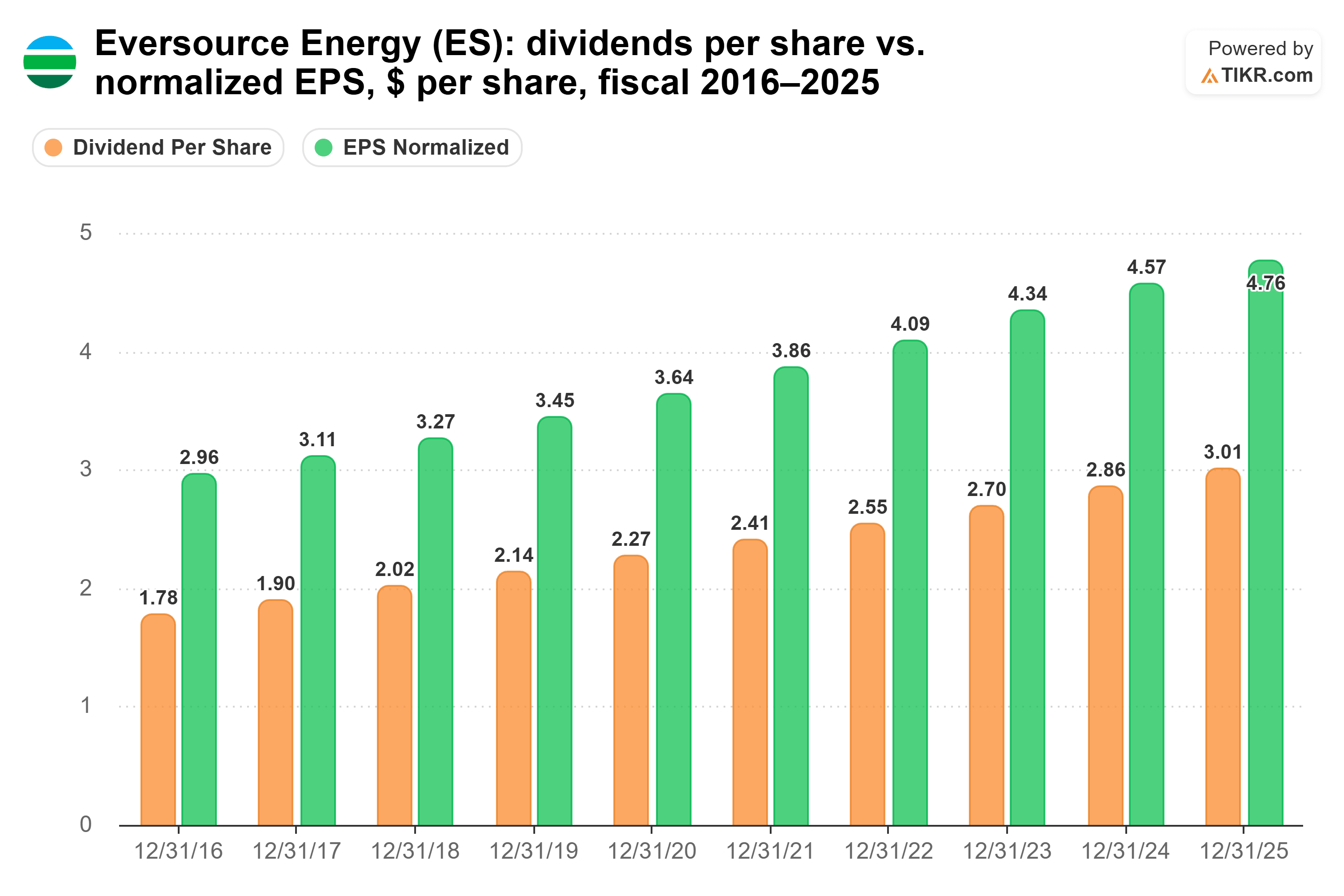
Eversource’s dividend rose every fiscal year from 2016 to 2025, from $1.78 a share to $3.01. Its normalized EPS kept pace, climbing from $2.96 to $4.76. As a regulated utility, it’s judged on the share of those earnings it pays out. That was a steady 63% in fiscal 2025, and it has stayed between 60% and 63% every year since fiscal 2016. The two lines have climbed together for a decade:
The third quarter was rougher. Eversource earned $0.92 a share, down from recurring earnings of $1.19 a year earlier. A lower allowed return on transmission, disallowed Connecticut storm costs, the June 30 sale of its Aquarion water business, higher expected payments tied to its 2024 offshore wind exit and a higher tax rate all weighed on the quarter. Still, management narrowed 2026 guidance to $4.62-$4.70 a share, raised the midpoint, and reaffirmed 5%-7% yearly EPS growth through 2030.
On Nov. 5, CEO Joe Nolan said Revolution Wind, the offshore project Eversource exited in 2024, had reached full commercial operation. He said that significantly reduces the company’s risk of further payments on it. Eversource still has obligations to settle with the buyer in 2027, but it believes its reserve is adequate.
The weak spot is debt. Net debt runs 5.8x EBITDA, and EBIT covers interest just 2.3x over the last twelve months.
CVS has the cash, but the dividend has stalled
CVS comes at it from the other direction: plenty of cash behind the dividend, and no raise lately. Over the twelve months to June 30, 2026, it paid $3.42 billion of dividends out of $11.76 billion of free cash flow, a well-covered 29%. But its dividend per share didn’t rise in fiscal 2025. The $0.665 quarterly payment it declared on Sept. 30 still comes to $2.66 a year.
That coverage has swung with free cash flow. Free cash flow fell from $15.8 billion in fiscal 2021 to $6.33 billion in fiscal 2024, then recovered to $7.81 billion in fiscal 2025:
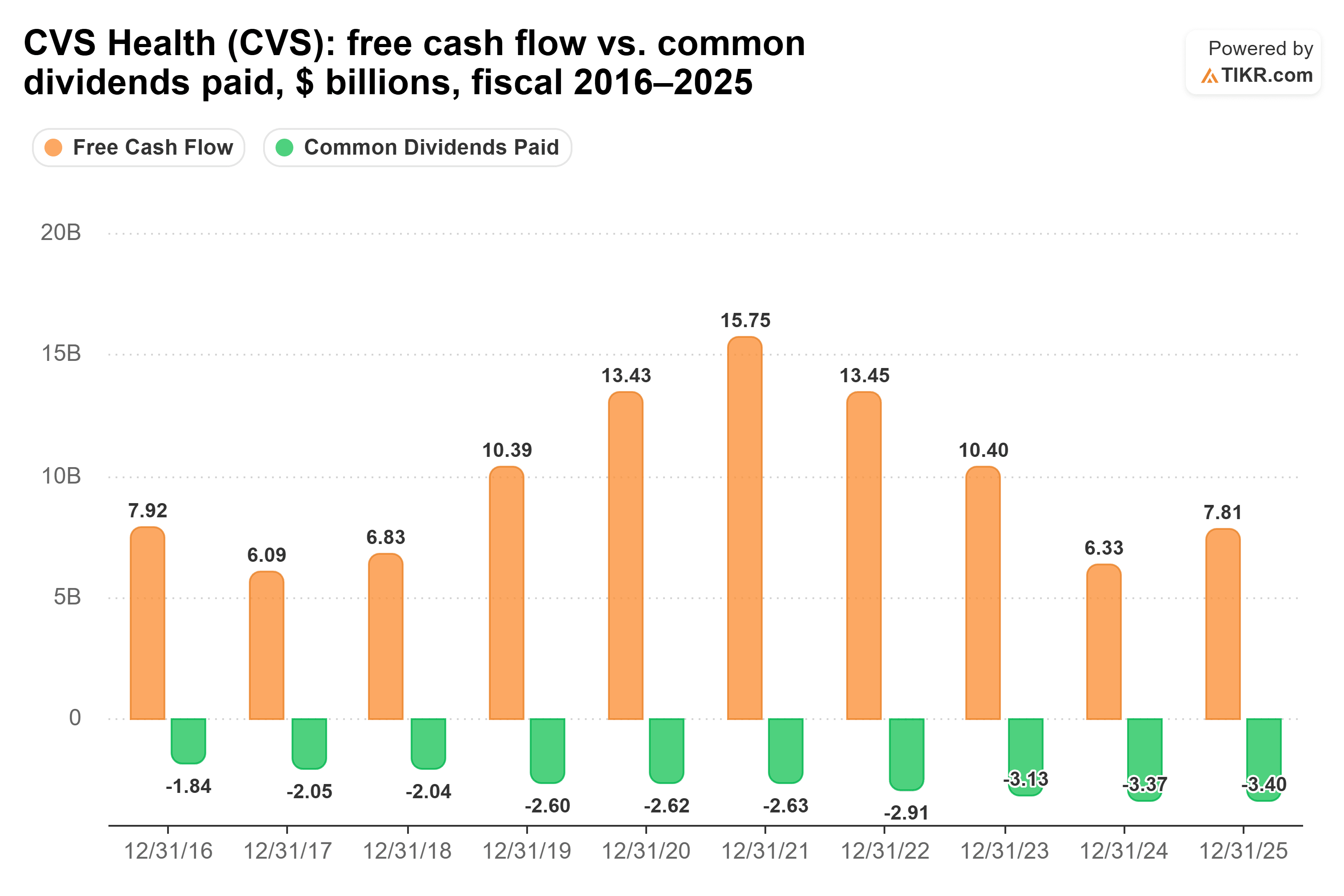
(At that low, in fiscal 2024, dividends took 53.3% of it.)
The business is improving. Third-quarter adjusted EPS rose to $2.09 from $1.60 a year earlier, and revenue grew 5.4% to $108.4 billion. CVS raised its 2026 guidance for cash flow from operations to at least $15.5 billion, from at least $11.5 billion. It also resumes buybacks in the fourth quarter.
Then there’s the split. CVS plans to separate its retail pharmacy business, to be called CVS Pharmacy, from Aetna, Caremark and its other health businesses. It says each company will be able to “pay an attractive dividend.” Shares still fell by double digits during the Nov. 4 session, beat and all. For 2027, CVS also expects a smaller 340B business, Caremark membership losses and one-time separation costs.
So which dividend wins?
Eversource is the better dividend stock. It pays the bigger check today and keeps raising it. $10,000 buys $460 a year of income from Eversource now, against $300 from CVS. At each dividend’s pace now (Eversource’s 5.2% raise in fiscal 2025, and no rise at CVS), that becomes about $729 in year 10 against about $300. Even at CVS’s 5.9% five-year rate, its income wouldn’t pass Eversource’s for more than 30 years.
Eversource isn’t expensive, either. It trades at 15x forward earnings, below its five-year average of 16x:

That isn’t to say CVS’s dividend is in danger. It takes just 29% of free cash flow, CVS carries far less debt, and management just raised its cash outlook. But a dividend that didn’t grow in fiscal 2025, at a company about to become two, is harder to plan an income around than Eversource’s steady raises.
Of course, Eversource has a big ruling ahead. Connecticut regulators are expected to decide its CL&P rate case, its first since 2018, next June.
Forget Eversource Energy: 6 safe 6%+ dividend yields you can buy right now
Dividends can hold the key to enormous wealth. But only if you buy the right ones.
Picking the right high-yield dividend stock can be the difference between a dream retirement…and scraping by every month, waiting for the next Social Security check to clear.
We’ve identified six stocks yielding 6%+ that we believe every retiree should know about right now. (And Eversource Energy isn’t one of them.)
Disclaimer:
Please note that the articles on TIKR are not intended to serve as investment or financial advice from TIKR or our content team, nor are they recommendations to buy or sell any stocks. We create our content based on TIKR Terminal’s investment data and analysts’ estimates. Our analysis might not include recent company news or important updates. TIKR has no position in any of the stocks mentioned. Thank you for reading, and happy investing!