Key Takeaways
- BETA Technologies stock is down 27% in 2026, after an early-year slide it shared with its electric-aircraft rival Joby Aviation.
- Since March, BETA has flown the first missions under the FAA’s eVTOL pilot program, raised its 2026 revenue outlook and become the first company the FAA has cleared to fly prospective customers in an electric VTOL.
- Losses are widening, and the H500A electric engine missed the first-half certification target BETA set in March.
- With $1.48 billion of cash on June 30, BETA looks like a speculative buy for patient investors, and its third-quarter report on Nov. 3 is the next test.
BETA Technologies (BETA) stock is down 27% in 2026, and most of that drop came before the end of March. Its electric-aircraft rival Joby Aviation (JOBY) has done far worse, down 64% over the same stretch.
So the early selloff hit the whole group. Since then, BETA’s business has mostly done what it promised. The engine is the big exception.
Losses keep getting bigger
BETA lost $304.1 million on an adjusted EBITDA basis in 2025, on $35.6 million of revenue. In March, it guided for a 2026 adjusted EBITDA loss of $305-395 million. It widened that to $355-445 million in May, then narrowed it to $400-445 million in August. Even the smallest loss in that range is 32% bigger than last year’s.
Spending is climbing: research and development costs hit $122.4 million in the second quarter (including $16.1 million tied to an acquisition), more than double the $58.0 million of a year before.
The bigger worry is the H500A electric engine. In March, BETA said it was on track for FAA type certification in the first half of 2026. On its first-quarter call in May, management said some of the FAA work, including continued-rotation testing, was taking longer than expected. By August, BETA had agreed with the FAA on how to show compliance there, and formal FAA testing was underway.
So BETA missed its first-half target.
TIKR tracks 9 analysts on BETA Technologies. How many say “Buy”?
See the full breakdown of Buy, Hold, and Sell ratings on BETA Technologies, along with Wall Street’s revenue and earnings estimates, all in one place. More than 500,000 investors use TIKR to research stocks like this one. See BETA Technologies’ Analyst Ratings
But the business keeps hitting its marks
Elsewhere, BETA has delivered. In the first quarter, the FAA and the Department of Transportation picked it for seven of the eight launch programs in their eVTOL Integration Pilot Program. That’s the most of any electric aircraft developer, Joby included. In the second quarter, it became the first company to fly under the program.
Second-quarter revenue rose 146% from a year before to $14.7 million, well ahead of the $9.65 million analysts expected. BETA also raised its 2026 revenue range to $42-50 million, from $39-43 million.
And on Oct. 21, the FAA gave the ALIA VTOL a special airworthiness certificate for market surveys, making BETA the first company cleared to fly prospective customers in an electric VTOL.
Analysts expect revenue to climb steeply from here:
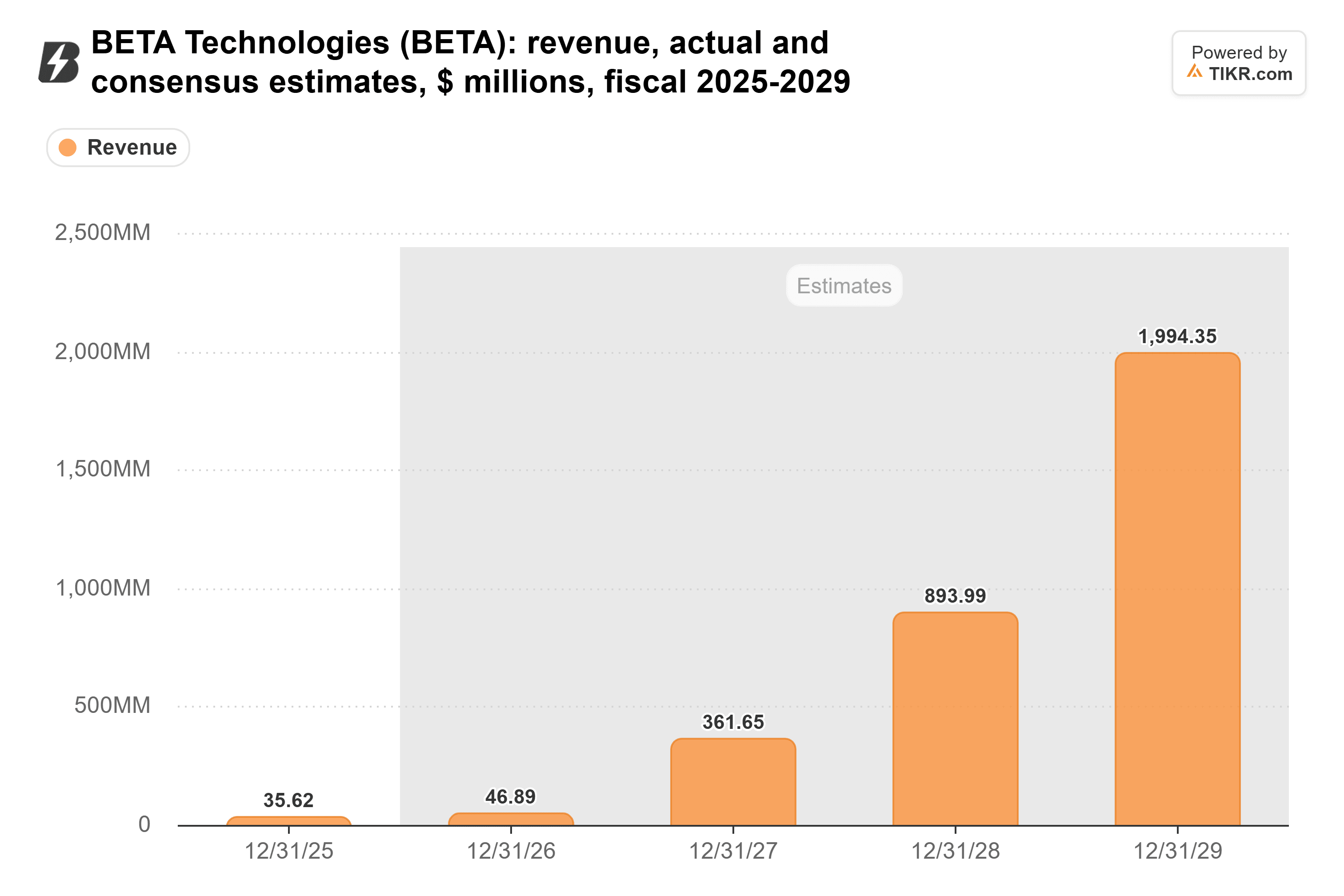
That’s $362 million in 2027, nearly eight times this year’s $46.9 million consensus. Getting there takes certified aircraft.
Still pricey, with the cash to wait
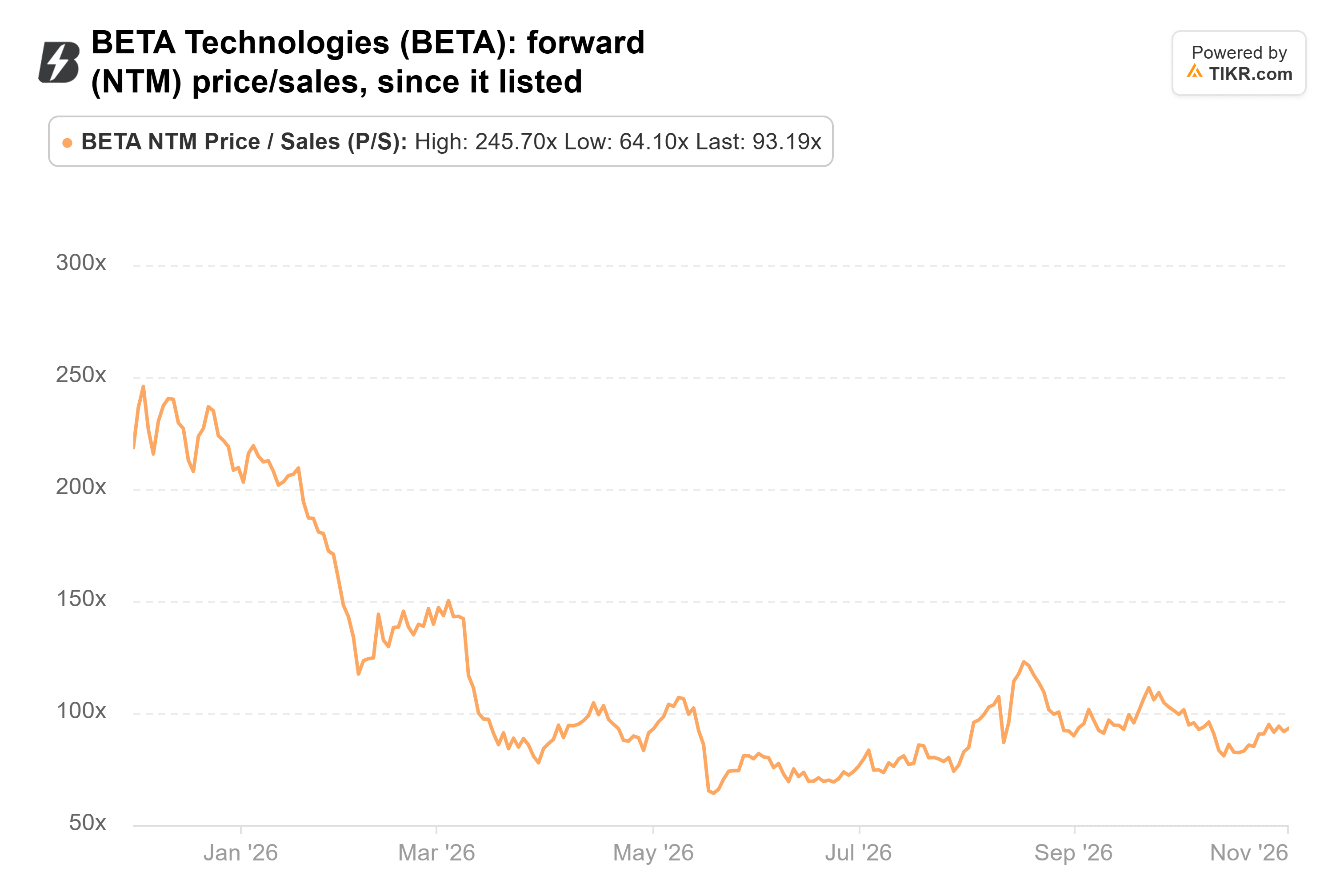
At Monday’s close, BETA traded at 93x forward sales. That’s below its 117x average since it listed but well above its 64x low in May:
BETA ended 2025 with $1.71 billion of cash and short-term investments, after its IPO and private financings:
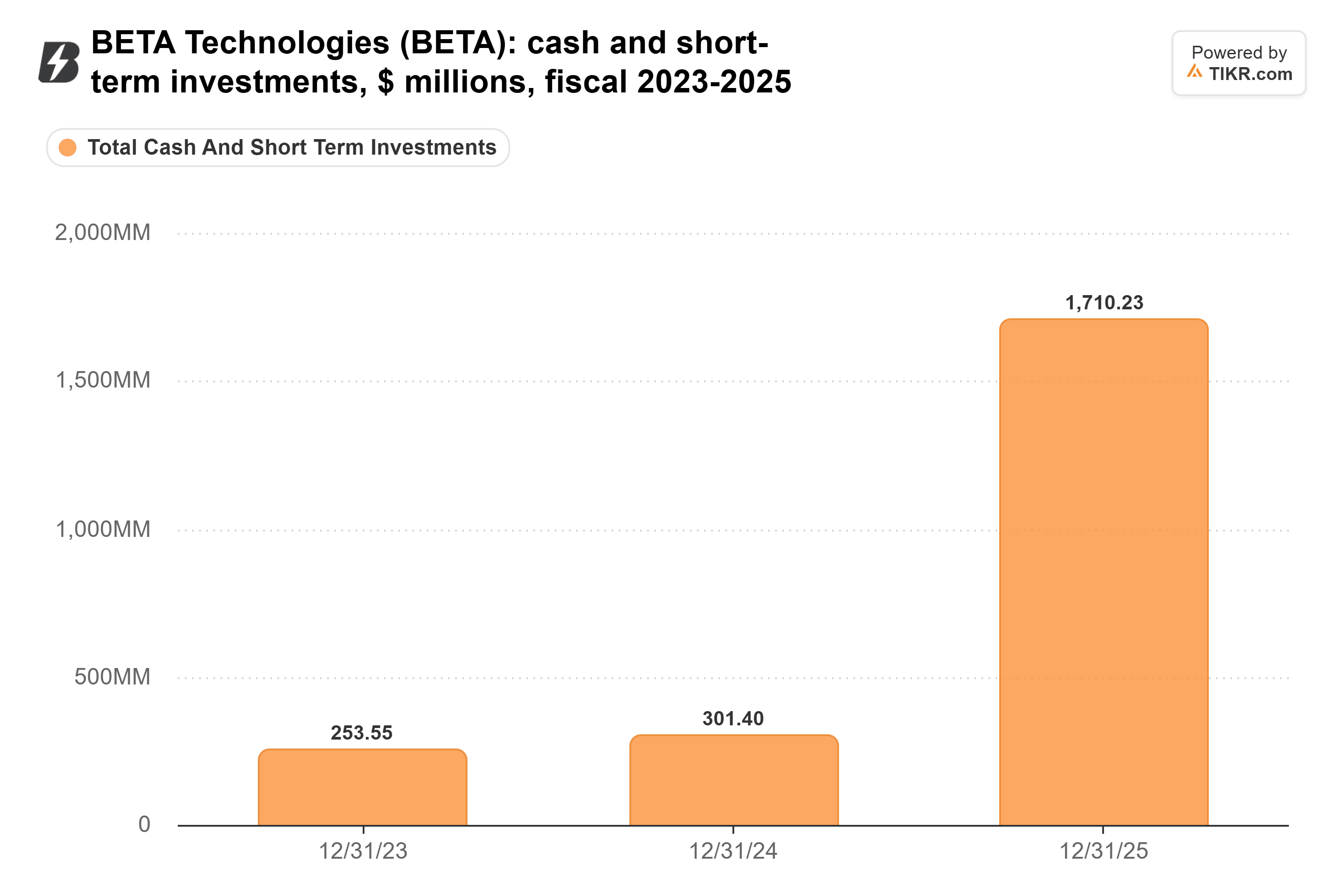
By June 30, that was down to $1.48 billion, with $41.1 million of capex in the second quarter alone. At the first half’s pace, that’s a little over three years of runway. (Still, I wouldn’t be surprised to see a stock sale once the engine is certified. Building aircraft is expensive!)
Barclays initiated coverage at Overweight with a $35 target on Oct. 8, and the Street’s $32 average target sits 58% above Monday’s close.
Here’s where I land: BETA is a speculative buy for patient investors, in a small position. If certification arrives on anything like the timeline analysts model, today’s price could look cheap next to 2027’s sales. If it keeps slipping, that $362 million estimate shrinks with it.
We’ll learn more on Nov. 3, when BETA reports third-quarter results. Watch for a firm date on the H500A certificate, whether the $42-50 million revenue range holds, and how far losses run against the $400-445 million guidance.
So what is BETA Technologies stock actually worth?
TIKR lets you forecast the future price of any stock in less than a minute. Just enter a few assumptions into TIKR’s valuation model and see what BETA Technologies could be worth. Start from Wall Street consensus estimates, or adjust the inputs to reflect your own view of the business. It’s free to use.
Value BETA Technologies for free
Disclaimer:
Please note that the articles on TIKR are not intended to serve as investment or financial advice from TIKR or our content team, nor are they recommendations to buy or sell any stocks. We create our content based on TIKR Terminal’s investment data and analysts’ estimates. Our analysis might not include recent company news or important updates. TIKR has no position in any of the stocks mentioned. Thank you for reading, and happy investing!