Key Takeaways
- NVIDIA fell about 12% on Wednesday and Thursday while Amazon and Microsoft rallied, after Democrats won control of Congress and Yorkville Ives’ Dan Ives estimated that 10% of planned U.S. data centers won’t happen.
- Stratechery’s Ben Thompson expects NVIDIA to lose in the short term from slower U.S. building, and expects cloud giants with capacity already running to come out ahead.
- Analysts haven’t cut their forecasts yet, but NVIDIA’s forward P/E has already fallen to 15x, its lowest of the past year, which prices in more damage than a slower build-out looks likely to do.
- With power scarce, upgrading old data centers to NVIDIA’s newest chips is the long-term bull case, and the Nov. 17 report is the next test.
Democrats won both chambers of Congress on Tuesday, and investors wasted no time sorting AI stocks into winners and losers. NVIDIA (NVDA) landed in the second pile.
The chipmaker fell 3.2% on Wednesday while Amazon (AMZN) and Microsoft (MSFT) rallied. Then it sank another 9.3% on Thursday as money kept rotating out of chip stocks. Friday’s bounce only lifted it back to $187. That came after NVIDIA had already dropped 11% in a month.
Stratechery’s Ben Thompson summed up what the vote means for NVIDIA in his post-election piece, AI on the Ballot:
“Nvidia will almost certainly be a short-term loser.”
Fewer data centers mean fewer NVIDIA chips, he argued. Weaker neoclouds also hurt NVIDIA twice, since they run almost entirely on its full-rack systems and NVIDIA is backstopping a lot of them.
Yorkville Ives’ Dan Ives put a number on the slowdown. Of the 800 to 1,000 data centers planned across the U.S., he estimates that “10% of datacenters will not happen now.”
That’s 80 to 100 projects.
TIKR tracks 62 analysts on Nvidia. How many say “Buy”?
See the full breakdown of Buy, Hold, and Sell ratings on Nvidia, along with Wall Street’s revenue and earnings estimates, all in one place. More than 500,000 investors use TIKR to research stocks like this one. See Nvidia’s Analyst Ratings
Big estimates, small multiple
Analysts haven’t cut their numbers yet. As of Oct. 27, they saw revenue nearly doubling to $412 billion this fiscal year and reaching $903 billion by fiscal 2029:
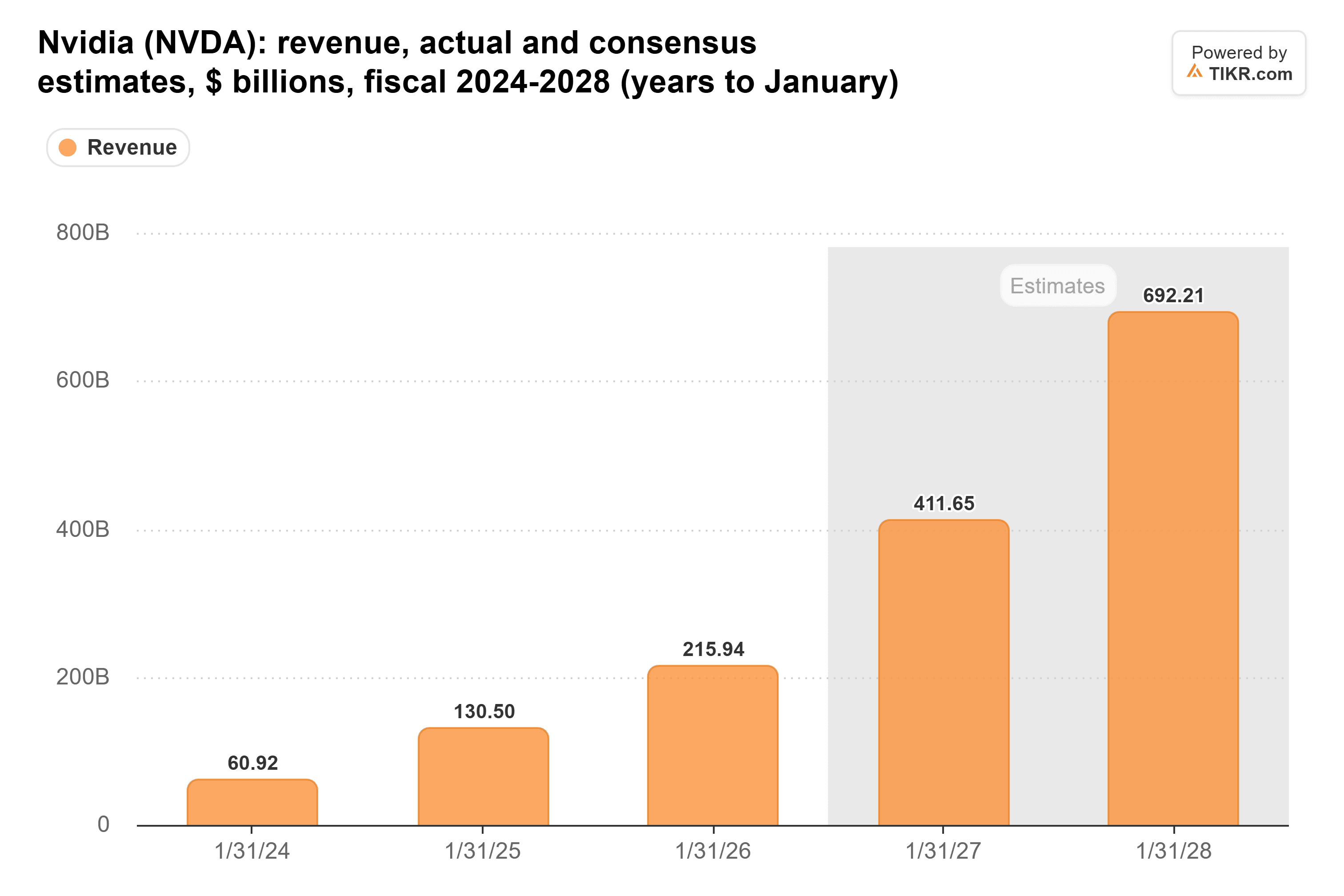
U.S.-headquartered customers supplied 69.3% of NVIDIA’s revenue. If Ives is right, I’d expect the cuts in fiscal 2028 and 2029, when today’s planned projects would open.
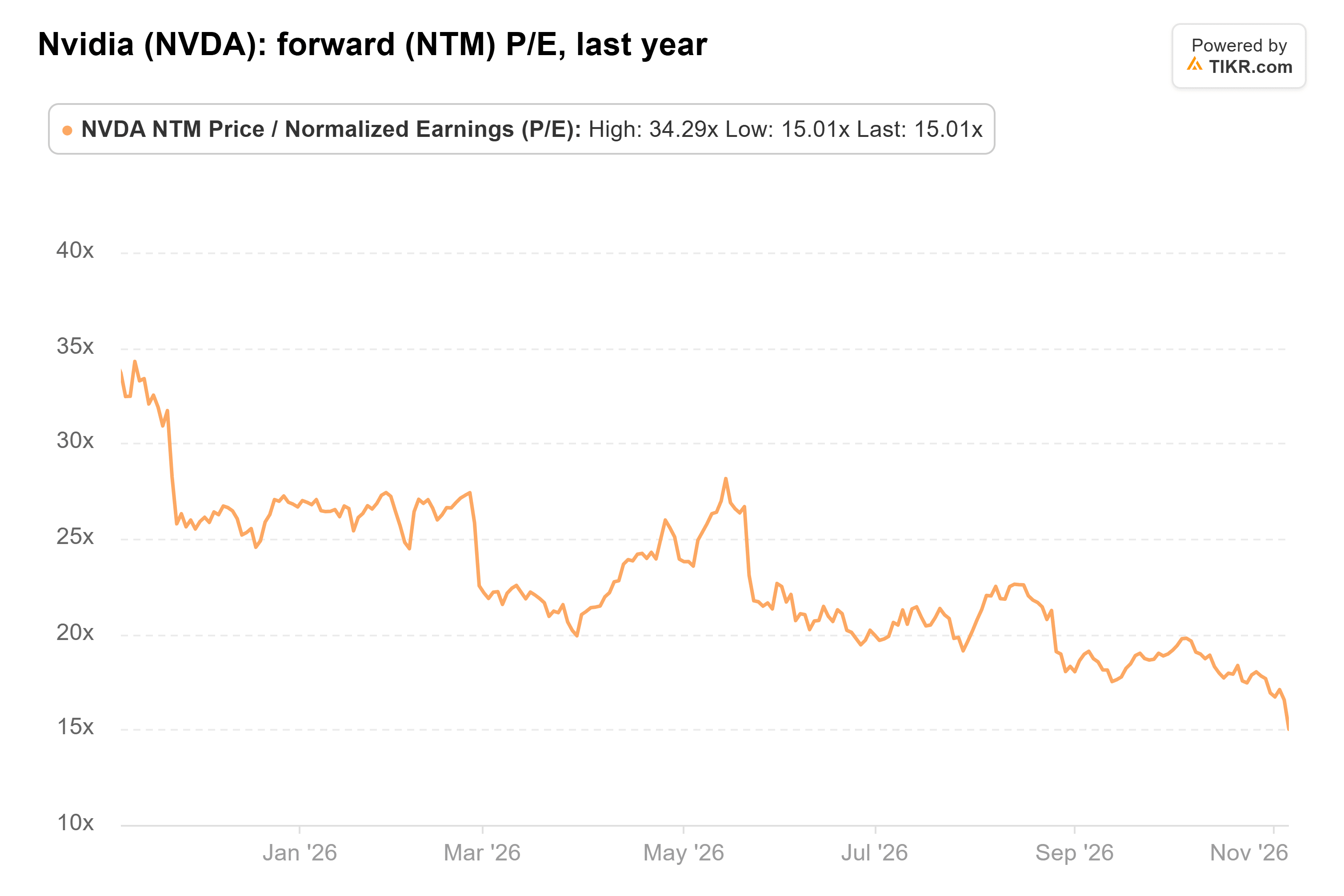
Investors aren’t waiting for the revisions. NVIDIA’s forward P/E fell to 15x on Nov. 5, the low of the past year and well below its 23x average:
The clouds that already built come out ahead
Thompson’s flip side is that the hyperscalers win. My read: as new data centers get harder to build, the capacity already running gets scarcer. And the companies that own it can charge more for it.
Microsoft owns plenty. Its capital spending nearly quintupled in four years, to $116 billion in fiscal 2026:
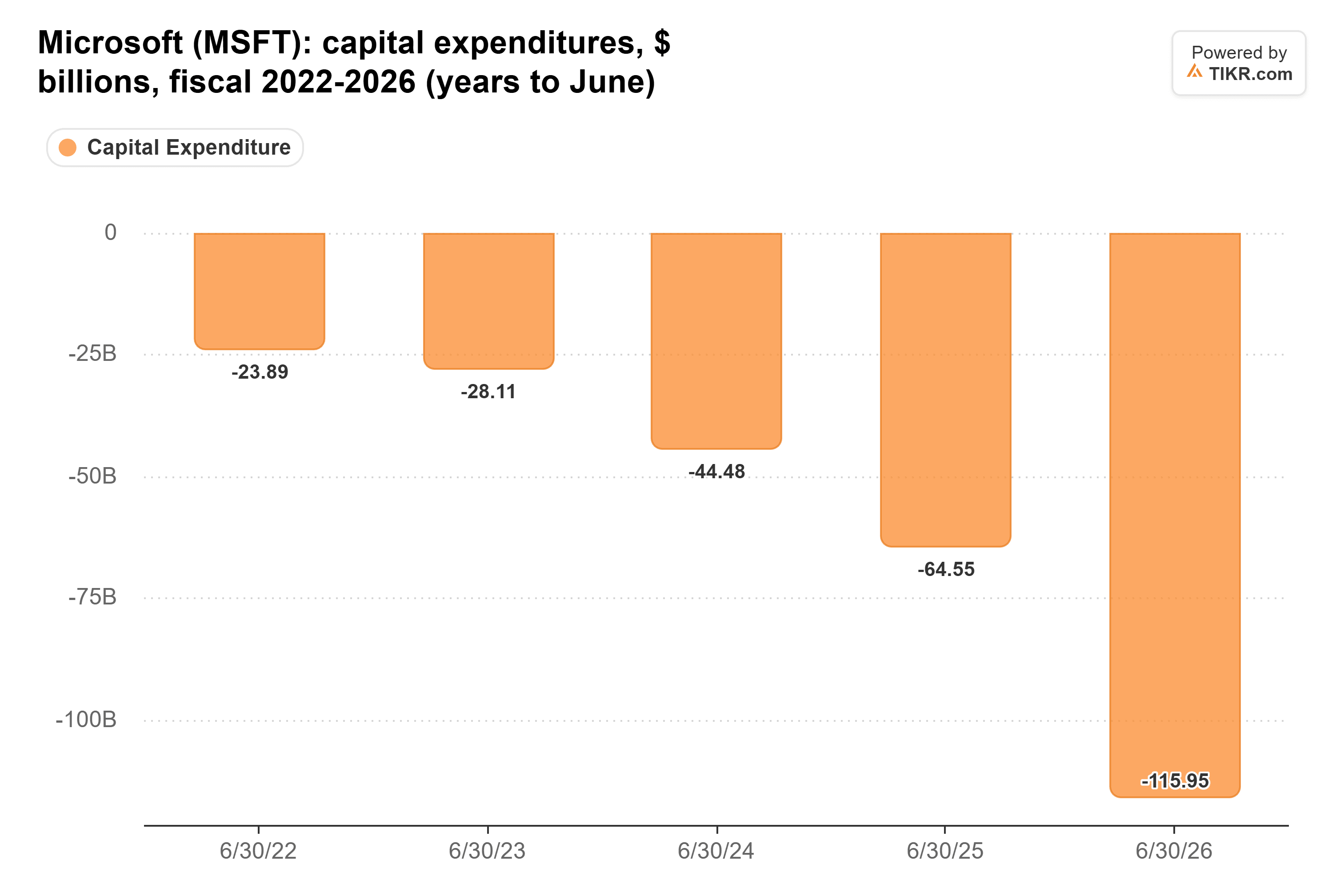
Investors may also like a slower pace. Ives said it means “less Capex worries which helps Big Tech stocks.” That helps explain why Amazon and Microsoft rallied while their chip supplier fell.
Fewer buildings, better chips
Thompson’s piece also holds the long-term bull case. Once power becomes the constraint, “an advantage in tokens/megawatt is worth a lot of money.” A customer that can’t build a new data center can rebuild an old one with new NVIDIA chips.
Management’s own math shows what that upgrade is worth. It sees about $18 billion of revenue per gigawatt with Hopper, $25 billion with Grace Blackwell and $40 billion with Vera Rubin. Swap Hopper for Vera Rubin in the same building, and NVIDIA’s take more than doubles.
Demand is still running ahead of supply, too. Management calls its outlook of about 70% revenue growth in fiscal 2028 supply-limited.
Thompson flags the risk on the other side himself. The hyperscalers, with the scale and cash to build their own chips, are NVIDIA’s biggest long-term threat.
Short term, he’s probably right
NVIDIA probably does have a bumpier few quarters ahead, as Thompson says, and its neocloud customers are its biggest exposure. But at 15x forward earnings, investors have already priced in far more damage than 10% fewer U.S. data centers would do.
Of course, Thompson himself isn’t calling the opposition permanent. The first real read comes Nov. 17, when NVIDIA reports its third quarter and guides for the January quarter.
So what is NVIDIA stock actually worth?
TIKR lets you forecast the future price of any stock in less than a minute. Just enter a few assumptions into TIKR’s valuation model and see what NVIDIA could be worth. Start from Wall Street consensus estimates, or adjust the inputs to reflect your own view of the business. It’s free to use.
Disclaimer:
Please note that the articles on TIKR are not intended to serve as investment or financial advice from TIKR or our content team, nor are they recommendations to buy or sell any stocks. We create our content based on TIKR Terminal’s investment data and analysts’ estimates. Our analysis might not include recent company news or important updates. TIKR has no position in any of the stocks mentioned. Thank you for reading, and happy investing!