Key Takeaways
- Bank of America shares fell nearly 5% after a $1.2 billion anti-money-laundering penalty pushed third-quarter EPS down to $0.91 from $1.04.
- Adjusted EPS of $1.08 missed the $1.10 consensus as FICC revenue fell 17%, while JPMorgan’s fixed-income revenue slipped just 4%.
- Net interest income rose 8% to $16.4 billion, and management expects growth of 8% or more again in 2027.
- CET1 slipped to 10.9%, so the fourth-quarter report expected in mid-January must show positive operating leverage returning.
Regulators fined Bank of America (BAC) $1.2 billion on October 13, one day before its third-quarter report. The stock fell nearly 5% the next day.
Excluding the charge, adjusted EPS of $1.08 still missed the $1.10 consensus. Bond trading did much of the damage, falling 17%, while JPMorgan Chase (JPM) saw its fixed-income revenue slip just 4%.
Four weeks later, the fine looks like the smaller issue. The real question is whether steady lending growth can offset thinner capital and softer trading.
A fine and a trading slump
The OCC, FinCEN and the Treasury’s sanctions office announced resolutions over the bank’s anti-money-laundering and sanctions programs. Because the $1.2 billion charge is not tax deductible, it cut EPS by a full $0.17.
The rest of the quarter was mixed:
- Net income fell to $6.9 billion, or $0.91 per share, from $8.3 billion, or $1.04, a year earlier.
- Revenue rose 3% to $30.0 billion, but investment banking fees dropped 11% to $1.8 billion.
- FICC revenue fell 17% to $2.6 billion, although equities posted a record third quarter at $2.5 billion.
CFO Alastair Borthwick tied the FICC slump to an 85 basis point jump in rates, which slowed client activity in credit, mortgages and munis.
Here’s how the charge shows up in quarterly profit…
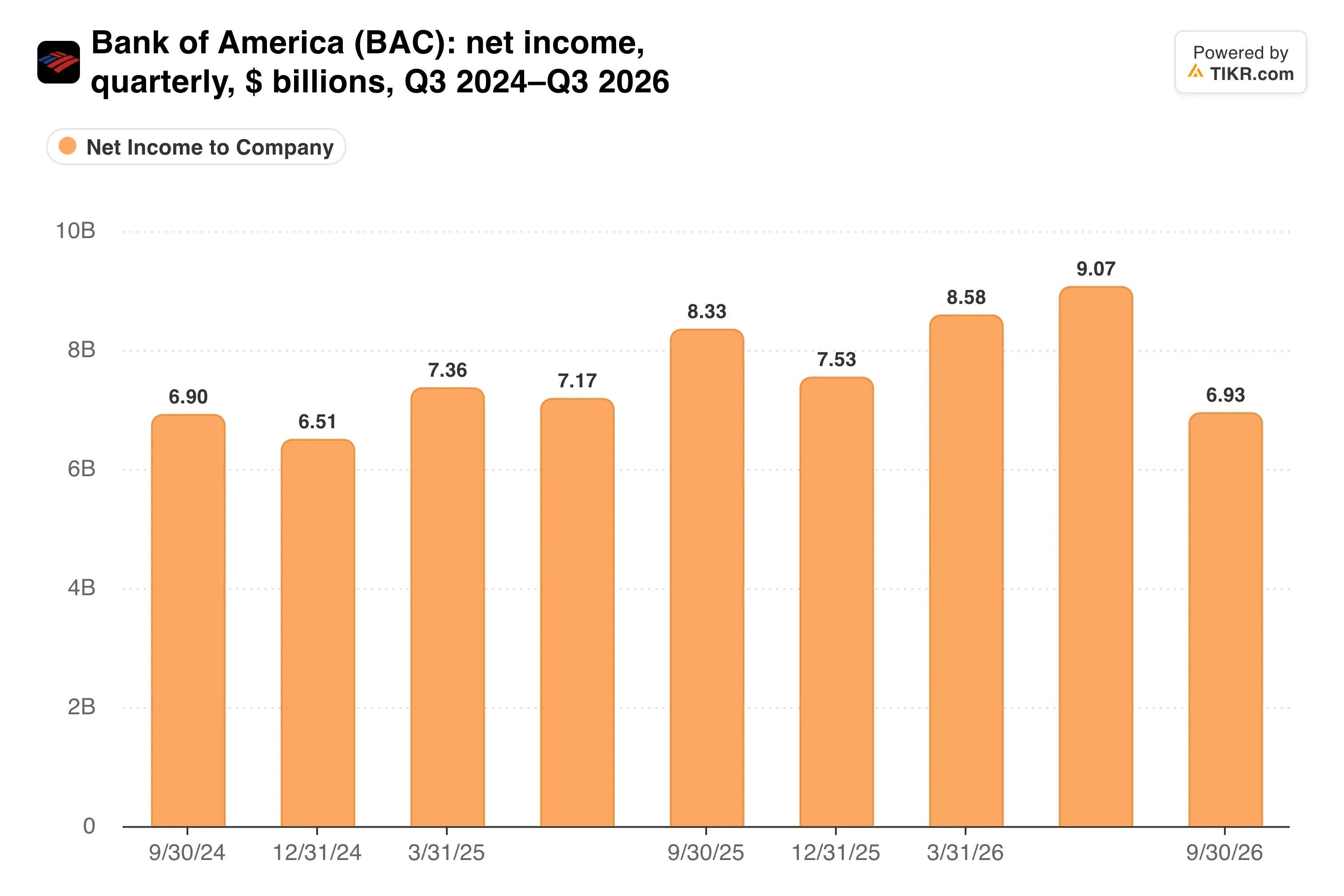
Adjusted net income of $8.1 billion sat only slightly below last year’s $8.3 billion.
Lending kept the engine running
Meanwhile, the steadier businesses kept growing. Net interest income rose 8% to $16.4 billion, and average loans climbed 6% to $1.23 trillion. That marked a 10th straight quarter of sequential loan growth.
Wealth management helped as well. Revenue in that segment rose 13% to $7.1 billion, while net income jumped 22% to $1.5 billion. Credit also improved, since the card charge-off rate eased to 3.22% from 3.46%.
So can lending carry the top line while trading cools?
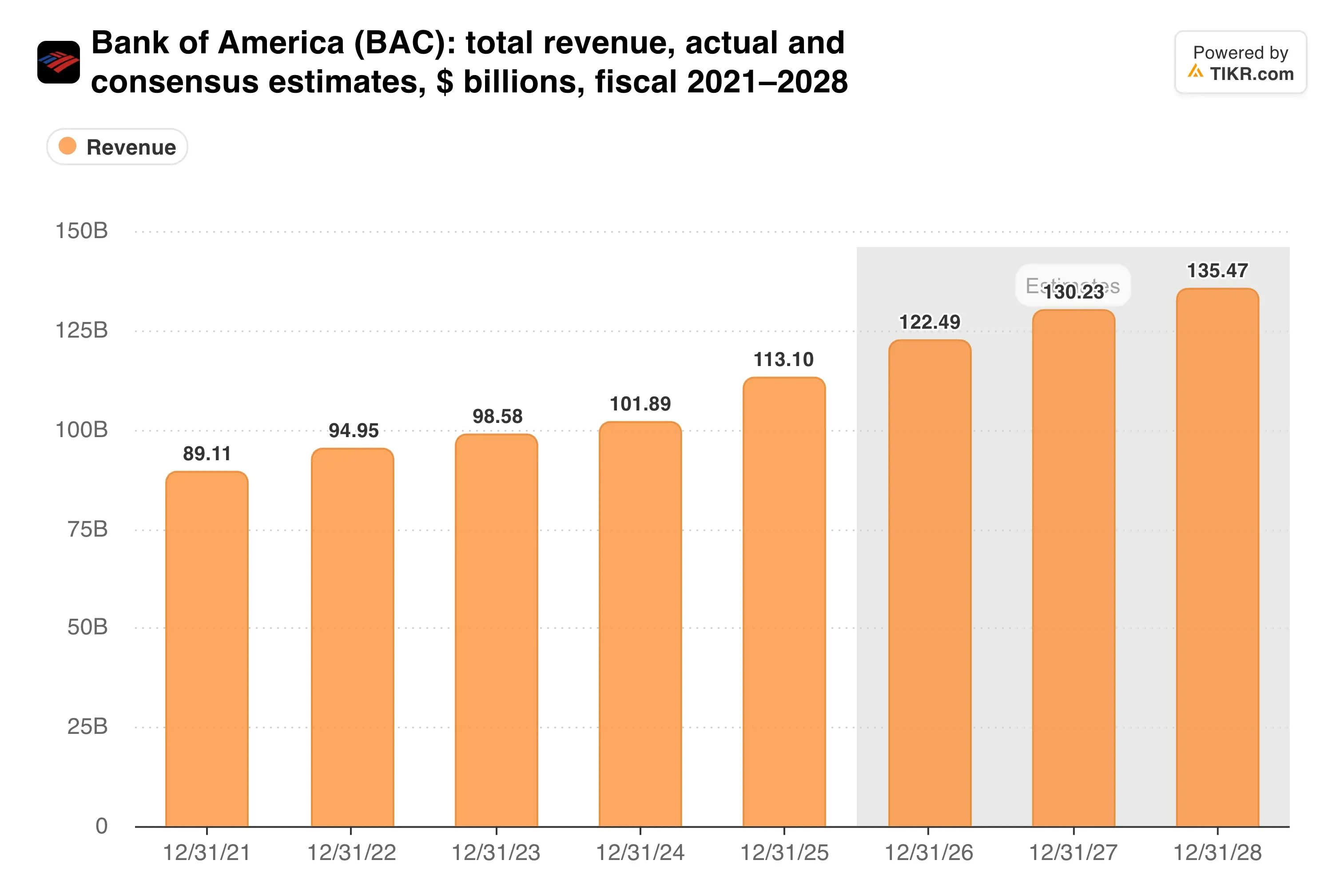
Net interest income now makes up more than half of revenue, so its outlook matters most. Management expects about 8% growth this year and 8% or more in 2027, assuming three 25 basis point rate hikes through June 2027.
JPMorgan grew total net interest income faster, by 13% to $27.1 billion. However, Bank of America’s guide already absorbs a drag from its markets business, which CEO Brian Moynihan flagged on the call.
The consent order also leaves growth untouched. “There’s no asset cap here,” Borthwick told analysts.
TIKR tracks 25 analysts on Bank of America. How many say “Buy”?
See the full breakdown of Buy, Hold, and Sell ratings on Bank of America, along with Wall Street’s revenue and earnings estimates, all in one place. More than 500,000 investors use TIKR to research stocks like this one. See Bank of America’s Analyst Ratings
Capital is the tighter squeeze
Capital is the harder issue. The CET1 ratio slipped to 10.9% from 11.6% a year earlier, against a 10% regulatory minimum.
Even so, the bank returned $8.3 billion this quarter, including $6.0 billion of buybacks. Its share count has shrunk more than 5% in a year. Yet Borthwick said the bank is waiting for final capital rules, expected this quarter, before settling its next moves.
Expenses add pressure too. Adjusted expenses rose about 7%, more than double the 3% revenue gain. Remediation costs sit inside that base, and Moynihan said “it is the focus of management to get it cleaned up.”
Investors already price in the gap with JPMorgan…
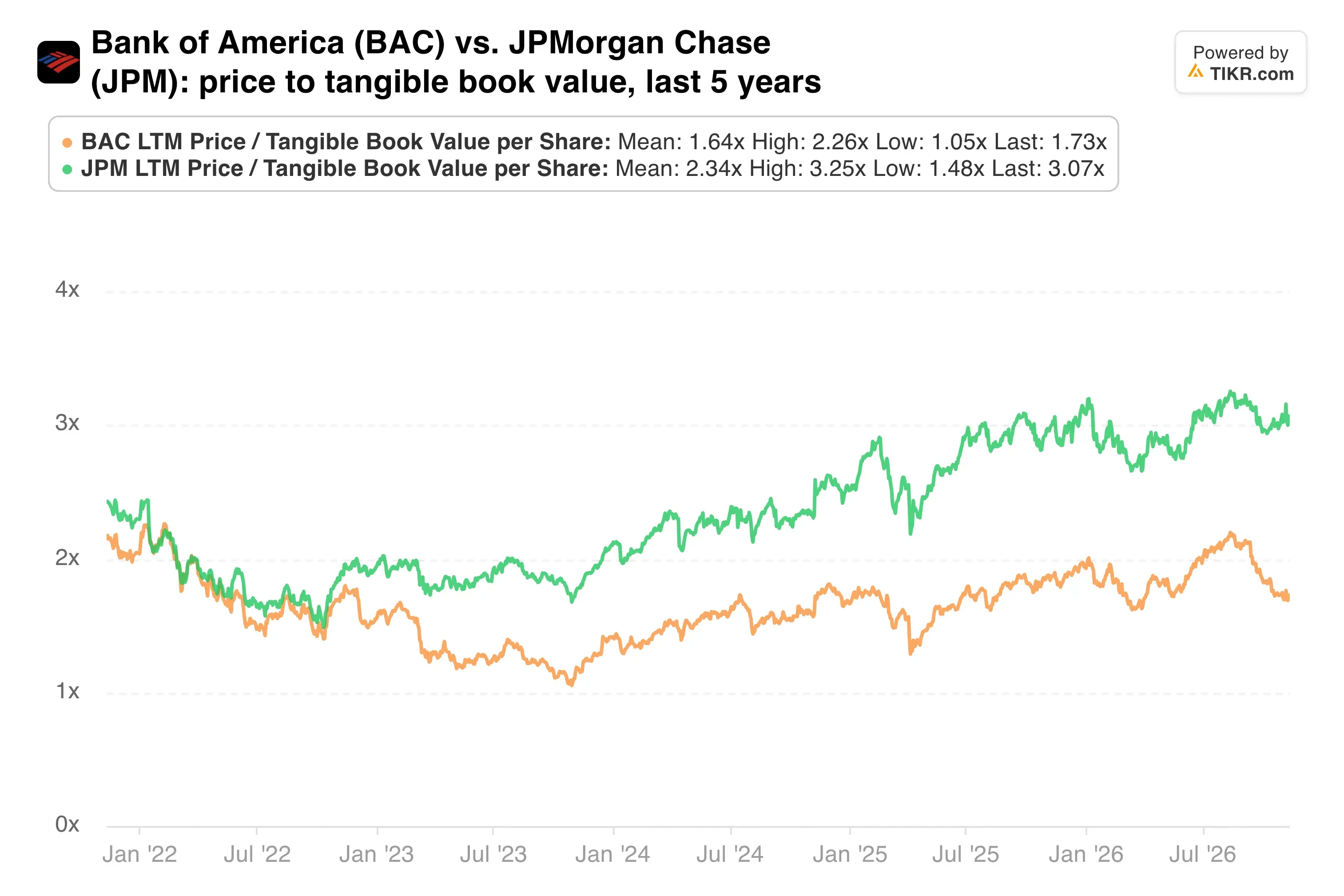
Bank of America has traded below JPMorgan on this measure throughout the period.
My take: The fine is a one-time charge, and the lending and wealth businesses look healthier than the headline EPS suggests. Still, I’d want proof that expenses are under control before treating the drop as a bargain. Rising rates also cut both ways, since higher yields helped NII but hurt FICC.
The fourth-quarter report, expected in mid-January, is the next test. It should show whether positive operating leverage returns and whether buybacks hold near recent levels.
So what is Bank of America stock actually worth?
TIKR lets you forecast the future price of any stock in less than a minute. Just enter a few assumptions into TIKR’s valuation model and see what Bank of America could be worth. Start from Wall Street consensus estimates, or adjust the inputs to reflect your own view of the business. It’s free to use.
Disclaimer:
Please note that the articles on TIKR are not intended to serve as investment or financial advice from TIKR or our content team, nor are they recommendations to buy or sell any stocks. We create our content based on TIKR Terminal’s investment data and analysts’ estimates. Our analysis might not include recent company news or important updates. TIKR has no position in any stocks mentioned. Thank you for reading, and happy investing!