Key Takeaways
- A new US chip rule cut many Asian data centers off from their Chinese customers, and Bloomberg reports they’re trying to rent that spare computing power to American buyers.
- Each US lab that rents that capacity can mean one less new Nvidia order.
- CoreWeave and Super Micro Computer depend on the same flow of new Nvidia systems.
- Nvidia trades at 11x forward earnings, near its five-year low.
Data centers across Southeast Asia filled up with Nvidia (NVDA) chips to rent to Chinese tech companies. A new US rule has put many of those renters out of reach, and Liquid Compute CEO Ronit Jain told Bloomberg that data centers across Asia are hurrying to find US buyers for capacity they can’t use. Lenders including Citigroup (C) are reportedly reviewing their data center clients in the region. Nvidia fell 3.9% on Nov. 25, the day both reports came out, after chip stocks sold off on Nov. 24 and erased part of its 31% jump on Huang’s return as CEO.
That’s bad news for Nvidia’s next orders. It’s also bad news for CoreWeave (CRWV), which rents Nvidia chips to the same US labs, and Super Micro Computer (SMCI), which builds the servers the chips go into.
TIKR tracks 63 analysts on Nvidia. How many say “Buy”?
See the full breakdown of Buy, Hold, and Sell ratings on Nvidia, along with Wall Street’s revenue and earnings estimates, all in one place. More than 500,000 investors use TIKR to research stocks like this one. See Nvidia’s Analyst Ratings
Some of Nvidia’s newest chips need renters
On Nov. 16, the US said shipments of advanced AI chips to Singapore, Malaysia, Indonesia, Thailand and Brazil will need a government license. Data centers that lease significant compute to Chinese firms have 90 days to get a separate license to keep doing it.
Since then, lenders have paused billions of dollars of loans tied to ByteDance, Alibaba and Tencent, and at least one fund backed out of a $300 million loan to GMI Cloud that would have paid for chips for a Thai data center. Citigroup and JPMorgan also added chip-rule terms to a potential loan of up to $6.6 billion for Bain Capital’s Bridge Data Centres, Bloomberg reported. Loans to Asia-Pacific data centers had gone from virtually zero in 2023 to more than $49 billion, so that’s a big pool of money slowing down.
A lot of the spare capacity runs on Nvidia’s newest chips. Jain also posted on X that a large number of neoclouds have approached Liquid Compute to resell long-term B300 capacity. Each of those nodes a US lab rents fills demand that would otherwise have become a new order.
Analysts still expect Nvidia’s revenue to grow from $215.9 billion in the year ended January 2026 to $424 billion in the year ending January 2027 and $726 billion in the year after that.
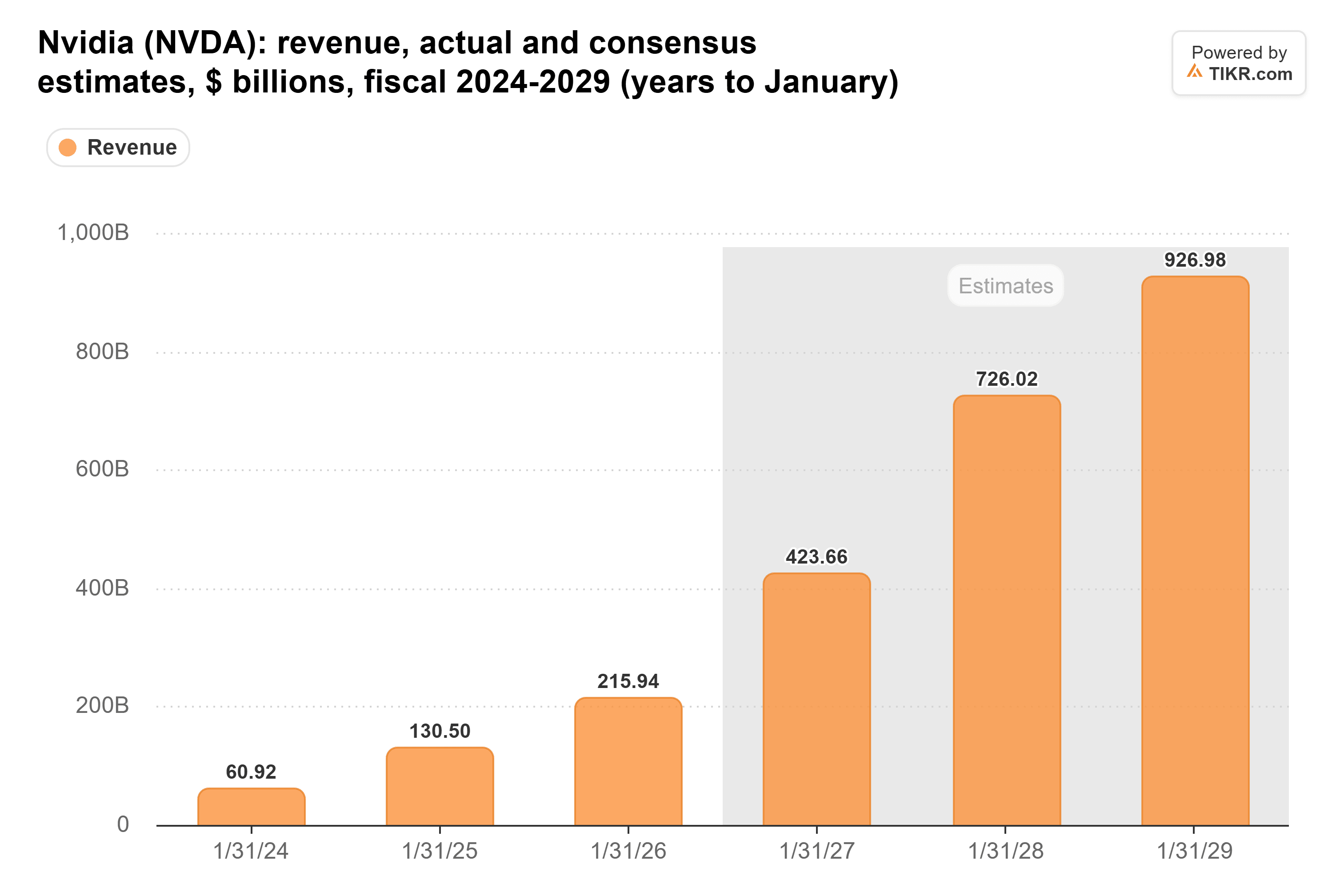
Those estimates were set before Bloomberg’s reports. If some US demand is met with Asian capacity that’s already built, the year ending January 2028 is where the cuts would most likely land.
The squeeze reaches CoreWeave and Super Micro
When supply is left over, rental prices usually fall, and CoreWeave depends on exactly this market. Analysts expect its revenue to grow from $5.13 billion in 2025 to $13.1 billion in 2026 and $27.2 billion in 2027.
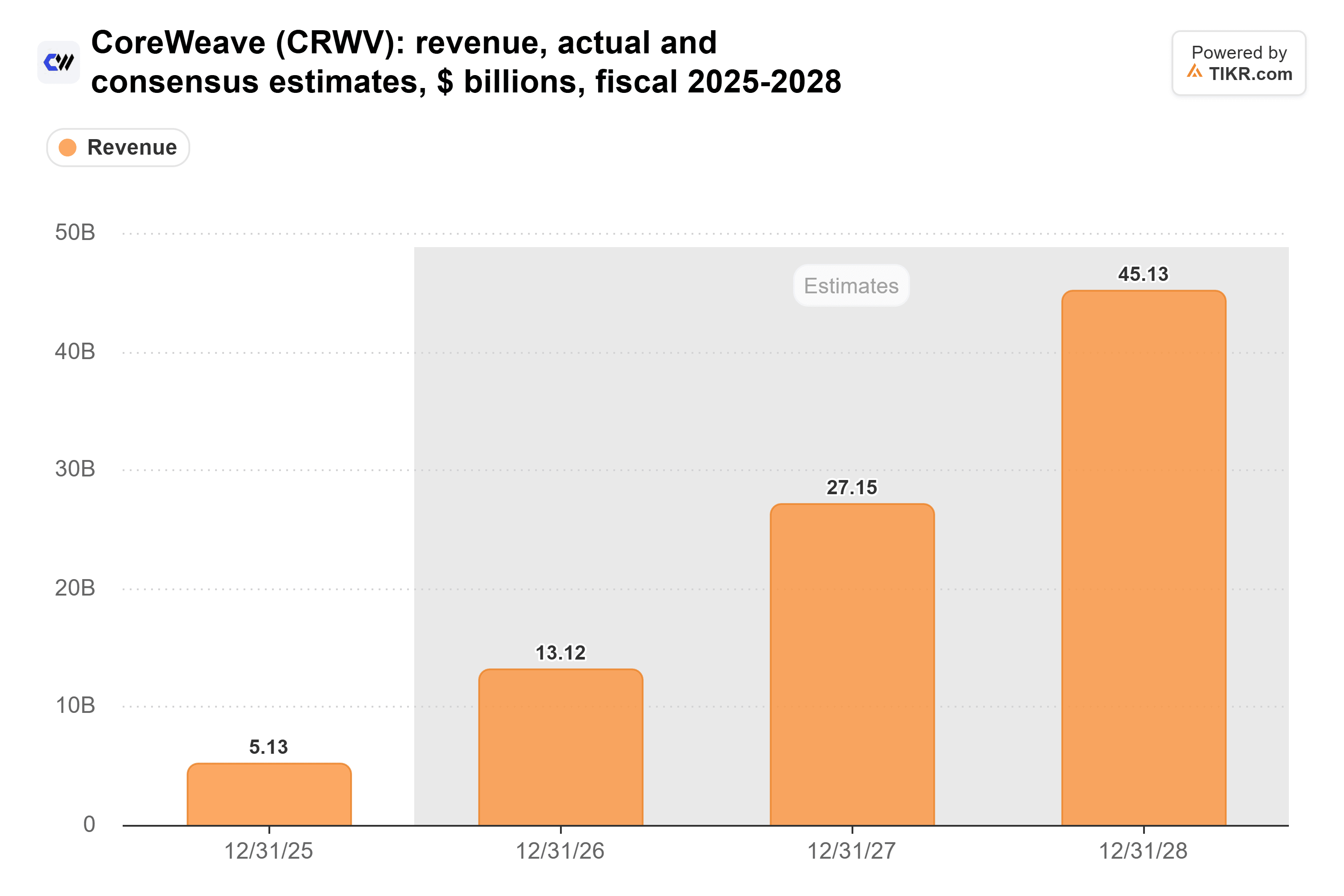
To hit those numbers, CoreWeave has to buy a lot more Nvidia chips and rent them to US labs at prices that cover their cost. Spare Asian capacity going after the same labs makes both of those harder.
Super Micro is one step further up the chain. It expects $72 billion to $82 billion of sales for the fiscal year ending June 2027, and the US made up 70.9% of its fiscal 2026 revenue. After $19.9 billion of sales in the September quarter, its next report, expected in early February, will show whether new orders are still coming.
The waiting list helps, up to a point
Dan Ives, partner and senior managing director at Yorkville Ives, said on CNBC’s Closing Bell on Nov. 24 that “if you try to order an NVIDIA chip in the U.S. today, you can’t get it until the end of 2028.” A wait that long is what pushes buyers to order years in advance, and B300 nodes available right now take some of that pressure off.
The multiple already sits near its five-year low. Nvidia trades at 11x forward earnings, against a five-year high of about 70x, and it hit a five-year low of 8.7x on Nov. 20.

Fewer US buyers are likely to keep reserving chips for 2027 and 2028 at the same pace. If Nvidia’s next report keeps consensus for the year ending January 2028 near $726 billion, the waiting list is holding.
So what is Nvidia stock actually worth?
TIKR lets you forecast the future price of any stock in less than a minute. Just enter a few assumptions into TIKR’s valuation model and see what Nvidia could be worth. Start from Wall Street consensus estimates, or adjust the inputs to reflect your own view of the business. It’s free to use.
Disclaimer:
Please note that the articles on TIKR are not intended to serve as investment or financial advice from TIKR or our content team, nor are they recommendations to buy or sell any stocks. We create our content based on TIKR Terminal’s investment data and analysts’ estimates. Our analysis might not include recent company news or important updates. TIKR has no position in any of the stocks mentioned. Thank you for reading, and happy investing!