Key Takeaways
- Arm CEO Rene Haas warned that “the rest of the world is ready and willing” to build data centers if the US holds back, after local voters rejected 40 of 41 data center ballot measures by Scott Galloway’s count.
- Long-running AI agents don’t need to sit near their users, so the build-out can move abroad, and Alphabet’s Google just committed $15 billion to Malaysia, much of it for data center campuses.
- Analysts expect Arm’s revenue to rise about 70% over two fiscal years and Nvidia’s to more than triple, which fits a build-out that is spreading out across the map.
- Export controls on Nvidia’s best chips are the main risk if capacity moves overseas, and Nvidia’s Nov. 17 report is the next thing to watch.
Arm Holdings (ARM) CEO Rene Haas has a warning for every town voting down a data center.
“If the U.S. hesitates in any way, shape, or form in terms of data center build-out, the rest of the world is ready and willing,” Haas told CNBC’s “Squawk on the Street” on Nov. 5. That day, a post-midterm rally in AI stocks had turned into a selloff.
There were numbers behind the fear. On Monday’s episode of Prof G Markets, Scott Galloway said there were “41 local ballot measures on data centers and 40 of them lost.”
Haas’s point is that the work goes somewhere else, and some of it already has. The day before he spoke, Alphabet (GOOG) said Google would invest $15 billion in Malaysia in 2027 and 2028, much of it for new data center campuses.
That matters most to Nvidia (NVDA), which sells the chips that fill those campuses. It also matters to Arm, whose designs run inside more and more of them. For both, what counts is how much capacity gets built, wherever it ends up.
TIKR tracks 43 analysts on Arm Holdings. How many say “Buy”?
See the full breakdown of Buy, Hold, and Sell ratings on Arm Holdings, along with Wall Street’s revenue and earnings estimates, all in one place. More than 500,000 investors use TIKR to research stocks like this one. See Arm Holdings’ Analyst Ratings
Agents can work from anywhere
Box CEO Aaron Levie explained why in a reply to CNBC’s Sara Eisen, who had posted Haas’s line. AI is “one of the few areas of technology that isn’t as sensitive to latency back to the user,” Levie wrote on X. He argued that long-running agents can send their work to “an AI factory somewhere,” finish it in that remote data center and send the result back.
His example was a task that returns $500 of value. Nobody minds much if it “takes an extra second to return.”
A video app still needs servers near its viewers, but an agent working through a company’s files for an hour doesn’t. So when a county votes no, the next AI campus can go to whichever state or country says yes.
Wall Street still expects the chips to sell
Analysts aren’t forecasting a slowdown for Arm. They expect its revenue to grow from $4.92 billion in the year to March 2026 to $8.37 billion two years later:

That growth now depends on data centers. Arm’s royalties grew just 8% in the September quarter because memory costs hurt phone sales. Over the same quarter, its data center royalties doubled again. On the earnings call, Haas said Arm has “a high degree of confidence” that those royalties will grow at triple-digit rates for several years.
Some of that data center growth goes through Nvidia, whose Arm-based Vera CPU is now in production with OpenAI. Analysts expect even faster growth for Nvidia: revenue rising from $216 billion in the year ended January 2026 to $692 billion two years later:

Google is adding capacity abroad
Alphabet shows how this works in practice. Its capital spending went from $24.6 billion in 2021 to $91.5 billion in 2025:
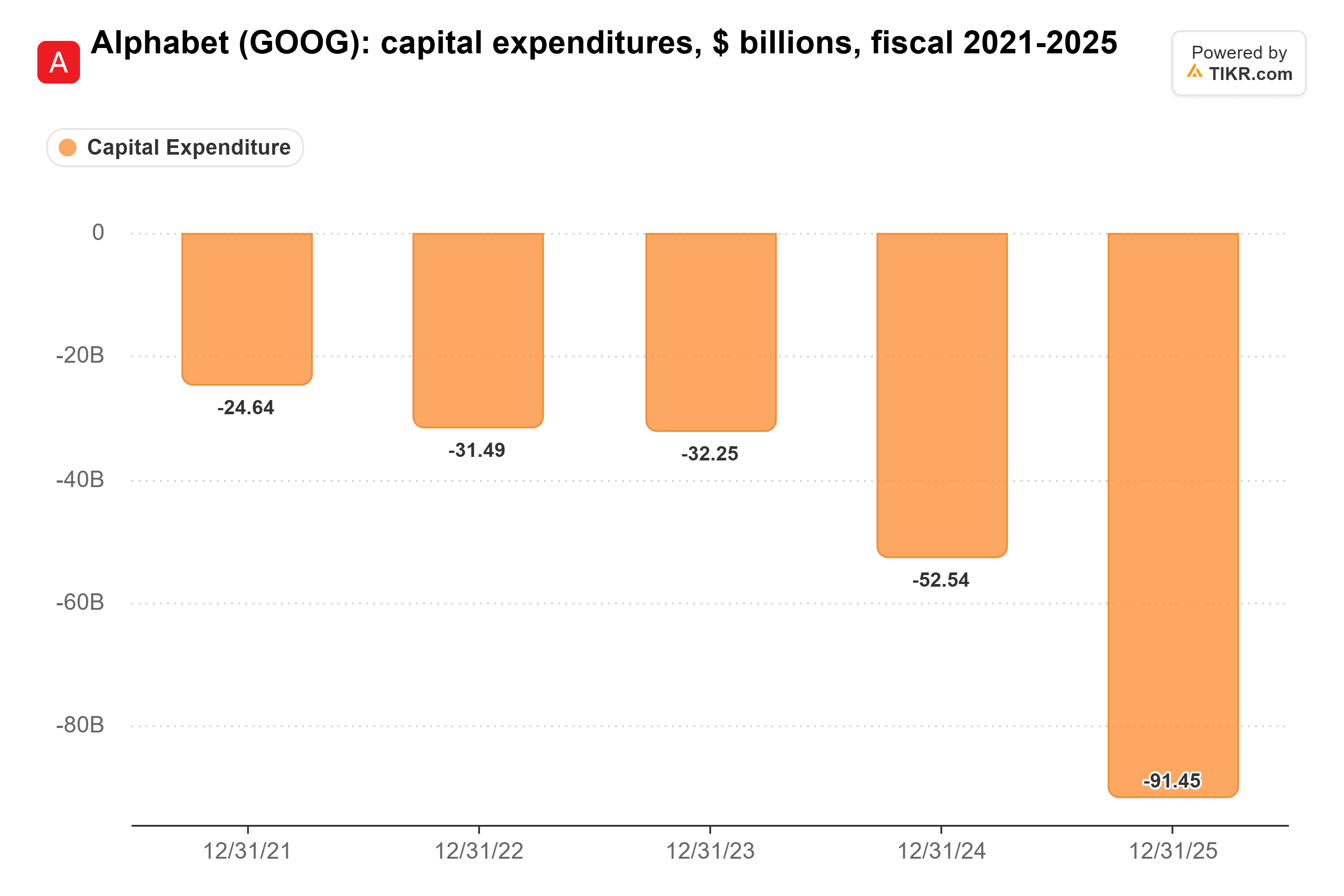
The Malaysia plan is small next to that. It works out to less than a tenth of 2025’s spending for each of its two years. Google says the money will go to new campuses in Selangor and Negeri Sembilan, plus more than a gigawatt of clean power for Malaysia’s grid.
So Google is adding capacity overseas on top of what it builds at home, and every campus in Malaysia needs chips like any campus in Texas. Arm gets paid there too: Haas said Google is moving the CPU paired with its eighth-generation TPU to Google’s own Arm-based Axion chip.
Export controls are the catch
Data centers can move abroad more easily than Nvidia’s best chips can. US export controls keep its top products out of China and require licenses for large shipments to other countries. That means capacity built overseas may run on lower-end chips or wait on approvals.
That’s why President Donald Trump’s Truth Social post on Sunday matters for Nvidia. While urging senators to pass a permitting bill, the American Affordability and Jobs Act, he wrote: “Remember, China will take any Data Center that we don’t want, and pay lots of money for it.” I suspect a data center that ends up in China runs on someone else’s accelerators.
Arm is better protected there. It earns money in China through Arm China, which brought in $790.6 million in the year to March 2026, or 16.1% of Arm’s revenue, according to Arm’s annual report.
Bans push the build-out overseas
Haas has this one right. Local bans can push the next wave of AI campuses out of a county, out of a state and, as Google’s Malaysia plan shows, out of the country. The demand for agent work stays the same either way. For Arm, which collects royalties wherever its designs ship, the location barely matters. For Nvidia, it matters only when the capacity ends up somewhere its best chips can’t legally go.
Of course, more evidence is coming soon. Nvidia reports on Nov. 17, and Arm has promised a firm forecast for its own data center chip with its results in early February.
So what is Arm Holdings stock actually worth?
TIKR lets you forecast the future price of any stock in less than a minute. Just enter a few assumptions into TIKR’s valuation model and see what Arm Holdings could be worth. Start from Wall Street consensus estimates, or adjust the inputs to reflect your own view of the business. It’s free to use.
Disclaimer:
Please note that the articles on TIKR are not intended to serve as investment or financial advice from TIKR or our content team, nor are they recommendations to buy or sell any stocks. We create our content based on TIKR Terminal’s investment data and analysts’ estimates. Our analysis might not include recent company news or important updates. TIKR has no position in any of the stocks mentioned. Thank you for reading, and happy investing!