Key Takeaways
- Chip stocks had their worst week since 2001, yet Apple closed Nov. 23 just 2% below its record.
- BTIG’s Jonathan Krinsky says Apple has fallen a median 23% at past market bottoms and “definitely needs to correct.”
- Apple traded at 36x forward earnings on Nov. 20, near its 10-year high, with analysts expecting about 5% EPS growth in fiscal 2027.
- Apple’s light capital spending earns it a haven premium, but even a 23% drop would leave it above its 10-year average multiple.
Apple (AAPL) is the last big tech stock standing in this selloff.
The PHLX Semiconductor Index fell 17% in the week ended Nov. 20, its worst week since 2001, TheStreet reported. Taiwan Semiconductor Manufacturing (TSM), which makes Apple’s processors, fell 20% that week. Qualcomm (QCOM), which licenses its patents to Apple, is 36% below its 52-week high even after Monday’s 10% bounce.
Apple, meanwhile, is up about 28% this year.
BTIG chief market technician Jonathan Krinsky thinks that’s the problem. By the Nov. 20 close, the S&P 500 was 12% below its Oct. 6 record after seven straight losses. On CNBC’s The Exchange podcast that day, he said that when the S&P has bottomed after a drop of 8% or more, “the median drawdown for Apple has been 23% and we’re down about 3% right now.”
His conclusion: “Apple definitely needs to correct.”
Apple has never sat out a bottom
Krinsky expected a short-term bounce, with sentiment washed out, and Monday delivered one. The S&P 500 jumped 4.7% on Nov. 23 after Nvidia reinstated Jensen Huang as CEO, and TSMC rose 14%. Apple gained just 1.9%, leaving it 2% below its Nov. 13 record close. But Krinsky said a bounce does little to change his view that “we probably have more downside to go over the medium term,” and he named Apple as one of the reasons. At past bottoms, he said, Apple has “never been down less than about 10 or 11%.”
TIKR tracks 45 analysts on Apple. How many say “Buy”?
See the full breakdown of Buy, Hold, and Sell ratings on Apple, along with Wall Street’s revenue and earnings estimates, all in one place. More than 500,000 investors use TIKR to research stocks like this one. See Apple’s Analyst Ratings
A Near-Record Multiple on 5% Growth
Krinsky’s argument is a technical one, but Apple’s own numbers explain why he’s focused on it. Analysts expect earnings per share to grow about 5% in fiscal 2027, which ends next September, after a 20% jump in fiscal 2026:

Memory costs are a big reason. On the July earnings call, Tim Cook, Apple’s CEO at the time, called it “a 100-year flood on the memory pricing.”
Even so, investors are paying more for Apple’s earnings than at almost any point in the last decade:
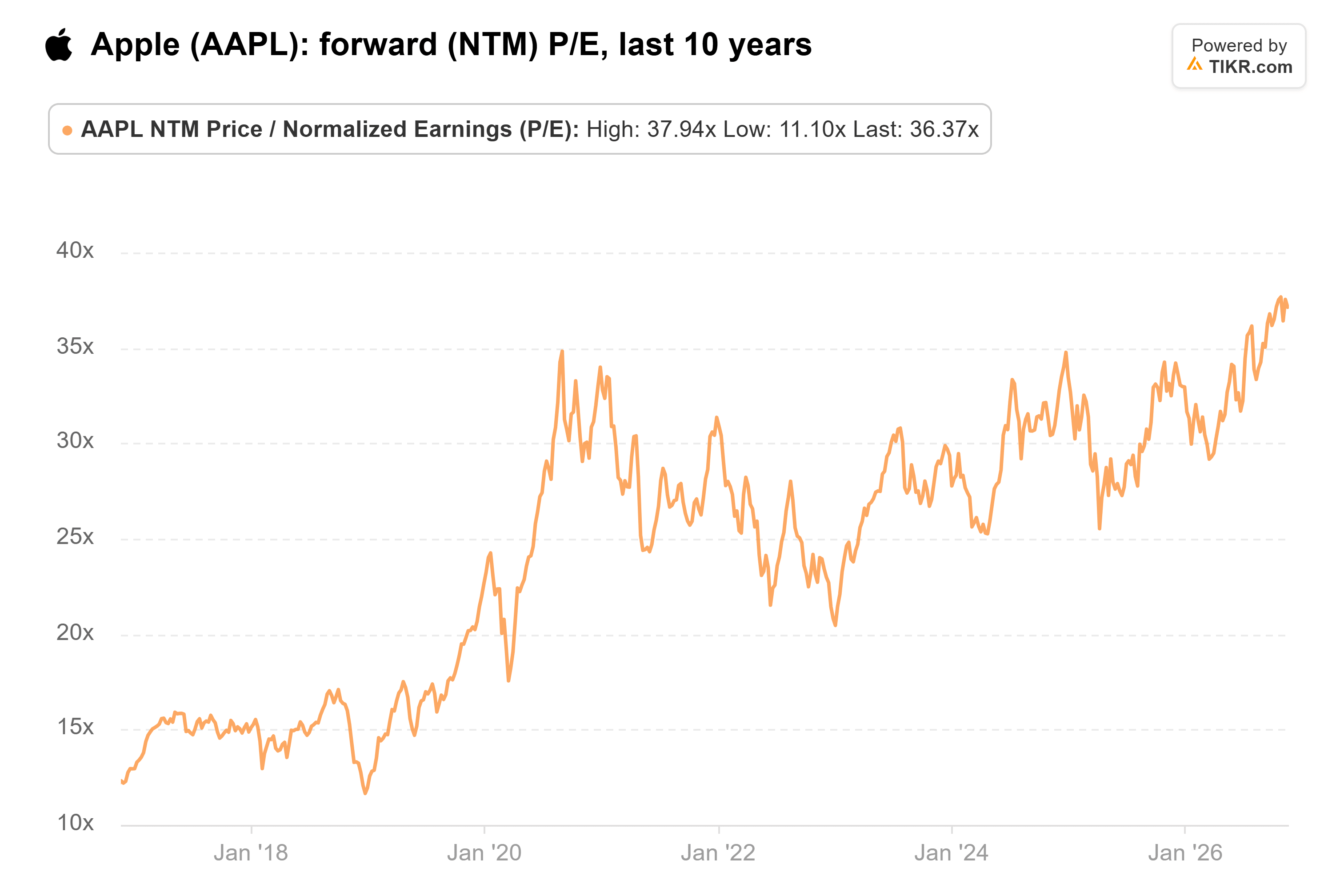
Apple traded at 36x forward earnings at the Nov. 20 close. That’s just under the 38x peak it hit on Oct. 22 and far above its 10-year average of 25x. Now apply Krinsky’s median: a 23% drop, with estimates where they are now, would take Apple to about 28x. That would still be above its 10-year average.
The Haven Premium Is Already in the Price
Apple has earned some of that premium, though. On the show, Kelly Evans pushed back, saying Apple has gone from market bellwether to “the emblem of all things safe and steady.” Evans has a point about the business, since Apple barely spends on the AI buildout that’s sinking the chip stocks:
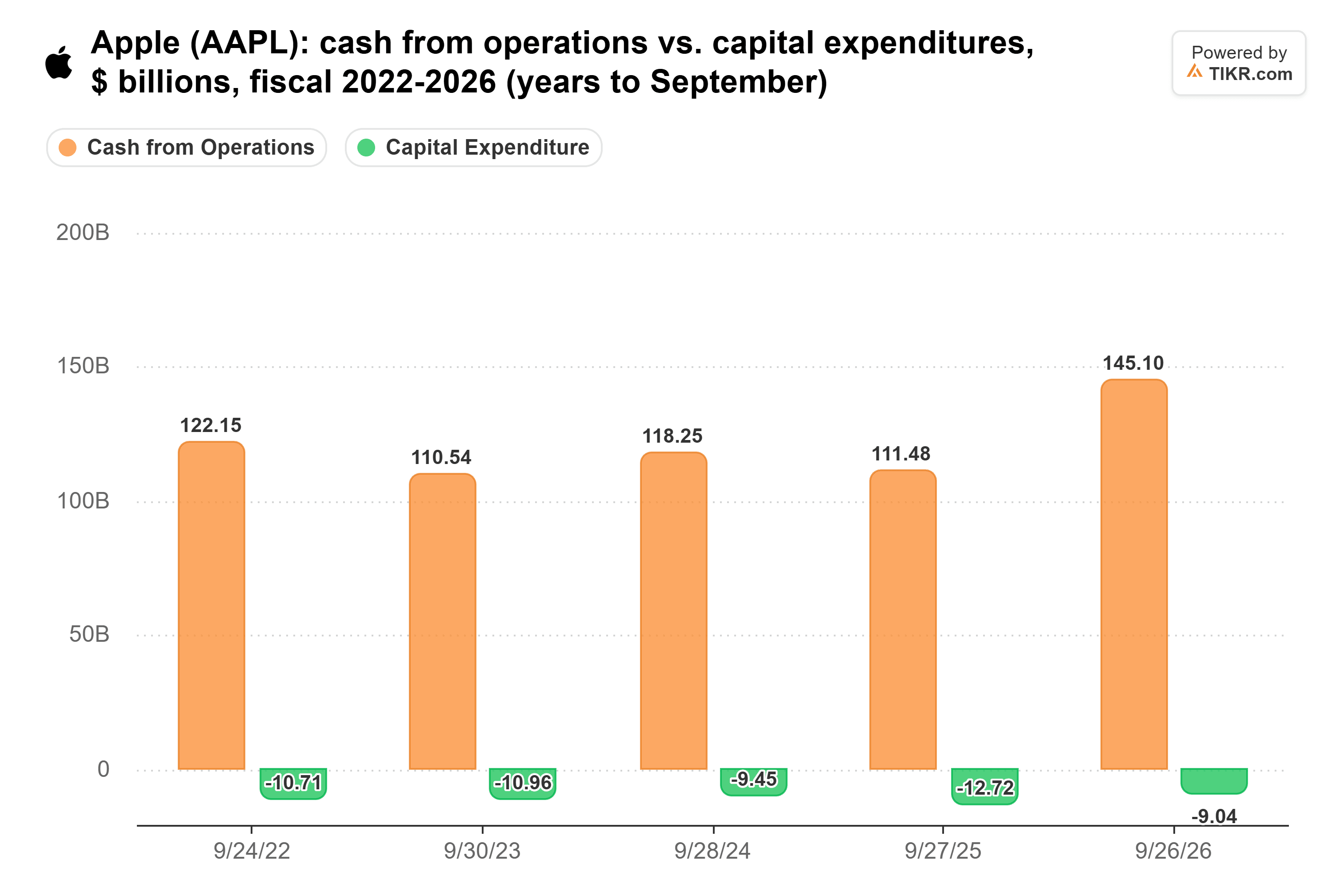
Apple’s operations brought in $145 billion of cash in fiscal 2026, and it spent just over $9 billion on capital expenditures.
TSMC is on the other side of that trade. It expects to spend $60 billion to $64 billion on capital projects in 2026, and high-performance computing, which includes AI chips, made up 68% of its third-quarter revenue.
Qualcomm points to a different gap. Its handset chip revenue fell 26% to $5.1 billion in its September quarter, as memory shortages cut Android phone builds and Apple moves to its own modems. Apple’s iPhone revenue rose 21% to $254.1 billion in fiscal 2026.
What Would Prove Krinsky Wrong
Krinsky’s call rests on how Apple has traded at past bottoms, not on a forecast for the business. Apple has been a place to hide while AI spending is in doubt, but at 36x to 37x forward earnings, the stock leaves little room for error if the selloff spreads beyond chip stocks.
The next real test is Apple’s December-quarter report in late January. If iPhone revenue clears last year’s record of $85.3 billion by a wide margin, the haven trade could last longer than Krinsky expects.
So what is Apple stock actually worth?
TIKR lets you forecast the future price of any stock in less than a minute. Just enter a few assumptions into TIKR’s valuation model and see what Apple could be worth. Start from Wall Street consensus estimates, or adjust the inputs to reflect your own view of the business. It’s free to use.
Disclaimer:
Please note that the articles on TIKR are not intended to serve as investment or financial advice from TIKR or our content team, nor are they recommendations to buy or sell any stocks. We create our content based on TIKR Terminal’s investment data and analysts’ estimates. Our analysis might not include recent company news or important updates. TIKR has no position in any of the stocks mentioned. Thank you for reading, and happy investing!