Key Takeaways
- Early Anthropic investor Anjney Midha called Elon Musk “a glorified compute reseller” on a recent 20VC episode, as SpaceX shares rose 4.35% on Monday after a Jefferies Buy rating.
- Renting out Nvidia chips pays SpaceX very well right now: pricing runs slightly above $50 a watt, and new compute pays for itself in under a year.
- Short-term deals at IREN and Nebius run $40 million to $50 million a megawatt, so SpaceX’s premium comes from selling at spot prices during a shortage.
- Anthropic’s SpaceX deals are set to reach about $3.1 billion a month in December, but either side can cancel on 90 days’ notice from early 2027, so those returns last only as long as spot prices hold.
SpaceX (SPCX) shares closed up 4.35% at $133.35 on Monday, November 23, after Jefferies started coverage with a Buy rating and a $210 price target. The stock opened nearly 10% higher but still trailed the Nasdaq Composite’s 6.51% gain, as tech stocks rallied and Nvidia (NVDA) jumped 31% after reinstating Jensen Huang as CEO. Meanwhile, one of the earliest investors in Anthropic (ANT) had a less flattering take on SpaceX’s AI business.
“Elon is just a glorified compute reseller,” Anjney Midha, founder of AI infrastructure and investment firm Amp, said on a recent episode of 20VC. Musk’s “launch business is cute compared to the earnings of the compute business,” he added.
The compute in question is Nvidia chips, the same ones Nebius (NBIS) and IREN (IREN) rent out. So for SpaceX shareholders, the question is what reselling actually earns.
TIKR tracks 9 analysts on Anthropic. How many say “Buy”?
See the full breakdown of Buy, Hold, and Sell ratings on Anthropic, along with Wall Street’s revenue and earnings estimates, all in one place. More than 500,000 investors use TIKR to research stocks like this one. See Anthropic’s Analyst Ratings
Reselling pays very well at $50 a watt
On SpaceX’s third-quarter call, CFO Bret Johnsen said pricing was tracking “slightly above the high end” of a $30-to-$50-per-watt range. He added that, at current pricing, new compute pays for itself in less than a year. Revenue in the Super Intelligence segment, which holds the compute business along with Grok, X and Cursor, nearly tripled to $7.56 billion in the third quarter from $2.56 billion in the second.
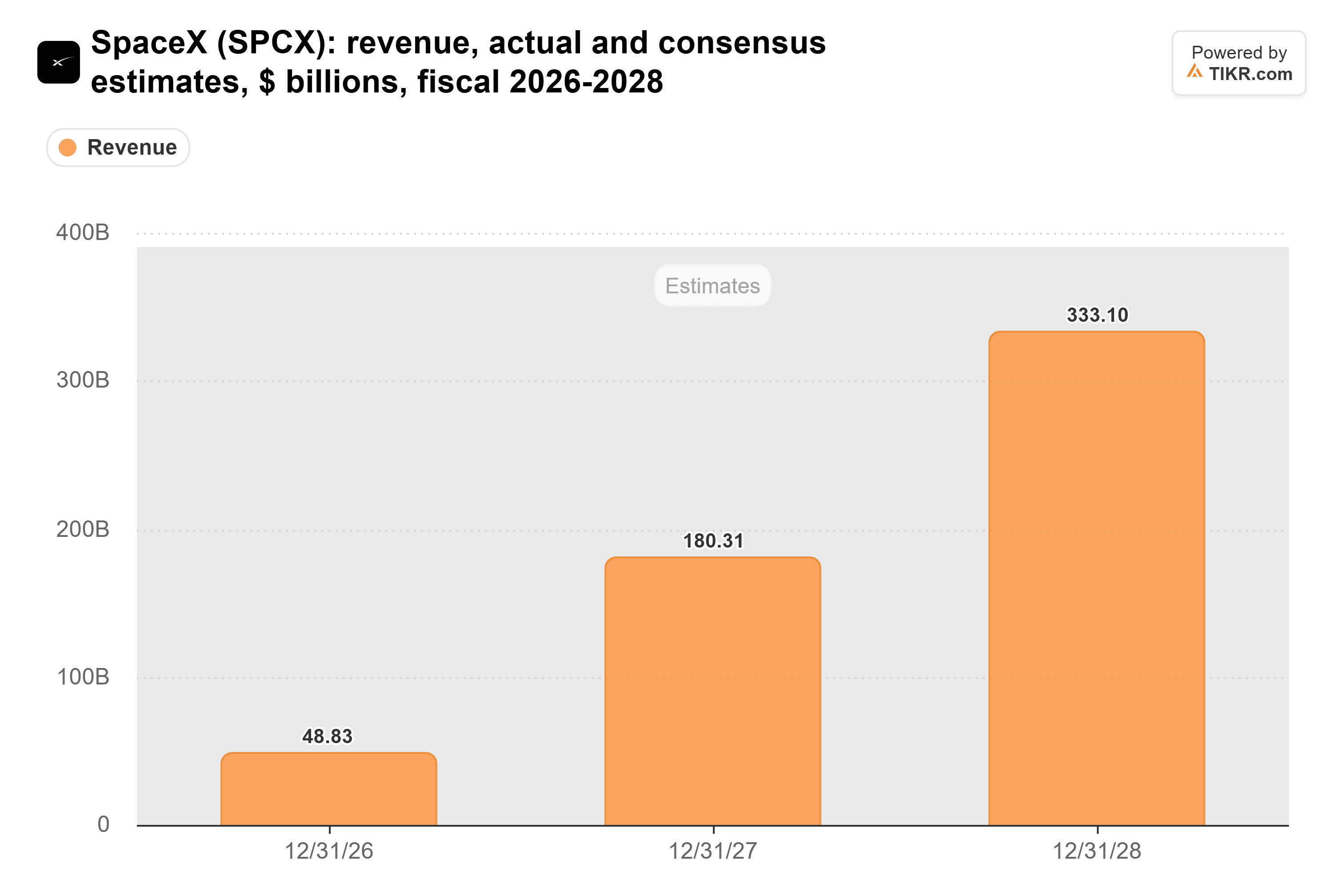
Analysts expect SpaceX’s total revenue to climb from $48.8 billion this year to $333 billion in 2028:
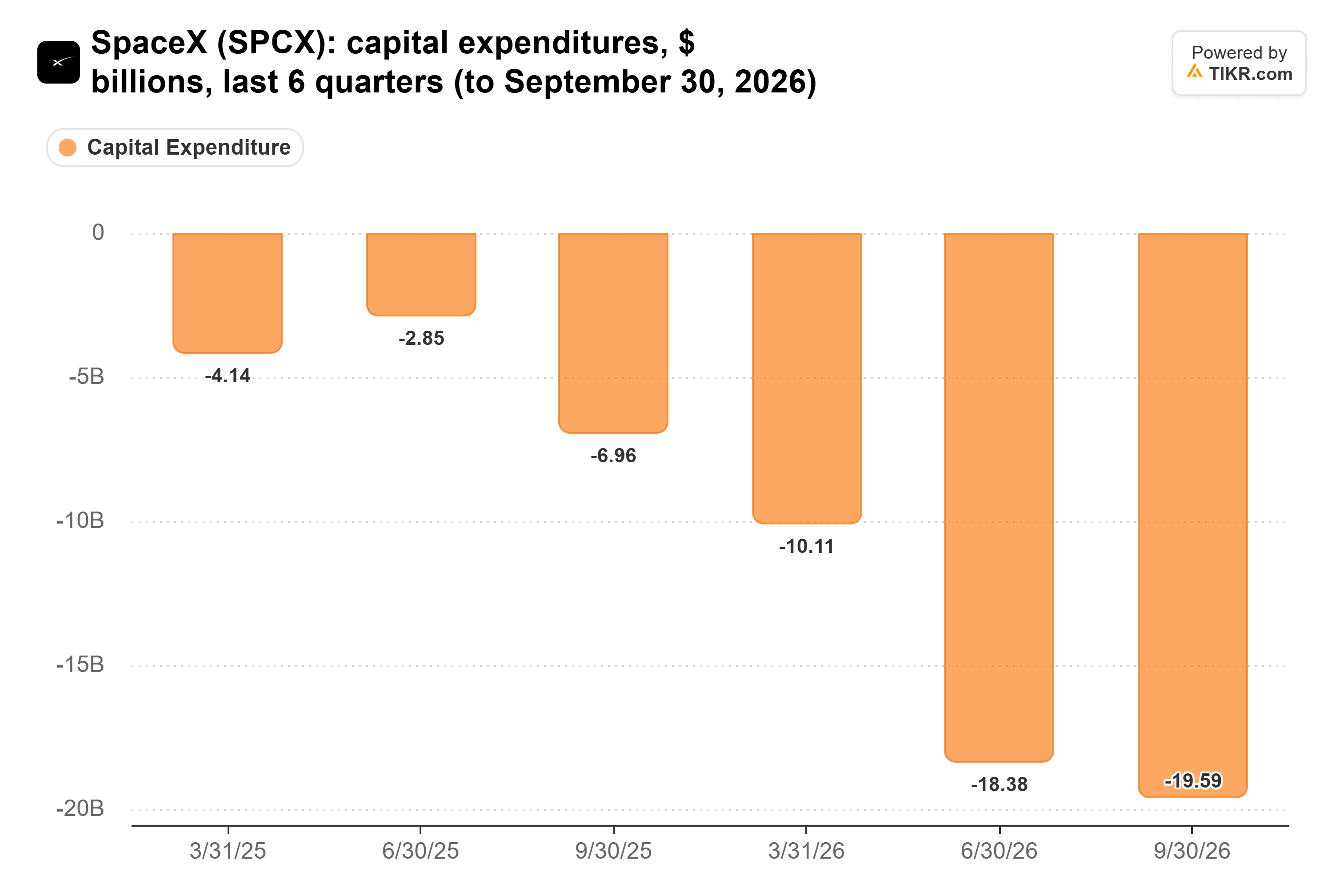
The chips cost a fortune, though. Capital spending hit $19.6 billion in the third quarter, and management guides the fourth to $35 billion to $40 billion:
So far, that spending is paying off. SpaceX’s EBIT margin, as TIKR calculates it, swung to 27.6% in the third quarter from -1.8% in the second:

Starlink earned most of the profit, though. On a GAAP basis, SpaceX’s operating income was $2.8 billion, about 19% of revenue, and Connectivity, the segment that holds Starlink, earned $2.37 billion of it. The AI segment’s GAAP operating margin was 5.7%, after $1.22 billion of stock pay tied to the Cursor deal. Leave out that stock pay and the margin is about 22%. Before depreciation, its adjusted EBITDA margin was 65.5%. Nebius, for comparison, posted a 5.1% operating margin across the group in the third quarter.
The premium belongs to the spot market
The neoclouds’ own deals show that SpaceX’s premium comes from the length of its contracts. After its quarter ended, IREN signed a short-term contract at $40 million per megawatt ($40 a watt). It also signed a five-year contract at about $22 million per megawatt. Nebius said in August that it was negotiating short-term deals at $40 million to $50 million per megawatt.
So SpaceX earns a spot premium, and it does so by choice: Musk said on the call that SpaceX’s approach is to rent at “effectively the spot market rate.” Spot prices are the first to fall when supply catches up. SpaceX’s own costs won’t fall with them: its lease on Nvidia’s next-generation Vera Rubin chips runs about five years, with rent paid quarterly in advance.
Anthropic holds the leverage
Anthropic’s IPO filing puts its SpaceX compute deals at up to $120.5 billion through 2029, or about $3.1 billion a month once all the capacity arrives, which Anthropic expects in December. That ceiling isn’t guaranteed: after initial periods that end in January and March 2027, either side can cancel on 90 days’ notice. Anthropic also spent $8.9 billion on compute and infrastructure in the first half of 2026, more than half of its $16.3 billion in revenue, according to its S-1. A customer with a compute bill that size has every reason to bargain.
Short seller Jim Chanos asked on X why, if these returns last, Nvidia won’t “simply raise prices 100-200% over the next few years.” So far, its margins aren’t moving that way: Nvidia’s GAAP gross margin was 74.8% in the quarter ended Oct. 25, and it guided this quarter’s to 71% to 72%.
Midha’s label fits the numbers. Shareholders are being paid very well for a shortage, on contracts Anthropic can start leaving in early 2027. The fourth-quarter report early next year will show two things: whether December revenue reached the roughly $8.3 billion that management’s $100 billion annualized goal requires, and whether renewals are still coming in “at higher dollars per watt,” as Musk said on the third-quarter call.
So what is SpaceX stock actually worth?
TIKR lets you forecast the future price of any stock in less than a minute. Just enter a few assumptions into TIKR’s valuation model and see what SpaceX could be worth. Start from Wall Street consensus estimates, or adjust the inputs to reflect your own view of the business. It’s free to use.
Disclaimer:
Please note that the articles on TIKR are not intended to serve as investment or financial advice from TIKR or our content team, nor are they recommendations to buy or sell any stocks. We create our content based on TIKR Terminal’s investment data and analysts’ estimates. Our analysis might not include recent company news or important updates. TIKR has no position in any of the stocks mentioned. Thank you for reading, and happy investing!