Key Takeaways
- Elon Musk warned on X that AI’s compute delays will take “hundreds of billions of incremental dollars just for working capital” next year.
- SpaceX relies more on outside credit than its CFO’s self-funding message suggests.
- J.P. Morgan’s credit default swap data puts SpaceX beside Oracle at about 275 basis points, against about 80 for Microsoft, Alphabet and Amazon.
- Analysts expect SpaceX’s free cash flow to be negative $146 billion in 2027.
SpaceX (SPCX) CEO Elon Musk has a warning for everyone building AI data centers. It may apply to his own company most of all.
“The cash shortage is also going to be nuts next year. Even cumulative industry delays of a few months between paying for compute and getting it reliable enough to generate revenue will mean hundreds of billions of incremental dollars just for working capital. Where will that come from?”
For SpaceX, credit markets have a pretty good guess: lenders.
SpaceX lands in the “credit-dependent” tier
One investor laid out J.P. Morgan’s credit default swap data on X. Microsoft (MSFT), Alphabet (GOOG) and Amazon trade at about 80 basis points, “with enough cash flow to fund most of their CapEx.” SpaceX and Oracle (ORCL) sit at about 275 basis points, “with buildouts increasingly reliant on outside funding.”
That means insuring SpaceX’s debt costs about 3.4x as much as insuring Microsoft’s.
This week’s bond sale backs that up. SpaceX sold $32 billion of debt backed by Nvidia chips, and people familiar with the sale say the biggest piece, about $25.2 billion, priced at 8.259%. The average US high-grade bond yielded 5.95% that day, according to Bloomberg’s index data.
TIKR tracks 40 analysts on SpaceX. How many say “Buy”?
See the full breakdown of Buy, Hold, and Sell ratings on SpaceX, along with Wall Street’s revenue and earnings estimates, all in one place. More than 500,000 investors use TIKR to research stocks like this one. See SpaceX’s Analyst Ratings
Analysts don’t see the cash flow yet
CFO Bret Johnsen said this week that much of the 10 gigawatts SpaceX plans to build next year will be funded from internal cash flows, as another investor relayed it on X. Analysts’ estimates show far more cash going out than coming in:
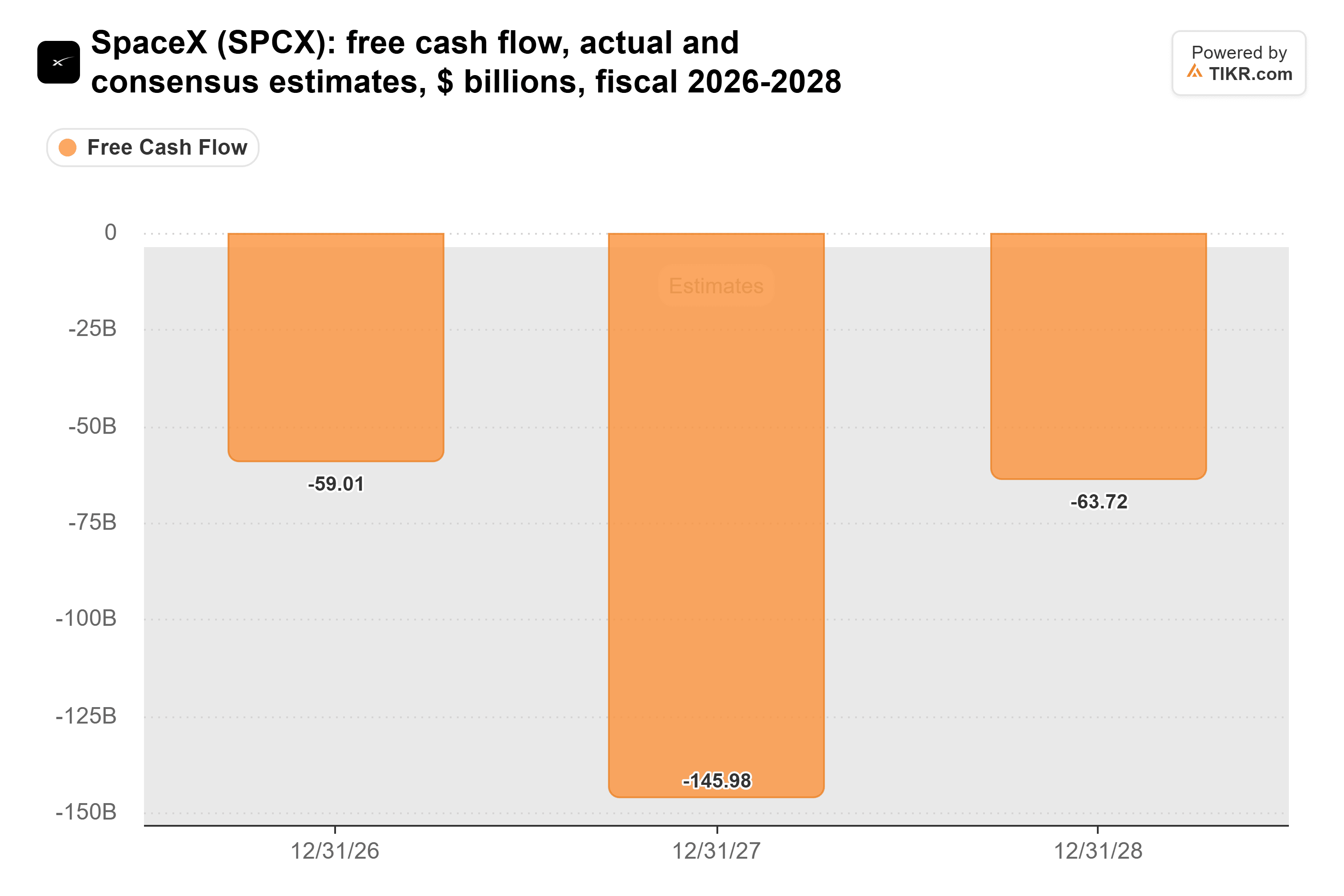
That adds up to nearly $270 billion of negative free cash flow from 2026 through 2028, with $146 billion of it in 2027, the year of the 10-gigawatt build. SpaceX held $89.9 billion of cash and marketable securities at Sept. 30, and it has guided to $35 billion to $40 billion of capex in the fourth quarter alone.
SpaceX’s new chip lease puts it right in Musk’s squeeze: rent is paid quarterly in advance, starting when the chips arrive in the first half of 2027, so it pays for that compute before it earns anything on it.
The lease comes on top of debt that more than doubled from March 2025 to Sept. 30:
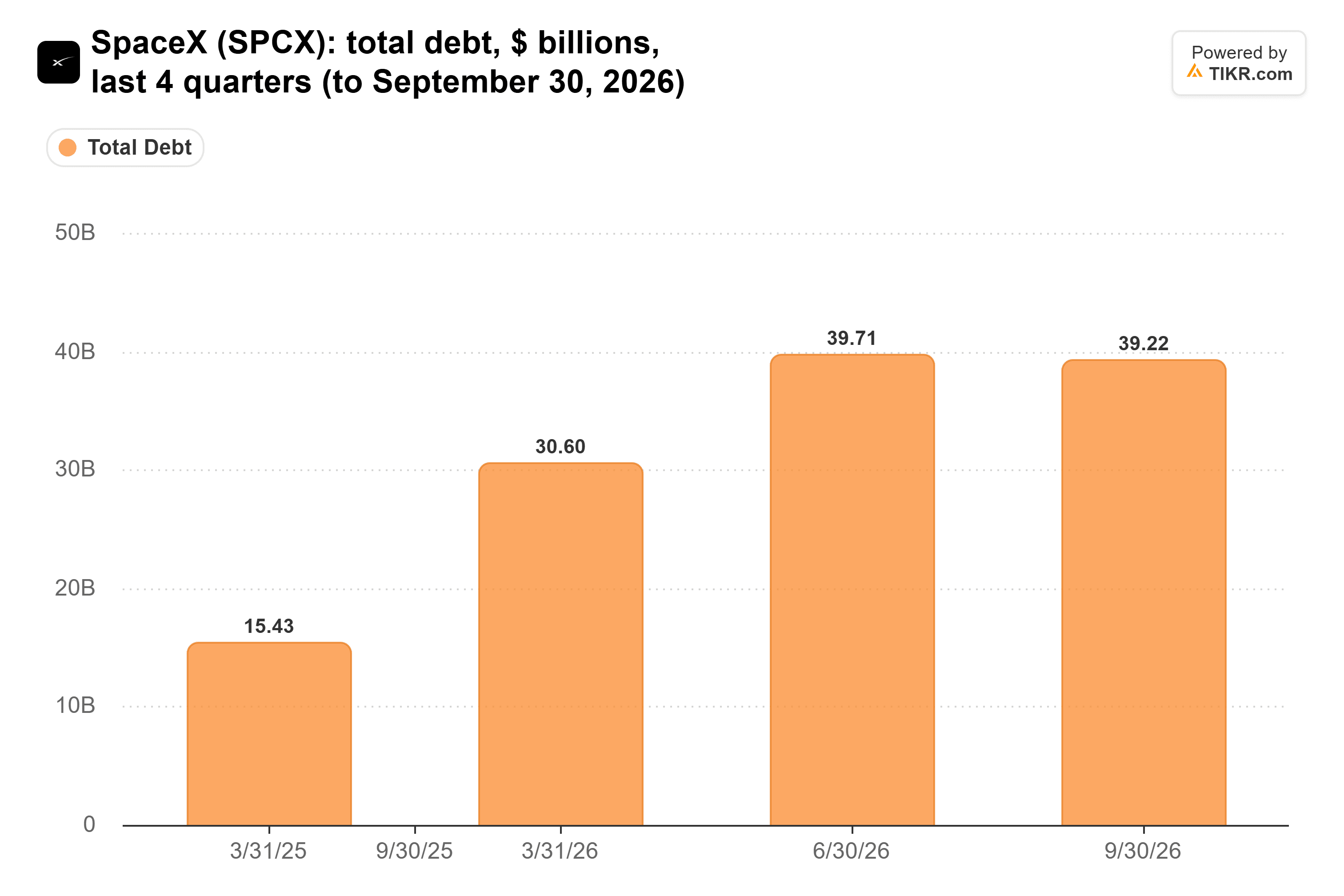
Once the chips arrive, the lease adds an obligation about the size of that $39.2 billion.
Oracle got here first
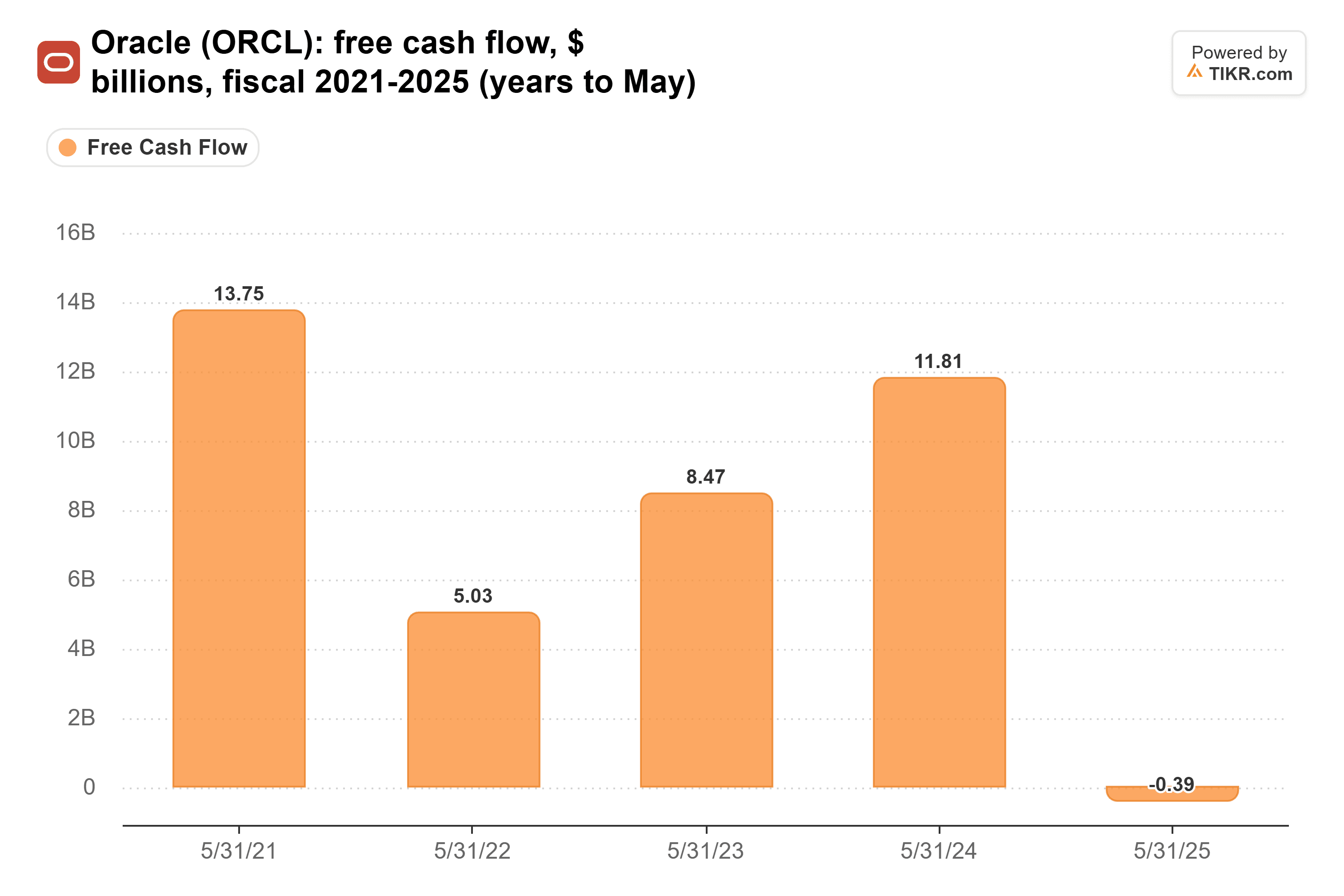
Oracle’s free cash flow has already turned negative. It went from $13.8 billion in the year ended May 2021 to negative $390 million in the year ended May 2025:
The cash-funded tier is also SpaceX’s customer base. SpaceX already rents compute to Alphabet, and Microsoft CEO Satya Nadella said at the New York Times’ DealBook Summit, “If he has SpaceX capacity that I can lease, I would lease it.” The companies paying about 80 basis points rent the capacity, and SpaceX borrows at more than 8% to build it.
Lenders are the answer, for now
Musk is right about the cash squeeze. But until cash flow catches up with capex, SpaceX is filling the gap the way Oracle has, with borrowed money, and credit markets are right to price it that way.
Fourth-quarter results in early 2027 are the first real test. If capex lands inside that guide and cash and securities stay well above $50 billion, I’d take Johnsen’s self-funding claim more seriously.
So what is SpaceX stock actually worth?
TIKR lets you forecast the future price of any stock in less than a minute. Just enter a few assumptions into TIKR’s valuation model and see what SpaceX could be worth. Start from Wall Street consensus estimates, or adjust the inputs to reflect your own view of the business. It’s free to use.
Disclaimer:
Please note that the articles on TIKR are not intended to serve as investment or financial advice from TIKR or our content team, nor are they recommendations to buy or sell any stocks. We create our content based on TIKR Terminal’s investment data and analysts’ estimates. Our analysis might not include recent company news or important updates. TIKR has no position in any of the stocks mentioned. Thank you for reading, and happy investing!